Home / Articles / LGBTQ+ Weddings
Two Grooms: Your Wedding Planning Guide
Key Takeaways
- Bespoke suits in the UK cost £500 to £2,000 each while off-the-rack options run £150 to £600
- Coordinating suits through colour or fabric works better than wearing identical outfits
- Two best men means two speeches so plan the running order and set time limits early
- Joint stag dos with both friend groups are the most popular format for two-groom couples
- Book a grooming timeline starting 3 months before the wedding for haircuts and skincare
A two grooms wedding brings its own set of practical questions that standard wedding guides were not written to answer. From coordinating two suits that look intentional without looking identical to handling the logistics of two best men, two sets of parents wanting to speak and a first dance where nobody assumes who leads, this guide covers what you actually need to know.
Same-sex marriage has been legal across the UK since 2014 in England, Wales and Scotland, and since 2020 in Northern Ireland. The legal framework is settled. What varies is how two grooms choose to shape their day within it. Some couples keep every traditional element. Others build something entirely new. Most land somewhere in the middle.
The practical reality is that a two grooms wedding costs roughly the same as any other wedding, with a few line items that shift. Suits are typically cheaper than dresses. Grooming replaces bridal hair and makeup. Stag dos may merge or double. The overall budget stays in the same range, but where the money goes changes.
How should two grooms coordinate their suits?
Getting the suits right is the single biggest style decision for a two-groom wedding. The goal is looking like you planned this together without looking like you raided the same rack.
Same colour family, different details
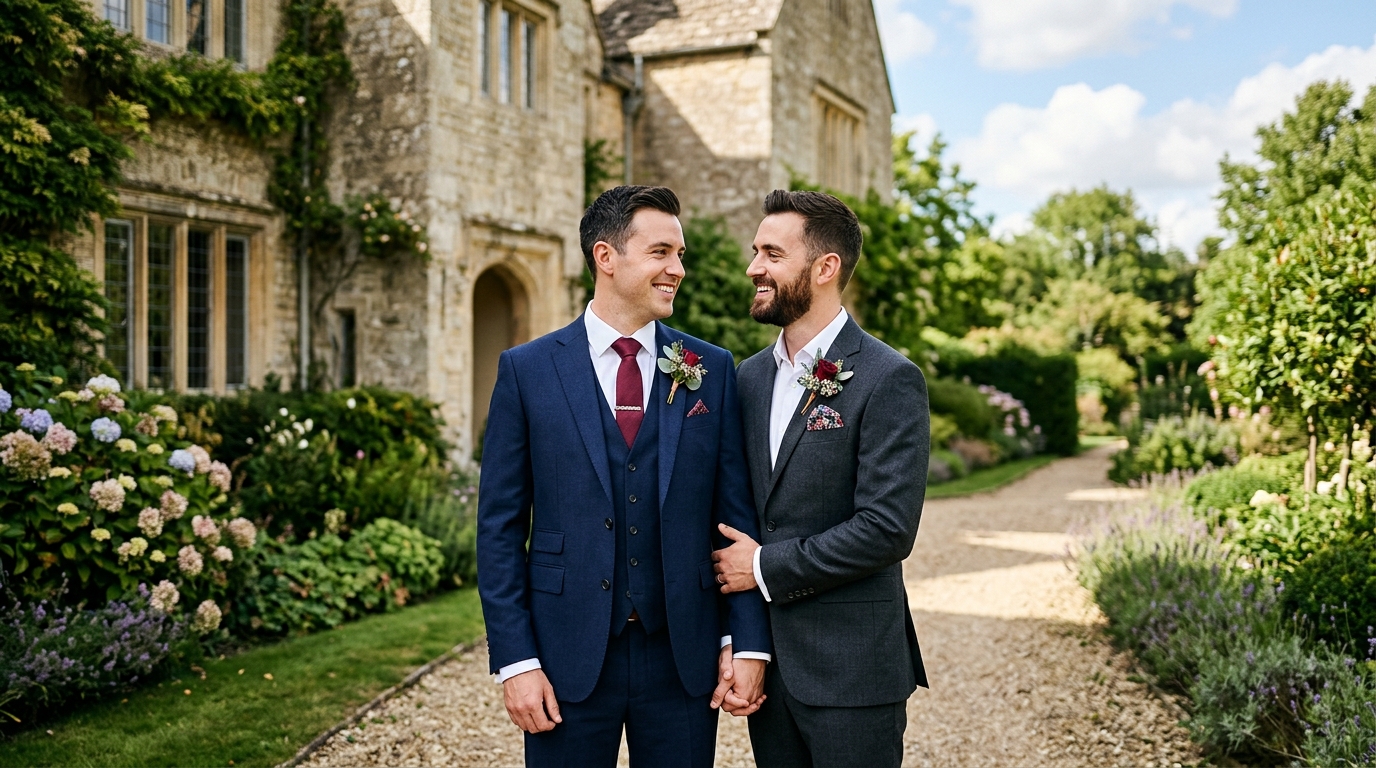
This is the safest and most popular approach. Both grooms in navy, but one in a three-piece and the other in a two-piece with a different lapel. Both in charcoal, but different fabrics or textures. The shared colour creates visual cohesion. The different details give each groom his own identity.
Complementary rather than matching
A bolder approach: one groom in a dark suit, the other in a lighter shade. Navy and light grey. Charcoal and tan. Black and midnight blue. This creates striking contrast in photographs and works especially well when the two grooms have different builds or colouring.
One formal, one less formal
Some couples deliberately play with formality. One groom in a classic suit and tie, the other in a more relaxed blazer with open collar. This works when the wedding itself mixes formal and casual elements. It also suits couples whose personal styles are genuinely different.
Tie coordination
Matching ties is the simplest way to signal “we are together” in photographs. Same tie, same pocket square, different suits. Alternatively, choose ties in the same fabric but different patterns. A solid navy tie on one groom and a navy paisley on the other creates a subtle link. Bow ties are popular at two-groom weddings and add a dash of personality. See our groom suit guide for more on accessories and styling.
Suit shopping: together or apart?
Unlike dress shopping for two brides, most two-groom couples shop together. The surprise element around suits tends to be less of a priority, and coordinating fit, colour and fabric is easier when you are standing next to each other in the fitting room.
Going together
Book an appointment at a tailor or menswear specialist that understands wedding suiting. Explain that you are a couple, not a groom and best man. Good tailors will already know how to dress two grooms. If they seem confused, find a different tailor. Our LGBTQ+ wedding suppliers guide lists UK businesses with proven experience.
The surprise route
If you want the reveal moment, set boundaries: agree on colour family and formality level, then shop independently. Share your notes with each tailor so the suits do not clash. Plan a first look before the ceremony to see each other’s choices.
UK suit options and pricing
| Option | Price per suit | Total for two | Turnaround | Best for |
|---|---|---|---|---|
| Off the rack (Moss, Charles Tyrwhitt, M&S) | £150 to £600 | £300 to £1,200 | Same day to 2 weeks (alterations) | Budget-conscious couples, standard sizes |
| Made to measure (Suit Supply, Edit Suits, Cad & The Dandy) | £400 to £1,200 | £800 to £2,400 | 4 to 6 weeks | Good fit without bespoke pricing |
| Bespoke (Savile Row, independent tailors) | £500 to £2,000+ | £1,000 to £4,000+ | 8 to 12 weeks, multiple fittings | Perfect fit, unique fabric choices |
| Hire (Moss Hire, Slaters) | £80 to £200 | £160 to £400 | Pick up 1 week before | One-off wear, very tight budget |
For bespoke, start the process at least four months before the wedding. You will need two to three fittings each, and good tailors book up quickly during wedding season (May to September).
Accessories and finishing touches
The details pull the whole look together. Plan these after the suits are chosen, not before.
Shoes
Matching shoes is a subtle and effective way to tie two outfits together. Polished Oxford shoes in black or brown are the classic choice. Loafers and brogues work for less formal weddings. Budget £80 to £300 per pair. Break them in before the day. Our wedding shoes guide has options for every budget and style.
Boutonnieres and buttonholes
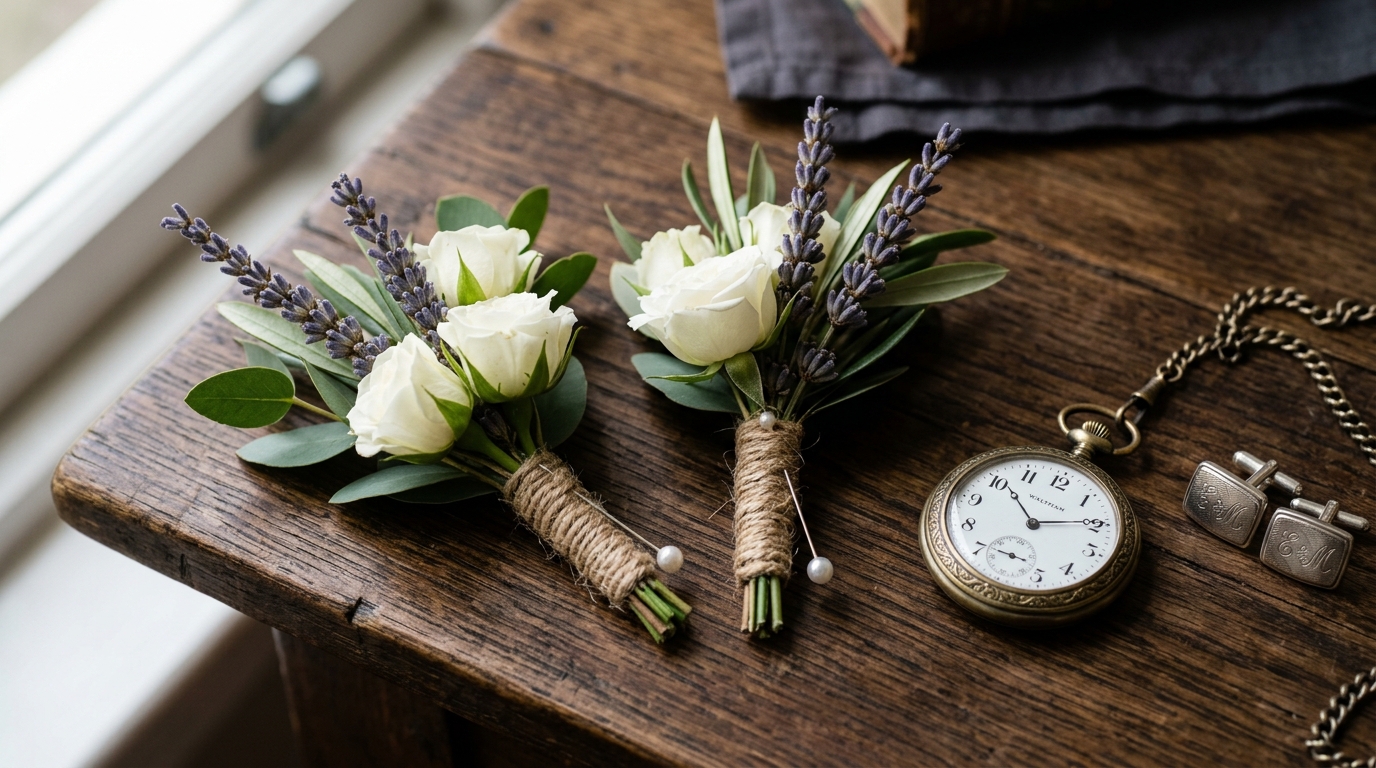
Both grooms wear a boutonniere. Matching flowers signal unity. Different flowers in the same colour palette signal individuality within a pair. Popular choices include roses, ranunculus, thistles (a nod to Scottish weddings), and herbs like rosemary or lavender. Budget £10 to £30 each from your florist.
Cufflinks and watches
Matching cufflinks are a popular gift that grooms exchange on the morning of the wedding. Engraved initials, wedding dates, or coordinates of your first date are all meaningful options. Budget £30 to £200 per pair depending on material.
A shared watch brand or style is another way to coordinate. This is not about spending thousands. Two matching Seiko Presage watches at around £300 each or two Daniel Wellington watches at £150 each create a lasting reminder.
Pocket squares
If your suits match, use pocket squares to differentiate. If your suits contrast, matching pocket squares pull the look together. The fold style matters too: a simple flat fold for formal weddings, a puffed fold for relaxed ones.
Getting ready: together or apart?
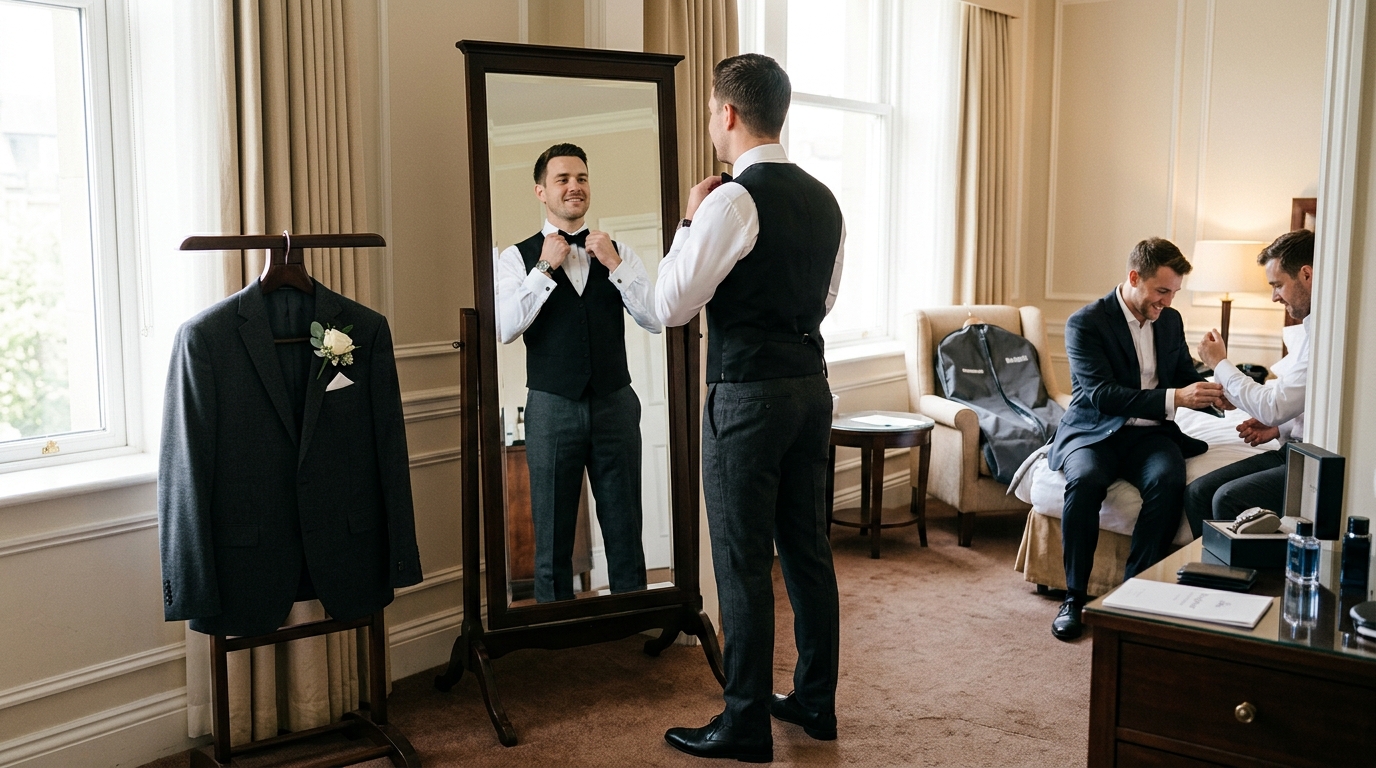
Most two-groom couples get ready in the same room. The atmosphere tends to be relaxed, music-filled and sociable. Unlike two-bride weddings where dress secrecy often demands separate spaces, two-groom mornings usually feel like a gathering of friends who happen to be putting on very nice suits.
If you want the surprise element, book two rooms. Have your best men coordinate timings so you both finish at the same time.
Best man duties times two
Two grooms means two best men (or best people). Divide the responsibilities clearly. One best man handles the rings. The other manages the morning logistics. Both give speeches, but set a time limit of five minutes each to keep the reception moving.
Some couples assign different duties entirely: one best man as morning coordinator and speech giver, the other as evening MC and dance floor hype person. Talk about this early so nobody treads on anyone’s toes.
Stag do: joint or separate?
The stag do question for two-groom couples is less fraught than the hen do equivalent, largely because stag culture tends to be flexible about group size and format.
Joint stag do
The most popular choice. Both friend groups merge for a weekend away, an activity day, or a night out. This works especially well when you have overlapping social circles. Popular UK options include brewery tours, karting, paintball, hiking weekends in the Lake District or Snowdonia, and city breaks to Edinburgh, Manchester or Brighton. Our stag do ideas guide covers dozens of options.
Separate stag dos
If your friend groups are distinct or you want a night that is specifically about you and your mates, separate events work perfectly. Set an informal budget cap so one stag does not become significantly more expensive than the other.
The “stag and stag” hybrid
One shared daytime activity (e.g. go-karting, whisky tasting, escape room) followed by separate evening plans. Everyone gets time together and time apart. This is the best compromise for couples with large, separate friend groups.
Walking down the aisle as two grooms
The aisle question for two grooms is identical to the options available to any same-sex couple, but the most popular choices differ slightly.
Both already at the front
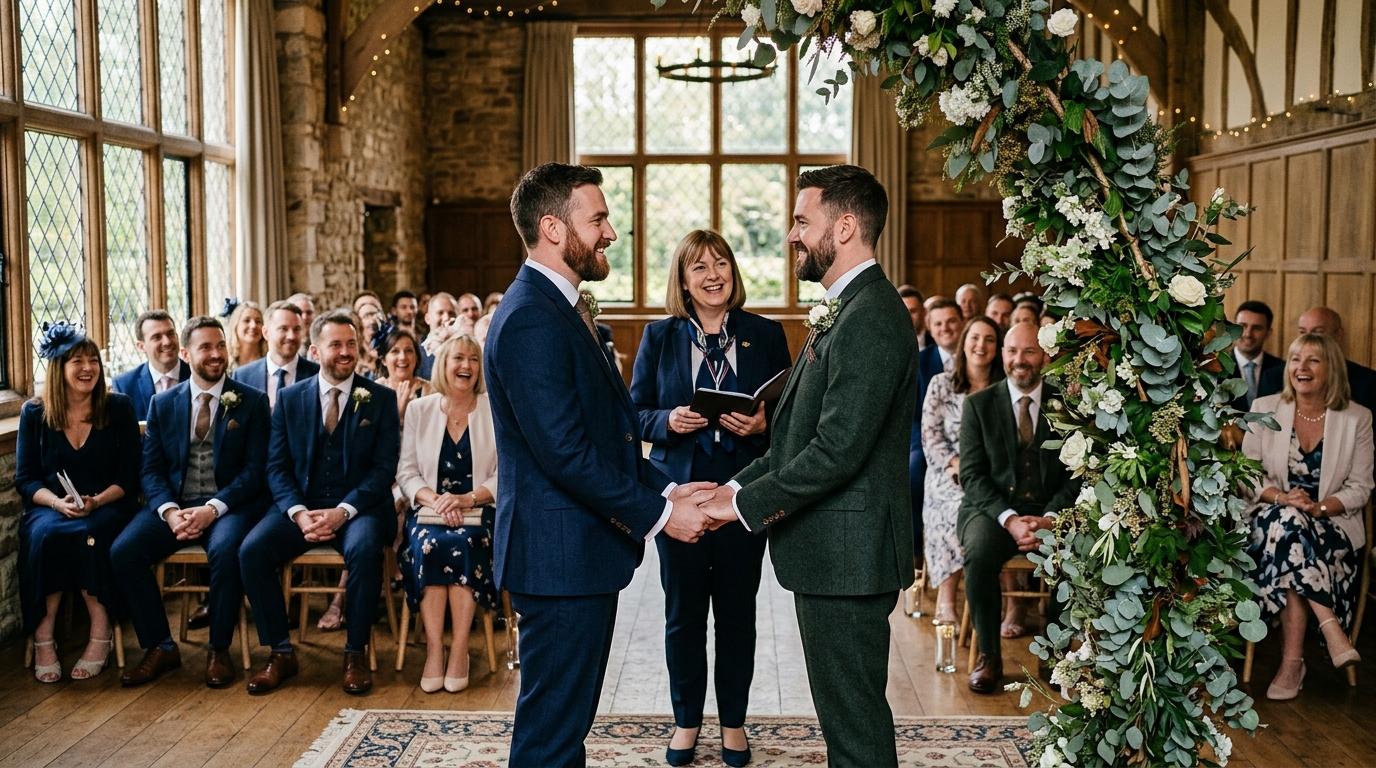
The most common choice for two-groom couples. You are both standing at the front when guests are seated. The ceremony begins without an entrance. This is simple, relaxed and removes the question entirely.
Walking in together
Both grooms walk down the aisle side by side. Some couples bring their mothers, fathers, or both parents. Others walk alone. This creates a strong visual moment and works well when you want a traditional entrance without deciding who waits.
Entering separately
One groom enters first, takes his position, and the second follows. This builds anticipation and gives each groom his own moment. If you choose this, decide the order together. Some couples flip a coin. Others give the entrance to whoever wants it more.
For a full breakdown of ceremony options including readings and vow ideas, see our LGBTQ+ wedding readings and vows guide.
Who stands where at the altar?
As with a two-bride wedding, there is no convention for two grooms. Stand wherever feels comfortable. Some couples choose based on their family’s seating side. Others pick based on which hand they want free for the ring exchange. Your officiant may suggest positions based on the venue layout.
If you are exchanging rings, consider which hand you write with. It helps to have your dominant hand free for sliding the ring onto your partner’s finger.
Speeches: managing a bigger line-up
Two grooms typically means more people want to speak. Without a clear traditional format (father of the bride, best man, groom), you need to create your own structure.
A suggested running order
| Order | Speaker | Time limit | Content |
|---|---|---|---|
| 1 | Best man 1 | 5 minutes | Stories and toast for Groom 1 |
| 2 | Best man 2 | 5 minutes | Stories and toast for Groom 2 |
| 3 | Parent (Groom 1’s side) | 3 to 5 minutes | Welcome, memories, advice |
| 4 | Parent (Groom 2’s side) | 3 to 5 minutes | Welcome, memories, advice |
| 5 | Both grooms (joint speech) | 5 to 7 minutes | Thank-yous, stories, toast to guests |
Total speech time: 25 to 30 minutes. Any longer and guests start checking their phones. Brief your MC on timings and give speakers a friendly but firm time limit.
For writing tips and templates, see our best man speech examples and how to write a wedding speech guides. Our maid of honour speech guide is also useful if one of your attendants is not a man.
The first dance
The first dance at a two-groom wedding is often the moment that surprises guests the most, largely because there is no assumed choreography. That is an advantage.
Leading and following
You can decide in advance who leads, switch halfway through, or skip the formal hold entirely and dance freestyle. Many couples take a few dance lessons to feel confident. Two or three sessions at £40 to £60 each is enough to learn basic moves and a simple spin.
Song choices
Choose a song that means something to your relationship rather than a “wedding” song. Two grooms tend to pick songs with lyrics that feel authentic rather than traditionally romantic. George Michael, Elton John, Sam Smith, and Hozier are popular choices, but do not feel limited to LGBTQ+ artists. A song is a song. Our first dance songs guide lists popular options across every genre.
Who dips whom?
If you want a dip for the finale, practise it. The taller or stronger partner usually dips, but height is not a requirement. Two mutual dips in quick succession always get a cheer. Or skip the dip entirely. It is not compulsory.
Cost comparison: traditional wedding vs two-groom wedding
A two-groom wedding often costs slightly less than a traditional wedding due to lower outfit and beauty costs. Here is where the numbers shift.
| Budget item | Traditional (one groom, one bride) | Two grooms | Difference |
|---|---|---|---|
| Outfits | £1,300 (dress) + £500 (suit) = £1,800 | £500 + £500 = £1,000 | -£800 |
| Alterations | £200 (dress) + £50 (suit) = £250 | £50 + £50 = £100 | -£150 |
| Hair and makeup | £350 (bridal) + £0 (groom) = £350 | £80 + £80 = £160 | -£190 |
| Flowers | £150 (bouquet) + £15 (buttonhole) = £165 | £15 + £15 = £30 | -£135 |
| Accessories | £200 (bride) + £100 (groom) = £300 | £150 + £150 = £300 | No change |
| Stag/hen do | £300 + £300 = £600 | £300 to £600 | -£0 to £300 |
| Venue | £5,000 | £5,000 | No change |
| Catering | £4,500 | £4,500 | No change |
| Photography | £1,500 | £1,500 | No change |
| Estimated total difference | -£975 to -£1,275 |
The saving comes from suits being cheaper than dresses, minimal hair and makeup costs, and boutonnieres costing a fraction of bridal bouquets. The overall budget for a two-groom wedding lands around £18,000 to £20,000 against the UK average of £20,000 to £22,000. Use our wedding budgeting guide to plan your numbers.
Grooming timeline for two grooms
Looking your best on the day starts weeks before, not on the morning of the wedding.
| Timeframe | Task | Details |
|---|---|---|
| 3 months before | Start a skincare routine | Cleanser, moisturiser, SPF. Nothing complicated. Consistency matters more than product cost. |
| 2 months before | Trial haircut | Get the style you want and let it grow out slightly to see how it settles. |
| 1 month before | Final haircut | Two weeks before is too close (looks freshly cut in photos), one month allows it to relax into shape. |
| 2 weeks before | Beard trim or shave plan | If you have facial hair, decide on the final shape. Get a professional barber trim to set the lines. |
| 1 week before | Teeth whitening (optional) | Over-the-counter strips or a quick professional session. Do not try anything new closer to the day. |
| Morning of | Shower, moisturise, style hair | Keep it simple. No new products on the day. Use what you know works. |
Budget around £50 to £150 per groom for pre-wedding grooming (haircuts, skincare, barber visits). This is a fraction of the bridal beauty spend and makes a noticeable difference in photographs.
Practical logistics for two-groom weddings
Small details that keep the day running smoothly.
Changing rooms. If you are getting ready separately, confirm two rooms with your venue. If you are getting ready together, one room works. Most venues accommodate this without issue.
Ring sizing. Get both rings sized professionally at least six weeks before the wedding. Fingers swell in warm weather, so if you are marrying in summer, size slightly larger. Budget £200 to £600 per ring for plain bands, more for diamond or engraved designs.
Name changes. The process is identical to any married couple. You can keep your own names, one partner takes the other’s name, you double-barrel, or you both choose something new. Apply for updated documents within six weeks of the wedding using your marriage certificate.
Guest assumptions. Some guests will ask “who is the groom?” without thinking. Your MC can set the tone early by using your names throughout and avoiding “the happy couple” cliches. Brief family members who might field questions.
Gendered stationery. Standard wedding stationery still defaults to “Mr and Mrs” in many shops. Order from suppliers who offer gender-neutral wording or custom text. Online printers like Papier, Minted and Vistaprint all support custom wording. Our wedding stationery guide covers the full process.
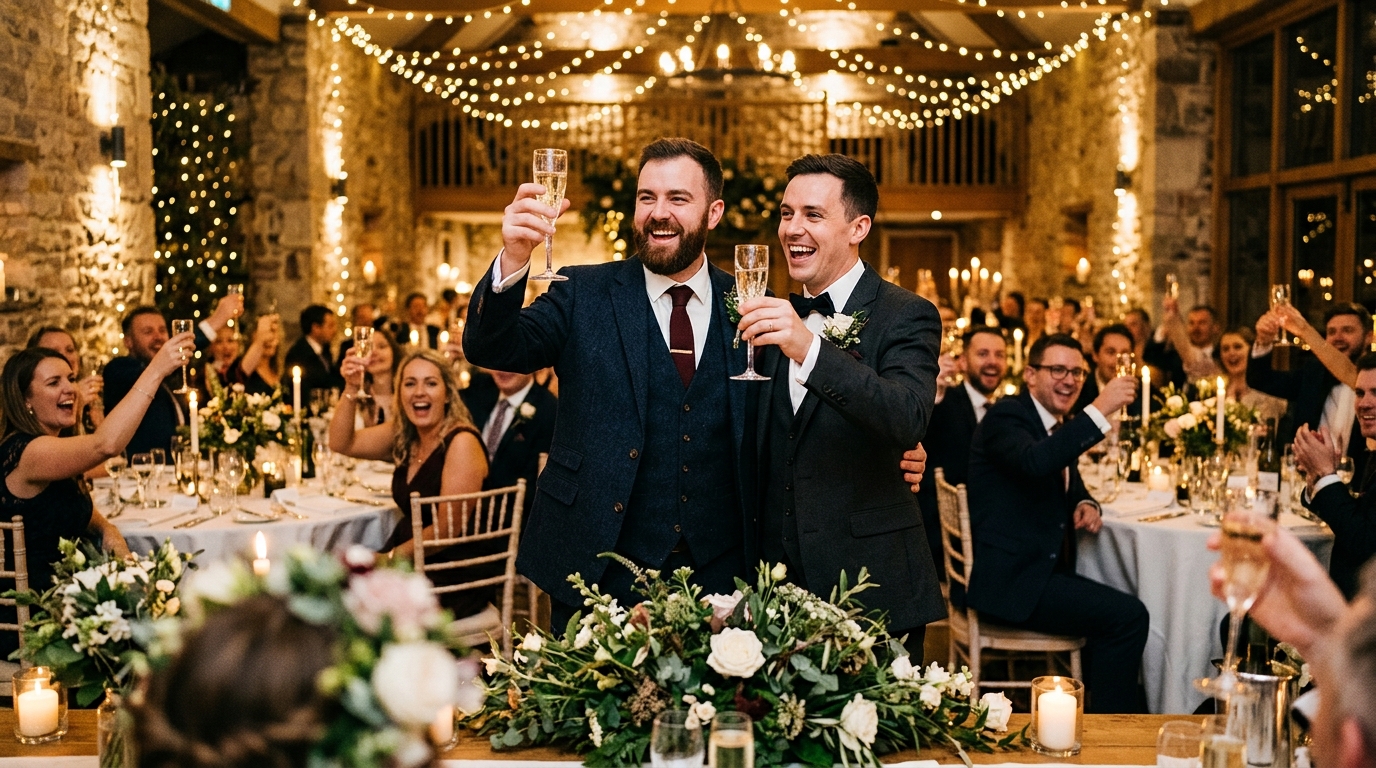
What real two-groom couples wish they had known
Order suits earlier than you think, especially bespoke. Eight to twelve weeks is the minimum turnaround, and wedding season (May to September) creates backlogs at popular tailors. Start by January for a summer wedding.
Do not overthink the “who does what” question. In a two-groom wedding, every decision is shared. If one of you cares more about flowers and the other about music, divide the planning by interest rather than by tradition.
Set expectations with family early. Parents may have questions about the ceremony format, the speech order, or their role in the day. A casual conversation three to four months out prevents last-minute surprises. If family dynamics are complicated, our LGBTQ+ wedding planning guide has advice on navigating those conversations.
Hire a photographer who has shot two-groom weddings before. The framing, the posing and the timing are different when both partners are in suits. Ask to see full galleries, not just single highlight images. Our guide on choosing a wedding photographer explains what to look for.
Write personal wedding vows. Standard vows are perfectly fine, but personal words at a two-groom ceremony carry real weight. You do not need to be a writer. Speak honestly about what your partner means to you and the room will be in tears.
Further reading
- LGBTQ+ Wedding Planning Guide for the full planning timeline and legal steps
- Same-Sex Wedding Traditions and Ideas for ceremony and reception inspiration
- Two Brides: Your Wedding Planning Guide for the equivalent guide for two-bride couples
- LGBTQ+ Wedding Readings and Vows for ceremony wording that fits
- Civil Partnership vs Marriage UK if you are weighing up your legal options
- Gay-Friendly Wedding Venues UK for venue ideas across the country
Frequently asked questions
Should two grooms wear matching suits?
Matching exactly is not recommended. Identical suits look like a uniform rather than a celebration. Coordinate instead: same colour family but different fabrics, matching ties with different suit styles, or the same tailor with different designs. This photographs better and lets each groom express his own personality.
How much do two wedding suits cost in the UK?
Off-the-rack suits range from £150 to £600 each. Made-to-measure options cost £400 to £1,200. Fully bespoke suits from a Savile Row or independent tailor run £500 to £2,000 or more. Budget £800 to £3,000 total for two grooms depending on your preference.
Who walks down the aisle when there are two grooms?
There are no rules. Walking in together is the most popular choice. Entering from opposite sides and meeting at the front works well in venues with two aisles. One groom waiting while the other walks is another option. Some couples are already standing at the front when guests arrive.
How do speeches work at a two-groom wedding?
With two best men, you will likely have two best man speeches. Keep each to five minutes maximum to avoid a long speech block. Parents from both sides may also want to speak. Set the order in advance and brief your MC. Many two-groom couples also give a joint thank-you speech.
Do two grooms both wear boutonnieres?
Yes, boutonnieres or buttonholes are the standard choice for two grooms. You can match them exactly or use the same flower in different colours. Some couples upgrade to small pocket bouquets or lapel corsages for a slightly different look.
Who leads the first dance at a two-groom wedding?
Decide in advance or simply move naturally. Many couples switch the lead partway through the song. Others skip the formal hold entirely and dance freely. There is no expectation about who leads. Choose a song you both love and let the moment happen. Our first dance songs guide has ideas.
Can two grooms have a religious wedding in the UK?
Yes, with opted-in religious bodies. Quakers, Unitarians and Liberal Judaism actively welcome same-sex marriages. The Church of England and Catholic Church do not currently perform same-sex marriages. Humanist ceremonies are legally recognised in Scotland and can serve as your personal ceremony in England and Wales alongside a civil registration.