Home / Articles / LGBTQ+ Weddings
LGBTQ+ Wedding Readings and Vows: UK Guide
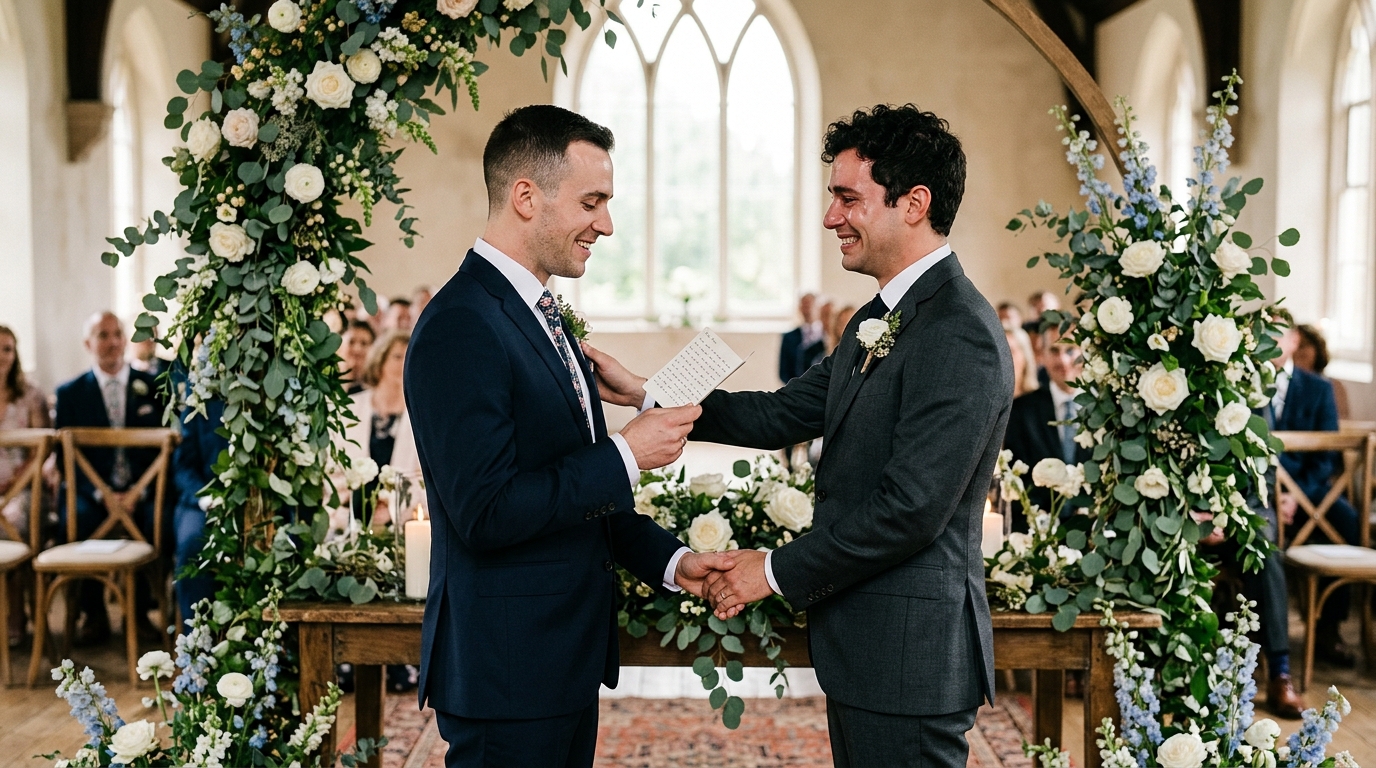
Key Takeaways
- Two to three readings is standard for a UK wedding ceremony, lasting around 15 minutes total
- Gender-neutral readings avoid awkward pronoun swaps and feel more authentic for LGBTQ+ couples
- Civil ceremonies cannot include hymns, religious readings or religious language anywhere in the service
- Writing personal vows takes 4-6 weeks of drafting and should run 1-2 minutes when spoken aloud
- Shakespeare, Maya Angelou, Carol Ann Duffy and Ocean Vuong all offer readings that work beautifully without adaptation
LGBTQ+ wedding readings are one of the most personal parts of your ceremony, and they deserve more thought than a last-minute Google search the week before. The right reading can make guests laugh, cry, or simply feel the weight of what your relationship means. The wrong one can feel borrowed from somebody else’s love story.
Choosing readings for a same-sex or LGBTQ+ ceremony comes with an advantage that straight couples do not always have: you are less likely to default to the obvious choices. Without the standard “bride and groom” script, you get to build a ceremony that sounds like you. That freedom is worth using well.
This guide covers the full range of options available to UK couples, from classical poetry and religious texts to modern LGBTQ+ authors and tips for writing your own vows. Whether you are having a civil ceremony, a religious service with an opted-in faith, or a humanist celebration, you will find something here that fits.
Why gender-neutral and LGBTQ+ readings matter
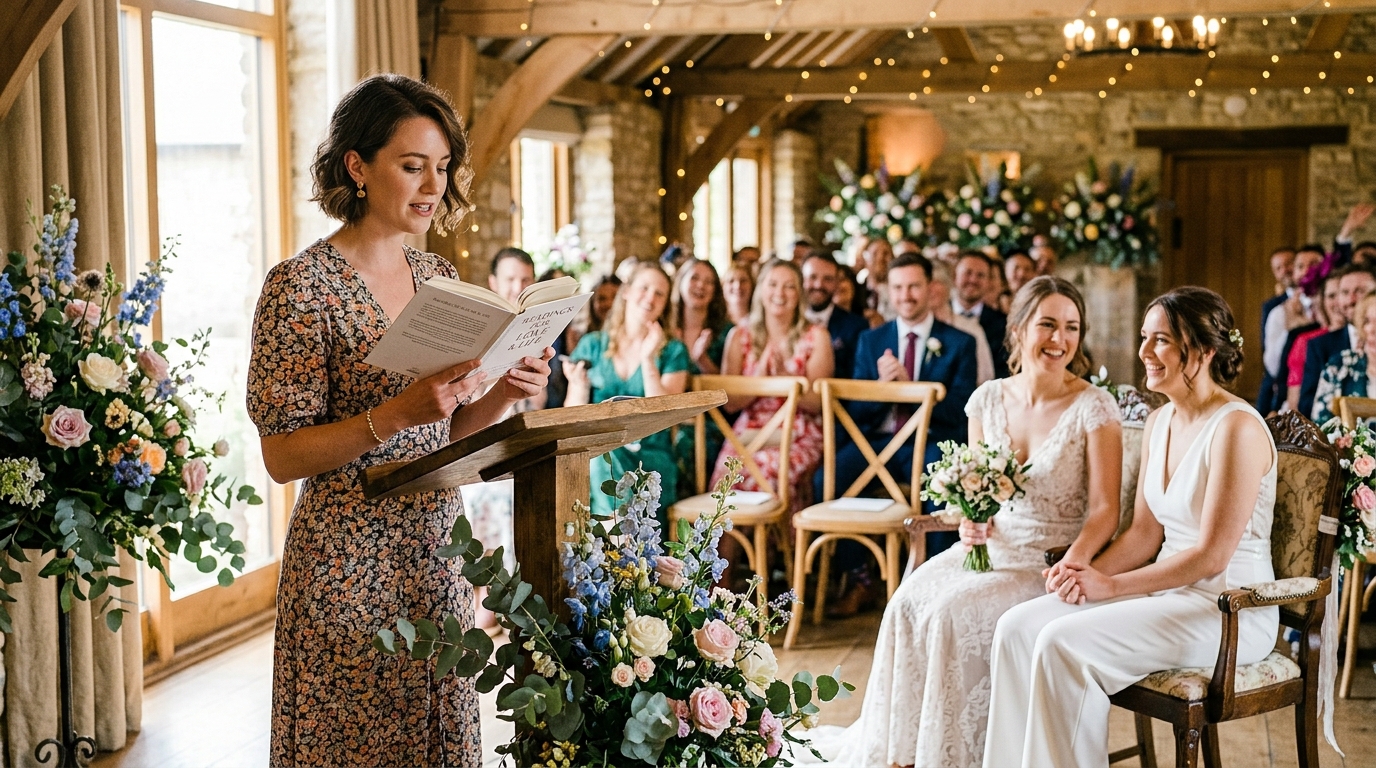
It is tempting to take a traditional reading and swap pronouns. “He” becomes “she” or “they,” and technically the words still work. But technically working is not the same as feeling right. A reading that was written about a man and a woman, then hastily edited, often carries an undercurrent of not-quite-belonging that guests can sense even if they cannot name it.
Gender-neutral readings avoid this problem entirely. They speak about love between two people, two souls, two hearts. No editing required, no awkward pauses while the reader navigates a pronoun swap mid-sentence, no feeling that you have borrowed someone else’s ceremony and crossed out the bits that did not apply.
Readings written by LGBTQ+ authors go further. They carry the specific joy, defiance and tenderness of loving someone when the world did not always make it easy. That resonance is something no amount of pronoun-swapping can replicate.
For couples planning a civil partnership rather than a marriage, the reading choices are the same, though religious texts are off the table for civil ceremonies.
Classical poetry readings that need no adaptation
Several of the most beloved English-language poems are already gender-neutral. These are safe choices that work in any ceremony setting.
Shakespeare, Sonnet 116
“Let me not to the marriage of true minds admit impediments.” This sonnet is about the constancy of love itself, not about any specific couple. No gendered language, no pronouns to swap. It runs about 90 seconds when read at a measured pace, making it ideal for a ceremony reading.
ee cummings, “i carry your heart with me”
A love poem that uses “i” and “you” throughout. Its rhythms are unusual enough to hold attention but simple enough to follow. At around 60 seconds, it works well as a shorter reading to pair with a longer one.
Maya Angelou, “Touched by an Angel”
Angelou writes about love as a force that liberates. The poem uses “we” and “us” rather than gendered pronouns. It is warm without being saccharine and carries enough gravitas for a wedding without feeling heavy.
Rumi, translated by Coleman Barks
Rumi’s love poetry predates modern gender categories entirely. “The minute I heard my first love story, I started looking for you” is a popular excerpt. Most Barks translations use “soul” and “beloved” rather than gendered terms.
Modern readings by LGBTQ+ authors
These readings bring something that classical poetry cannot: the lived experience of loving outside the mainstream. They are specific, contemporary and written from a place of genuine understanding.
Carol Ann Duffy
Scotland’s former Poet Laureate and an openly gay woman. Her poem “Words, Wide Night” is a love poem about distance and longing that works beautifully as a wedding reading. “Somewhere on the other side of this wide night and the distance between us, I am thinking of you” speaks to couples who know what it means to fight for closeness.
Ocean Vuong
Vietnamese-American poet whose work explores queer love with extraordinary precision. Excerpts from “Night Sky with Exit Wounds” or his novel “On Earth We’re Briefly Gorgeous” offer readings that are lyrical and grounded. His writing is particularly moving for couples whose love story includes navigating cultural or family complexity.
Jeanette Winterson
The excerpt from “Written on the Body” that begins “Why is the measure of love loss?” is one of the most requested LGBTQ+ wedding readings in the UK. Winterson’s prose is dense and poetic, so keep the excerpt to 2-3 paragraphs for a ceremony reading.
Audre Lorde
“Love Poem” by Lorde is explicitly about desire between women. It is bold, sensual and celebrates queer love without apology. Best suited to couples who want their ceremony to acknowledge the specific nature of their love rather than keeping things general.
Ali Smith
Scottish author whose novels and short stories explore love between women with wit and intelligence. Short excerpts from “How to Be Both” make unusual, engaging readings that feel literary without being impenetrable.
Comparing reading types for your ceremony
Choosing a reading is easier when you know what each type brings to the room. This table covers the main categories, their strengths and what to consider.
| Reading type | Best for | Ceremony type | Length | Things to consider |
|---|---|---|---|---|
| Classical poetry (Shakespeare, Rumi) | Formal ceremonies, traditional venues | Civil, religious, humanist | 60-90 seconds | Universally recognised; may feel safe rather than personal |
| Modern LGBTQ+ authors (Vuong, Winterson) | Couples wanting queer-specific resonance | Civil, humanist | 60-120 seconds | Powerful and specific; check guests will follow the language |
| Religious texts (Ruth, Song of Solomon) | Faith-based ceremonies | Religious only (opted-in faiths) | 60-90 seconds | Not permitted in civil ceremonies in England and Wales |
| Film and book excerpts | Informal or creative ceremonies | Civil, humanist | 30-90 seconds | Can feel lightweight if not chosen carefully |
| Personal writing (by a guest or the couple) | Intimate ceremonies, small weddings | Any | 60-180 seconds | Highly personal; quality depends on the writer |
| Song lyrics (read, not sung) | Relaxed, modern ceremonies | Civil, humanist | 30-60 seconds | Works best when the audience knows the song |
For help choosing wedding readings more broadly, our main guide covers additional options beyond the LGBTQ+ focus of this article.
Religious readings that welcome same-sex couples
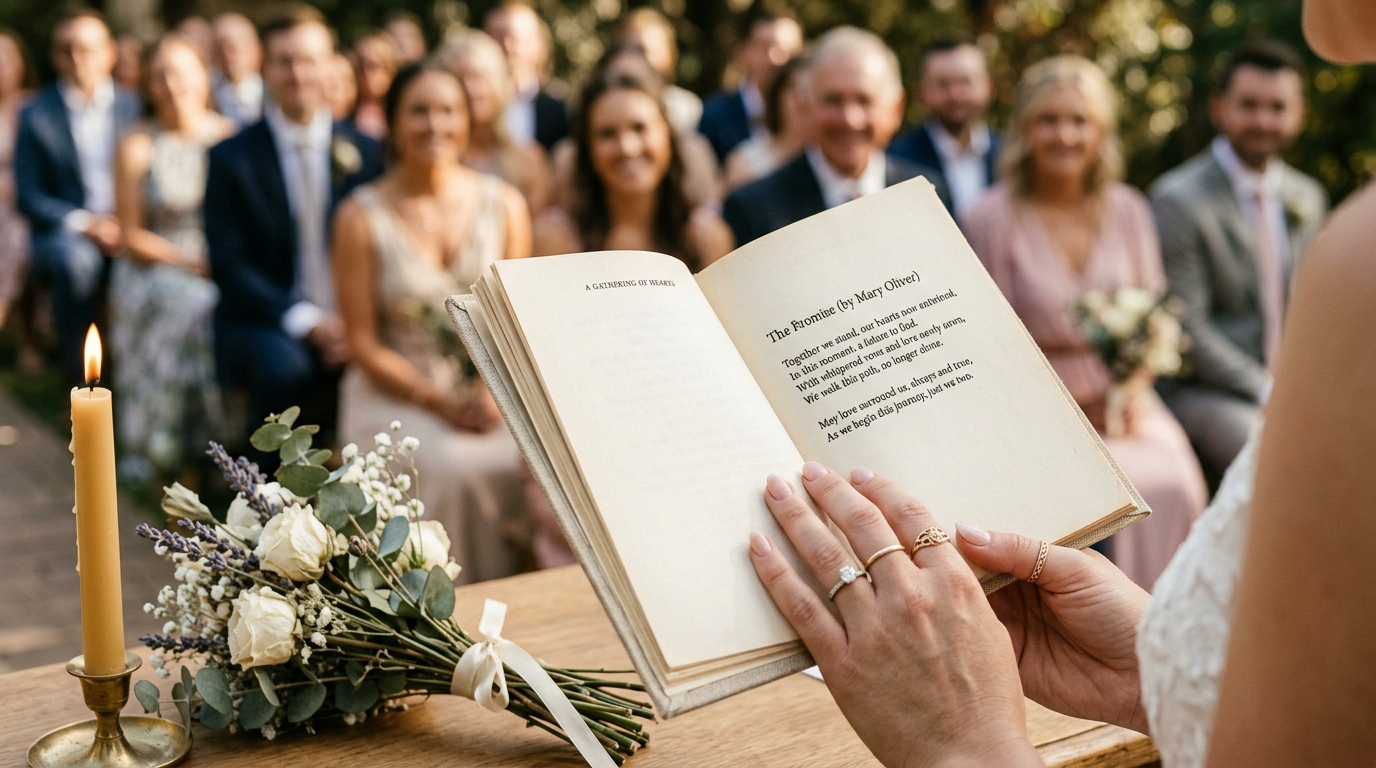
If your ceremony is with a religious body that has opted in to conducting same-sex marriages (Quakers, Unitarians and Liberal Judaism in the UK), you can include religious readings. Several passages from scripture work naturally for LGBTQ+ couples.
Ruth 1:16-17
“Where you go I will go, and where you stay I will stay. Your people will be my people and your God my God.” Originally spoken between two women, Ruth and Naomi, this passage is about loyalty and chosen family. Its context makes it especially fitting for a same-sex ceremony.
Song of Solomon 8:6-7
“Set me as a seal upon your heart, as a seal upon your arm; for love is strong as death.” The Song of Solomon is a celebration of romantic love that uses no gendered pronouns in most translations. Its imagery is vivid and passionate without being inappropriately intimate for a ceremony.
1 Corinthians 13:4-8
“Love is patient, love is kind.” This is the most popular wedding reading in the UK regardless of the couple’s orientation. It describes the qualities of love itself rather than the people involved. It works in any religious ceremony and carries a familiarity that many guests find comforting.
Keep in mind that civil ceremonies in England and Wales cannot include any religious content. If your heart is set on a religious reading but you are having a civil registration, consider having a separate blessing or celebration where religious texts can be included freely.
Secular readings from books, films and letters
Not every reading needs to come from a published poet. Some of the most moving ceremony moments come from unexpected sources.
“Love is not breathlessness, it is not excitement, it is not the promulgation of promises of eternal passion. That is just being in love, which any fool can do. Love itself is what is left over when being in love has burned away.” This passage from Louis de Bernieres’ “Captain Corelli’s Mandolin” has become a wedding staple because it speaks to lasting love rather than initial infatuation.
The Velveteen Rabbit by Margery Williams contains the passage about becoming “Real” through being loved, which works particularly well for LGBTQ+ couples. The idea that love transforms and authenticates resonates with the experience of living openly.
Letters between real couples make powerful readings too. The letters of Vita Sackville-West and Virginia Woolf offer beautiful material that is explicitly about love between women. Choose a short excerpt and give it context with a brief introduction from the reader.
For couples looking at the full range of wedding music and readings together, planning them as a pair ensures the ceremony flows naturally from one to the next.
Writing your own wedding vows
Personal vows are the most powerful words in any ceremony. They are also the most terrifying to write. Here is a practical framework for LGBTQ+ couples.
Start 4-6 weeks before the wedding
Do not leave vow writing until the last week. Good vows go through several drafts. Start with a brain dump of everything you want to say, then edit ruthlessly. The best vows are specific to your relationship rather than general statements about love.
Agree on ground rules
Before either of you starts writing, decide together: Will you share vows before the ceremony or keep them as a surprise? What is the rough word count? (150-300 words is the sweet spot.) Are you comfortable with humour, or do you want to keep things serious? Will you make promises, or focus on what you love about each other?
Setting these parameters avoids the situation where one partner delivers a two-minute heartfelt speech and the other reads a five-word joke from a napkin. That imbalance can feel awkward in the moment.
Tips specific to LGBTQ+ couples
Reference your shared history honestly. If coming out, family acceptance, or finding each other in a world that was not always welcoming is part of your story, it belongs in your vows. You do not need to turn your ceremony into a political statement, but acknowledging the specific path you walked to get to this moment gives your vows a depth that generic love language cannot match.
Avoid gendered language by default. Use your partner’s name rather than “my wife” or “my husband” throughout. This keeps your vows personal and sidesteps any assumptions about roles within your relationship.
If you are struggling with structure, try this framework: one sentence about when you knew, one paragraph about what you love, one paragraph about what you promise. That gives you a beginning, a middle and an end without feeling formulaic.
How many readings should you include?
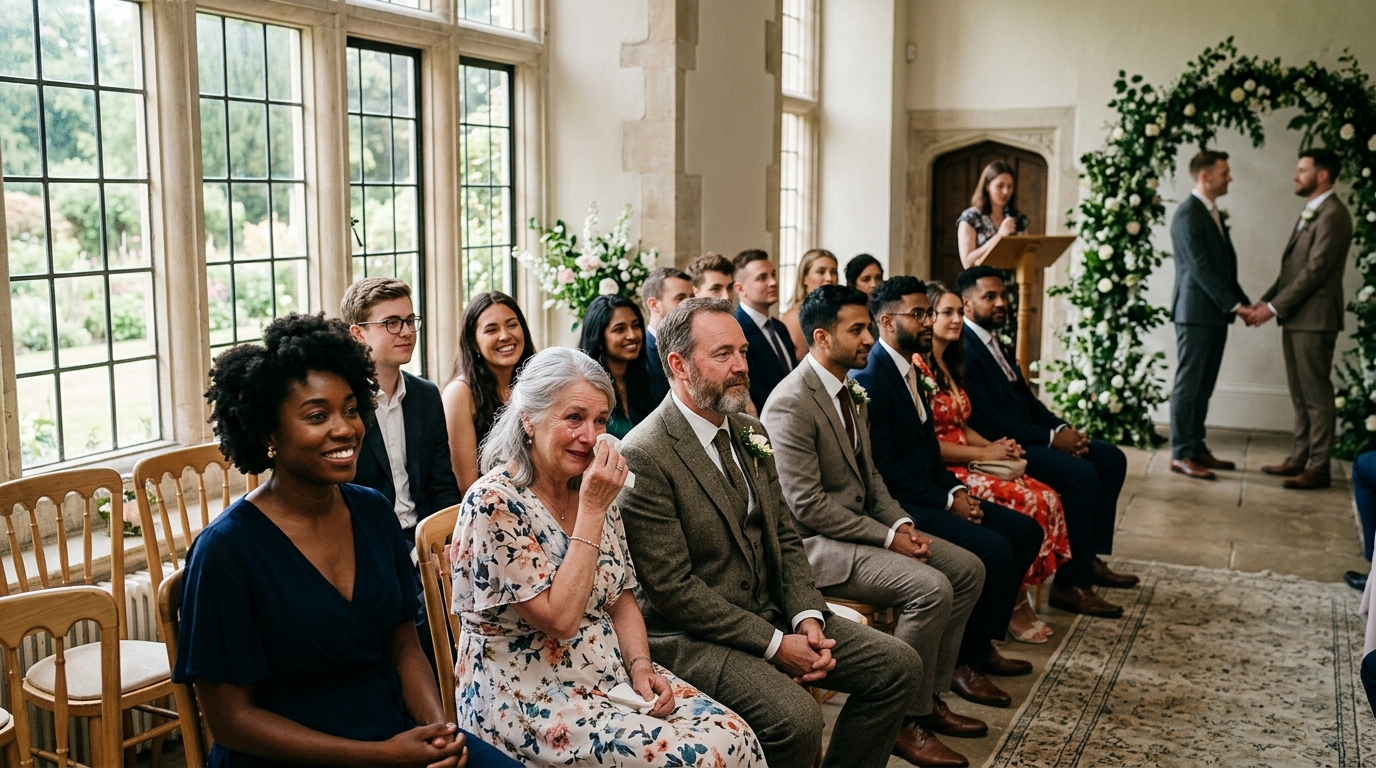
Two to three readings is the standard for a UK wedding ceremony. One is too few to create a sense of ceremony around the readings. Four or more risks making the service feel like a poetry recital.
A common structure is one reading before the vows and one or two after, before the signing of the register. This gives the ceremony a rhythm: reading, vows, reading, signing. Some couples add a third reading during the signing itself, as this is a natural pause in the ceremony.
Each reading should run between 60 seconds and two minutes. Much shorter and it feels insubstantial. Much longer and attention drifts, particularly if the language is dense or unfamiliar.
If you are writing personal vows as well as having readings, lean towards two readings rather than three. Your vows are already adding personal content to the ceremony, and you do not want the spoken elements to overwhelm the ritual moments.
Choosing your readers
Who delivers a reading is almost as important as the reading itself. A beautiful poem read nervously in a barely audible whisper loses its impact entirely.
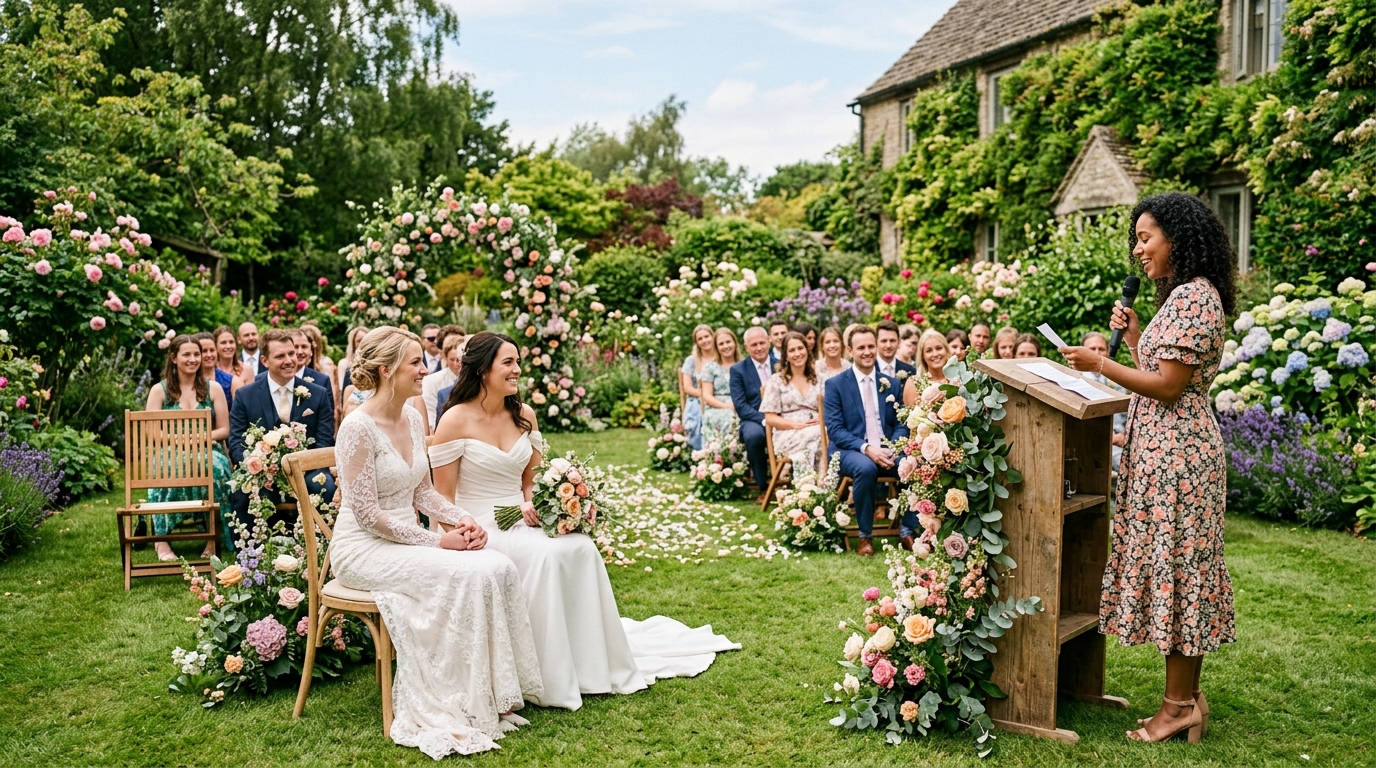
Choose people who are comfortable speaking in public. This matters more than their relationship to you. A confident friend who loves performing will serve the reading better than a shy parent who dreads public attention, even if the parent feels like the more meaningful choice.
Brief your readers properly. Give them the text at least two weeks in advance. Tell them the tone you are going for. Suggest they practise reading aloud three or four times, including once at full volume, because reading aloud in a large room is very different from reading silently.
Consider having your wedding celebrant or officiant read one piece. Professional celebrants are experienced at projecting and pacing, and having them read alongside a friend or family member creates a nice contrast between the polished and the personal.
Legal wording requirements: what you must know
The legal declarations in your ceremony are fixed by law and cannot be changed. Everything else, including readings and personal vows, is flexible.
In a civil ceremony in England and Wales, the registrar will lead you through prescribed legal wording. You must declare that you are free to marry and exchange contracted words. Outside of these legal requirements, the readings, personal vows and ceremony structure are entirely up to you, with the exception that nothing religious can be included.
In Scotland, the rules differ slightly. Humanist ceremonies are legally binding, giving you more flexibility with the entire ceremony format. Religious ceremonies with opted-in faiths can include whatever that faith community typically uses.
For couples choosing a civil partnership rather than marriage, the legal wording is slightly different but the freedom around readings is the same. Our guide to civil partnerships vs marriage covers the full legal distinctions.
If you are planning to write a wedding speech as well, keep in mind that the speech is separate from the ceremony. Speeches happen at the reception and have no legal constraints at all.
Readings for civil partnerships vs marriage ceremonies
The ceremony structure for a civil partnership registration and a civil marriage is very similar. Both are conducted by a registrar (in England and Wales), both require legal declarations, and both allow personal readings and vows alongside the legal elements.
The main practical difference is the legal wording. In a marriage, you say “I take thee to be my lawful wedded wife/husband/spouse.” In a civil partnership, the words are “I declare that I know of no legal reason why we may not register as each other’s civil partner.”
Beyond the legal wording, your choices about readings and personal vows are identical. The same poetry, the same prose, the same personal writing all work equally well in either ceremony. Do not let the distinction between marriage and civil partnership limit your ceremony planning.
Some registrars are more flexible than others about ceremony personalisation. When you meet your registrar before the ceremony, bring your chosen readings and discuss the running order. Most will happily accommodate two or three readings and a set of personal vows alongside the legal requirements.
Putting your ceremony together
Building a ceremony order that flows well takes a bit of planning. Here is a suggested structure that works for most LGBTQ+ ceremonies:
- Processional and welcome from celebrant/registrar
- Opening words from the celebrant about your relationship
- First reading by a friend or family member (a shorter, warm piece)
- Legal declarations (the fixed wording required by law)
- Personal vows (if writing your own)
- Exchange of rings
- Second reading (a longer, more emotional piece)
- Signing of the register (optional third reading during this moment)
- Pronouncement and recessional
This structure gives your ceremony about 25-35 minutes, which is long enough to feel like an event and short enough to keep everyone engaged. Adjust the order to suit your preferences. Some couples prefer to have both readings before the vows. Others want a reading between the vows and the ring exchange.
Work with your celebrant to shape the ceremony around your wedding venue’s specific layout and acoustics. A reading that works in an intimate room might need a microphone in a large hall.
For inspiration on same-sex wedding traditions beyond readings and vows, including aisle walks, first dances and unity rituals, see our dedicated traditions guide.
Further reading
Frequently asked questions
How many readings should we have at our LGBTQ+ wedding?
Two to three readings is the standard number for a UK wedding ceremony. One before the vows and one or two after works well. More than three can make the ceremony drag, especially if you are also writing personal vows. Keep total ceremony time between 20 and 40 minutes.
Can we use religious readings in a civil ceremony?
No. Civil ceremonies in England and Wales cannot include any religious content, including hymns, prayers, bible readings or religious language. If you want Ruth 1:16-17 or 1 Corinthians 13 in your ceremony, you need a religious ceremony with an opted-in faith or a separate blessing service alongside your civil registration.
Do we have to change pronouns in traditional readings?
Not if you choose well. Many classic readings are already gender-neutral. Shakespeare's Sonnet 116, ee cummings' 'i carry your heart', and most Rumi translations use 'love' and 'soul' rather than gendered terms. Avoid readings that require heavy editing because the result often sounds forced.
How long should personal wedding vows be?
Aim for 1 to 2 minutes when spoken aloud, which is roughly 150 to 300 words. Shorter vows land with more impact. If both partners are writing vows, agree on a rough word count beforehand so one person does not speak for 30 seconds while the other reads for five minutes.
Who should we ask to do a reading at our wedding?
Choose people who are comfortable speaking in public and who genuinely support your relationship. Close friends, siblings and parents are the most common choices. Some couples ask their celebrant to read one piece and a guest to read another. Always give readers the text at least two weeks in advance so they can practise.
What readings work for a civil partnership ceremony?
Civil partnership ceremonies follow the same rules as civil marriages: no religious content. Secular poetry, prose excerpts, song lyrics and personal writing all work. Carol Ann Duffy, Mary Oliver, ee cummings and Ocean Vuong are popular choices. Film and book quotes are also welcome.
Can we write our vows together instead of separately?
Yes. Some couples write vows together and say the same words to each other. Others write separate vows but share them beforehand so the tone matches. Both approaches are valid. Writing vows together removes the anxiety of not knowing what the other person will say, which some couples find comforting.