Home / Articles / Costs & Budget
How to Budget for a Wedding: UK Guide
A useful wedding budget starts with money you genuinely have, not an industry average. Keep a separate contingency, record every deposit and due date, and compare quotes on the same basis. Credit-card protection may help with eligible purchases, but the payment route matters.

Key Takeaways
- Start with affordable savings and confirmed gifts, then keep a separate contingency.
- Ask every supplier for a full written price, including VAT, travel and likely extras.
- Track estimated, quoted, paid and remaining costs in one place.
- Credit-card protection can apply to eligible purchases, but payment routes matter.
- Cut guest numbers before quietly removing the parts you both care about.
The nicest wedding budget is not the biggest one. It is the one that lets you enjoy the day without months of dread afterwards.
MoneyHelper’s advice begins with a pleasingly plain idea: “set a budget and stick to it.” That sounds obvious. It becomes useful when you turn it into a routine.
1. Agree the amount you can actually spend
Start with money that already exists or can be saved comfortably before each bill arrives.
| Money available | Confirmed amount |
|---|---|
| Savings already set aside | £_____ |
| Monthly saving before the wedding | £_____ |
| Confirmed family gifts | £_____ |
| Other confirmed money | £_____ |
| Total available | £_____ |
Do not count an expected bonus, future gift or hopeful side income until it is confirmed.
Keep normal emergency savings outside the wedding pot. A broken boiler remains spectacularly uninterested in your centrepieces.

Handle family contributions early
Ask four questions before treating family help as part of the budget:
- How much is being offered?
- Is it a gift or a loan?
- When will it be available?
- Does the giver expect a say in the plans?
Awkward now is usually kinder than angry later.
2. Hold back a contingency
Move part of the total into a separate contingency line before dividing the rest.
There is no magic percentage. Choose enough to cover likely changes without making the main plan unrealistic.
For a £15,000 total, you might hold back £1,000. Your working budget would then be £14,000.
That buffer is for genuine changes. It is not a permission slip for spontaneous upgrades.
3. Choose your priorities before percentages
Generic percentage tables can look reassuring. They also ignore what makes your wedding yours.
Pick three priorities together. They might be food, photographs and a relaxed venue. Spend confidently there and stay lighter elsewhere.
Then divide the working budget into flexible pots:
| Pot | Working amount | What belongs here |
|---|---|---|
| Venue and ceremony | £_____ | Hire, registrar, licence and room fees |
| Food and drink | £_____ | Catering, service, corkage and evening food |
| People capturing the day | £_____ | Photography and video |
| Clothes and beauty | £_____ | Outfits, alterations, hair and make-up |
| Atmosphere | £_____ | Flowers, styling, music and entertainment |
| Guest details | £_____ | Stationery, transport, favours and gifts |
| Contingency | £_____ | Price changes and forgotten essentials |
The figures should add back to your real total. If they do not, the plan is already overspending.
4. Compare quotes on the same basis
A £4,000 venue quote and a £5,000 quote may not cover the same things.
Ask each supplier whether the price includes:
- VAT
- Travel and accommodation
- Set-up and pack-down
- Delivery and collection
- Staff and equipment
- Overtime
- Service charges
- Changes to guest numbers
- Cancellation or postponement terms
Save the written answer with the quote. A cheerful telephone promise is difficult to find six months later.
5. Track the whole bill, not only deposits
Deposits make a wedding appear cheaper than it is. Record the final balance as soon as you book.
| Supplier | Estimate | Agreed total | Paid | Remaining | Due date |
|---|---|---|---|---|---|
| Venue | £_____ | £_____ | £_____ | £_____ | _____ |
| Photographer | £_____ | £_____ | £_____ | £_____ | _____ |
| Florist | £_____ | £_____ | £_____ | £_____ | _____ |

Update this after every booking, payment and change. Review it together once a month, then weekly near the wedding.
You can also use our printable wedding budget sheet. It works in a browser and prints cleanly.
6. Catch the quiet extras
The dangerous costs are rarely dramatic. They are several small additions arriving from different directions.
Check for:
- dress or suit alterations
- ceremony and certificate fees
- corkage and cake-cutting charges
- supplier meals
- postage
- venue overtime
- delivery outside a supplier’s local area
- card, platform or currency fees
- insurance
- breakfast, taxis and childcare around the wedding
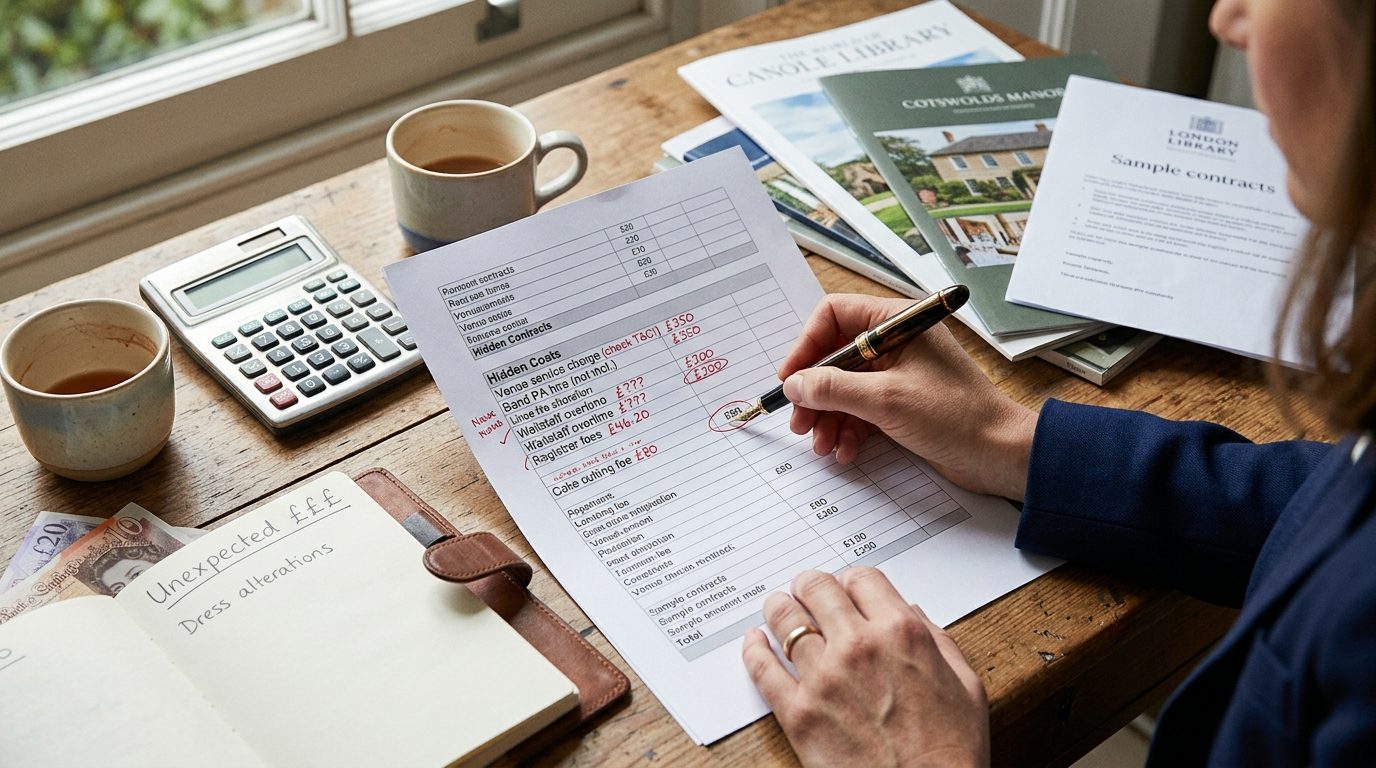
Create a line for each cost. “Miscellaneous” becomes a hiding place when it grows too large.
7. Pay with your eyes open
MoneyHelper explains that Section 75 may cover eligible credit-card purchases costing more than £100 and up to £30,000.
The protection can apply even when only the deposit went on the card. However, some payment intermediaries can break the required link.
Check the current guidance before paying. Ask your card provider if the route is unclear.
Keep the contract, invoice, payment confirmation and important messages together. Never send cash to an account changed by an unexpected email.

What to cut when the total stops working
Start with changes that remove a whole cost, rather than making every part slightly worse.
- Reduce the guest list.
- Change the day, season or ceremony time.
- Shorten coverage or simplify a package.
- Remove a low-priority extra completely.
- Ask for a revised quote before cancelling anything.
Do not borrow simply to match somebody else’s wedding. Guests remember warmth, food and how the day felt.
Your ten-minute budget reset
If the spreadsheet has become frightening, do this tonight:
- Write down the true total available.
- Add every contracted balance.
- Add known unbooked essentials.
- Keep the contingency separate.
- Cut one low-priority item if the total is negative.
Then stop. You have a plan again, which is far more useful than another hour of scrolling.
Sources
We opened these pages when checking the guide. Prices and rules can change, so follow the link before booking.
- MoneyHelper: saving money for a wedding — Independent guidance on setting a budget, saving and avoiding unaffordable borrowing. Checked 3 September 2026
- MoneyHelper: how to create your wedding budget — A practical budget process and prompts for discussing family contributions. Checked 3 September 2026
- MoneyHelper: Section 75 protection — Explains when credit-card purchases costing more than £100 and up to £30,000 may be protected. Checked 3 September 2026
- FCA: fraudulent payments and card protection — Consumer guidance on card payments, disputes and contacting your provider. Checked 3 September 2026
- GOV.UK: plan your marriage ceremony — Current statutory registrar fee for a register-office ceremony in England and Wales. Checked 3 September 2026
Keep planning
Frequently asked questions
How much should I budget for a UK wedding?
There is no correct national amount. Choose a figure you can save without missing bills, draining emergency savings or relying on expensive debt.
Who pays for a wedding in the UK?
There is no modern rule. Couples and families contribute in different ways, so agree each amount and any expectations before booking.
Does Section 75 protect wedding deposits?
It can protect eligible credit-card purchases. The cash price must exceed £100 and not exceed £30,000, although intermediaries can affect protection.
What wedding costs are easy to miss?
Several small costs are easily missed. Check VAT, travel, alterations, corkage, overtime, supplier meals, postage, insurance and ceremony certificates.