231,949
Marriages and civil partnerships in England and Wales, 2023
£20,604
Average UK wedding cost, Bridebook 2026
£613
Average spent by a guest per wedding, 2026
Key Takeaways
- ONS counted 231,949 marriages and civil partnerships in England and Wales in 2023, 8.6% fewer than in 2022.
- August is the busiest month (14.3% of marriages) and 41.9% of weddings are on a Saturday.
- The average wedding costs £20,604 (Bridebook) to £21,990 (Hitched). There is no official national figure.
- London weddings average £26,986, compared with £17,342 in the North West.
- Guests spent £613 per wedding in 2026, down from £692 in 2025.
- Humanist ceremonies made up about 30% of Scottish marriages in 2024.
Open source table
Download the cited figures
The CSV contains 15 official data points. Every row includes its jurisdiction, reference year, coverage note, source URL, release date and checking date.
How many weddings are there in the UK each year?
Each UK nation publishes its own marriage statistics on its own timetable. The latest final releases for Scotland and Northern Ireland cover 2024. The latest England and Wales release covers 2023.
| Jurisdiction | Reference year | Published figure | Official source |
|---|---|---|---|
| England and Wales | 2023 | 231,949 marriages and civil partnerships | ONS |
| Scotland | 2024 | 26,955 marriages | National Records of Scotland |
| Northern Ireland | 2024 | 7,251 marriages | NISRA |
The England and Wales total was 8.6% lower than in 2022. That comparison needs care, because ceremonies postponed during the pandemic boosted the preceding years. Opposite-sex marriages made up 216,901, or 93.5%, of all marriages and civil partnerships.
Scotland's latest quarterly figures point upwards. There were 6,458 marriages from October to December 2025, 5.2% above the average for that quarter (National Records of Scotland).
Why this is not a complete UK total
Adding releases from different periods can produce a number that looks current but is not genuinely comparable. This page gives the coverage beside every headline figure. We will only publish a combined UK total when the national datasets cover compatible periods and definitions.
When do UK couples get married?
Summer Saturdays dominate the wedding calendar. These are historic registration figures, not a forecast of future venue demand.
| Measure | Figure | Source |
|---|---|---|
| Most popular month | August: 32,121 marriages (14.3%) | ONS, England and Wales 2023 |
| Most popular day of the week | Saturday: 93,916 marriages (41.9%) | ONS, England and Wales 2023 |
| Busiest single date | Saturday 2 September 2023 | ONS, England and Wales 2023 |
| Largest regional share | South East, 16.1% | ONS, England and Wales 2023 |
| Most expensive month to marry | June: £23,809 average spend | Bridebook 2026 |
| Cheapest month to marry | January: £11,000 average spend | Bridebook 2026 |
Our guide to UK summer wedding months compares June, July and August in more detail.
How old are people when they marry?
| Jurisdiction | Men | Women | Measure |
|---|---|---|---|
| England and Wales, 2023 | 34.8 | 33.0 | Median age, opposite-sex marriages (ONS) |
| Scotland, 2024 | 40.0 | 37.8 | Mean age, all marriages (NRS) |
These figures are not directly comparable. A median is the middle value. A mean is pulled upwards by people marrying later in life, including remarriages. People aged 30 to 34 accounted for the largest number of both opposite-sex and same-sex marriages in England and Wales.
Civil, religious or humanist: how do couples marry?
Scotland shows what happens when humanist weddings are legal. They have been recognised there since 2005. In 2024, civil ceremonies accounted for 12,381 Scottish marriages (46%). Humanist ceremonies accounted for 8,142, about 30% of all marriages (National Records of Scotland).
Scotland also recorded 1,086 same-sex marriages in 2024. In England and Wales, female couples accounted for 59.8% of same-sex marriages in 2023 and male couples for 40.2%. ONS also recorded 6,179 opposite-sex civil partnerships and 1,368 same-sex civil partnerships.
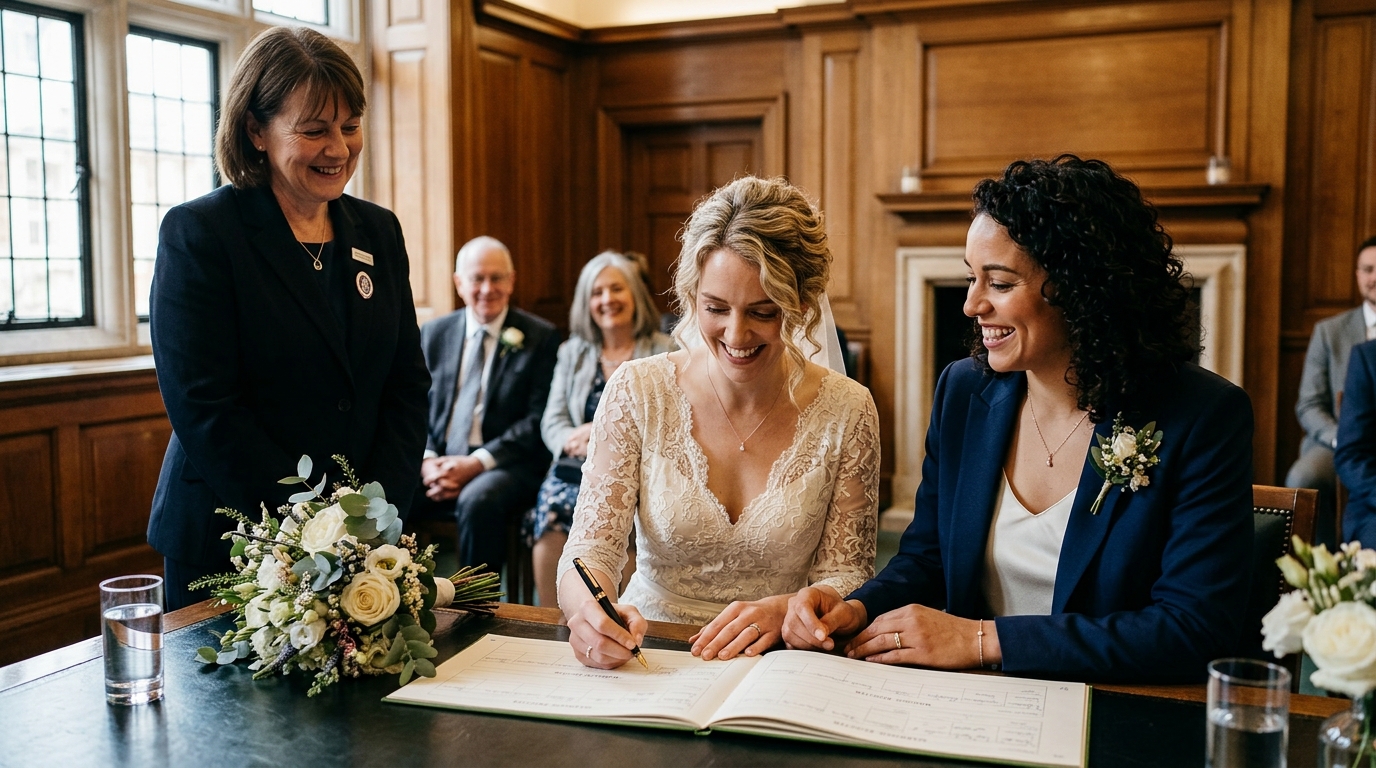
In England and Wales, a humanist ceremony has no legal standing yet, so couples also need a civil ceremony. Our guide explains whether humanist weddings are legal in England and Wales.
How much does a UK wedding cost?
There is no official national statistic for the average cost of a UK wedding. Spend figures come from commercial surveys, so the sample matters. The two largest UK surveys put the average just above £20,000. Both exclude the engagement ring and the honeymoon.
| Measure | Bridebook 2026 | Hitched 2026 |
|---|---|---|
| Average wedding cost | £20,604 | £21,990 |
| Average cost per guest | £278 | £272 |
| Couples surveyed | About 7,000 | 2,020 |
Hitched's January 2026 report adds detail on budgets and who pays (Hitched):
- 56% of couples overspent their budget in 2025. 32% stayed on budget and 6% came in under.
- Weddings with more than 100 guests cost £35,591 on average, nearly 40% above the overall average.
- Cost per guest rose 4%, from £261 in 2024 to £272.
- Millennial couples spent £23,612 on average. Gen Z couples spent £21,373, and 68% relied on parents to help pay.
- 61% of UK couples received money from family, compared with 40% in France, 39% in Italy and 35% in Spain.
We compare both surveys in our Hitched vs Bridebook cost guide. Our research methodology explains how Weddings Hub labels survey claims.
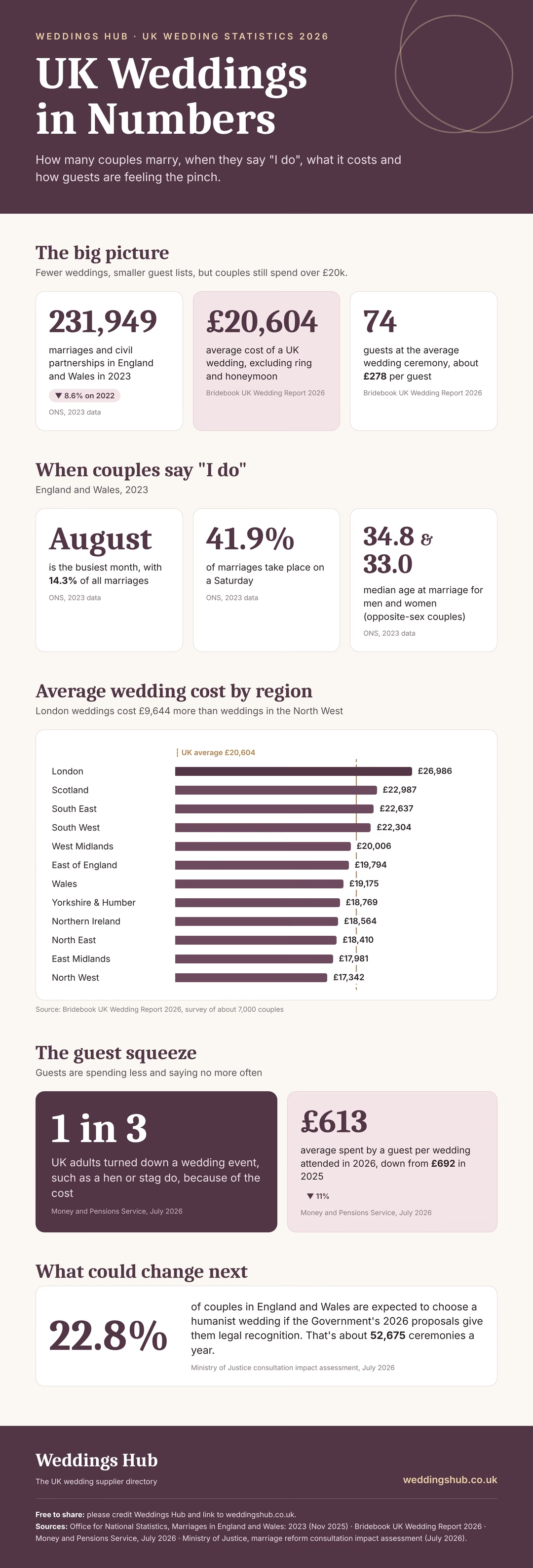
UK wedding statistics infographic
Share this infographic
You are welcome to use this infographic on your website or in your article. Please copy the code below so it credits Weddings Hub.
How much does a wedding cost in each region?
London weddings cost £9,644 more than weddings in the North West, according to Bridebook. Hitched reports a lower London figure and a higher one for the East of England, which shows how much survey samples vary.
| Region | Bridebook 2026 | Hitched 2026 |
|---|---|---|
| London | £26,986 | £24,622 |
| Scotland | £22,987 | £22,123 |
| South East | £22,637 | £23,589 |
| South West | £22,304 | Not published |
| West Midlands | £20,006 | Not published |
| East of England | £19,794 | £23,350 |
| Wales | £19,175 | Not published |
| Yorkshire and the Humber | £18,769 | Not published |
| Northern Ireland | £18,564 | Not published |
| North East | £18,410 | Not published |
| East Midlands | £17,981 | Not published |
| North West | £17,342 | Not published |
Scottish couples spend the most per guest, at £293 a head (Hitched). See our UK wedding cost by region guide for how to budget in your area.
How many guests come to a UK wedding?
The average wedding ceremony has around 74 guests, and 41% of receptions host fewer than 60 people (Bridebook). Bridebook also reports a sharp fall in evening guest numbers.
Hitched calls this shift "quality over quantity". Couples invite fewer guests but spend more on each one. Our guide to spend per wedding guest breaks this down.
How much does it cost to be a wedding guest?
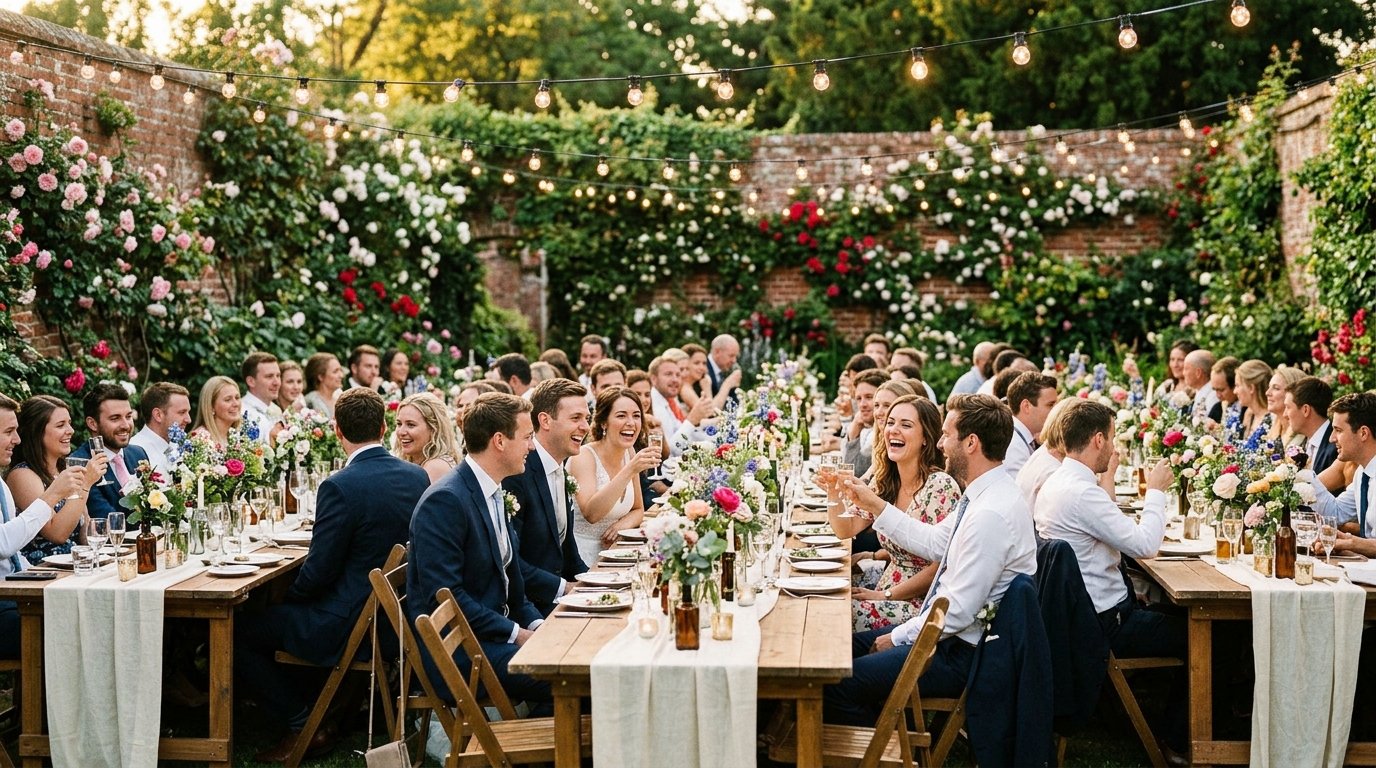
Guests are cutting back. The Money and Pensions Service published its latest survey in July 2026 (MaPS). It did not publish a sample size.
| Measure | 2025 | 2026 |
|---|---|---|
| Average spend per wedding attended | £692 | £613 |
| Average yearly spend on attending weddings | £2,000 | £1,200 |
| Weddings attended in the past 12 months | 3 | Just under 2 |
- One in three UK adults turned down a wedding event, such as a stag or hen do, because of the cost.
- Four in ten 25 to 34-year-olds declined at least one wedding-related event because of the cost.
How big is the UK wedding industry?
The number of UK wedding businesses is shrinking after 15 years of growth. This comes from an analysis of Companies House records by companydata.com.
- There are 6,720 active wedding businesses in 2026 so far: 2,990 wedding planners and 3,730 bridal shops.
- This is the first annual fall since records began in 2010. Wedding planners are down by 150, about 5%.
- The sector grew from 2,183 businesses in 2010 to 6,870 in 2025.
- Net growth peaked at 675 new businesses in 2018, then slowed every year to just 34 in 2025.
What could change for UK weddings?
On 16 July 2026 the Government opened a consultation on reforming marriage law in England and Wales. It includes legal recognition for humanist weddings. The Ministry of Justice impact assessment expects 22.8% of couples to choose one, about 52,675 ceremonies a year (Humanists UK).
The estimate is based on Scotland's experience since 2005. The reforms follow the Law Commission's July 2022 report on weddings law. If they pass, demand for wedding celebrants in England and Wales is likely to rise.
How couples can use the figures
National data can help with broad planning, but it cannot tell you what a venue or photographer has available on your date. Summer Saturdays are popular in the historic figures, so couples considering a similar date may want to begin enquiries earlier. A weekday or off-season date may offer more choice, although each supplier sets its own prices and calendar.
Dataset notes and reuse
The downloadable table is a transcription of selected official figures. It does not merge different reference years into a new UK total. Values remain attributed to the original statistical authority, and coverage notes explain what each row counts. Cost and guest figures on this page come from commercial and public-body surveys, and are labelled with their source.
The official source publications are released under public-sector reuse terms. Please cite the relevant statistical authority as the primary source. If you also reference this page, link to it so readers can see the checking date and any corrections.
Cite this page
Weddings Hub (2026). UK Wedding Statistics 2026. Available at: https://weddingshub.co.uk/uk-wedding-statistics/ (accessed 16 October 2026).
Press enquiries
Journalists can request the full dataset, extra regional figures or a comment from the Weddings Hub team.
editor@weddingshub.co.uk
Frequently Asked Questions
How many weddings take place in the UK each year?
There is no single directly comparable annual UK total. England and Wales recorded 231,949 marriages and civil partnerships in 2023. Scotland recorded 26,955 marriages in 2024 and Northern Ireland 7,251.
What is the average UK wedding cost?
Published surveys put it between £20,604 and £21,990. Bridebook reports £20,604 and Hitched reports £21,990 for 2026. There is no official national figure, and both exclude the ring and honeymoon.
What is the most popular month and day for a wedding?
August and Saturday. In England and Wales, 14.3% of 2023 marriages took place in August and 41.9% on a Saturday. Saturday 2 September was the single most popular date.
What is the average age to get married in the UK?
It is about 33 to 35 in England and Wales. Median ages in 2023 were 34.8 for men and 33.0 for women in opposite-sex marriages. In Scotland, mean ages in 2024 were 40.0 and 37.8.
How much does it cost to be a wedding guest?
Guests spent £613 per wedding in 2026. That is down from £692 in 2025, according to the Money and Pensions Service. One in three adults turned down a wedding event because of the cost.
Are humanist weddings legal in England?
Not yet. Humanist weddings are legal in Scotland and Northern Ireland. In England and Wales, couples still need a separate civil ceremony. The Government opened a consultation on changing this in July 2026.
Official sources: ONS, England and Wales 2023; National Records of Scotland, 2024; National Records of Scotland, Q4 2025; and NISRA, Northern Ireland 2024.
Survey and other sources: Bridebook UK Wedding Report 2026; Hitched Wedding Industry Report 2026; Money and Pensions Service, July 2026; Humanists UK on the Ministry of Justice impact assessment; and companydata.com.
Figures checked 16 October 2026. Download the official source table as CSV.