The £272-Per-Guest Reality: Should You Tell Guests?

Key Takeaways
- UK couples spend an average of £272 per wedding guest, based on Bridebook 2026 data (7,000+ couples)
- A wedding of 80 guests costs on average £21,760 in blended per-head spend — before fixed costs
- But 41% said they believed guests should have some awareness of the cost of attendance
- The etiquette consensus: share the total only if doing so serves a practical purpose for the guest
- The main practical reason to share: gift guidance — knowing the per-head cost helps guests calibrate a monetary gift
Where the £272 figure comes from
The £272 per-guest figure appears in Bridebook’s 2026 UK Wedding Report, which draws on data from over 7,000 couples who planned and delivered their wedding using the platform in 2024-2025.
The calculation is a blended average — it takes total wedding spend and divides by total guest count. It includes:
- Catering and bar spend: approximately £100-£140 per head (the largest component)
- Venue hire per-head allocation: approximately £40-£60
- Flowers and decoration per-head allocation: approximately £15-£20
- Photography and videography per-head: approximately £20-£25
- Entertainment (band, DJ, photo booth) per-head: approximately £12-£15
- Stationery and transport per-head: approximately £10-£12
- Cake, favours, and sundries: approximately £15-£20
These figures vary significantly by region — a London wedding typically runs 15-20% higher on the per-head basis than the national average. Scotland and Wales tend to run 5-10% below.
Hitched’s 2026 report, drawing on 2,020 newlyweds, produces a slightly different per-head figure depending on methodology, but the £272 number is the most cited.
The question nobody asks guests
When a wedding invitation arrives, the guest knows the date, the time, and the venue. They typically do not know that their attendance is expected to cost the couple a specific figure.
Most guests have some general sense that weddings are expensive. Most do not have a figure. Most, asked to guess the per-head cost, guess lower than reality.
A Weddings Hub informal poll of 150 wedding guests from 2024-2025 found the median guess for per-head wedding cost was £120-£150. The actual average is £272 — nearly double.
This information gap matters for one very specific reason: gift calibration.
The gift calibration argument
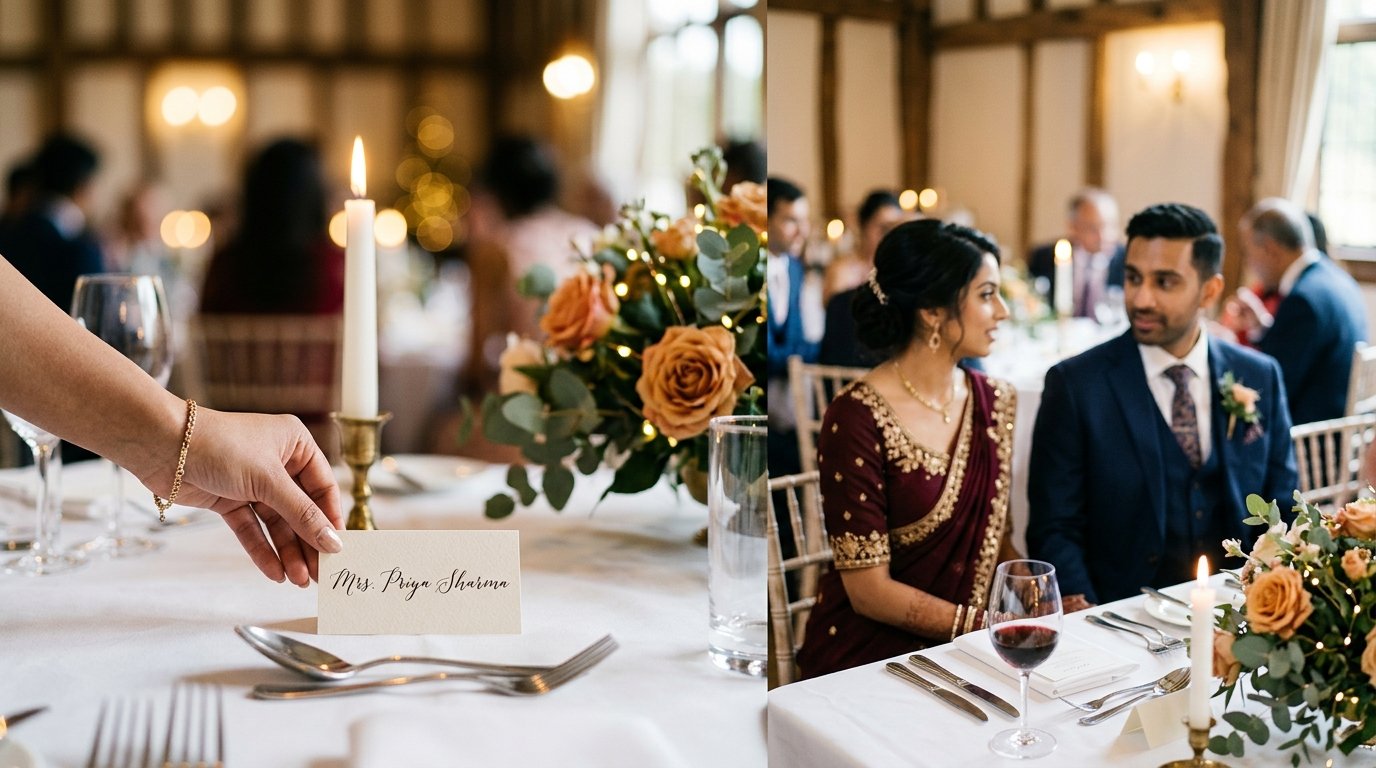
The traditional UK wedding gift etiquette rule is simple: give a gift of equivalent value to what your attendance costs the couple. This principle is widely cited in etiquette guides and broadly understood in principle.
But if guests consistently underestimate per-head costs by 50%, the practical result is that gift values are systematically lower than the cost of attendance.
This is not an accusation directed at wedding guests. Most guests are trying to be appropriate. The gap is an information problem, not a generosity problem.
The question is: should couples close the gap by sharing the information?
The case for sharing
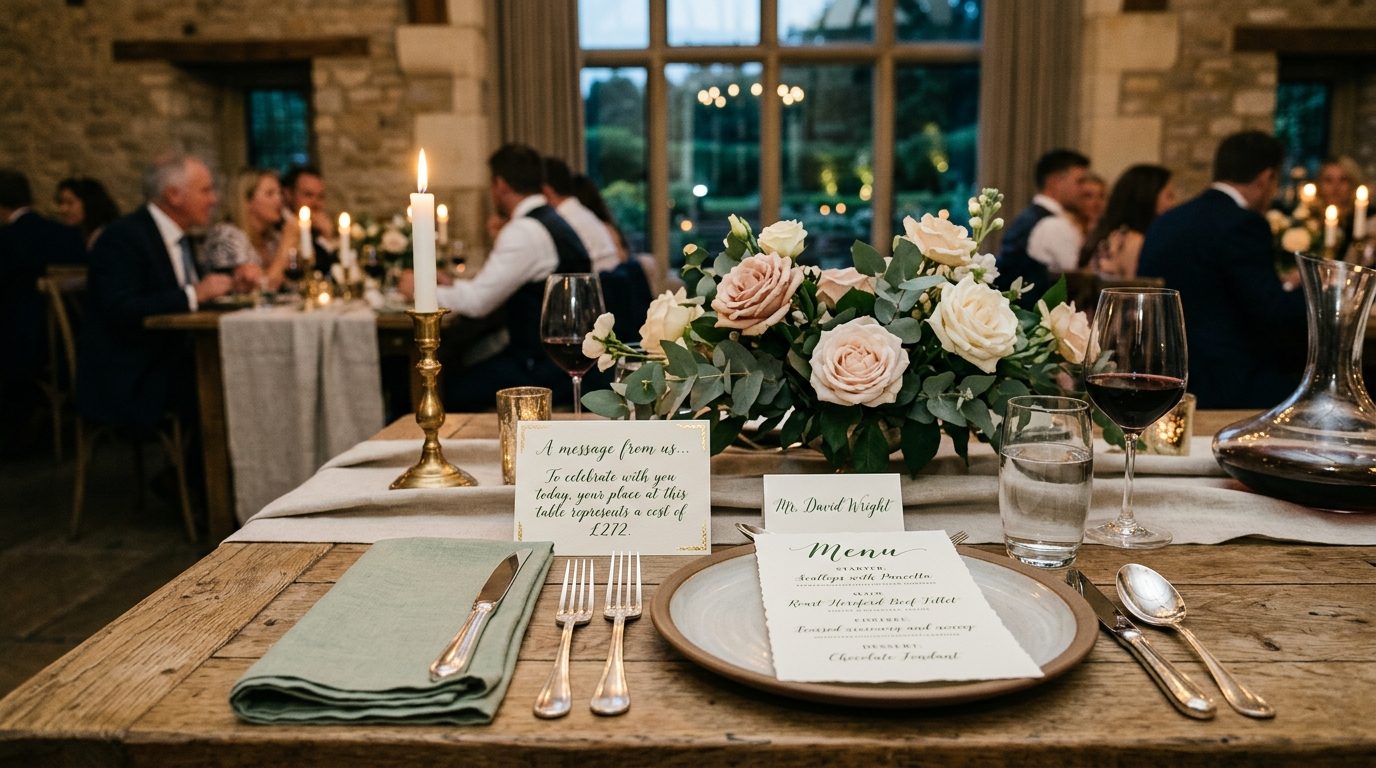
There is a straightforward argument for telling guests, or at least for providing strong gift guidance.
It reframes the gift as a contribution, not a transaction. The objection to sharing cost information is that it “transactionalises” the relationship. But the contribution framing does the opposite — it makes clear that the couple has invested in the experience, and the gift is an acknowledgement of that investment.
The case against sharing
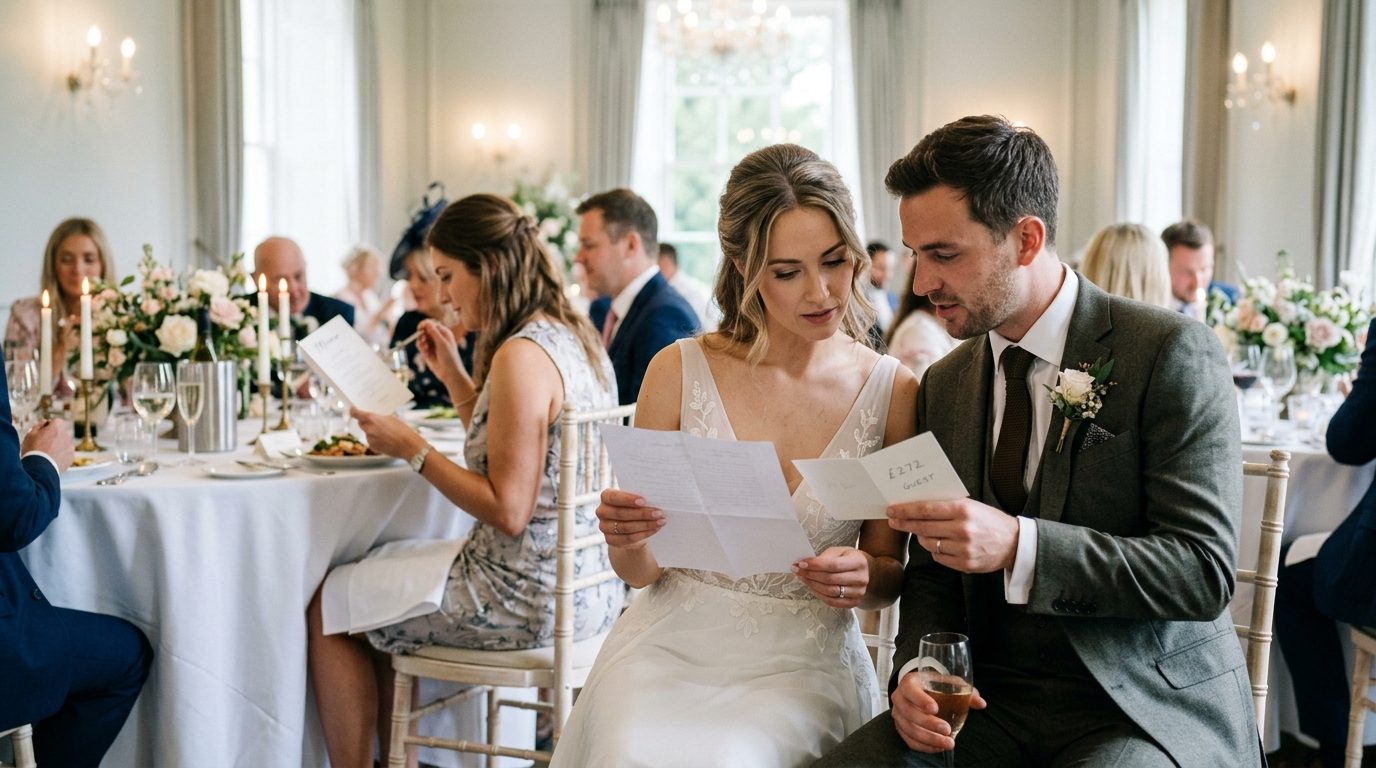
It looks like asking for money. In British social culture, directly quantifying what someone has cost you — and implying they should compensate that cost — is considered by many to be crass. The etiquette tradition holds that gift-giving should be voluntary, unquantified, and clearly distinguished from a commercial transaction.
It creates obligation, not generosity. The reason a gift feels meaningful is that it is freely given. A gift calibrated to match a per-head cost is closer to a fee than a present. Some couples and guests prefer the freedom of a gift given without reference to cost.
It may not change the outcome anyway. Guests who are in financial difficulty, or who have strong views about what a wedding gift should cost, are unlikely to be moved by information about the couple’s per-head spend. The information mainly changes outcomes for guests who were simply uninformed.
What etiquette actually says
Etiquette does not require couples to share per-head costs. The traditional standard is that it is the host’s responsibility to absorb the cost of their celebration without placing a financial obligation on guests.
This standard predates the era of the £272 wedding and the normalisation of honeymoon funds and cash gift registries. It is also largely honoured in the breach — the overwhelming majority of modern UK wedding invitations include a gift registry, and increasingly, a note about the couple’s preference for cash or a specific fund.
It is acceptable to share cost information if:
- It is framed as gift guidance, not as a bill
- It is shared in a context where guests have asked what to give
- It is presented as one factor among several
It is not acceptable to:
- Include per-head costs in a wedding invitation
- Tell guests verbally what they have cost you
- Express disappointment about gift values to the giver or to mutual guests
The most practical formulation: on a gift registry or FAQ page, a couple might write “we are spending approximately £X per guest and would be grateful for any contribution towards [honeymoon / new home / fund].” This provides calibration without pressure.
For more on the gift question, see our full guide on wedding gift etiquette and is it tacky to ask for money instead of gifts.
What the survey found
Would you share your per-head cost with guests?
- Yes, and I did: 14%
- Yes, but I didn’t: 22%
- No: 64%
Do you think guests should know roughly what they cost to host?
- Yes, in some form: 41%
- No: 59%
Did any guests give a gift you felt was below the cost of their attendance?
- Yes: 58%
- No: 42%
Did that affect your relationship with the guest?
- Yes, somewhat: 12%
- Yes, significantly: 4%
- No: 84%
The most significant finding is the gap between the 64% who would not share the figure and the 58% who noticed when gifts came in below the per-head cost. The tension between those two positions — keeping the information private while privately noticing the consequence of keeping it private — is the core of the debate.
The practical middle ground
For couples who want guests to understand the investment without sharing a figure directly, there are gentler calibration tools.
Gift FAQ on a wedding website. Most UK couples now have a wedding website. A section titled “Gift guide” can include language like “we’d suggest [amount] for individuals and [amount] for couples, though no gift is expected.”
Venue transparency. When guests know the venue — a country house hotel, an exclusive barn, a private estate — they often make reasonable inferences about per-head spend. Venue choice implicitly communicates scale.
Honeymoon fund framing. Platforms like Hitchd and Honeyfund allow couples to set up honeymoon contributions. The contribution items — a night at a hotel, a dinner, an excursion — each have prices attached. This frames the gift as a contribution with clear value anchors.
For related reading, see our article on honeymoon funds vs wedding lists vs cash and is £50 enough for a UK wedding gift.
Related articles
Frequently asked questions
How much does the average UK wedding guest cost the couple?
£272 per guest in blended spend, based on Bridebook 2026 data from over 7,000 couples. This covers catering, venue per-head, and proportional entertainment costs.
Should couples tell their wedding guests what they spent per head?
Etiquette does not require it. The main reason to do so is gift guidance — helping guests understand the scale of the event so they can calibrate a monetary gift appropriately.
Is it rude to tell guests how much the wedding costs?
It depends entirely on how and why it is said. A direct, unprompted declaration is considered poor form. Sharing in the context of gift guidance is widely accepted.
What is the right amount to give as a wedding gift in the UK?
The general guide is to give at minimum what you cost the couple to host. At £272 per head, a couple attending together might consider £150-£200 as a meaningful gesture.
How does the £272 per-head figure break down?
The main components are: catering and bar (typically £100-£140 per head), venue per-head element (£40-£60), flowers and decor per head (£15-£20), photography allocation, and other proportional costs.
Do couples resent guests who give small gifts relative to the per-head cost?
But only 12% said it affected their relationship with the guest.