Home / Articles / Costs & Budget
56% of UK Couples Overspend Their Wedding Budget
Key Takeaways
- 56% of UK couples overspent their wedding budget in 2025, according to Hitched's survey of 2,020 newlyweds
- The average overspend is £4,800 — equivalent to a full additional supplier
- Only 32% of UK couples stayed on budget; just 6% came in under their original figure
- Guest count creep is the #1 cause of overspend, cited by 37% of over-budget couples
- The second most common cause is catering upgrades (31%), followed by last-minute supplier changes (22%)
- Booking 18+ months ahead locks in 2025 supplier rates and reduces the risk of emergency premium pricing
More than half of all UK couples spend more on their wedding than they planned to. Hitched’s 2026 survey of 2,020 UK newlyweds found 56% overspent their original budget. The average overspend is £4,800. Only 32% of couples delivered a wedding that matched their budget. Just 6% came in under. The numbers are consistent across three years of Hitched data. Overspend is not a planning failure. It is the normal outcome of planning a wedding in the UK. The question is whether you plan for it or get surprised by it.
By Matt, Editor at Weddings Hub. I’ve tracked UK wedding cost data across the major annual reports since 2018. This article draws on Hitched’s 2026 survey of 2,020 newlyweds, the Bridebook UK Wedding Report 2026 (7,000+ couples), and independent overspend analysis from For Better For Worse’s 2025 industry survey. All figures are in GBP.
The 56% figure: where it comes from
Hitched (the UK arm of The Knot Worldwide) publishes an annual post-nuptials survey of UK newlyweds. The 2026 release, covering weddings that took place in 2025, drew on 2,020 responses. Respondents were asked about their initial budget target and their actual final spend. 56% reported spending more than their initial target. 32% matched their target. 6% came in below.
The remaining 6% had no initial budget target and were excluded from the overspend calculation.
Bridebook’s data from a larger sample (7,000+ couples, including in-progress planners) is less directly comparable on overspend percentage because mid-plan couples may not yet have discovered their overspend. But For Better For Worse’s independent survey, which focuses on couples who completed their weddings in 2024-2025, puts the overspend rate at 54%, within 2 percentage points of Hitched’s figure.
The figure is consistent across three years of data. The 2024 Hitched report put the overspend rate at 53%. The 2025 report showed 55%. The 2026 report shows 56%. The trend is a very slow upward drift, not a dramatic shift.
What the average overspend of £4,800 looks like in context
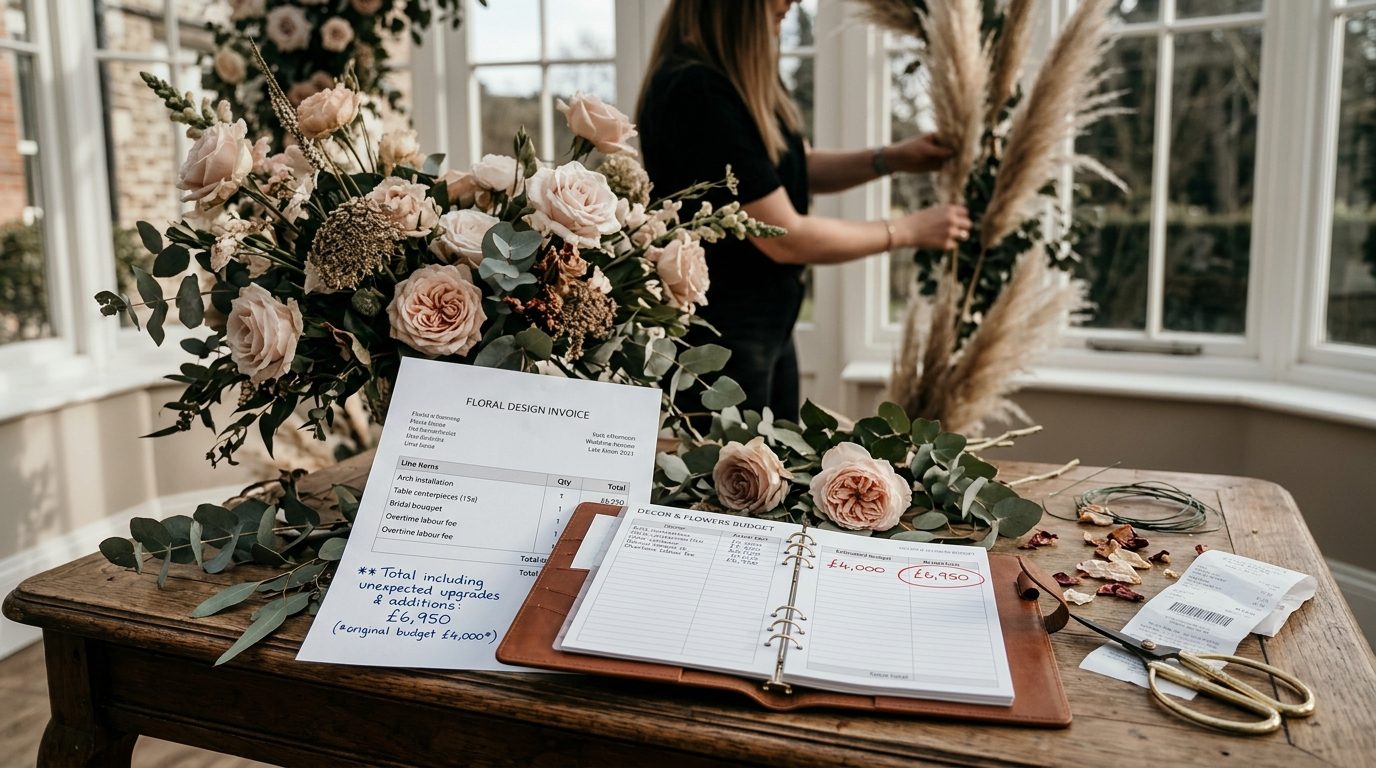
An average overspend of £4,800 on an average UK wedding budget of approximately £17,000-£18,000 (the typical pre-booking target, before the full scope is added) is an overspend rate of around 24-27%.
To frame this differently: £4,800 is more than the average cost of UK wedding photography (£2,060), more than the average spend on attire for both partners (£2,267), and close to the average total spend on all flowers (£1,030), all entertainment (£1,030) and all stationery, transport and decor combined (£1,442).
The overspend is not a rounding error. It is the equivalent of one complete additional supplier category that the couple did not budget for.
The three main causes of wedding budget overspend
Hitched’s 2026 data includes a breakdown of causes. Couples who overspent were asked to identify the primary driver. Three causes account for 90% of all citations.
1. Guest count creep (37% of over-budget couples)
The most common cause. Couples begin the planning process with a target guest count, then add people as the guest list negotiations proceed.
The pattern is well-documented. Initial plan: 80 guests. First revision, after family pressure: 90 guests. Second revision, after recounting the extended family: 98 guests. Final day count: 105 guests.
Each additional guest adds approximately £272 in blended per-head cost. Adding 25 guests to an original 80-person list is an additional £6,800. This single change, which happens in stages and feels incremental at each decision point, accounts for a £6,800 overspend on its own.
The problem is compounded because caterer contracts are signed early, based on the initial count. Most contracts allow increases at the final confirmation stage. Very few allow significant reductions without penalty. Couples who start at 80 and end at 105 often pay full rates for 105 guests, while couples who started at 80 and needed to reduce to 65 still pay for 80.
Fix: Fix the guest list before signing any supplier contract. Treat the final guest count as a budget ceiling, not a starting estimate. Use a spreadsheet, not a mental list. If family pressure is a known force, build a 10% buffer above your preferred count as your ceiling.
2. Catering upgrades (31% of over-budget couples)
The second most common cause. Catering is typically quoted early in the booking process at a standard package rate. Over the following months, couples make incremental changes:
- Upgrading from a two-course to a three-course meal: typically £18-28 per head additional
- Adding canapes for the arrival drinks: typically £12-20 per head additional
- Upgrading the bar package from a set allocation to an open bar: typically £25-40 per head additional
- Adding a late-night food station (pizza van, cheese board, chip cart): typically £10-18 per head additional
Each upgrade looks small in isolation. Three upgrades on a 90-guest wedding can add £4,050-£7,740 to the original catering quote. The quote line in the spreadsheet is not updated after each conversation. The final invoice is the first time the full effect is visible.
Fix: Lock the catering specification in writing after each decision. Every change to the package should be confirmed by email, with the new per-head rate specified. Run the running total against your catering budget cap monthly, not just at the final invoice.
3. Last-minute supplier changes (22% of over-budget couples)
The third most common cause. This covers two distinct situations.
Supplier failure: a photographer, caterer, cake maker or other supplier cancels or goes out of business. Replacement suppliers booked within 3-6 months of the date typically charge a premium of 15-40% above market rates. They also have limited availability, which reduces negotiating options. The couple pays whatever is available.
Couple-driven change: the couple decides to upgrade or replace a supplier after the initial booking. Cancelling a booking typically incurs a penalty of 25-50% of the original fee. Adding a new supplier at full price means the couple has effectively paid for the same function twice.
Fix: Buy wedding insurance (from around £79 for a policy covering up to £30,000 in supplier costs). Insurance covers supplier failure but not couple-driven changes. For couple-driven changes, the fix is a 60-day cooling-off rule: any planned change to a supplier must be discussed but not acted on for 60 days. This prevents impulse upgrades that look attractive in the moment.
The cost categories where couples overspend most

Beyond the three primary causes, Hitched’s data shows specific categories where couples consistently underestimate costs.
| Category | Average budgeted | Average actual spend | Overshoot |
|---|---|---|---|
| Catering | £5,200 | £6,800 | +31% |
| Photography | £1,650 | £2,060 | +25% |
| Flowers | £850 | £1,030 | +21% |
| Entertainment | £920 | £1,030 | +12% |
| Attire | £2,050 | £2,267 | +11% |
| Venue hire | £3,550 | £3,710 | +5% |
| Stationery + transport + decor | £1,150 | £1,442 | +25% |
Catering overshoots by the largest amount in absolute terms. Photography overshoots by 25%, often because couples book at the lower end of the available range and then decide mid-planning to upgrade to a photographer whose work they prefer. Flowers overshoot due to scope creep: initial quotes often cover ceremony and top table only; couples later add pew ends, buttonholes and dessert-table arrangements.
Why the 10% contingency advice is wrong
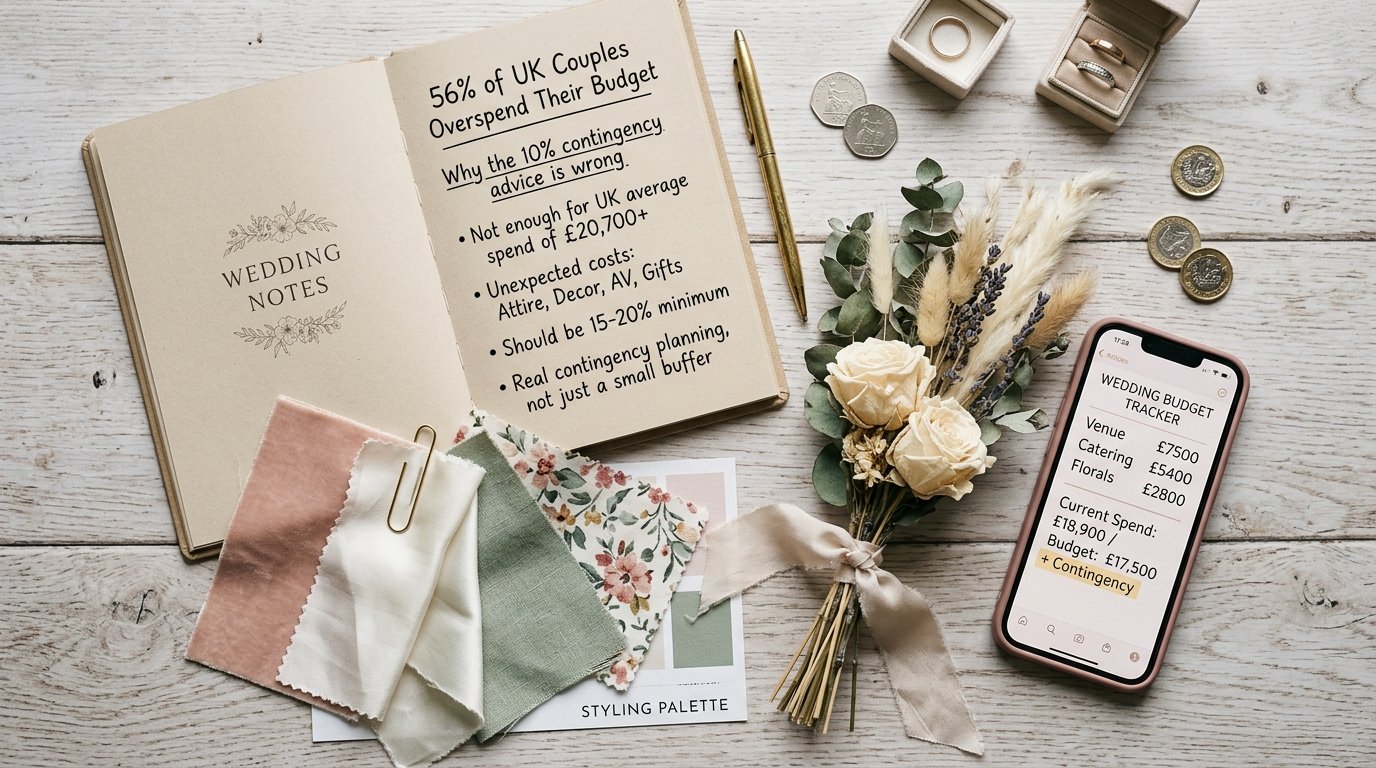
Most wedding planning articles advise a 10% budget contingency. At the national average of £21,990, that is £2,199 in reserve. The actual average overspend is £4,800. A 10% contingency covers the first half of a typical overspend and leaves £2,600 that the couple either borrows or finds from elsewhere.
A 15% contingency at £21,990 is £3,299. This covers more of the average case but still falls short of £4,800 by £1,501.
A 20% contingency covers the average overspend almost exactly (£4,398 vs £4,800 average). But building 20% into a wedding budget effectively means planning a £21,990 wedding on a £18,325 base, which limits choices significantly.
The practical resolution is a two-stage contingency:
Stage 1: Add 15% to the base budget before booking anything. This is the “known unknown” fund: the caterer upgrade you will almost certainly make, the extra guests you will almost certainly add.
Stage 2: Keep a further £1,500-2,000 liquid but unallocated. Do not add this to the spreadsheet total. It is the “unknown unknown” fund: supplier failure, the tab the parents run at the bar, the last-minute transport issue.
Together, stage 1 and stage 2 cover the average UK overspend of £4,800 without requiring the couple to increase their visible budget by 20%.
How to set a budget that reflects reality
Most couples set their initial budget before they have any supplier quotes. The first quote almost always exceeds the budget. This is a feature of the market, not a planning failure.
The approach that produces the most accurate initial budget:
- Get 3 quotes for the venue, the caterer and the photographer before setting any other budget line. These three items account for 61-64% of total spend.
- Use the mid-range quote for each, not the lowest. The lowest quote often has exclusions that become paid extras later.
- Add all other categories at their national average (available in our wedding budget breakdown).
- Apply a 15% contingency to the total.
- If the 115% total exceeds your available funds, decide which categories to cut before booking anything, not after.
This sequence prevents the common pattern of booking a venue and caterer at a price that already consumes 90% of the budget, then discovering there is nothing left for photography.
Related articles
Frequently asked questions
What percentage of UK couples overspend their wedding budget?
56% of UK couples overspend, based on Hitched's 2026 survey of 2,020 newlyweds. Only 32% stay on budget. The majority outcome is overspend, not on-budget delivery.
By how much do UK couples typically overspend their wedding budget?
The average overspend is £4,800, according to Hitched 2026 data. This is on a base budget that itself averages £17,000-£18,000 before the couple begins adding extras — an overspend rate of around 24-27%.
What is the main cause of wedding budget overspend in the UK?
Guest count creep is the most common cause, cited by 37% of couples who overspent. Each additional guest costs roughly £272 in blended spend, so adding 20 uninvited guests adds £5,440 to the total.
How can couples avoid overspending their wedding budget?
Fix your guest list before booking any supplier. Build a 15% contingency into the initial budget. Use a budget tracker that shows running totals against category caps. Avoid signing contracts without reading the extras and upgrades clauses.
Is it normal to overspend your wedding budget?
Yes — 56% of couples do. It is the majority outcome. Building a realistic contingency (15%, not 10%) into the original budget means overspend is absorbed rather than becoming a debt.
What is the 15% wedding budget contingency rule?
The 15% contingency rule says to add 15% to your wedding budget total before you start booking. On a £20,000 plan, that means holding £3,000 in reserve. Most couples who follow this rule stay out of debt even when they overspend the base figure.