How to Write Your Own Wedding Vows UK
Personal wedding vows are permitted at all celebrant-led ceremonies in England and Wales with no word restrictions. At civil (registrar) ceremonies, couples must include the legal declaratory and contracting words but can add personal statements before and after. WeddingsHub's 2026 survey of 200 UK couples found 63% wrote personal vows; 41% found writing them harder than expected; the average personalised vow runs 180 words, delivered in around 90 seconds.
Key Takeaways
- Personal vows allowed at all celebrant ceremonies — no word count or content restrictions
- Civil ceremonies: legal words must be included, personal additions permitted before and after
- Average personal vow length: 180 words — about 90 seconds when spoken aloud
- 63% of UK couples in 2026 wrote personalised vows, up from 44% in 2020
- Registrars must approve any additional text at a civil ceremony in advance — usually 4 weeks before
- The most common mistake: writing for the page, not for speaking aloud
Writing your own wedding vows is one of the most searched wedding topics in the UK — and one of the most under-prepared. WeddingsHub’s 2026 survey of 200 UK couples found that 63% wrote personal vows, but 41% found the process harder than expected. This guide covers what UK law actually allows, how to structure vows that work when spoken aloud, and 25 examples you can adapt.
By Matt, Editor at WeddingsHub. Based on WeddingsHub’s 2026 survey of 200 UK couples who wrote personalised vows, celebrant interviews, and guidance from the General Register Office on civil ceremony word requirements.
What UK law actually allows
There are two completely different rules depending on your ceremony type.
Celebrant ceremonies have no legal content restrictions whatsoever. You can write whatever you want — personal stories, promises, poetry, song lyrics, jokes. The legal marriage is completed separately at a register office appointment (usually a low-key signing of a marriage schedule). The celebrant ceremony is the emotionally significant event; the legal paperwork is administrative.
Civil (registrar) ceremonies have one legal requirement: you must include the declaratory and contracting words. These are fixed by the Marriage Act 1949 and cannot be changed:
- Declaratory words: “I do solemnly declare that I know not of any lawful impediment why I [full name] may not be joined in matrimony to [full name].” Or the shorter alternative: “I [name] know of no legal reason why I may not be married to [name].”
- Contracting words: “I call upon these persons here present to witness that I [name] do take thee [name] to be my lawful wedded wife/husband.” Or alternatively: “I [name] take you [name] to be my wedded wife/husband.”
Beyond those legal words, registrars in England and Wales permit personal additions before and after. You must submit the full text 4 weeks before the ceremony. Religious content is not permitted at a civil ceremony — this includes explicitly religious promises, scripture, or references to God.
Why 41% find it harder than expected
The survey finding that 41% of couples found personal vow-writing harder than expected breaks down into three specific problems:
- Starting with a blank page. Most couples have never written a speech or public statement before. The blank page problem is real.
- Writing for reading, not speaking. Vows that look elegant on paper can sound wooden when read aloud in front of 100 people.
- Not knowing when to stop. The urge to include every shared memory, inside joke, and meaningful moment produces vows that run to 500+ words and lose the room after the first 90 seconds.
The solution to all three is the same: structure first, content second, then read it aloud.
The structure that works
Most successful personal vows follow one of two patterns:
Pattern 1: Past-Present-Future
- One or two sentences about how you met or a moment that defined the relationship.
- One or two sentences about what they mean to you now.
- Three to five specific promises.
- One closing line.
Pattern 2: Because-Therefore-Promise
- “Because you are [specific quality 1], [specific quality 2], [specific quality 3]…”
- “I choose you above everyone.”
- Three to five specific promises.
- One closing line.
Both patterns work because they have a clear shape. Guests — and the person receiving the vows — can follow the emotional arc even through tears.
The three rules for vows that work
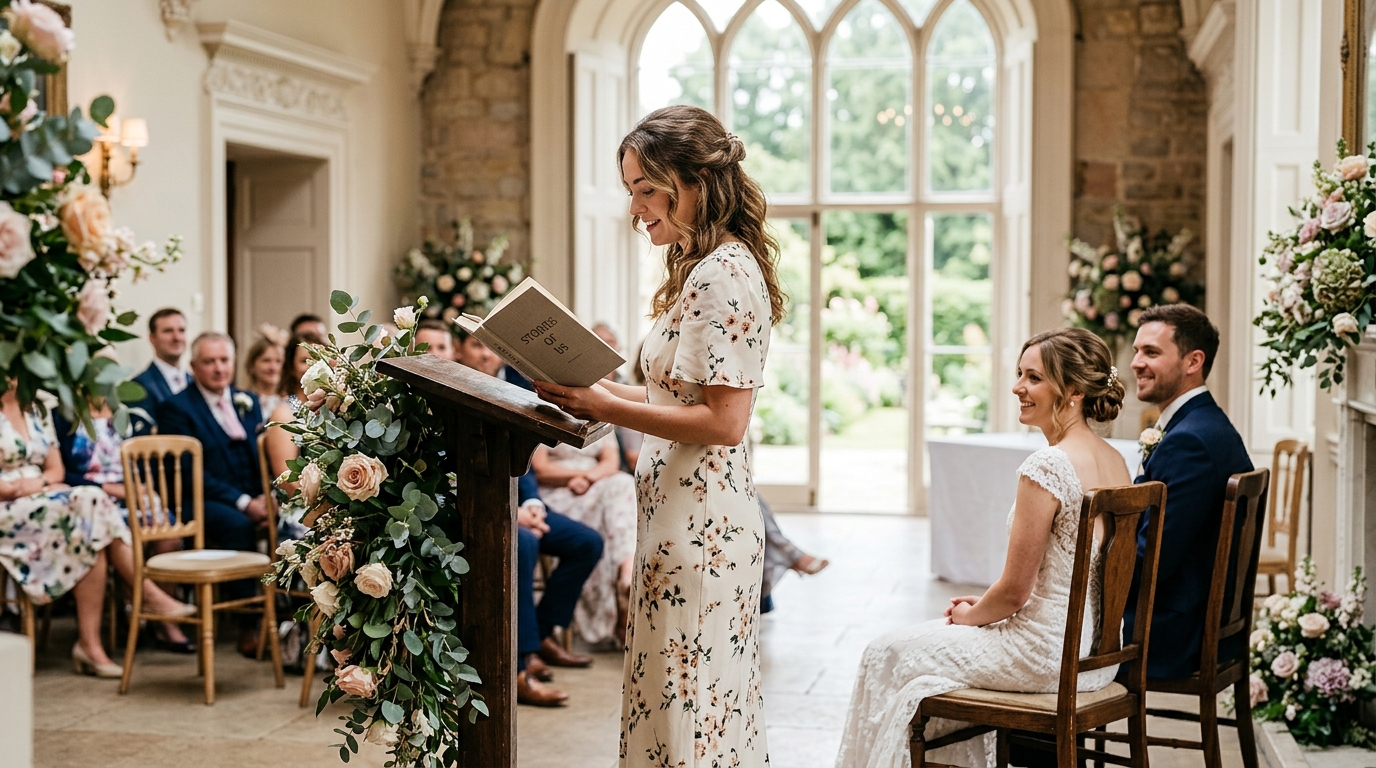
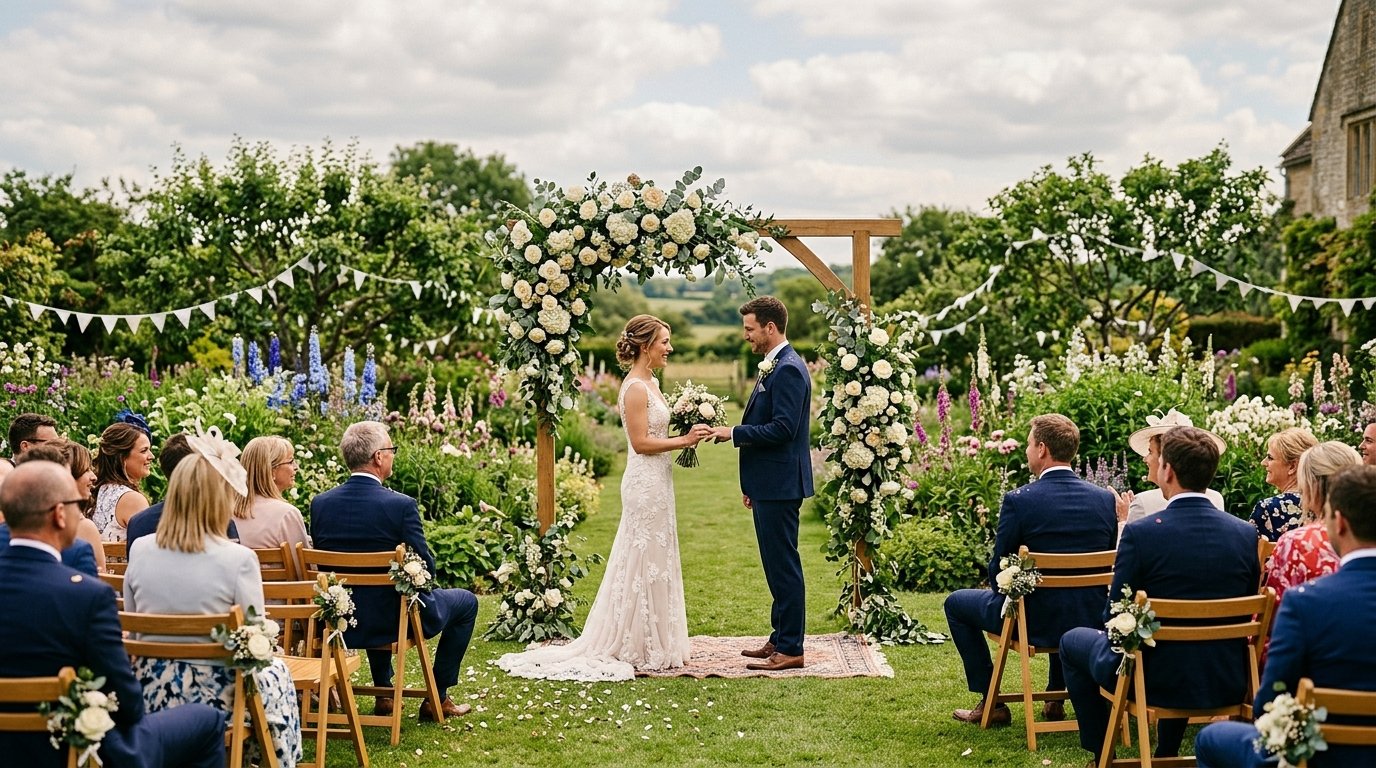 Rule 1: Specific beats general. “I promise to always be by your side” is generic. “I promise to sit with you through every Liverpool away defeat and pretend it doesn’t hurt as much as it does” is specific. Specifics produce the genuine laughter and tears that make ceremony moments memorable.
Rule 2: Speak in your own voice. If you do not normally use words like “boundless” or “henceforth” in conversation, do not put them in your vows. Elevated language that does not match how you actually speak sounds performative when read aloud.
Rule 3: Read it out before the day. Read your vows aloud, timed, at least once a week for three weeks before the wedding. You will find where the rhythm breaks, where you run out of breath, and which words are harder to say under emotion than you expected.
25 examples — adapt these, do not copy them verbatim
These are starting points. Change the specific details to match your relationship.
Openings
- “I never planned to fall for someone who [specific quirk]. And yet.”
- “When [specific memory], I knew I was already halfway to marrying you.”
- “I have loved you since before I knew I was doing it.”
- “You are the person I call first. That is not a small thing.”
- “When I imagine my life, I cannot imagine it without the specific mess of it that you bring.”
Middle sections (qualities and reasons)
- “You are patient when I am not. You are steady when I panic. You laugh at things that do not deserve a laugh and mean it.”
- “You taught me that [specific lesson] — which is not the lesson I expected to learn from dating someone who [characteristic].”
- “I love that you [specific habit]. I know that is unlikely to make sense to anyone in this room except you.”
- “You have seen me at [specific low moment] and still chose to stay. That is the version of love I did not expect.”
- “You make ordinary [Tuesday evenings / Sunday mornings / supermarket trips] feel worth having.”
Promises
- “I promise to always tell you when you have food in your teeth. Even in public.”
- “I promise to be the person who remembers which restaurant you said was better than expected.”
- “I promise to argue with you honestly rather than pretend everything is fine.”
- “I promise to choose us even on the days when choosing us is harder than I planned.”
- “I promise to let you be right sometimes — even when you are wrong — because you nearly always come round on your own.”
- “I promise to keep making you [specific thing] on [specific occasion].”
- “I promise to be your biggest champion in every room you are not in.”
- “I promise to grow alongside you rather than assume we will always want the same things.”
- “I promise to ask before I make decisions that affect us both — and to mean it, not just say it.”
- “I promise to still be curious about you in twenty years.”
Closings
- “I am ready. Let’s go.”
- “You have already changed me. I am grateful to be changed by you.”
- “I would choose you again. In every version of this.”
- “Thank you for saying yes. I intend to make it worth your while.”
- “I love you. That is the whole of it.”
What to avoid
- Other people’s weddings. Your vows should not sound like a Pinterest compilation.
- Inside jokes that only you understand. One is charming; three starts to exclude guests.
- Promises you cannot keep. “I promise to never make you angry” will be tested within six months.
- Reading from your phone. Print on card stock. Hands shake less when holding something solid.
- Apologising for crying. Emotion is appropriate. Apologising for it interrupts the flow.
The format for civil ceremony additions
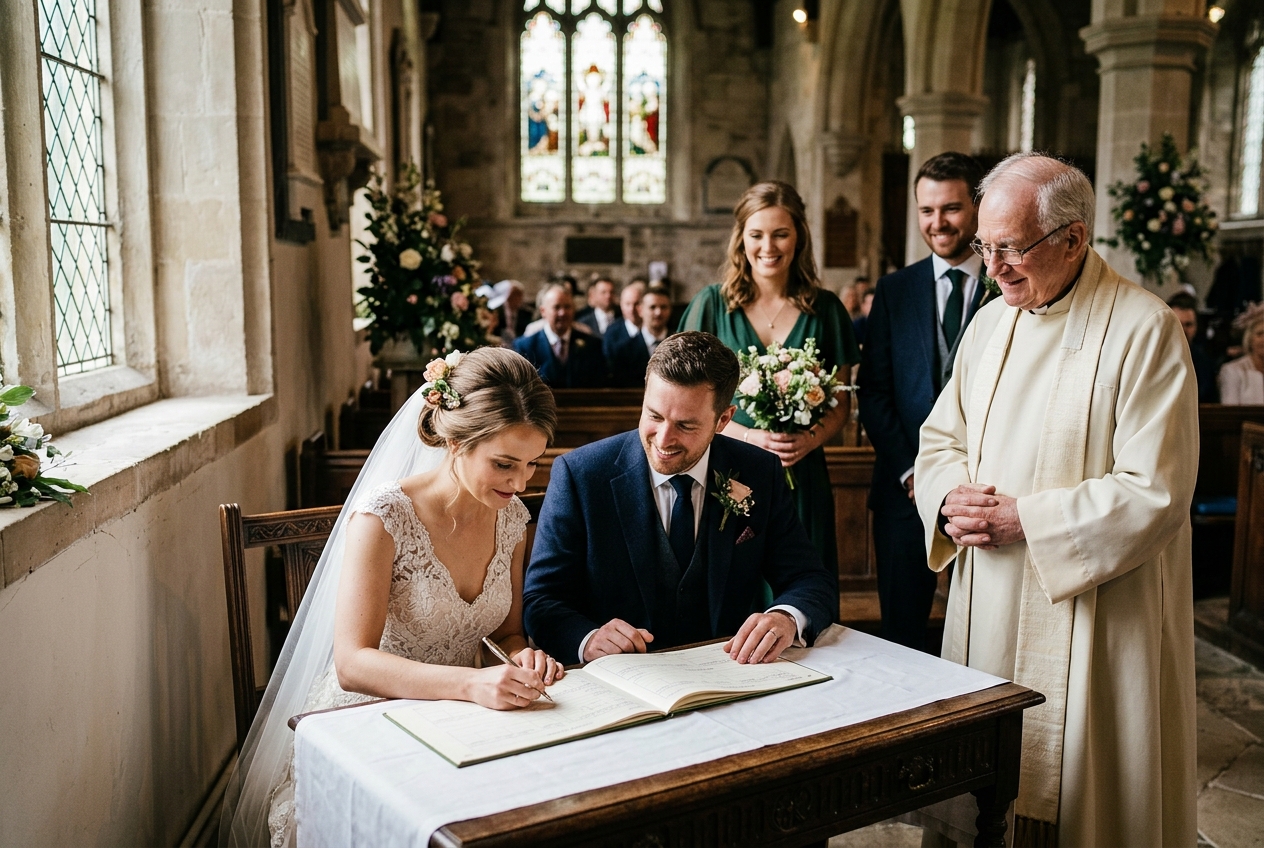
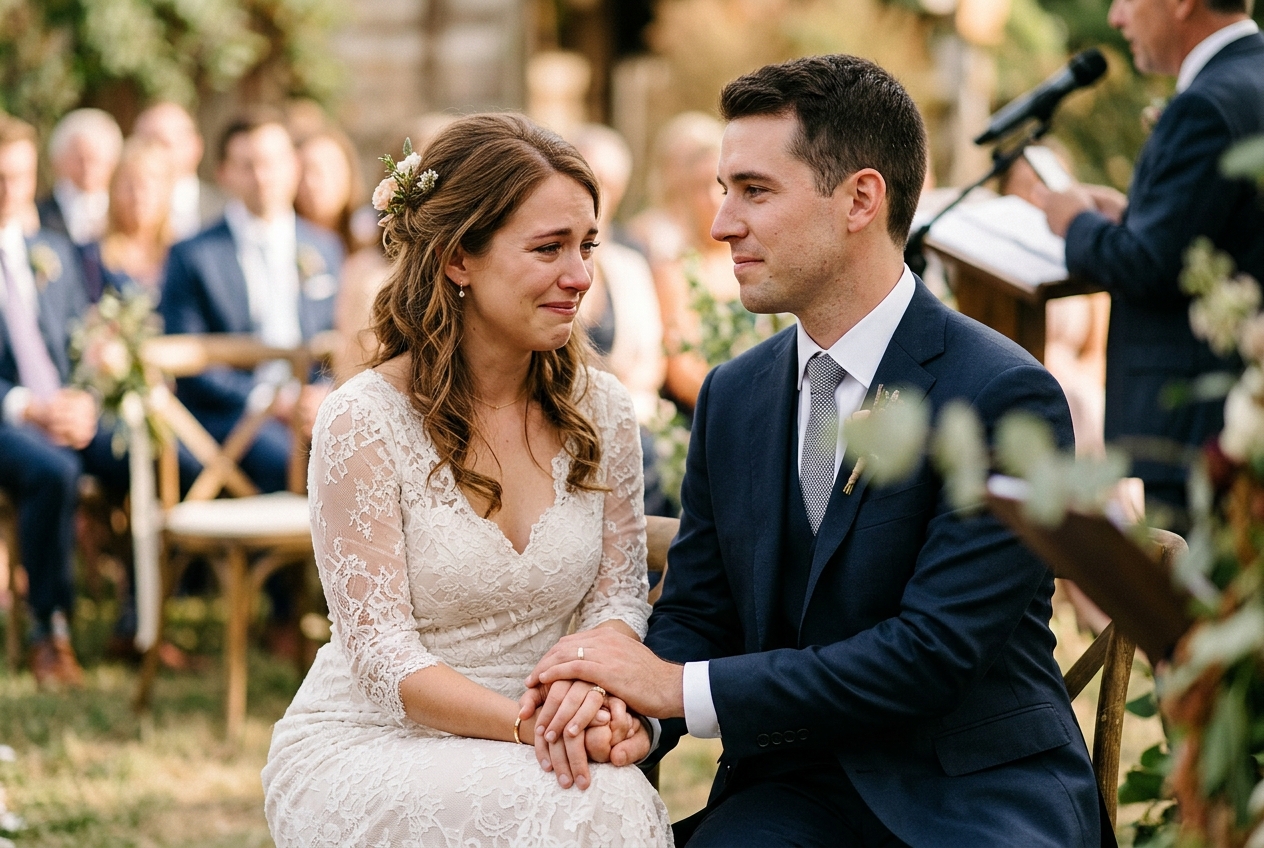 If you are having a civil ceremony with a registrar, your personal addition follows this format:
- The registrar reads the declaratory words (or you repeat them).
- You deliver your personal statement.
- The registrar reads the contracting words (or you repeat them).
- Your partner follows the same sequence.
Typical successful civil additions run 80-120 words and are phrased as promises rather than narrative. Keep religious references out entirely.
Timing the submission
| Ceremony type | Submission deadline |
|---|---|
| Civil (registrar) | 4 weeks before the ceremony |
| Celebrant | Depends on celebrant — usually 2-4 weeks for review |
| Humanist | No statutory requirement; humanist officiant may want 2 weeks |
Send the text by email so you have a paper trail. Registrars occasionally lose documents — a submitted email confirmation protects you.
Related articles
For the full ceremony planning guide, see wedding rehearsal UK. For wording options beyond vows, see funny wedding readings UK and wedding vows for second marriages. For legal ceremony requirements, read are humanist weddings legal in England and Wales.
Frequently asked questions
Can you write your own wedding vows in the UK?
Yes, but it depends on the ceremony type. Celebrant-led ceremonies have no restrictions on personal vow content. Civil (registrar) ceremonies require the legal declaratory and contracting words by law, but personal additions before and after are permitted and must be submitted to the registrar in advance.
How long should personal wedding vows be?
WeddingsHub's 2026 data puts the average personal vow at 180 words — about 90 seconds spoken aloud. Most celebrants recommend 90-150 words as the sweet spot. Under 60 words can feel rushed. Over 300 words risks losing guests' attention and can create uneven pairings if one partner writes significantly more.
What must you legally say in your wedding vows in England and Wales?
At a civil ceremony in England and Wales, you must include the declaratory words ('I do solemnly declare that I know not of any lawful impediment why I...' etc.) and contracting words ('I call upon these persons here present to witness that I...' etc.). Celebrant ceremonies have no legally required words — the legal marriage is completed at a separate register office appointment.
Do registrars have to approve your personal vows?
Yes, at a civil ceremony. Any text beyond the legal words must be submitted to the registrar at least 4 weeks before the wedding. Registrars reject text that is religious in nature, contains promises that cannot be legally made, or includes anything the registrar deems inappropriate. In practice, rejections are rare — most personal additions are approved without issue.
Should wedding vows rhyme?
Rhyming vows work only if your natural speech rhythm carries them without effort. Forced rhymes are the most frequently cited vow regret in WeddingsHub's couple surveys. Most celebrants advise against rhyming unless the couple is genuinely comfortable with poetry. Short rhyming lines at the end of otherwise conversational vows are the safest compromise.
Should both partners write the same length vows?
Not necessarily, but a significant mismatch creates an awkward moment. If one partner writes 50 words and the other writes 400, the shorter vow reads as less engaged — however heartfelt it may be. Most celebrants recommend aiming for a similar length without sharing the actual content in advance. Agree on an approximate word count together.
When should you write your wedding vows?
Start drafting 6-8 weeks before the wedding. Write a first draft within 2 weeks. Allow 2-3 revision rounds. Practice reading aloud at least once a week for the final 3 weeks. For civil ceremonies, submit the final text to the registrar 4 weeks before the date. The biggest mistake is leaving vow-writing to the week before — emotion and deadline pressure produce rushed, generic results.