Wedding Rehearsal UK: Do You Need One & What Happens?
Key Takeaways
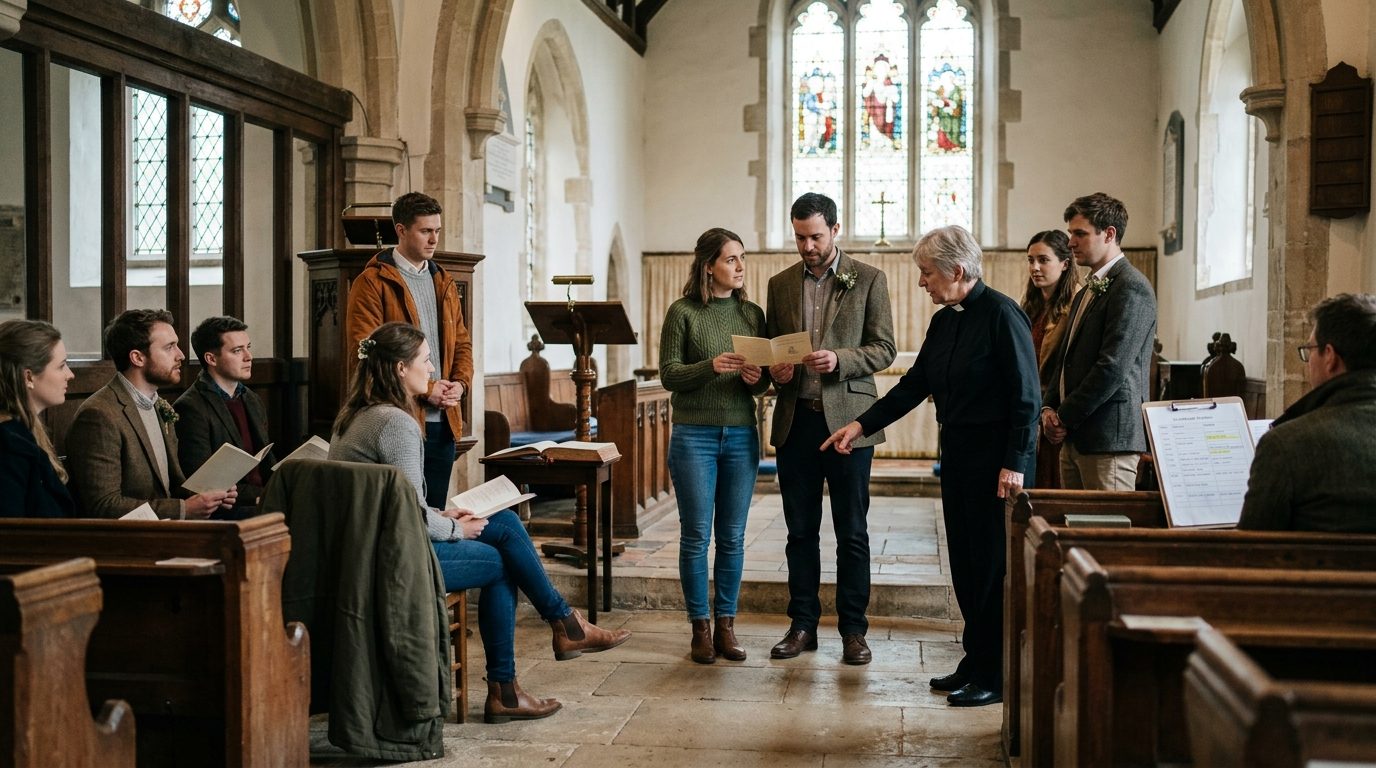
- Church weddings almost always include a rehearsal — it is typically organised by the officiant and takes 45-90 minutes
- For civil ceremonies at licensed venues, the couple must request a rehearsal separately; many venues include one in the coordination package
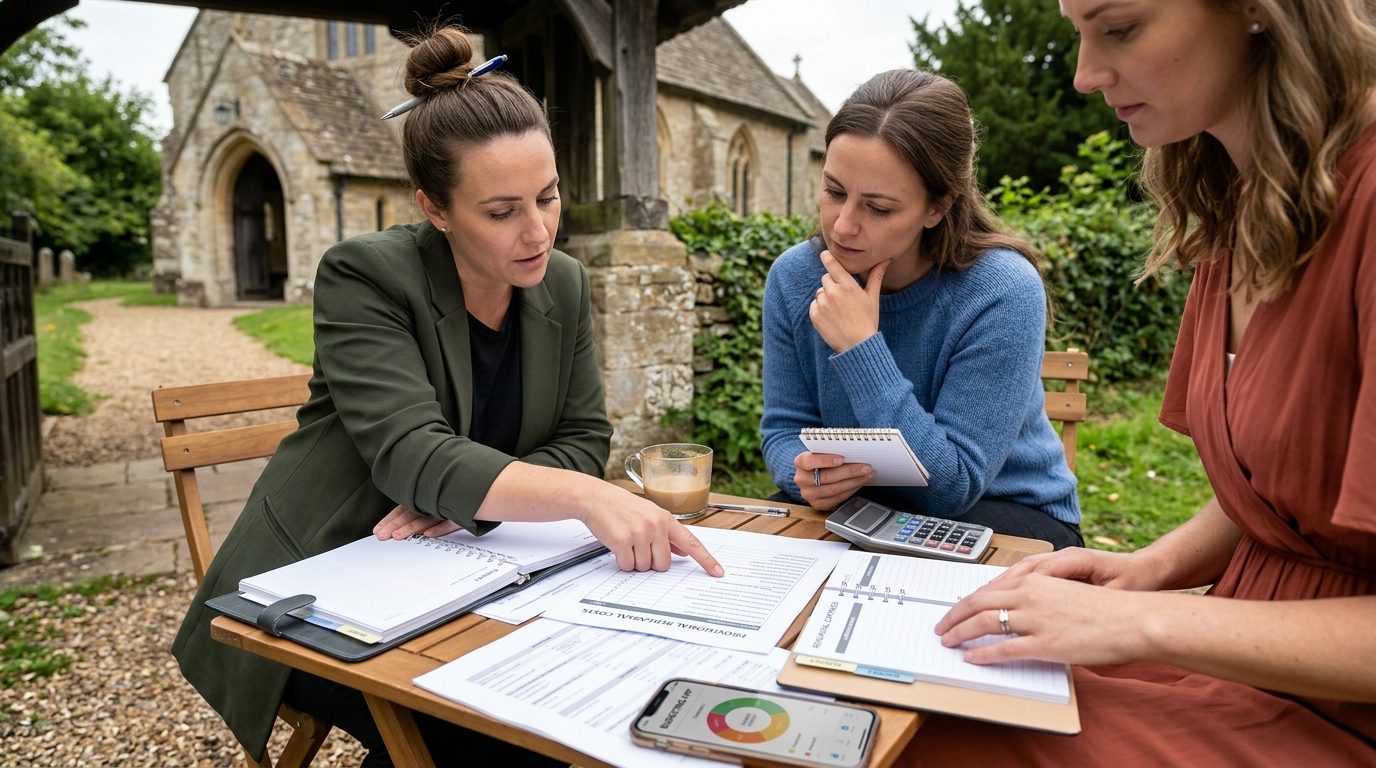
- A rehearsal typically costs £0-£150 extra at UK venues — most include it in the ceremony hire fee if you ask
- Key attendees: couple, officiant, wedding party (bridesmaids, ushers, best man), parents giving readings, and venue coordinator
- The single biggest rehearsal benefit is cue confidence — knowing exactly when music changes, when to walk, and where to stand
Do UK weddings always include a rehearsal?
No — but the tradition differs sharply by ceremony type.
Church of England weddings: Yes, almost always. The vicar or officiant organises the rehearsal as a standard part of their service. It usually takes place the Thursday or Friday before the wedding. Most Church of England, Catholic, and nonconformist church ceremonies include a rehearsal without additional charge.
Civil ceremonies at licensed venues: No automatic rehearsal. The ceremony is legally administered by a registrar from the local council, and the registrar is not available for a pre-ceremony walkthrough in the way a vicar is. You can — and should — request a walkthrough with your venue coordinator instead. Most UK licensed wedding venues include a coordination meeting and optional walkthrough in their hire fee. Ask at the point of booking, not three weeks before the wedding.
Humanist and other non-legal ceremonies: Varies by celebrant. Many humanist celebrants include a rehearsal as standard. Check your contract. If your ceremony uses a separate legal notice signing (for the legal element) plus a celebrant-led ceremony, you need to coordinate a rehearsal with the celebrant only.
Who should attend the rehearsal?
The rehearsal is not a guest event. Keep it tight — a large group slows everything down.
Essential:
- The couple
- The officiant (vicar, celebrant, or venue coordinator)
- All bridesmaids
- Best man and ushers
- Maid of honour
- Parents who are escorting the bride or groom (e.g. father of the bride walking the aisle)
- Anyone doing a reading, including readers who are not in the wedding party
- The venue coordinator if they are cuing music or managing entrances
Optional:
- Flower girls and page boys (only if old enough to understand direction — typically 6 and over)
- Musicians or singers who are performing live in the ceremony (so they know exactly when their cue lands)
- Photographer or videographer (useful but not essential — some attend to plan their positions)
Not needed:
- General guests
- Catering staff
- Family members not involved in the ceremony
What happens at a wedding rehearsal?
A well-run rehearsal follows the structure of the ceremony itself. The officiant or coordinator leads.
1. Briefing (5-10 minutes)
Everyone gathers in the ceremony space. The officiant explains the running order, points out where everyone will stand, and identifies the musical cues. This is the moment to ask logistical questions: where do the ushers sit? What is the signal to start walking?
2. Processional walkthrough (15-20 minutes)
The wedding party practises entering in the correct order. In a typical UK ceremony:
- Ushers enter first and take positions (or escort guests if they’re doubling as ushers)
- Bridesmaids enter (often in pairs, or single file)
- Maid of honour enters
- Flower girl and page boy (if included)
- The bride enters (with father, or chosen escort, or alone)
The pace is always slower than people expect. Walk to the music — most people rush because silence feels awkward. The rehearsal is where you learn to pause, breathe, and move at the right speed. The groom and best man are typically already standing at the altar, having entered before the processional began.
3. Ceremony sequence walkthrough (20-30 minutes)
The officiant walks through each element in order:
- Welcome and opening words
- Any hymns or songs (you will walk through the cue, not sing the whole song)
- Readings (the readers walk up, practise finding their position, say the opening line, and the officiant moves on)
- The vows (couples often say abbreviated versions — “I do” rather than the full text)
- The ring exchange (where do the rings come from? The best man holds them — practise the handover)
- Signing the register (where is it? Who witnesses? Practise the walk)
- Pronouncement
Each step includes time for questions. The best rehearsals have constant interruption — “where do I look?”, “how long does the music play?”, “do I kiss before or after you say ‘you may kiss’?“
4. Recessional walkthrough (5-10 minutes)
The couple exits first, then the wedding party follows in reverse processional order. Practise the pace and the turn out of the ceremony space into whatever follows (confetti throw, drinks reception, photo location).
5. Final questions and logistics (10-15 minutes)
Who holds the bouquet during the ring exchange? Where does the best man stand for the signing? What happens if a reader is nervous and loses their place? The officiant answers these and clarifies any remaining cues.
Rehearsal dinner: UK vs US customs

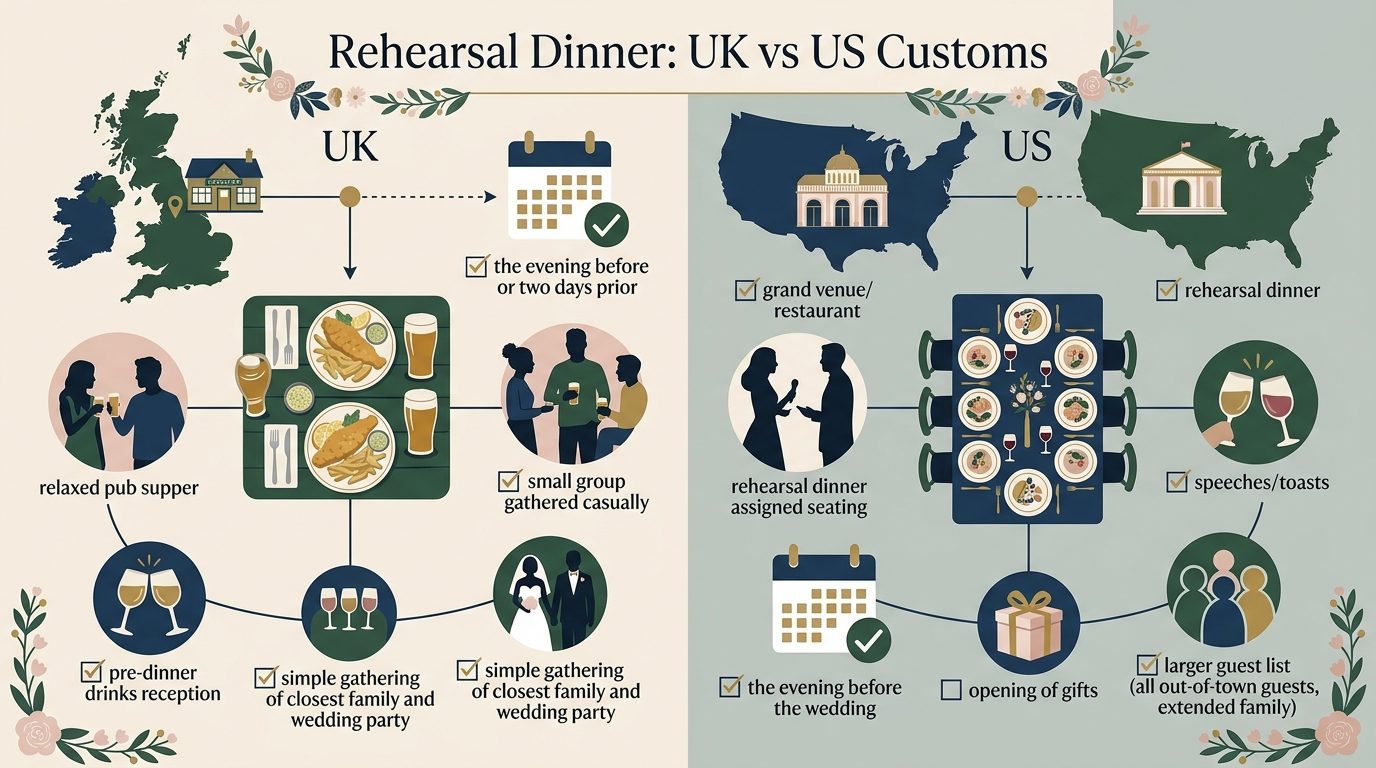 In the US, a rehearsal dinner (a formal sit-down meal for the wedding party after the rehearsal) is standard and often as large as a small reception. In the UK, this tradition is much less common.
What UK couples typically do instead:
- Informal drinks at the venue bar after the rehearsal (most popular option)
- Dinner at a local restaurant for the wedding party only (for destination or destination-adjacent weddings)
- Nothing formal — the rehearsal ends and people disperse
If you are hosting family who have travelled from abroad, a casual dinner the night before is a good way to give them one-to-one time before the wedding itself. It does not need to be formal or expensive — a set menu at a local pub works perfectly.
For hen do planning and stag do ideas, most UK couples separate these from the rehearsal weekend entirely.
How to arrange a wedding rehearsal at a UK civil venue
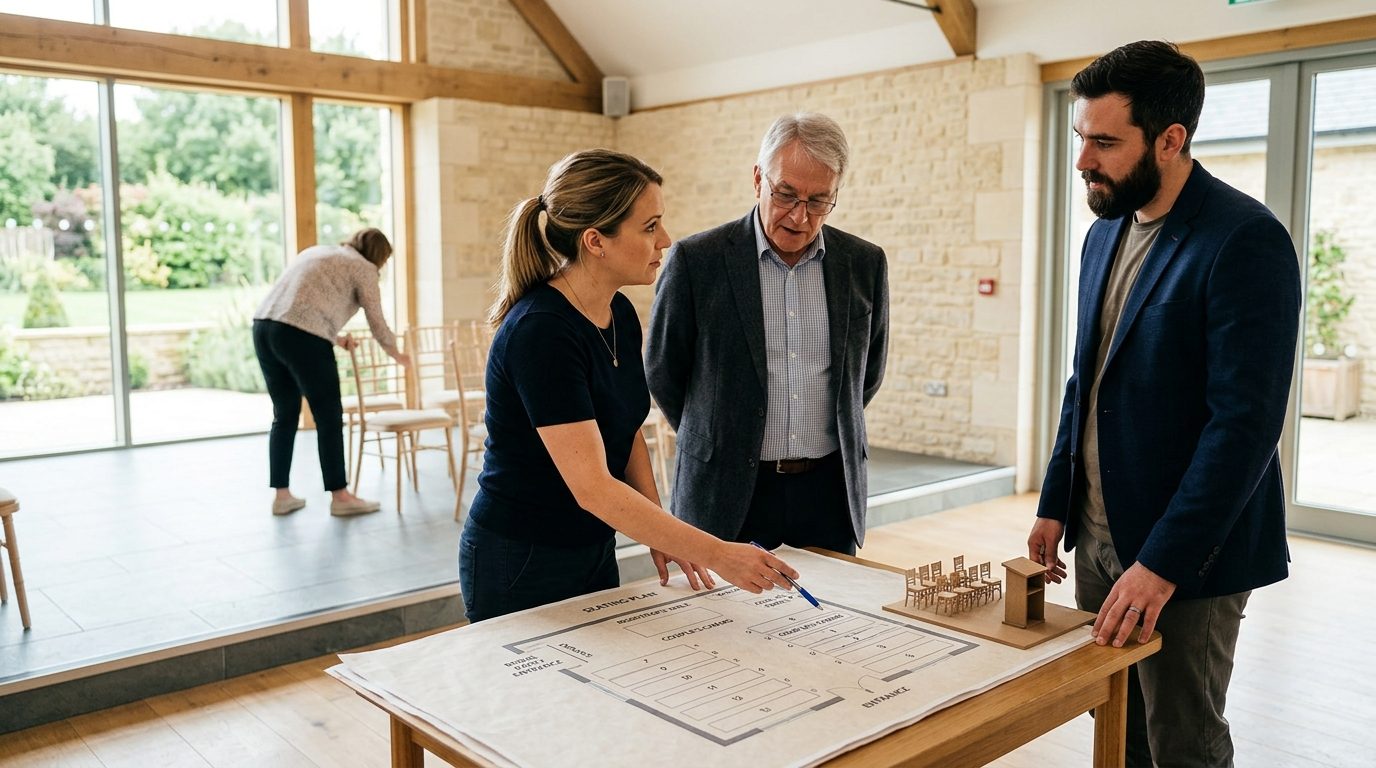 Most couples assume the venue will organise it. They do not — you have to ask.
- At contract signing: Add a line to your contract confirming one evening rehearsal slot is included in the hire fee. Ask what date and time is available.
- 6 months before: Confirm the rehearsal date and add it to every attendant’s calendar immediately.
- 4 weeks before: Send a rehearsal briefing to all attendees — location, arrival time, what to wear (comfortable clothes, not wedding day outfits), and the ceremony running order so they can read through their roles in advance.
- Evening of rehearsal: Arrive 10 minutes early. Bring printed order-of-service sheets for every attendee. Run the rehearsal as the officiant leads it — do not try to direct it yourself.
Common rehearsal mistakes to avoid
Starting late: If the rehearsal starts 30 minutes late, it runs long, people get tired, and retention drops. The rehearsal is the one thing that must start on time.
Too many directors: Every family has someone who wants to add notes. Nominate one point of contact (usually the best man or maid of honour) to collect notes during the rehearsal and address them at the end. Multiple people calling “stop” mid-walkthrough is chaotic.
Skipping the recessional: Most rehearsals run out of time and skip the exit. Do not skip it. The recessional is the moment most captured on video and the moment that feels the most chaotic if unrehearsed.
Not confirming music cues: If you have a musician playing live — string quartet, organist, pianist — they need to know exactly when to start the processional, when to switch from pre-ceremony music to processional music, and when to play the recessional. These transitions need to be agreed at the rehearsal, not improvised on the day.
Treating it as optional for small weddings: A 30-person wedding with a short ceremony can still go wrong. The fewer people involved, the more each person’s confidence matters. Rehearse regardless of size.
What does a wedding rehearsal cost?
| Venue type | Rehearsal included? | Additional cost |
|---|---|---|
| Church of England | Almost always | £0 |
| Catholic church | Usually | £0-£50 donation |
| Licensed civil venue | Rarely automatic | £0-£150 |
| Humanist celebrant-led | Varies by contract | £0-£100 |
| Private estate | Depends on package | £0-£200 |
Rehearsal checklist
Use this the evening of your rehearsal:
- Order of service printed for all attendees
- Readings printed for all readers
- Vow cards or booklets for the couple
- Ring placement confirmed (who holds them, when to hand over)
- Music cues confirmed with musicians or venue AV operator
- Processional order agreed and written down
- Recessional order agreed and written down
- Flower girl and page boy briefed separately if under 10
- All readers have walked to their reading position and back
- Signing table location confirmed
- Exit route confirmed (into confetti throw, drinks reception, etc.)
See also: wedding venue checklist and how to plan a wedding for the full planning timeline.
Related articles
- Wedding Day Timeline: Hour-by-Hour Guide
- How to Write Wedding Vows UK
- Best Man Speech Examples & Tips
- Wedding Venue Checklist: 47 Questions to Ask
- Order of Service: Templates & Wording Guide
Frequently asked questions
Do you need a wedding rehearsal in the UK?
Church ceremonies almost always include a rehearsal organised by the vicar or officiant. Civil ceremonies at licensed venues require you to arrange it separately — ask your venue coordinator.
How long does a wedding rehearsal take?
Most UK wedding rehearsals take 45-90 minutes. A simple ceremony with a small wedding party typically takes 45 minutes. A church wedding with multiple readings, a processional, a recessional, choir involvement, and a large wedding party can take up to 2 hours. Budget 90 minutes and plan to finish in 60.
Who should attend the wedding rehearsal?
Essential: the couple, the officiant, bridesmaids and groomsmen, best man, maid of honour, parents who are escorting or doing readings, and the venue coordinator. Optional: flower girls, page boys (only if they're old enough to stand still for guidance), and musicians or singers who are performing in the ceremony.
When should you hold a wedding rehearsal?
The evening before the wedding is the UK standard — usually 5-7pm on the Friday if the wedding is on a Saturday. This keeps the ceremony fresh in everyone's mind. If a venue is unavailable the evening before, book it two days prior. Avoid the morning of the wedding — stress levels are too high to absorb choreography.
Does a wedding rehearsal cost extra?
Most UK wedding venues include a rehearsal in their ceremony hire fee if you ask. Some charge a separate venue access fee of £50-£150 for the evening slot. Churches rarely charge extra — the vicar or officiant runs the rehearsal as part of their preparation service. Always confirm with your venue when you sign the contract.
What do you actually do at a wedding rehearsal?
Walk through the processional (who enters in what order and at what pace), positions at the altar or ceremony space, the ceremony sequence (readings, vows, ring exchange), the recessional, and any musical cues. The officiant will usually pause at each key moment to explain what happens and answer questions. It is not a performance — interruptions and questions are expected.
What should I bring to a wedding rehearsal?
Bring your ceremony order of service (so attendants can follow along), any printed readings, a printed version of your vows if you are reading from paper, and comfortable shoes for walking the aisle. The officiant handles the script. Bring a notebook for last-minute cue notes — phone notes work, but paper is easier to share quickly.