Can a Registrar Refuse to Marry You in the UK?
Key Takeaways
- A registrar in England and Wales can refuse to marry a couple in 6 specific legal circumstances
- Missing documentation is the most common reason for a refused or delayed ceremony
- Registrars cannot refuse based on personal, moral or religious beliefs under current law
- Forced marriage grounds give registrars a legal duty to refuse, not just a right
- Couples wrongly refused can appeal to the Registrar General or seek judicial review
- The Marriage Act 1949 (as amended) governs all refusals in England and Wales
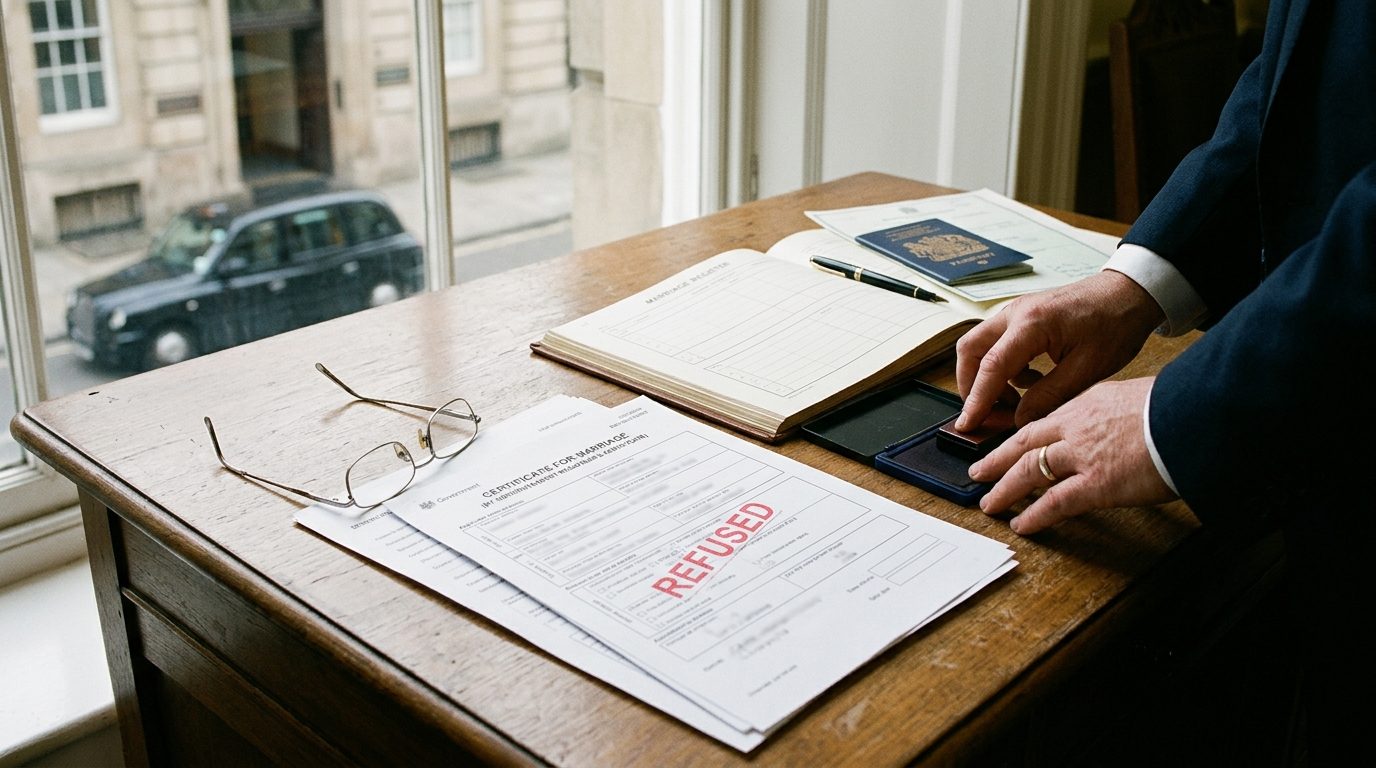
A registrar in England and Wales can refuse to marry a couple in six specific legal circumstances. Missing documentation is the most common cause of a refused or delayed ceremony. Registrars cannot refuse on personal, moral or religious grounds. The Marriage Act 1949, as amended, governs all refusals. In 2023, the General Register Office reported fewer than 180 ceremony refusals or delays across England and Wales — the majority due to incomplete paperwork, not legal impediments to the marriage itself.
By Matt, Editor at Weddings Hub. I have covered UK marriage law, civil ceremony requirements and registration practice since 2018. This article draws on the Marriage Act 1949, the Forced Marriage (Civil Protection) Act 2007, the Marriage (Same Sex Couples) Act 2013, General Register Office guidance, and published case law. It is not legal advice. For legal advice, contact a qualified solicitor.
Most UK couples never encounter any difficulty with a registrar. The standard civil ceremony process runs smoothly: give notice, wait 28 days, present your documents, marry. For the small number of couples who do face a refusal or delay, understanding the legal framework makes the situation significantly less frightening.
The Marriage Act 1949 and what it says
The Marriage Act 1949 is the primary legislation governing marriages in England and Wales. It has been amended multiple times, most significantly by the Marriage (Same Sex Couples) Act 2013 and the Forced Marriage (Civil Protection) Act 2007.
The Act sets out what a valid marriage requires. It also sets out what makes a marriage void or voidable. Where the legal conditions for a valid marriage are not met, a registrar has both the right and, in some circumstances, the duty to refuse.
The Act does not give registrars discretion based on personal judgement. It sets a framework of objective legal conditions. A registrar who refuses outside those conditions is acting unlawfully.
The 6 legal grounds for refusal
1. Missing or invalid documentation
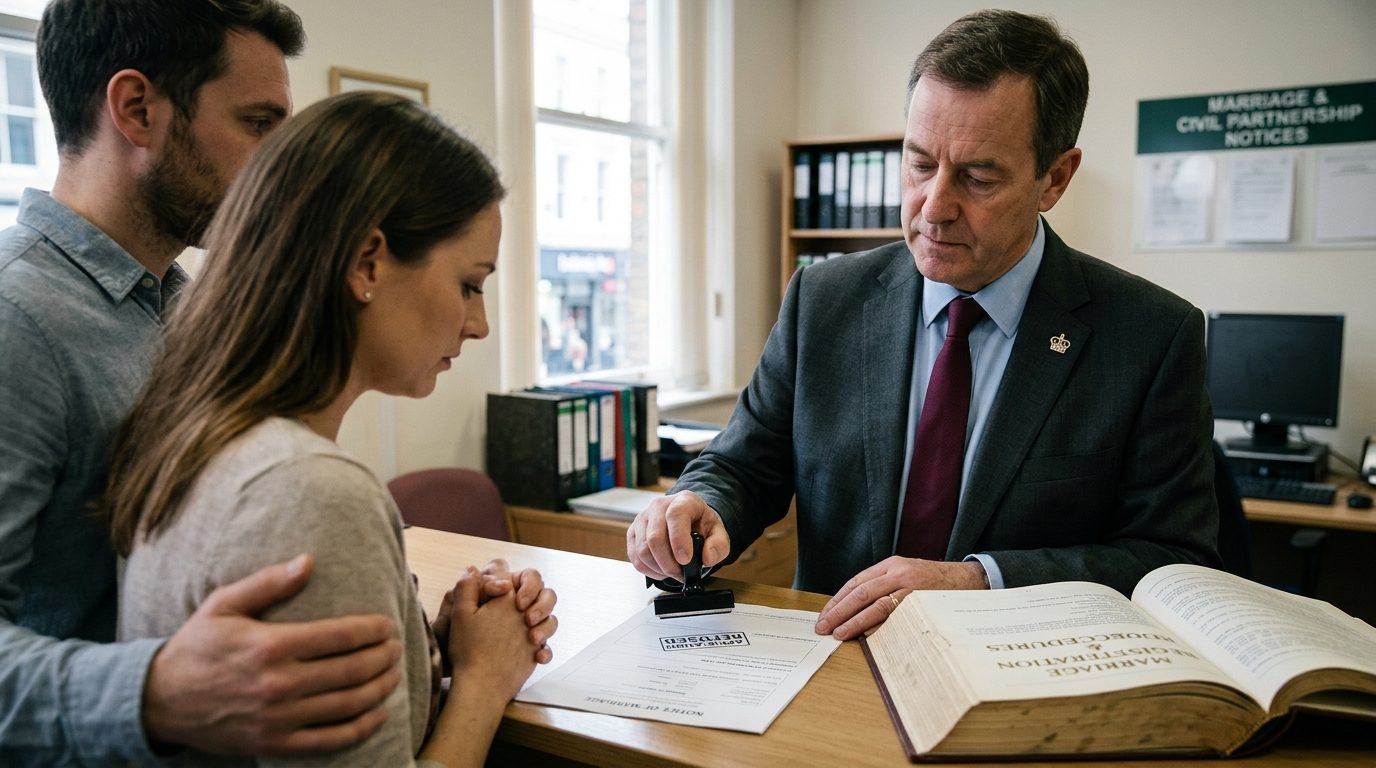
This is by far the most common cause. Required documents include a notice of marriage filed at least 28 days in advance, valid photographic ID (passport or, for non-UK nationals, a biometric residence permit), and evidence that any previous marriage has ended (a decree absolute or death certificate).
If these are not presented on the day, the ceremony cannot proceed. This is not a discretionary refusal. It is a legal precondition of conducting the marriage. Contact your local register office well in advance of the ceremony to confirm exactly what documents are required for your specific situation.
2. One or both parties are already married
Bigamy is a criminal offence under the Offences Against the Person Act 1861. A registrar who has reasonable grounds to believe one party is already in a legal marriage or civil partnership has a duty to refuse. This ground is rarely invoked: most couples have self-declared their single status on the notice of marriage form.
3. Lack of mental capacity to consent
Valid marriage requires that both parties understand what marriage is and freely consent to it. The Mental Capacity Act 2005 applies. If a registrar has specific reason to doubt one party’s capacity — based on prior information from the police, social services, or their own direct observation during the ceremony — they may pause or refuse the ceremony.
This ground is important but narrow. A registrar does not diagnose mental capacity. They can only delay a ceremony where there is a genuine prior concern, not a subjective impression on the day.
4. Forced marriage
The Forced Marriage (Civil Protection) Act 2007 and subsequent legislation give registrars a specific duty in cases of suspected forced marriage. This is not a discretionary refusal. Registrars in England and Wales have been receiving training from the Forced Marriage Unit (a joint Home Office and Foreign Office body) since 2008.
Signs a registrar might act on include a party who appears fearful, who cannot answer basic questions about their partner, or where third parties attempt to answer on behalf of a party. The registrar’s first step is typically to speak with each party separately.
5. Prohibited degrees of relationship
Some blood and adoptive relationships prevent legal marriage. These are set out in Schedule 1 of the Marriage Act 1949. For example, a parent cannot marry their child, nor can a sibling marry their sibling. Some of these prohibitions are absolute; others are conditional on certain circumstances.
This ground is extremely rare in practice but is a mandatory refusal when it applies.
6. One party is under 18
Since the Marriage and Civil Partnership (Minimum Age) Act 2022, the minimum age for marriage in England and Wales is 18, with no exceptions. Before 2022, 16 and 17-year-olds could marry with parental consent. That exemption has been removed. A registrar must refuse to marry anyone under 18. See church wedding requirements for the parallel rules in religious settings.
What a registrar cannot do
A registrar cannot refuse for personal, moral, or religious reasons. This is an important protection that predates and survives recent culture-war debates about conscience exemptions.
A civil registrar is a public official conducting a legal function. The state has decided to make certain forms of marriage legal. It cannot then allow its officials to selectively withhold that right based on personal belief.
This protection is explicit in General Register Office guidance. It applies equally to same-sex marriages, marriages between people of different faiths, second marriages, and marriages following gender recognition. A refusal on any of these grounds would be unlawful and challengeable.
What happens if a registrar refuses your ceremony
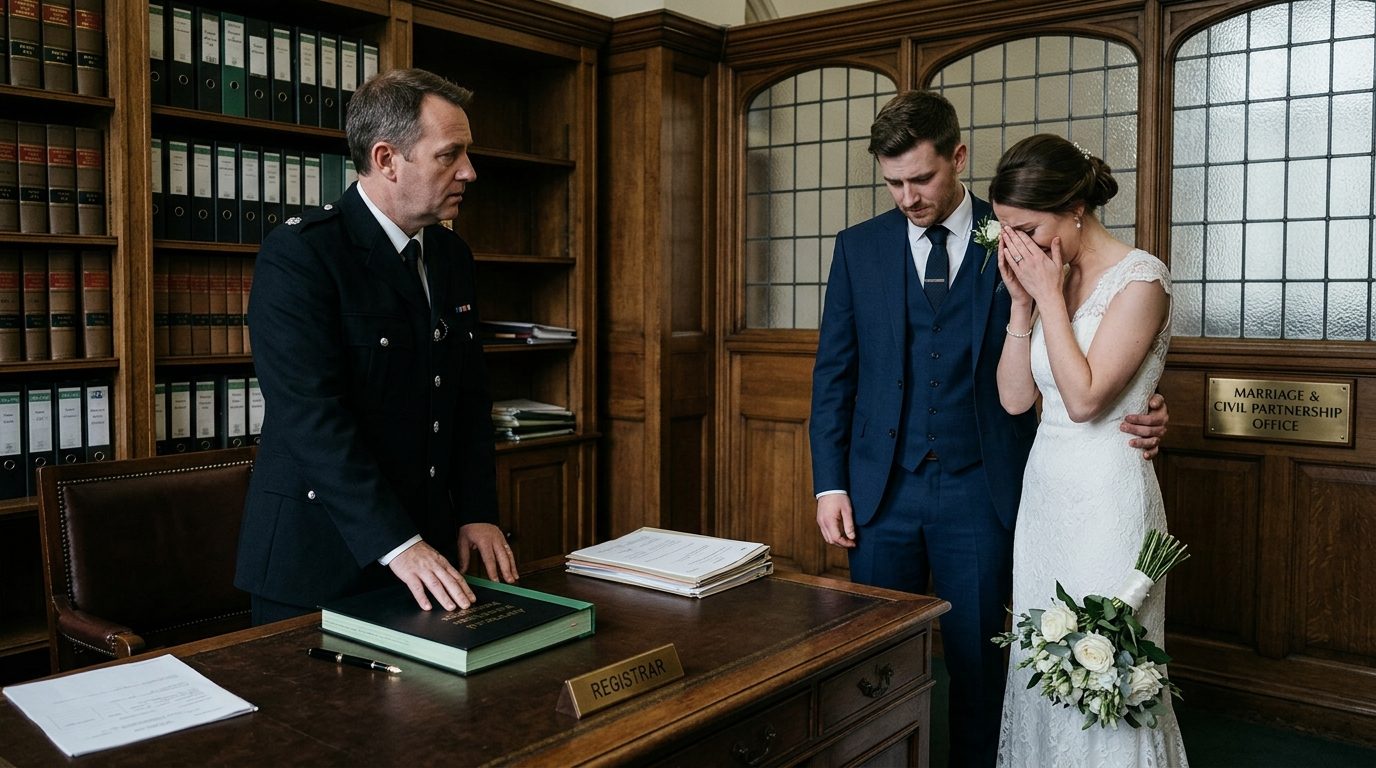
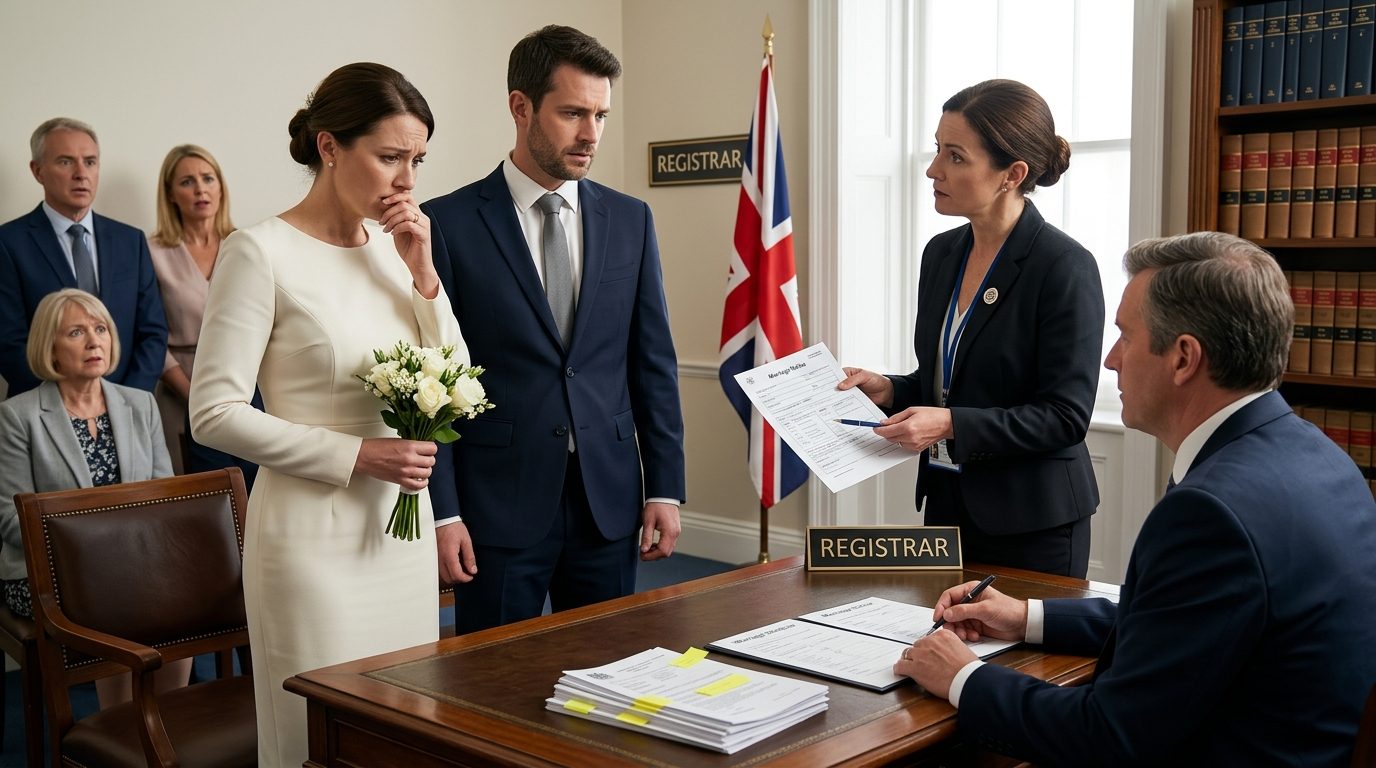
If a registrar refuses or delays your ceremony, the first step is to ask for the refusal in writing, with the specific legal ground cited. A professional registrar will provide this without resistance. An oral refusal with no explanation is a red flag.
If the refusal is for a documentation reason, the fix is usually practical: get the missing document and rebook. Most refusals for this reason resolve within a few weeks.
If the refusal appears to be for a reason not listed above, the escalation path is:
- Speak to the Superintendent Registrar at the same register office.
- Escalate to the Registrar General for England and Wales (based at the General Register Office).
- If the refusal was unlawful, judicial review is available as a legal remedy.
In practice, the vast majority of refusals that seem unreasonable resolve at step 1 or 2. Judicial review has been used in a small number of documented cases involving refusal to conduct same-sex ceremonies before they became uniformly mandatory.
Registrars in Scotland and Northern Ireland
Scotland and Northern Ireland have separate legal frameworks.
In Scotland, the Registration of Births, Deaths and Marriages (Scotland) Act 1965 governs civil marriage. The prohibited grounds are similar but the administrative process differs, including different notice requirements and a wider range of authorised celebrants.
In Northern Ireland, marriage law is governed by the Marriage (Northern Ireland) Order 2003. The grounds for refusal are comparable to England and Wales.
How to avoid a registrar problem entirely
The majority of certificate problems are avoidable. Follow these steps and the risk drops to near zero.
File your notice of marriage at least 10 weeks before the ceremony. The minimum is 28 days, but filing earlier gives you time to resolve any issues the register office flags.
Confirm the exact document requirements for your specific situation. Non-UK nationals, people with previous marriages, and people who have changed their name all have slightly different requirements. Do not rely on a generic list.
Carry original documents on the day. Photocopies are not accepted. Originals are required. Keep them in a separate bag from the rest of your wedding day items so they are not misplaced.
Confirm the venue’s licence. If you are marrying at a licensed venue rather than a register office, confirm the licence is current and covers the room you intend to use. An expired or incorrect licence is another ground for a ceremony to be refused. See our wedding planning timeline for when to check each requirement.
Related articles
Frequently asked questions
Can a registrar refuse to marry you in the UK?
Yes, in limited and specific circumstances. The Marriage Act 1949 allows refusal where documentation is missing, either party is already married, there is no valid consent, the parties are within prohibited degrees of relationship, or forced marriage grounds apply.
What are the legal grounds for a registrar to refuse?
The six main grounds are: missing documentation, existing marriage or civil partnership, lack of mental capacity to consent, forced marriage, prohibited relationship (blood or adoptive), and where a party is under 18 without valid parental consent.
Can a registrar refuse for religious or moral reasons?
No. A civil registrar cannot refuse to conduct a legal marriage on personal, moral or religious grounds. That protection exists specifically to prevent personal beliefs from blocking legal access to marriage.
What happens if a registrar refuses wrongly?
Couples who believe they have been wrongly refused can escalate to the Superintendent Registrar, then to the Registrar General for England and Wales. Legal challenge by judicial review is also available in cases of clear unlawful refusal.
Can a registrar refuse to marry a same-sex couple?
No. Same-sex marriage has been legal in England and Wales since 2014. A civil registrar has no legal basis to refuse a same-sex marriage. The protections that prevent moral or religious refusal apply equally here.
What documentation do you need for a civil marriage in the UK?
You need a notice of marriage filed at least 28 days in advance, valid ID (passport or biometric residence permit for non-UK nationals), and proof of any previous marriage ending (decree absolute or death certificate). Missing any of these can delay or prevent the ceremony.
What if one party can't consent due to disability or medication?
Mental capacity to consent is legally required. If a registrar has genuine reason to doubt capacity — based on observation or prior information — they have a duty to investigate and may refuse until capacity is confirmed. The Mental Capacity Act 2005 framework applies.