What Happens If Someone Objects at a UK Wedding?
Key Takeaways
- In England and Wales, only four grounds justify a legal objection: existing marriage, close blood relationship, age under 16, or lack of mental capacity
- A registrar who receives an objection must stop the ceremony and investigate before proceeding
- Romantic objections ('I love them') have no legal standing and the registrar will dismiss them immediately
- Church of England ceremonies include a formal opportunity for objections via the calling of banns on three consecutive Sundays
- Making a false or vexatious objection at a marriage ceremony is a criminal offence under the Marriage Act 1949
- In practice, most genuine legal impediments are caught during the notice-of-marriage process, months before the ceremony
In England and Wales, a wedding can be stopped by an objection — but only on one of four specific legal grounds. A registrar who hears an objection during a civil ceremony must pause and investigate before the marriage can continue. A Church of England minister does the same. Romantic objections, personal opinions and “I love them” declarations carry no legal weight. This article explains exactly what happens when someone objects, what the law says and how rare the genuine legal version actually is.
Key takeaways
- ✓ Only four grounds justify a legal objection: existing marriage, close blood relationship, age under 16, or lack of mental capacity
- ✓ A registrar must pause the ceremony and investigate any stated objection
- ✓ Romantic objections have no legal standing and are dismissed immediately
- ✓ Church of England banns give the public three Sundays to raise objections before the wedding
- ✓ Making a false objection is a criminal offence under the Marriage Act 1949
- ✓ Most genuine legal impediments are caught months earlier, during the giving-of-notice process
By Matt Ward, Editor at Weddings Hub. I have reviewed the Marriage Act 1949, the Matrimonial Causes Act 1973 and the General Register Office’s guidance on giving notice. The legal content in this article reflects the law in England and Wales as of May 2026. Scotland and Northern Ireland operate under separate marriage law.
The four legal grounds for objection in England and Wales
The Marriage Act 1949 governs marriage law in England and Wales. It defines the conditions under which a marriage is void (has never legally existed) or voidable (can be annulled after the fact). An objection at a wedding ceremony relates to the void conditions — the situations where the marriage simply cannot legally take place.
There are four grounds:
1. One or both parties is already married or in a civil partnership. Bigamy is a criminal offence under the Offences Against the Person Act 1861, carrying a sentence of up to seven years. If a valid, undivorced marriage exists, the new marriage is void. This is the most serious ground and the only one that has ever realistically been raised at a UK wedding ceremony.
2. The parties are within the prohibited degrees of relationship. You cannot marry a parent, sibling, grandparent, grandchild, aunt, uncle, niece or nephew. The full list is set out in Schedule 1 of the Marriage Act 1949. First cousins are not prohibited in England and Wales (unlike in some US states). Half-relatives are prohibited to the same degree as full relatives.
3. Either party is under 16. Since the Marriage and Civil Partnership (Minimum Age) Act 2022 came into force on 27 February 2023, the minimum age for marriage in England and Wales is 18, with no parental consent exceptions. Before 2023, the minimum was 16 with parental consent. This change eliminated a significant area of child marriage in England and Wales.
4. Either party lacks the mental capacity to consent. A person must understand the nature of marriage and be capable of consenting freely. Severe dementia, acute psychotic illness or substance impairment can all affect capacity. The Mental Capacity Act 2005 governs how capacity is assessed.
These are the only four grounds. Everything else — personal disapproval, a prior relationship with one of the parties, a belief that the couple is unsuited — has no legal standing whatsoever.
What the registrar does when an objection is raised
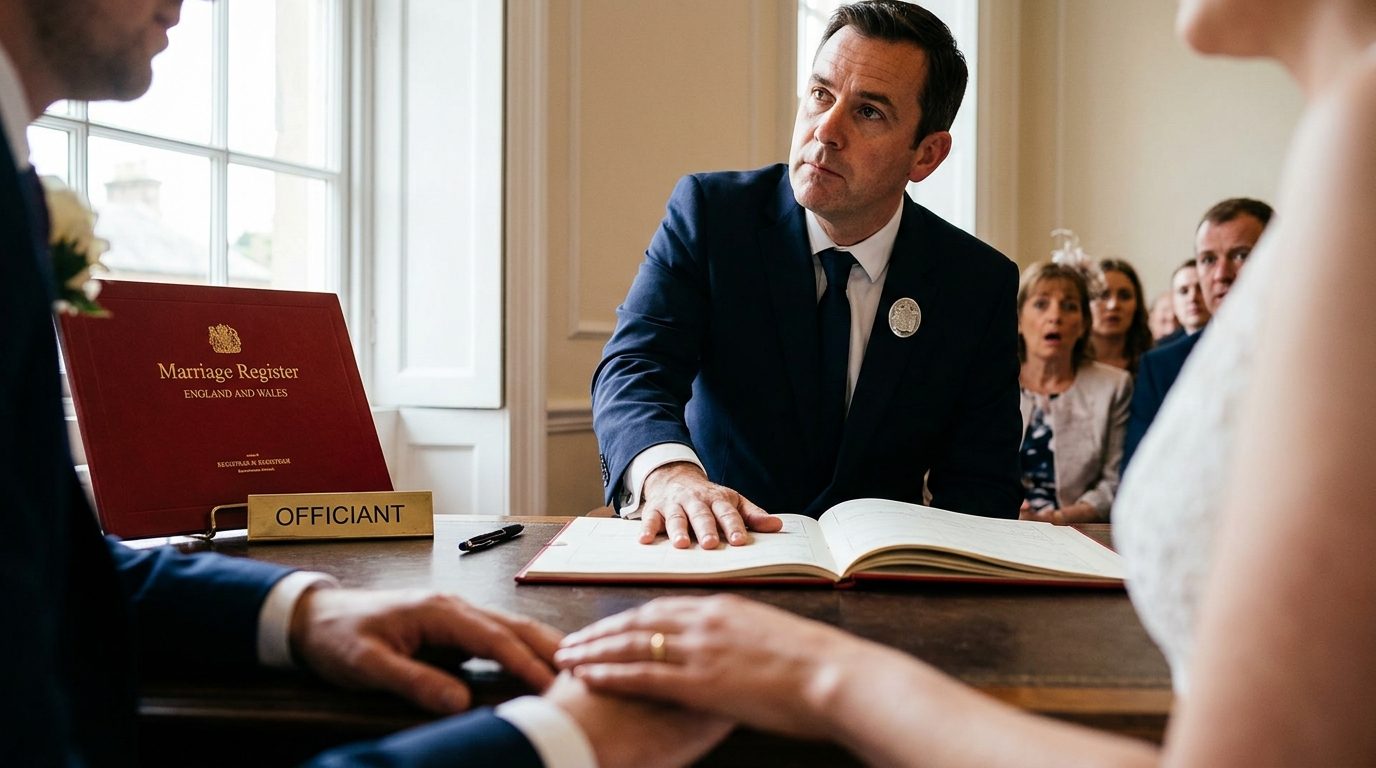
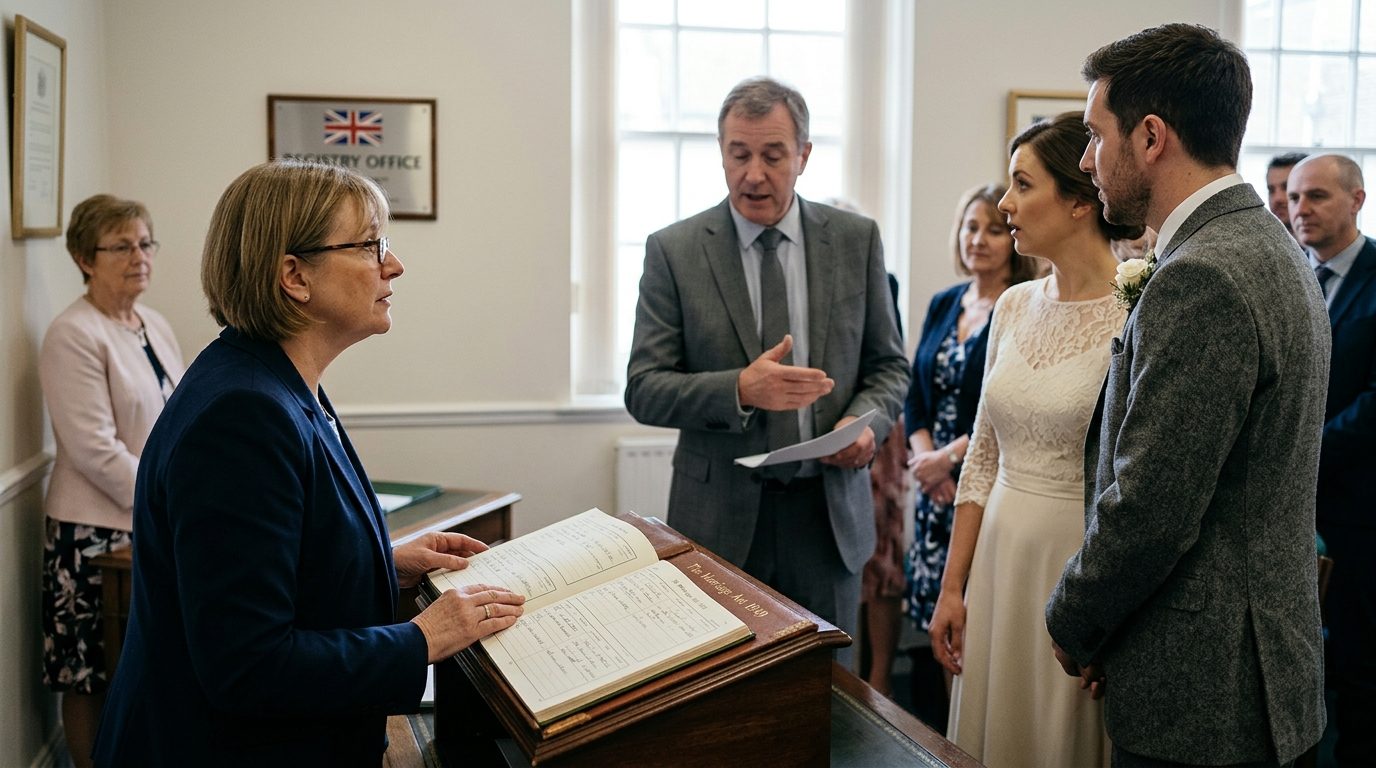
When someone raises an objection during a civil ceremony in England and Wales, the registrar is legally required to take it seriously. The sequence of events:
Step 1: The ceremony stops. The registrar will not continue while an objection is pending.
Step 2: The objector is asked to state the ground. Not their feelings. The specific legal reason. “I believe [name] is already married to [other name]” is a legal ground. “I love her and I don’t want this to happen” is not.
Step 3: The registrar assesses the claim. If the stated ground is not one of the four legal grounds, the registrar can — and will — dismiss it and continue the ceremony. If it is a legal ground, the registrar cannot proceed and will notify the Superintendent Registrar and, if necessary, police.
Step 4: Investigation. A claimed existing marriage would be checked against GRO (General Register Office) marriage records. This takes time. The ceremony cannot proceed on the same day.
Step 5: Criminal consequences for the objector. If the objection is found to be false, the person who raised it faces potential prosecution under the Marriage Act 1949 for knowingly obstructing a marriage. This is rarely pursued but it is real law.
In practice, the registrar retains discretion about whether to immediately dismiss a clearly groundless objection or formally note it. Most experienced registrars know within 30 seconds whether an objection has any legal merit.
The Church of England: how banns change the picture
Church of England marriage operates under a different pre-wedding framework that makes ceremony-day objections even less likely. Before a Church of England wedding, the couple’s intention to marry must be publicly announced — called the banns — in their local parish church, on three consecutive Sundays.
The wording at the reading of banns: “I publish the banns of marriage between [name] of [parish] and [name] of [parish]. If any of you know cause or just impediment why these two persons should not be joined together in Holy Matrimony, ye are to declare it.”
Any parishioner who knows of a legal impediment can raise it during the banns period. In practice, this is the main objection mechanism — it happens before the wedding, not during it.
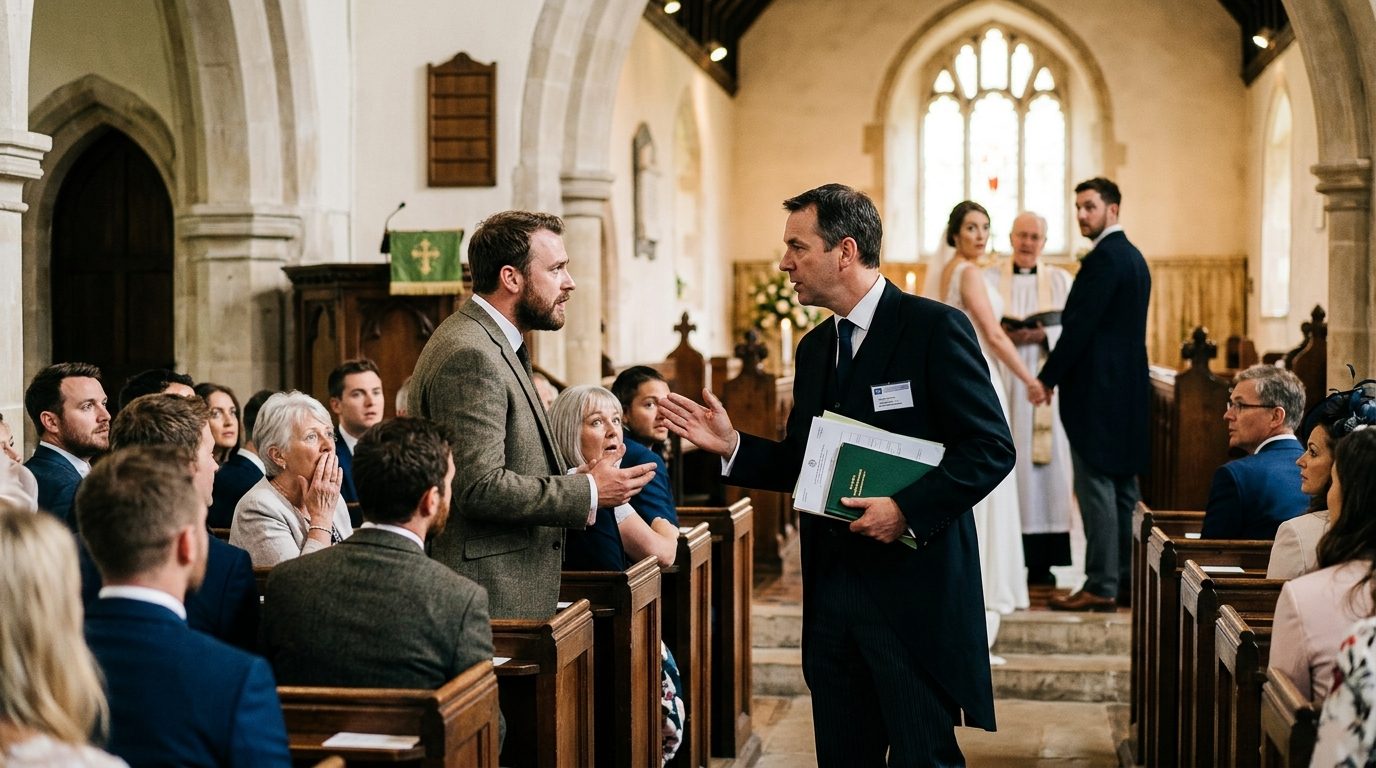
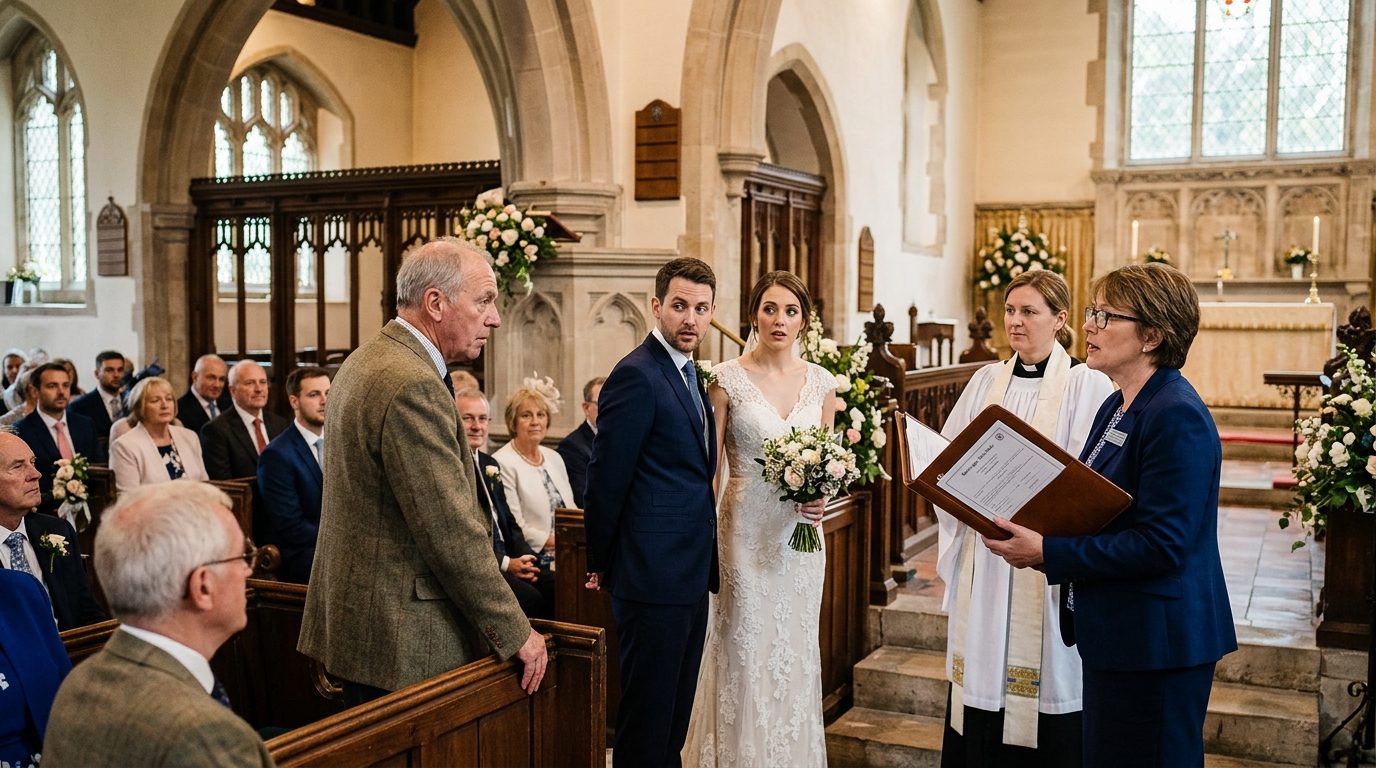
During the Church of England ceremony itself, the minister asks whether anyone present knows of a lawful impediment. This is the moment depicted in films and TV drama. Historically, this moment was genuinely important: banns might have been read in a different parish from where the objector lived, so ceremony-day was a final opportunity.
Today, in a mobile society where couples may marry far from where they grew up, the ceremony-day question retains legal force but almost never produces a genuine objection.
Civil ceremonies: does the registrar say “speak now or forever hold your peace”?
Not in those exact words. The civil ceremony in England and Wales includes a formal legal declaration, which varies slightly between local authorities but follows General Register Office wording. The registrar will typically say something like: “Before you are joined in matrimony, I have to remind you of the solemn and binding character of the vows you are about to take… Is there any person present who knows of any lawful reason why these two persons may not be joined in matrimony?”
This is a legal formality, not a dramatic invitation for romantic objections. The phrasing emphasises “lawful reason.” Experienced registrars at popular wedding venues have run this moment thousands of times. They expect silence.
Some couples opt for a humanist or independent celebrant ceremony alongside a civil legal ceremony. In a fully humanist ceremony (not legally binding on its own), there is no requirement to ask for objections at all. For the legal component — which must be separately registered — the lawful impediment check still applies. Our civil partnership vs marriage guide explains the legal structure of different ceremony types in England and Wales.
How objections are usually caught before the ceremony
The process of giving notice of marriage at a register office exists partly for this reason. Both parties must attend their local register office and give notice — at least 28 days before the wedding, longer if either party is a non-EEA national. The registrar checks identity documents, checks existing marriage records and issues a marriage schedule once satisfied there is no legal impediment.
This administrative screening catches the overwhelming majority of genuine impediments. An existing marriage, for example, would appear in GRO records when the new notice is given. A person under the required age would be identified from their passport or birth certificate.
The ceremony-day objection in a real legal sense is therefore the fallback, not the first line of checking. It handles the cases that slipped through notice-giving — which are extremely rare.
What actually happens when someone objects at a real UK wedding
Genuine ceremony-day objections in England and Wales are so rare that there are no reliable official statistics. The GRO does not publish data on interrupted ceremonies.
What does happen — somewhat more frequently — is guests making inappropriate comments during the objection moment: laughter, a joke, a muttered remark that the registrar hears. Experienced registrars treat this with professional calm. Unless the remark amounts to a stated legal ground, the ceremony continues.
Anecdotal reports from UK wedding planners suggest that emotional outbursts — an estranged parent, a jilted ex — occasionally occur at receptions rather than ceremonies, where the formal objection moment has already passed. These are etiquette problems, not legal ones.
The scenario familiar from films — a passionate objector declaring love and halting everything — is almost entirely fictional. The legal framework does not support it, and no registrar is obliged to take it seriously.
What to do if you are worried about an objection
If you have a specific reason to believe someone may attempt to disrupt your ceremony, there are practical steps:
Talk to your registrar in advance. Registrars can — and do — take pre-wedding precautions. A note on the file, awareness of the situation and a quiet word with the venue’s security contact are all options.
Consider a private ceremony. In England and Wales, a civil marriage requires two witnesses but does not require a public audience. A very small ceremony with only your closest people eliminates the opportunity for disruption.
Know that it is criminal. If someone has made explicit threats to disrupt your wedding, that may amount to harassment or threatening behaviour. This is a matter for the police, not the registrar.
For help planning around difficult family dynamics, our wedding planning timeline includes guidance on managing guest relationships in the months before the wedding.
FAQs: objections at UK weddings
Can someone legally stop a UK wedding by objecting?
Only on four grounds: an existing marriage, a close blood relationship, being under 16, or lacking mental capacity. All other objections have no legal force in England and Wales.
What does the registrar do if someone objects at a wedding?
The registrar must pause the ceremony and formally investigate the objection. If it has no legal merit, the ceremony resumes. If it does, the marriage cannot legally proceed that day.
Is it a crime to object at a UK wedding?
Making a false or vexatious objection at a marriage ceremony is a criminal offence under the Marriage Act 1949. You can face prosecution for deliberately disrupting a wedding with a groundless claim.
Do civil ceremonies include the “speak now or forever hold your peace” line?
Not in those exact words. The civil ceremony includes a formal question about lawful impediment, worded as a legal check rather than an invitation for general objections. The registrar does not invite romantic declarations.
What happens if someone objects at a Church of England wedding?
The minister halts proceedings and the objection is investigated. Banns called on three consecutive Sundays before the wedding serve as the primary public objection opportunity — most impediments are raised there rather than at the ceremony.
Has anyone ever objected at a real UK wedding?
Yes, but rarely at the ceremony itself. Most legal impediments are raised during the banns period or at the giving-of-notice stage at the register office. Ceremony-day objections are extremely rare and almost always groundless.
What are banns in a church wedding?
Banns are a public announcement of a planned Church of England marriage, read aloud in church on three consecutive Sundays. Any parishioner who knows of a legal impediment has the banns period to raise it formally before the ceremony takes place.
Frequently Asked Questions
Can someone legally stop a UK wedding by objecting?
Only on four grounds: an existing marriage, a close blood relationship, being under 16, or lacking mental capacity. All other objections have no legal force.
What does the registrar do if someone objects at a wedding?
The registrar must pause the ceremony and formally investigate the objection. If it has no legal merit, the ceremony resumes. If it does, the marriage cannot legally proceed that day.
Is it a crime to object at a UK wedding?
Making a false or vexatious objection at a marriage ceremony is a criminal offence under the Marriage Act 1949. You can be prosecuted for deliberately disrupting a wedding with a groundless objection.
Do civil ceremonies include the 'speak now or forever hold your peace' line?
Not as standard. The 'lawful impediment' question is asked during the civil ceremony, but it is worded as a formal legal check, not as a romantic dramatic pause. The registrar does not invite general objections.
What happens if someone objects at a Church of England wedding?
The Church of England ceremony includes a formal objection moment. If an objection is raised, the minister halts proceedings and the objection is investigated. Banns called on three Sundays before the wedding serve as the primary public objection opportunity.
Has anyone ever objected at a real UK wedding?
Yes, but rarely at the ceremony itself. Most legal impediments are raised during the banns period or during the giving of notice at the register office. Ceremony-day objections are extremely rare and almost always groundless.
What are banns in a church wedding?
Banns are a public announcement of a planned Church of England marriage, read aloud in church on three consecutive Sundays before the wedding. Any parishioner who knows of a legal impediment has the banns period to raise it.