Home / Articles / Wedding Trends
Verona Sunset Orange: The 2026 Wedding Palette
Key Takeaways
- Pinterest UK searches for 'orange wedding palette' increased 210% in the 12 months to April 2026
- Verona sunset orange sits between terracotta and amber — warmer and richer than Pantone's Living Coral
- The palette is strongest for late afternoon and evening ceremonies in September and October
- Key flowers: amber dahlias, apricot garden roses, coral gerberas, orange lisianthus, and golden spray chrysanthemums
- The palette pairs naturally with warm neutrals — aged brass, dark wood, warm ivory, and antique gold
What Verona sunset orange actually is
The colour reference is specific. Think of the sky above Verona — or any northern Italian city — at 7pm in September. Not the blazing noon orange of the tropics. Not the brown-red of a terracotta pot. The specific warm, golden-amber that fills the sky in the last two hours before dark, when the light is low and the air is still warm.
In paint terms, this corresponds roughly to a mix between Benjamin Moore ‘Golden Harvest’ and Farrow & Ball ‘Babouche’ — warm, slightly amber, with a gold undertone that lifts it above either coral or terracotta.
How to distinguish it from similar palettes:
- Not terracotta: Terracotta has a clay-brown base. Verona sunset orange is more luminous and less earthy.
- Not coral: Coral has a pink undertone. Verona sunset orange has a gold undertone.
- Not amber: Amber leans more yellow than orange. Verona sunset orange leans more orange than yellow.
- Not tomato red: Tomato is cooler and more red-based. Verona sunset orange has no cool undertone.
The palette works alongside gold and warm ivory as neutrals. It works against dark wood, olive green, and aged brass as contrasting elements. It does not work alongside silver, cool white, or grey-blue.
The flowers of Verona sunset orange
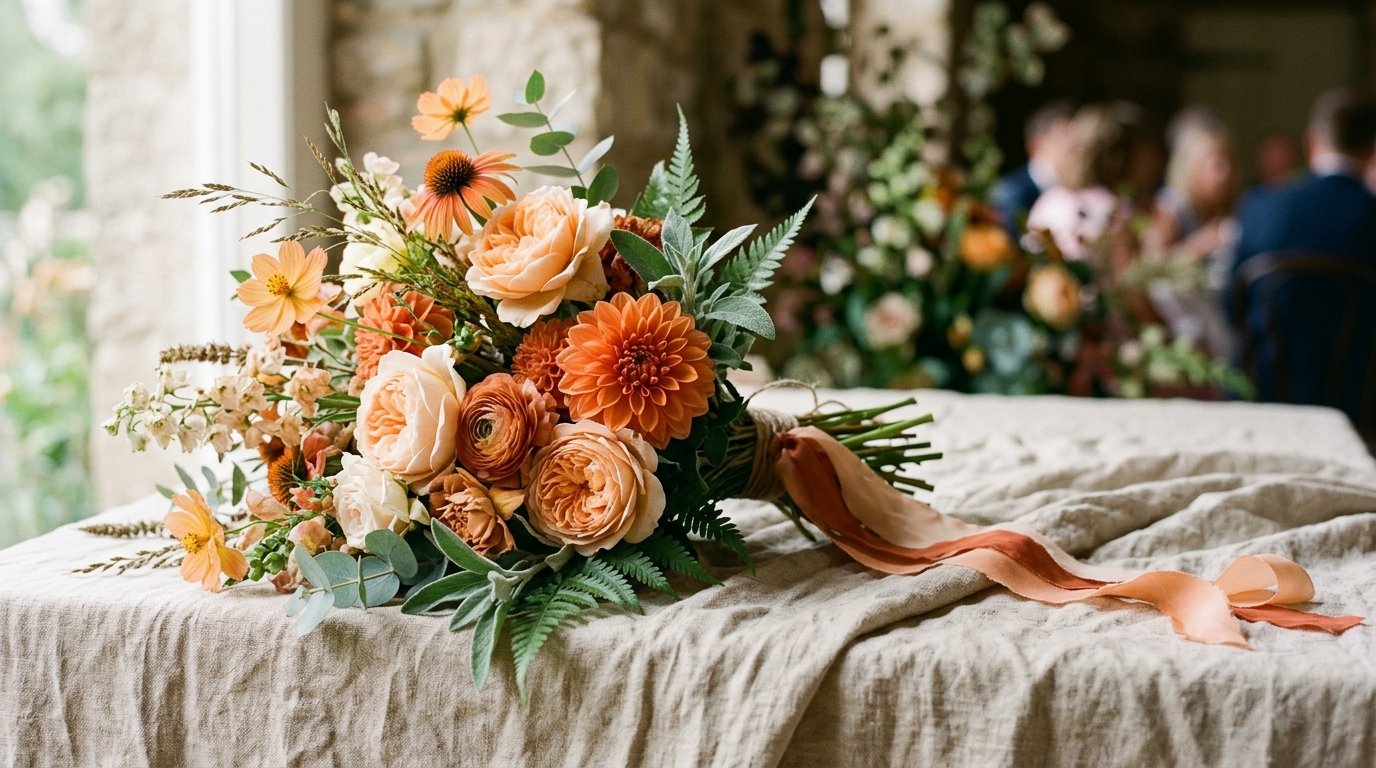
Amber and copper dahlias
The defining flowers. Dahlia varieties in amber, copper, and warm orange — ‘Preference,’ ‘Emory Paul,’ ‘David Howard,’ and ‘Warm Wishes’ — capture the exact shade. They are UK-grown and at peak availability August through October. The flower structure — large, layered, and architectural — creates impressive centrepieces and bouquets.
UK price: £2.50-£5.50 per stem in season. Out of season, Dutch imports are available but typically £1-£2 more per stem.
Apricot and amber garden roses
David Austin’s ‘Wren,’ ‘Olivia Rose Austin,’ and ‘Leah’ in their apricot-amber expressions carry the golden-orange note without tipping into coral. These are among the most photographed rose varieties in UK wedding florals currently. Available year-round from specialist UK florists.
UK price: £4-£8 per stem for David Austin varieties.
Orange lisianthus
Lisianthus in orange and deep apricot — ruffled, peony-like, and long-lasting — is a florist’s practical choice for this palette. Available year-round and relatively robust. The layered petals catch light in a way that single-petal flowers do not.
UK price: £2.50-£4 per stem.
Golden spray chrysanthemums
Often overlooked in favour of more fashionable flowers, golden chrysanthemums in amber and warm orange are the reliable filler flower of this palette. They are inexpensive, long-lasting, and genuinely match the Verona sunset colour.
UK price: £1.50-£2.50 per stem.
Marigolds
Both English pot marigolds (calendula in orange and amber) and larger African marigolds in deep orange work in this palette. Marigolds have been rehabilitated from their association with cheap summer borders — in well-composed wedding florals, they read as genuinely warm and abundant. UK season May-October. Price: 50p-£1.50 per stem.
Sunflowers
A polarising choice — some couples find sunflowers too casual. In the right setting (outdoor, rustic, relaxed), smaller sunflower varieties like ‘Teddy Bear’ (compact, globe-shaped, amber-orange) work beautifully in this palette. Price: £1.50-£3 per stem.
See our elongated stem bouquets guide for how to arrange these flowers in the current extended-handle style.
Colour pairings
With dark wood and aged brass
The most successful combination in UK wedding photography using this palette. Aged brass candleholders and cutlery, dark walnut or oak wood tables, and the warm orange of the florals create an atmosphere that references old Italian hotels and supper clubs. The metal tones amplify the gold undertone in the orange.
With olive green
Olive green — specifically the grey-green of Mediterranean foliage — is the natural foliage partner for this palette. Olive branches, eucalyptus in its grey-green form, and trailing ivy in muted green tones all complement rather than compete.
With warm ivory
The bride’s gown in warm ivory (as opposed to cool white) sits within this palette. Stark white competes with the orange; warm ivory bridges the gap. For bridesmaids, ivory or champagne can serve as the neutral base alongside one or two dresses in the amber-orange range.
What to avoid
Cool grey, silver, and stark white all fight this palette. Navy and royal blue clash sharply. Black works in small doses (black candles, black tableware accents) but risks killing the warmth of the palette if overused.
Dress and bridesmaid styling
The bride’s gown
Most brides within this palette choose warm ivory or champagne rather than white. An ivory or champagne gown positions the bride within the palette rather than outside it. Several 2025-2026 bridal collections include amber and apricot lining details on ivory gowns — a practical expression of this palette.
The Halfpenny London 2026 collection included two gowns in what the brand described as “apricot gold” silk — a direct match for this palette. The Phillipa Lepley atelier has also produced bespoke gowns in amber silk satin on request.
Bridesmaid dresses
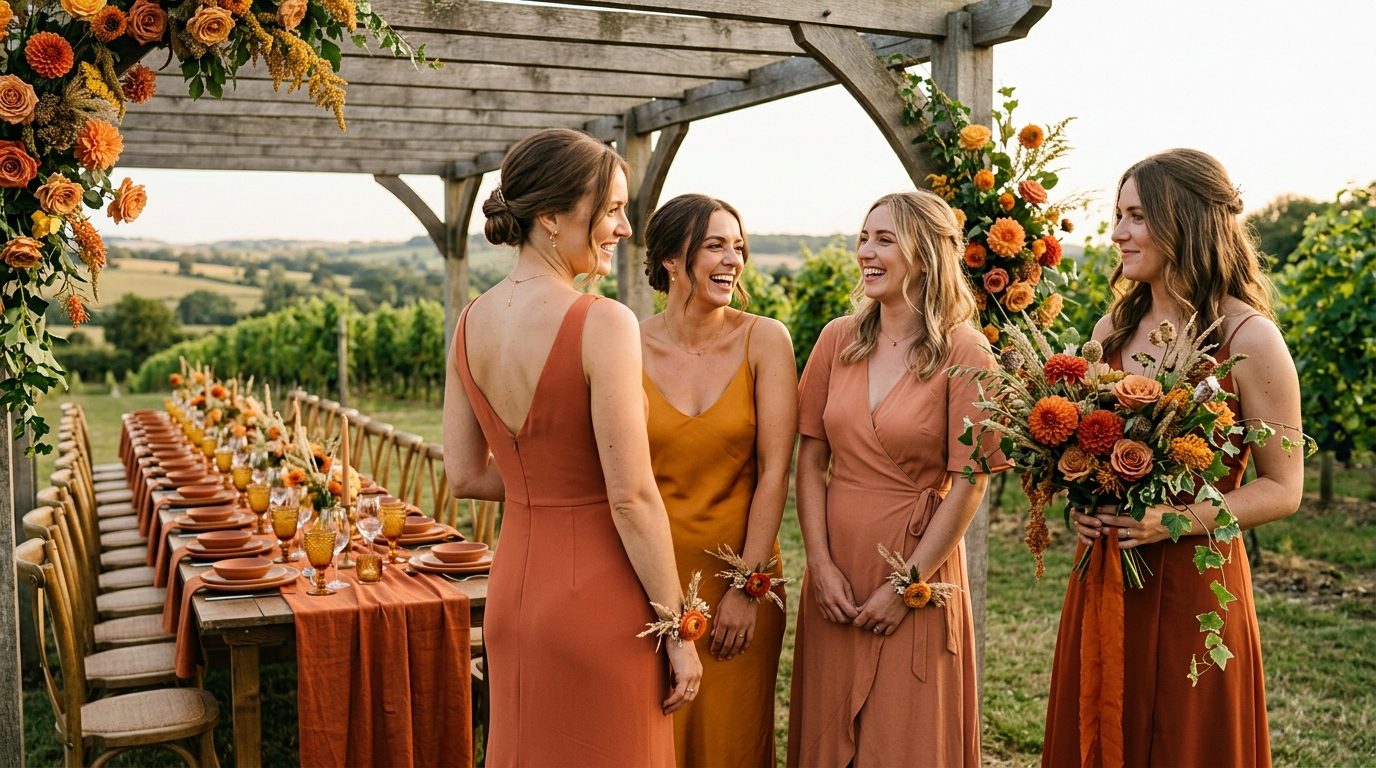
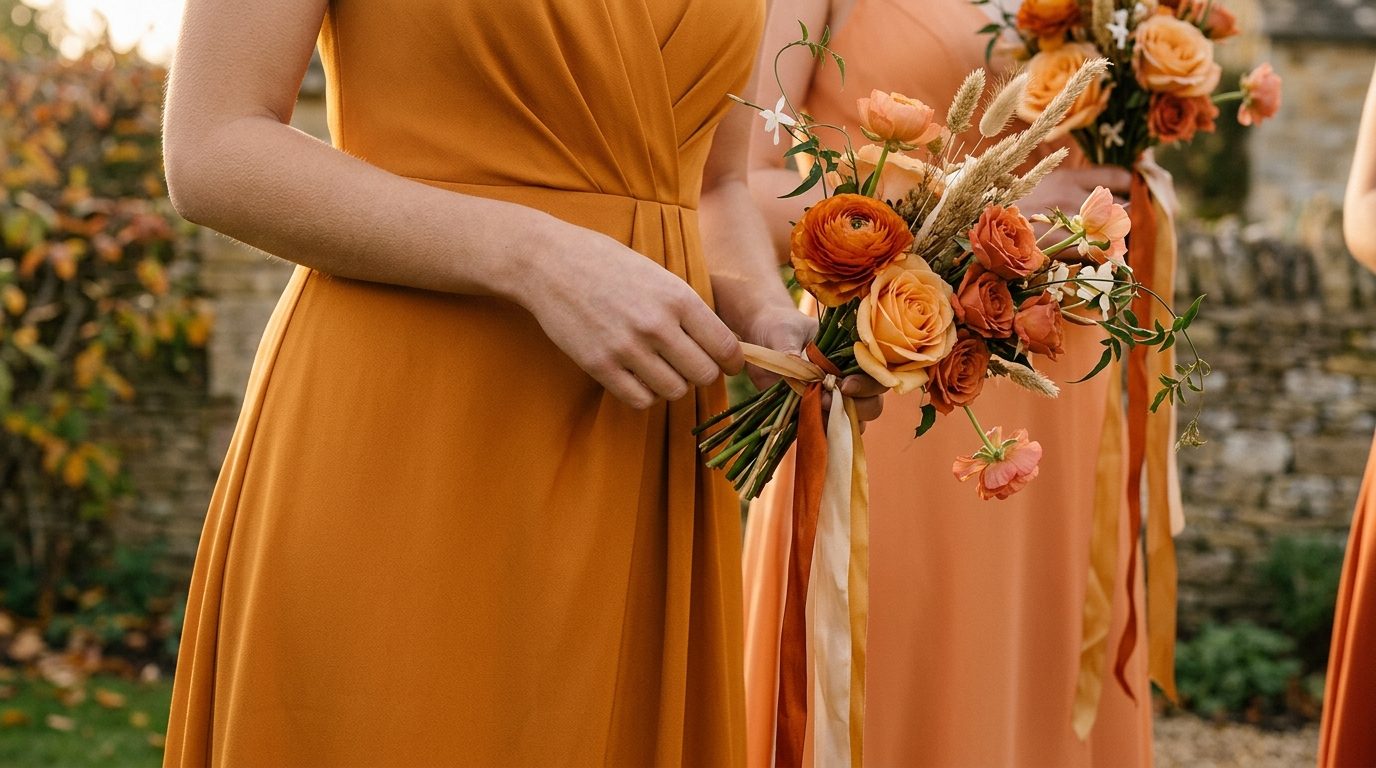
Burnt orange, amber, and deep apricot midi or maxi dresses are the most natural bridesmaid choice. Current UK options include:
- ASOS Edition — burnt orange satin midi from approximately £75-£95
- Reiss — amber satin column dress at approximately £220-£280
- Ghost — deep apricot silk-feel dress at approximately £150-£190
- Needle & Thread — amber and apricot styles with embellished details for a more formal version of the palette, from approximately £350-£550
A staggered approach works well: one or two bridesmaids in deep amber-orange, one or two in warm ivory or champagne. The resulting photograph has both the warmth of orange and the lightness of ivory.
Venues that suit this palette
Cotswolds and limestone-belt manor houses
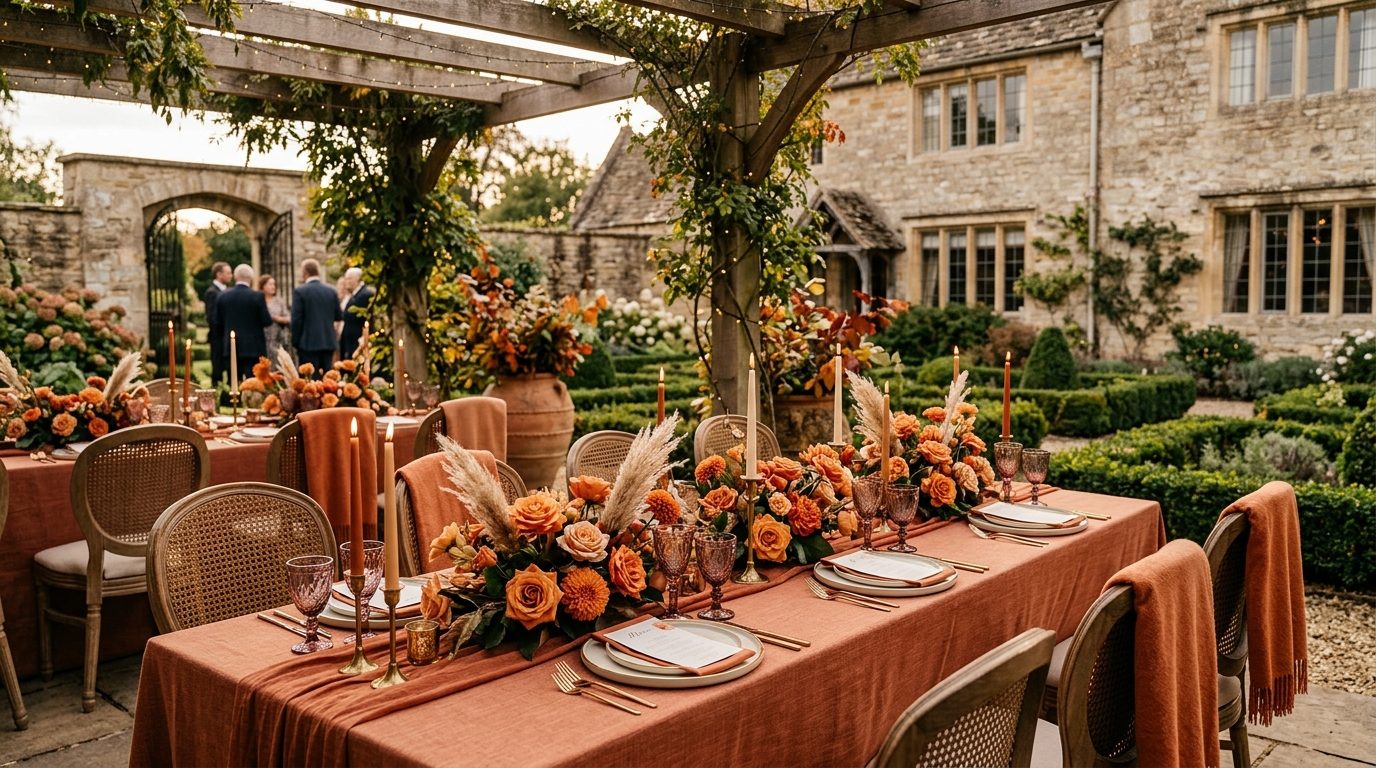
Cotswold stone — the honey-coloured oolitic limestone of the region — amplifies the golden undertone of this palette. The warm stone, the late summer light, and the amber-orange flowers create a coherent visual world. Elmore Court, Cripps Barn, and Caswell House in Oxfordshire are frequently cited as natural settings for this palette.
Italian-inspired and Mediterranean venues
UK venues that have been designed to evoke Mediterranean character — terracotta tiles, vine-covered stone walls, garden pergolas — are the best settings for the Verona reference embedded in the palette name.
Outdoor evening ceremonies
The palette’s strongest expression happens at the exact moment when the actual sunset light meets the ambient colour scheme. A 4pm September ceremony in an outdoor Cotswolds garden, finishing with golden hour photographs at 7pm, creates the most powerful version of this palette. Planning the ceremony time specifically to capture golden hour light is worth doing.
Farm and barn venues with warm interior lighting
Warm tungsten and candlelight deepens orange tones. A barn reception with Edison-bulb string lights and pillar candles on tables will intensify the amber-orange palette throughout the evening. See our barn wedding venues guide for specific recommendations.
Table styling
Linens: Warm ivory, dusty amber, or natural linen. Warm-toned table runners over cream or ivory cloth. Avoid white.
Vessels: Aged brass urns, copper pots, warm bronze metallic vases, or rough terracotta. Any warm metal tone works. Silver and chrome do not.
Candles: Amber, warm orange, and deep gold taper candles. Pillar candles in cream or warm ivory. The candlelight itself adds orange warmth to the table.
Stationery and signage: Warm ivory card stock with deep amber or rust-orange lettering. Hand-lettered in gold ink on amber card works particularly well for table numbers and menu cards.
Related articles
Frequently asked questions
What is Verona sunset orange as a wedding palette?
Verona sunset orange is a warm, golden-orange wedding colour palette that references the late-afternoon light of a northern Italian evening — deeper and richer than coral, less brown than terracotta. It combines amber, apricot, deep orange, and warm gold in a palette that is maximally warm without tipping into Halloween orange.
How is Verona sunset orange different from terracotta or coral?
Terracotta is earthier and more brown-tinted. Coral is lighter and pinker. Verona sunset orange sits between the two — it has the warmth of terracotta but the luminosity of coral. The key distinguishing feature is the gold undertone: it reads as amber-orange in daylight and golden-orange in candlelight.
What flowers suit a Verona sunset orange wedding?
Amber and copper dahlias, apricot garden roses, orange lisianthus, coral gerberas, golden spray chrysanthemums, and marigolds. Supplementary flowers in warm yellow — sunflowers, yellow ranunculus — add light to the arrangement without clashing.
What does a Verona sunset orange bridesmaid dress look like?
Burnt orange, amber, or deep apricot midi or maxi dresses. Most UK bridal boutiques have an orange or amber option in their satin and chiffon bridesmaid ranges. The exact shade matters — too red reads as tomato, too yellow reads as mustard. The target is golden amber-orange.
What venues suit this palette?
Warm-stone venues in the Cotswolds, Devon, and Cornwall; Italian-inspired gardens; converted farmhouses; and outdoor evening ceremonies anywhere. The palette is at its best when the actual sunset light reinforces the colour scheme — so late afternoon start times are worth planning for.
What time of year is best for this palette?
August through October. The palette is at its most natural when the light quality matches — golden late-summer and early-autumn light complements the warm orange tones. The flowers are also UK-seasonal: dahlias and marigolds peak August to October.