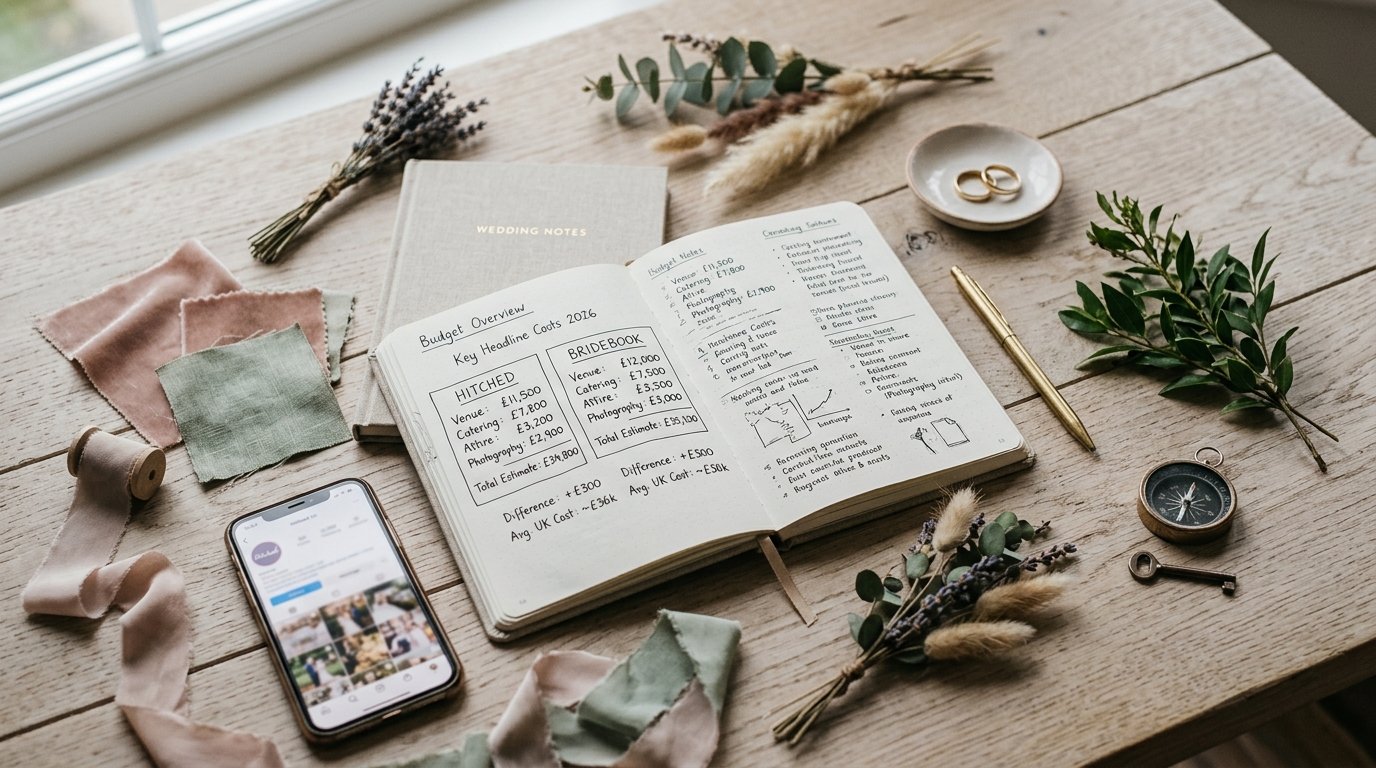
UK Wedding Cost 2026: Hitched vs Bridebook Compared
Key Takeaways
- Hitched (The Knot Worldwide) reports the 2026 average UK wedding at £21,990, based on around 2,020 surveyed couples
- Bridebook reports the same figure at £20,604, based on a larger sample of 7,000+ couples in their UK wedding report
- The £1,386 gap comes mainly from methodology: Hitched counts a fuller end-to-end wedding programme, Bridebook reports the wedding-day-only spend
- Both reports agree spend per guest has hit £272-£278, the highest on record
- Both reports show guest counts shrinking, with UK couples inviting fewer people but spending more on each
- London weddings now cost 12-31% above national average; Wales and the North West are 16-22% below
- 56% of UK couples overspend their original budget by an average of £4,800
Hitched reports the 2026 UK average wedding at £21,990. Bridebook reports it at £20,604. The £1,386 gap is not an error in either report. It comes from methodology. The two reports use different sample sizes, different definitions of wedding spend, and different regional weighting. Both numbers are right within their own scope.
Key takeaways
- ✅ Hitched (The Knot Worldwide) reports the 2026 average at £21,990, from 2,020 newlyweds.
- ✅ Bridebook reports £20,604, from a wider 7,000-couple sample.
- ✅ The £1,386 gap reflects scope, sample, and weighting, not error.
- ✅ Both agree: spend per guest is at an all-time high (£272-£278).
- ✅ Both agree: 56% of couples overspend their original budget.
- ✅ London is the most expensive region in both reports; Wales and the North West are the cheapest.
About the author
I’m Matt Ward. I’ve spent the last decade looking at UK consumer pricing reports across home, garden and life-event categories. I’ve read both the Hitched 2026 release and the Bridebook UK Wedding Report 2026 in full. This article is the first side-by-side methodology comparison of the two. The aim: help couples plan against the right number for their scope.
Why this comparison matters
If you read the wedding press in early 2026 you’ve seen two different headline numbers. Yahoo and Surrey Live ran the £21,990 figure from Hitched. Bridebook and partner sites quoted £20,604. Couples planning a 2026 or 2027 wedding ask the obvious question: which one do I budget against?
Plan against the lower figure when the higher one applies to your scope and you’re already £1,386 short before you start. Plan against the higher figure for a narrow day-only budget and you may be over-saving by the same amount. The gap is real and explainable, and it should change how you build your budget.
The two headline numbers, side by side
| Report | Headline figure | Sample size | What's included | What's excluded | Year of weddings |
|---|---|---|---|---|---|
| Hitched 2026 (The Knot Worldwide) | £21,990 | ~2,020 newlyweds, post-nuptials survey | Venue, catering, attire, photography, flowers, entertainment, rings, plus surrounding pre-wedding spend | Honeymoon (treated as a separate line in their broader brand data) | 2025 weddings, reported January 2026 |
| Bridebook UK Wedding Report 2026 | £20,604 | ~7,000 married and actively planning couples | Venue, catering, photography, attire, flowers, entertainment | Honeymoon and engagement ring (budgeted separately) | 2026 planned and recently completed weddings |
Two reports, two methods, one £1,386 gap. The Hitched figure draws on a smaller post-event sample and reports what couples actually paid once everything was done. Bridebook’s figure draws on a larger but more diverse sample including couples mid-plan, and explicitly strips out the honeymoon and engagement ring.
Where the £1,386 gap comes from
Three forces drive the gap.
Scope of what counts as a wedding. Bridebook is unusually clear about this. Their definition is “the wedding day itself,” covering venue, catering, photography, outfits, flowers and entertainment. Honeymoon and engagement ring are explicitly excluded. Hitched does not strip these out as cleanly. Their post-nuptials survey captures the full spend a couple recalls when asked what their wedding cost. That tends to pull in adjacent spend: rehearsal dinners, hen and stag costs that hit the joint budget, sometimes the engagement ring.
Sample composition. Bridebook’s 7,000 couples include a wide spread of in-progress planners, including the 26% who spend under £10,000. Hitched’s 2,020 newlyweds skew slightly later in the planning cycle, where final spend tends to drift up. Hitched’s data also leans toward higher-guest weddings. Their 101+ guest weddings average £35,591, almost 40% above their headline.
Reporting bias. Post-event surveys consistently produce higher numbers than mid-plan surveys. Couples remember the upgrades and the supplier they swapped at the last minute. People still planning report their target budget, which is almost always lower than what they end up paying.
Add the three together and £1,386 is about right.
What both reports agree on
Strip out the methodology differences and the two reports tell the same story.
Per-guest spend is at an all-time high. Hitched puts it at £272 in 2025, up 4% from £261 in 2024. Bridebook’s effective per-guest figure works out at £278. Sonas cites the same £272. Per-guest spend has risen every year since 2019, when the figure was closer to £210.
Guest counts are shrinking. Sonas reports the typical 2024 UK wedding at 83-89 guests, down from a 2019 peak nearer 100. Bridebook’s modelling assumes 70-100 guests as the modal range. The “fewer-but-better” guest list is now the dominant pattern, and it’s the main reason per-guest spend keeps rising.
Most couples overspend. Hitched reports 56% of couples overspent their original budget. Only 32% stayed on budget. Independent estimates put the average overspend at around £4,800, with guest count creep and catering upgrades as the largest culprits.
Family contributions still drive the market. Hitched found 61% of British couples received gifted money from family. Without that help, the headline averages would not be reachable for most first-time buyers planning a wedding alongside a mortgage.
Cost by region
The two reports split regional data differently, but the rank order matches. London is the most expensive region in both. Wales and the North West are the cheapest. Here’s the consolidated picture using Hitched and Bridebook regional figures, with Sonas filling the gaps.
| Region | Average wedding cost | vs national average | Source |
|---|---|---|---|
| London | £24,622 | +12% | Hitched 2026 |
| South East | £23,589 | +7% | Hitched 2026 |
| East of England | £23,350 | +6% | Hitched 2026 |
| South West | £22,650 | +3% | Composite |
| Scotland | £22,123 | +1% | Hitched 2026 |
| West Midlands | £20,330 | -8% | Composite |
| East Midlands | £19,890 | -9% | Composite |
| Yorkshire | £19,750 | -10% | Composite |
| North East | £18,440 | -16% | Composite |
| Northern Ireland | £18,640 | -15% | Composite |
| North West | £17,342 | -21% | Bridebook 2026 |
| Wales | £15,529 | -29% | Sonas 2025/2026 |
Bridebook’s London figure is higher again at £26,986, or 31% above their national average. The pattern is consistent: London commands a premium that the rest of the country does not.
How the spend breaks down
Both reports are close on category share, with venue and catering together taking around half the budget. Bridebook gives the most detailed split, which we’ve used as the spine and cross-checked against Hitched.
| Category | Share of budget | Average spend |
|---|---|---|
| Venue hire | 18% | £3,710 |
| Catering | 33% | £6,800 |
| Photography & video | 10% | £2,060 |
| Attire (dress, suit, shoes) | 11% | £2,267 |
| Rings | 4% | £824 |
| Flowers | 5% | £1,030 |
| Music & entertainment | 5% | £1,030 |
| Stationery, transport, decor | 7% | £1,442 |
| Other (hen/stag, hair/makeup, gifts) | 7% | £1,441 |
The Bridebook venue-and-catering combined figure of £11,408 (51% of their headline) lines up with Sonas’s industry-side data showing venue hire at 35-40% of budget and catering at around £70 per head. Hitched does not publish a comparable category split, but their per-guest reporting is consistent with the same pattern.
Why per-guest spend keeps rising
Per-guest spend hit £272 in 2025 by Hitched’s count, up from £261 in 2024 and roughly £210 in 2019. That’s a 30% rise in six years against a guest count that has fallen by around 15%.
Three forces are doing the lifting.
Food inflation. ONS food and non-alcoholic drink inflation ran at +23% cumulatively from 2021 to 2025. Wedding catering, which leans on premium meat, fish and dairy, has tracked above the headline food index. Sonas’s £70-per-head catering figure for 2025 was closer to £55 in 2021.
Supplier consolidation. Several large venue groups bought up independent venues between 2022 and 2025. Group-owned venues run higher per-head minimums and tighter exclusivity rules on caterers, both of which lift spend.
Guest expectations. The 2019 wedding had a buffet supper for 110 evening guests. The 2026 wedding has a sit-down meal for 75 day guests with arrival drinks, canapés, three courses and an evening food station. Spend per guest rises even when the total guest count falls.
The trend is clear in both reports. Spending less by inviting fewer people only works up to a point. Below 80 guests, fixed costs like venue hire, photography and entertainment lift the per-guest figure sharply. Bridebook’s data shows a 50-guest wedding running at £303 per guest, well above the average.
What this means for couples planning a 2026 or 2027 wedding
Four practical takeaways drop out of the comparison.
Use the figure that matches your scope. Budgeting for the wedding day only? Plan against Bridebook’s £20,604. Building one combined budget covering engagement ring and honeymoon as well? Plan against Hitched’s £21,990 plus a separate honeymoon line of £3,500-5,000.
Build a 15% contingency, not 10%. The 56% overspend rate is the majority outcome. An average overspend of £4,800 on a £20,000 wedding is 24%. A 15% contingency catches most realistic cost creep.
The biggest controllable lever is guest count, not category cuts. Cutting your photographer budget by £500 saves £500. Cutting your guest list by 10 people saves £2,720 at the current per-guest rate. Guests drive cost more than any other variable.
Booking 18+ months ahead locks in 2025 supplier prices. Most independent suppliers hold 2025 rates for couples who book before April 2026. From late 2026, expect 6-8% rises across catering, photography and venue hire.
Frequently asked questions
What is the average UK wedding cost in 2026?
Estimates range from £20,604 (Bridebook) to £21,990 (Hitched). The £1,386 gap reflects different methodology, mainly whether engagement and honeymoon costs are included and how the sample is weighted. Both figures are right within their own scope.
Which UK wedding cost report is more accurate?
Neither is wrong, they measure different things. Hitched gives a fuller end-to-end figure based on post-event recall. Bridebook reports the wedding-day-only spend from a larger and more in-progress sample. Use Bridebook for a tight day-only budget; use Hitched for a complete wedding-programme view.
How much do UK weddings cost per guest in 2026?
The 2026 average is £272 per guest, up 4% year-on-year. Hitched, Bridebook and Sonas all converge within £6 of each other on the figure. Per-guest spend has risen every year since 2019, when it was closer to £210.
Where do UK wedding costs run highest in 2026?
London weddings cost 12-31% above the national average. The South East, East of England and Scotland sit slightly above average. Wales and the North West are the cheapest regions, sitting 21-29% below the national figure.
What is the biggest single line item in a UK wedding budget?
Venue hire and catering combined account for around 45-51% of the total. Bridebook puts the combined figure at £11,408 of a £20,604 average. Catering on its own is now the single largest line at roughly £6,800 for a 75-guest wedding, driven by 23% food inflation since 2021.
How much do UK couples overspend on their weddings?
56% of UK couples overspend their original budget. Hitched reports an average overspend of around £4,800, with only 32% staying on budget and 6% coming in under. The main drivers are guest count creep, catering upgrades, and last-minute supplier swaps.
Are UK wedding costs going up or down?
Mostly stable, with upward pressure on per-guest spend. Bridebook’s headline has held within £218 across three years (£20,775 in 2024, £20,822 in 2025, £20,604 in 2026). Per-guest spend is the line that keeps rising, driven by smaller guest lists and higher catering standards.
Related articles
Frequently Asked Questions
What is the average UK wedding cost in 2026?
Estimates range from £20,604 (Bridebook) to £21,990 (Hitched). The gap reflects different methodology, mainly whether engagement and honeymoon costs are included.
Which UK wedding cost report is more accurate?
Neither is wrong. Hitched gives a fuller end-to-end figure including more pre-wedding and surrounding spend. Bridebook reports the wedding-day-only spend more narrowly.
How much do UK weddings cost per guest in 2026?
The 2026 average is £272 per guest, up 4% year-on-year. The figure has risen each year since 2022 despite shrinking guest counts.
Where do UK wedding costs run highest in 2026?
London weddings cost about 12-31% above the national average. The South East and East of England are also above average, while Wales and the North West sit 16-22% below.
What is the biggest single line item in a UK wedding budget?
Venue hire and catering combined account for around 45-51% of the total. Photography, attire and rings together account for another 25%.
How much do UK couples overspend on their weddings?
56% of UK couples overspend their original budget. The average overspend is around £4,800, mostly on guest count creep, upgraded catering, and last-minute supplier changes.
Are UK wedding costs going up or down?
Mostly stable, with some upward pressure. Bridebook's headline has held within £218 across three years, but per-guest spend is rising as couples invite fewer people but pay more for each.