Outdoor Weddings: Beautiful But Plan for Rain
Key Takeaways
- Outdoor civil ceremonies are legal in England and Wales since 2022 — but only at licensed venues, not your own garden
- A rain plan is non-negotiable: 60% of UK summer days have some rainfall, even in July and August
- Marquee hire costs £2,000-£6,000 for 80-100 guests — add flooring, furniture, lighting, and power for a total of £4,000-£10,000
- The realistic outdoor wedding window in the UK is May to September, with June-August offering the longest daylight and warmest temperatures
- Toilets, power supply, and ground conditions are the three logistics that trip up first-time outdoor wedding planners
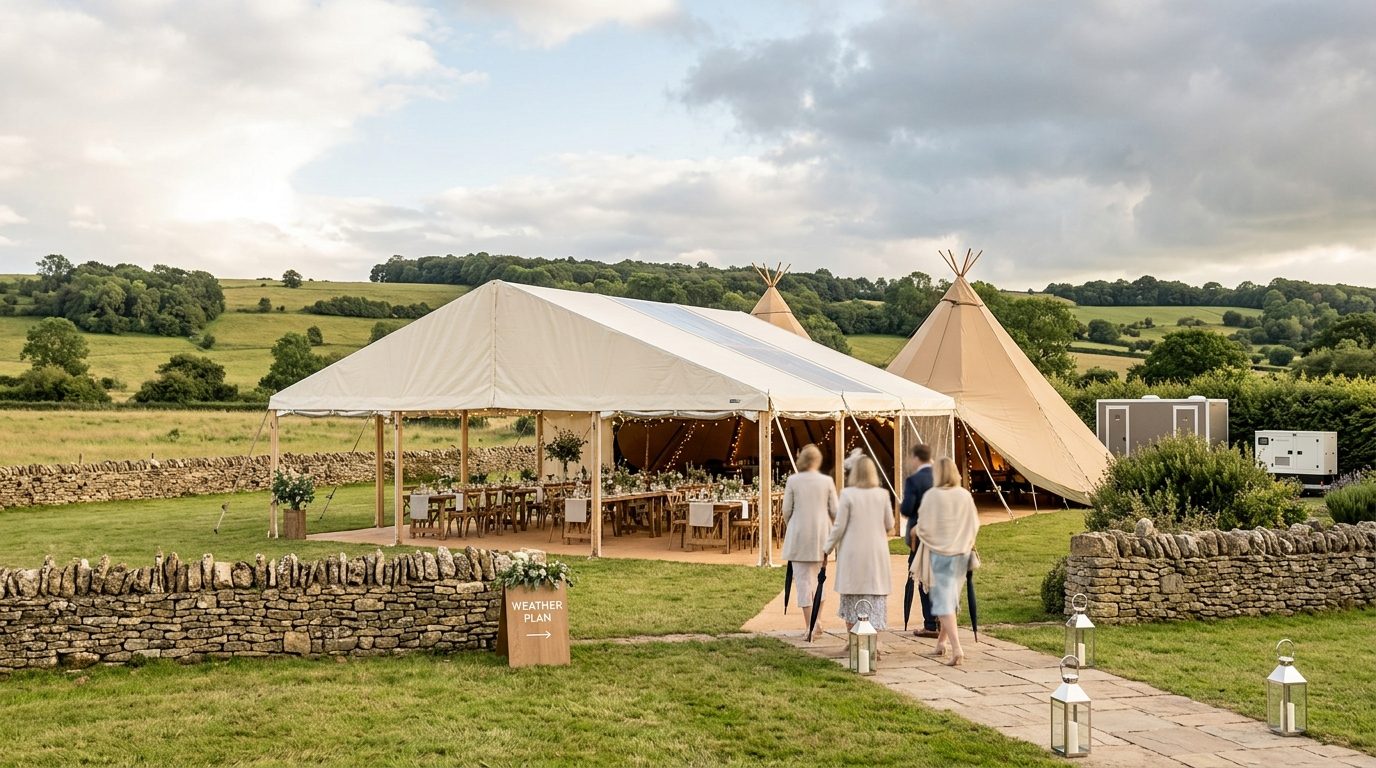
An outdoor wedding in the UK is a calculated risk that pays off spectacularly when the weather cooperates. Blue sky, green grass, golden light — no four walls can compete with the English countryside on a good day.
On a bad day, you are standing in a field in the rain. This guide covers how to plan an outdoor wedding that works in every weather scenario, what it costs, what is legally required, and the logistics that first-time planners underestimate.
Can you legally get married outdoors in the UK?
Yes — but with conditions.
England and Wales
Since 2022, civil ceremonies can take place in the open air at licensed venues. The change came after the COVID-era temporary permissions were made permanent. The outdoor space must be covered by the venue’s Approved Premises Licence.
What this means in practice:
- You can marry outdoors at a stately home, country estate, hotel garden, or any venue whose licence covers their outdoor space.
- You cannot marry in your own garden, a public park, a beach, or a random field — the location must hold an Approved Premises Licence.
- The registrar must be satisfied that the ceremony can be conducted with dignity. Excessive wind, rain, or noise may cause them to move the ceremony indoors.
Scotland
Scotland has allowed outdoor marriages since 2002. Civil and religious ceremonies can take place almost anywhere — including gardens, beaches, forests, and mountaintops. The couple applies for a Marriage Schedule, not the venue. This makes Scotland the most flexible option in the UK for outdoor ceremonies.
Northern Ireland
Ceremonies must take place in approved venues. Outdoor ceremonies are possible at venues whose approval covers outdoor spaces, but the choice is more limited than in England, Wales, or Scotland.
The register office backup
If your preferred outdoor location is not licensed for ceremonies, the practical option is a quick register office ceremony (£57-£120) followed by a non-legal outdoor celebration. Many couples do this — the legal paperwork happens at the register office in the morning, and the “real” ceremony with personal vows happens outdoors in front of all the guests.
Weather: the non-negotiable conversation
British weather does not care about your wedding date. Even in July, the warmest month, there is a 50-60% chance of some rainfall on any given day. Planning for rain is not pessimism — it is basic competence.
Average UK summer weather
| Month | Average High | Rainfall Days | Sunset |
|---|---|---|---|
| May | 15-17C | 10-12 | 8:45pm |
| June | 17-20C | 9-11 | 9:20pm |
| July | 19-22C | 9-12 | 9:10pm |
| August | 19-21C | 10-12 | 8:30pm |
| September | 16-18C | 10-12 | 7:15pm |
Source: Met Office 30-year averages, central England.
Key takeaway: Even the best months have rain on roughly every third day. The temperature drops sharply after sunset — by 9pm in August, it can be 12-14C. Evening guests will need warmth.
Your rain plan checklist
Every outdoor wedding needs answers to these questions:
- Where does the ceremony move if it rains? (Indoor room, marquee, covered structure)
- Who makes the rain call, and when? (Venue coordinator, 2 hours before ceremony)
- Where do guests shelter during a heavy shower between ceremony and reception?
- Is the marquee/tipi large enough for the ceremony AND reception if both move indoors?
- What happens to the ground if it rains for 48 hours before the wedding? (Mud, access, parking)
Marquee, tipi, or clear-span: which structure?
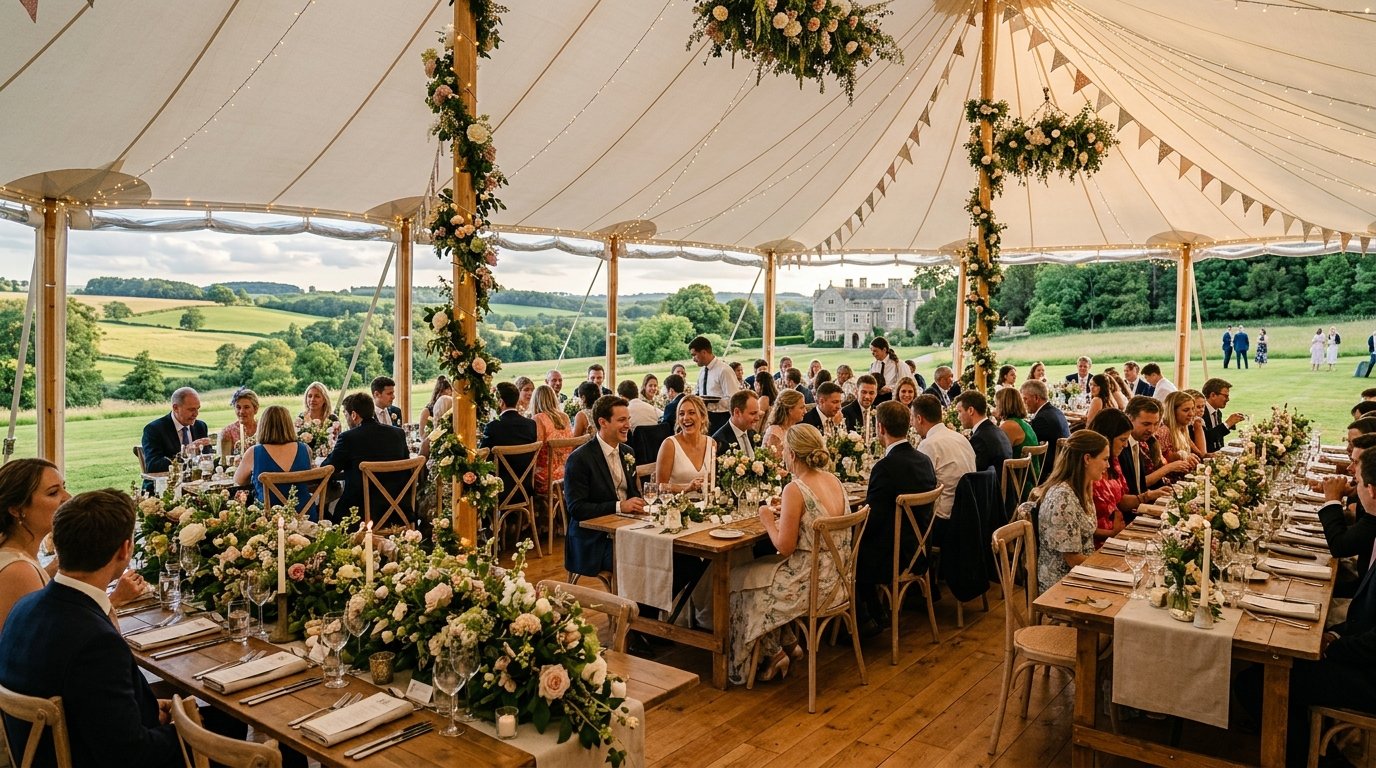
The structure you choose defines the look, the feel, and a significant portion of the cost. Here is how they compare.
Structure comparison
| Type | Hire Cost (80 guests) | Total Cost (with floor, furniture, lighting) | Best For |
|---|---|---|---|
| Traditional pole marquee | £2,500-£4,000 | £5,000-£8,000 | Classic, elegant, garden parties |
| Tipi / kata tent | £2,000-£4,000 | £4,500-£8,000 | Bohemian, festival, relaxed |
| Clear-span marquee | £4,000-£7,000 | £7,000-£12,000 | Modern, no centre poles, maximum space |
| Stretch tent | £1,500-£3,000 | £3,500-£6,000 | Organic shape, informal, works with uneven terrain |
| Sailcloth tent | £3,000-£5,500 | £5,500-£9,000 | Translucent fabric, natural light, elegant |
Traditional pole marquee
The classic white marquee with internal poles and guy ropes. Lined interiors give a clean, formal look. Requires flat ground and guy rope space around the perimeter.
Pros: Widely available, familiar look, good value. Cons: Centre poles can block sightlines. Needs flat ground. Guy ropes take up space.
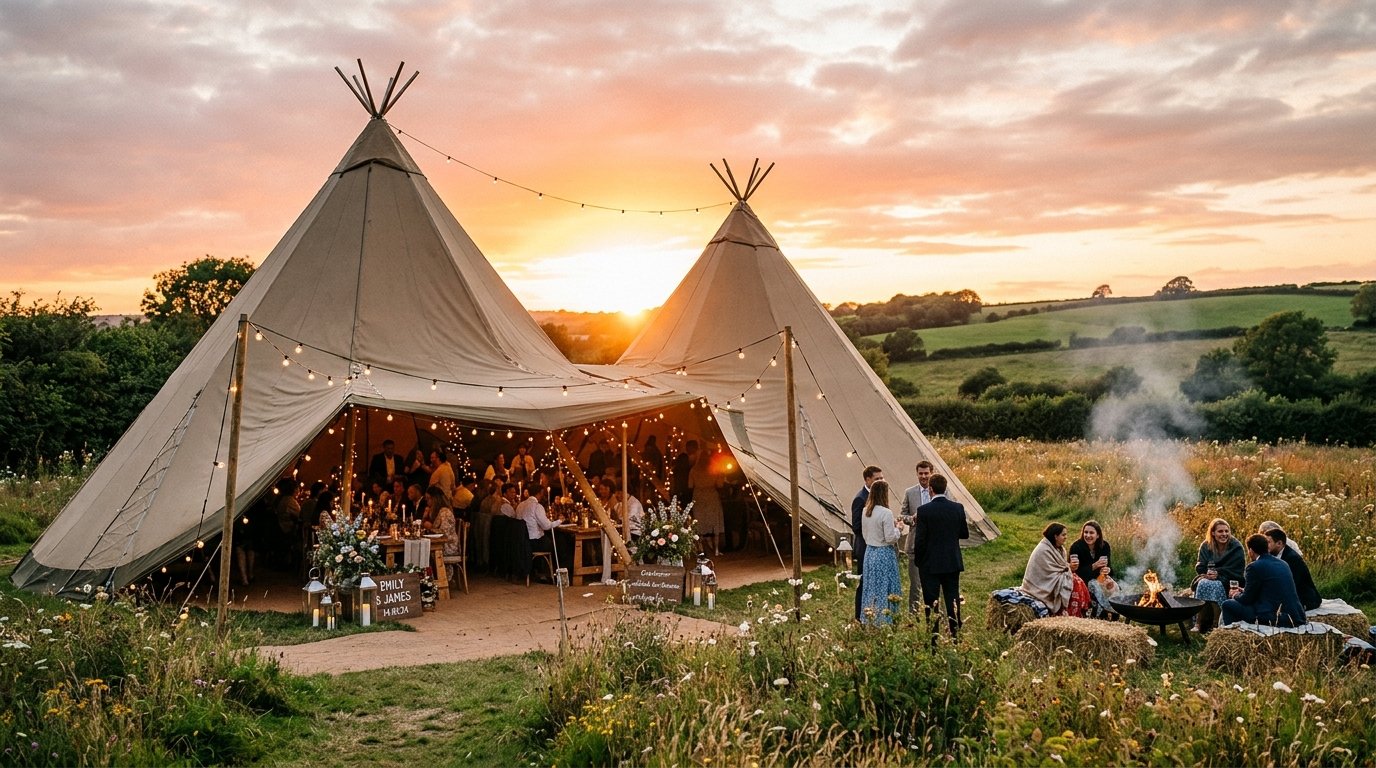
Tipi / kata tent
Scandinavian-style conical tents, usually connected in clusters. Exposed wooden poles, open fire pit in the centre (where permitted), natural canvas.
Pros: Distinctive look, festival atmosphere, works on sloped ground. Cons: Centre poles reduce usable floor space. Open sides mean less weather protection. The fire pit cannot always be used (fire regulations).
Clear-span marquee
Aluminium-framed structures with no internal poles. Maximum usable floor space. Often used for corporate events, which means they can look formal.
Pros: No poles, clean sightlines, strong in wind, modular sizing. Cons: Most expensive option. Can look corporate without styling. Heavy framework requires vehicle access for installation.
What the total cost includes
The hire fee covers the structure itself. Everything else is extra:
| Item | Cost Range |
|---|---|
| Flooring (wooden, carpet, or matting) | £500-£2,000 |
| Furniture (tables, chairs, bar) | £500-£1,500 |
| Lighting (festoon, uplighters, chandelier) | £300-£1,000 |
| Lining (interior fabric) | £300-£800 |
| Heating (for evening/autumn weddings) | £200-£600 |
| Power (generator or mains connection) | £200-£500 |
| Delivery, installation, and removal | Often included in hire |
The practical logistics
Ground conditions
The ground under your marquee and around your venue needs to support structures, vehicles, and 100 guests in formal shoes.
Before booking, check:
- Drainage: Does the field flood or waterlog after heavy rain? Visit after a wet week to see.
- Gradient: Marquees need reasonably level ground. Tipis are more forgiving. A slope of more than 1 in 20 requires levelling.
- Access: Can delivery lorries, catering vans, and portable toilet trucks reach the site? Is there a hard track or only grass?
- Ground protection: Track matting (£200-£500) prevents vehicle ruts. Walkway matting keeps guests’ shoes clean.
Power supply
Outdoor venues rarely have enough mains power for a wedding. You will likely need a generator.
| Power Requirement | Typical Draw |
|---|---|
| Lighting (festoon + uplighters) | 2-5 kW |
| Catering (ovens, fridges, hot plates) | 10-15 kW |
| Band / DJ | 3-5 kW |
| Toilet trailer (heating, water pump) | 1-2 kW |
| Total | 16-27 kW |
A 30kVA generator covers most wedding setups. Cost: £300-£600 for a weekend hire. Position it at least 20 metres from the reception area — generators are noisy.
Toilets
No outdoor wedding works without proper toilet facilities. Your options:
| Type | Cost | Capacity | Best For |
|---|---|---|---|
| Standard portable | £200-£400 | 1 unit per 25-30 guests | Budget, large guest counts |
| Luxury trailer | £600-£1,200 | 2-4 cubicles per trailer | Comfortable, formal events |
| Compost toilet | £300-£500 | 1 unit per 20-25 guests | Eco-conscious, rustic |
Placement tips:
- Downwind of the reception area
- On level, hard ground if possible
- With lighting for evening use
- Accessible for servicing (the supplier needs vehicle access)
- Signed so guests can find them
Catering logistics
Outdoor catering requires more planning than indoor catering. Your caterer needs:
- Power: From the generator or a dedicated mains supply
- Water: A mains connection or a portable water tank
- Preparation space: A catering tent or gazebo adjacent to the marquee
- Refrigeration: Powered fridges or cool boxes for food safety
- Waste disposal: Bins and a plan for removing waste after the event
Read our sit-down vs buffet vs street food guide for outdoor-friendly catering options.
The drinks reception
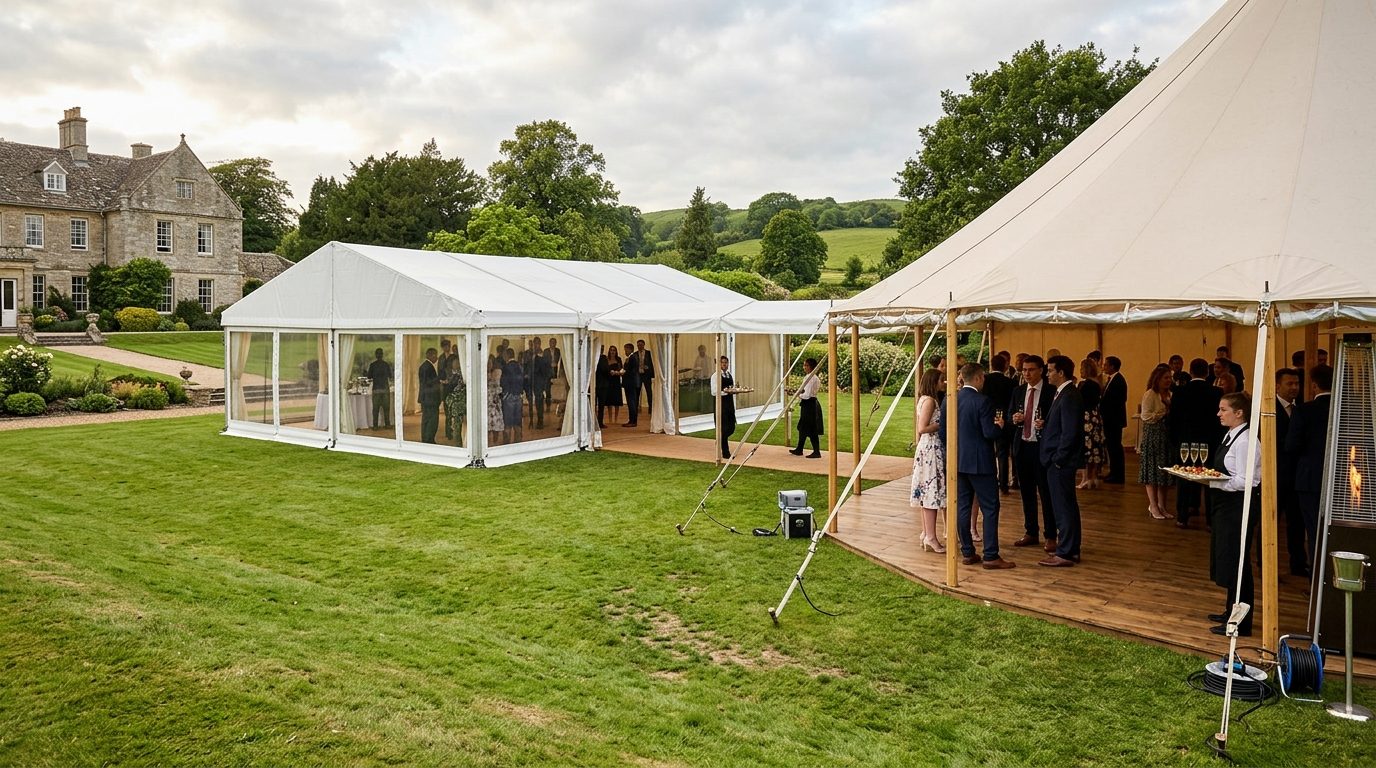
The outdoor drinks reception — that golden hour between the ceremony and the meal — is the highlight of an al fresco wedding.
Making it work:
- Timing: 60-90 minutes is ideal. Longer and guests get bored or sunburnt. Shorter and it feels rushed.
- Shade: Parasols, trees, or a stretch tent over the drinks area. Guests standing in direct sun for an hour will wilt.
- Lawn games: Croquet, pallet games, giant Connect 4, and boules keep guests entertained.
- Welcome drinks: Pimm’s, prosecco, or a signature cocktail. Budget £4-£6 per drink for 2 drinks per guest.
- Canapes: 3-5 per person. Budget £5-£10 per head.
The rain reality
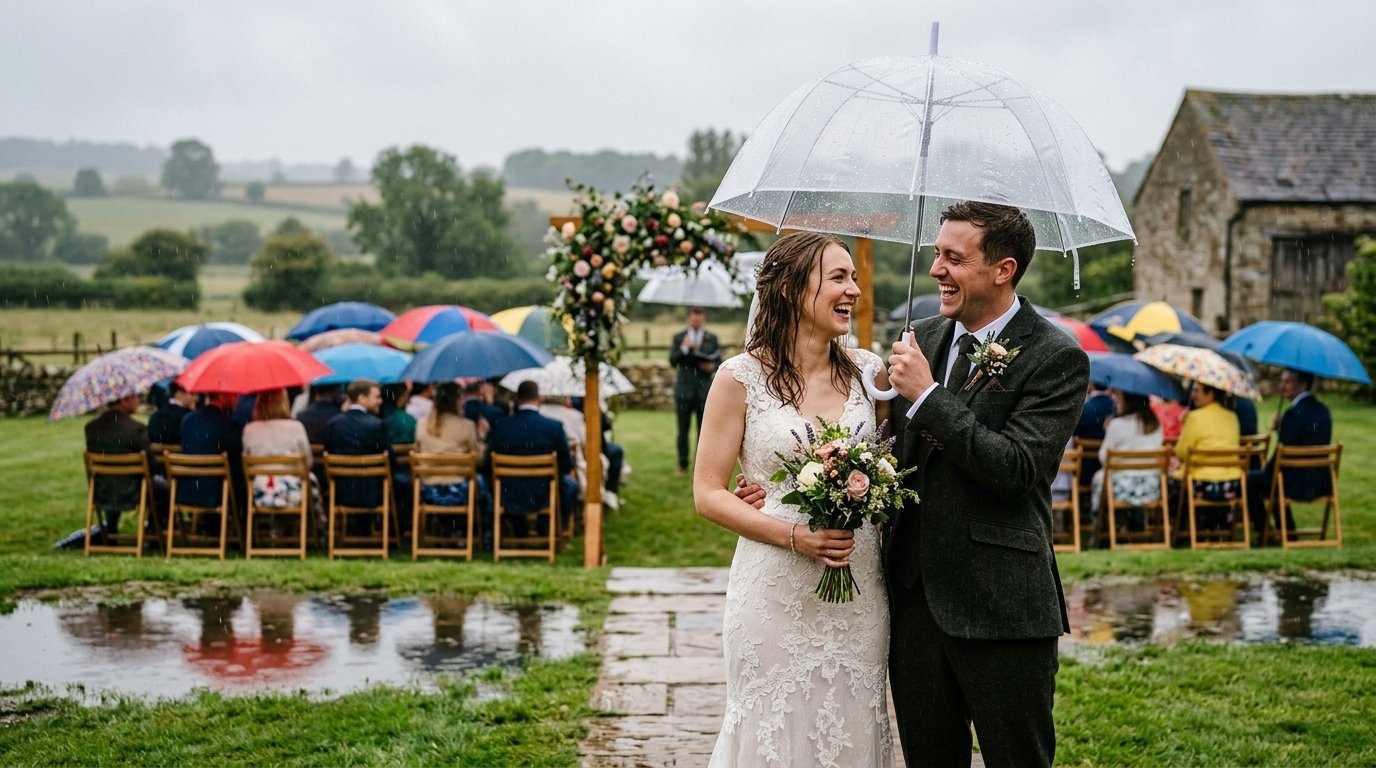
Rain at an outdoor wedding is not a disaster. It is a scenario you have planned for. The couples who panic are the ones who assumed it would not rain. The couples who laugh about it are the ones who had a plan.
If rain is forecast:
- Make the call early. If the forecast shows rain during your ceremony time, move it indoors the night before. Do not wait until the morning hoping for a miracle.
- Brief your guests. A message in the group chat or a note on the wedding website: “Ceremony will be in the marquee due to weather — everything else unchanged.”
- Embrace it for photos. Some of the most memorable wedding photos involve rain. Umbrellas, reflections in puddles, and the couple running through a downpour create images that sunny-day couples cannot replicate.
- Keep guests dry between spaces. Covered walkways, umbrellas at the ready, or a short dash to the marquee. No one minds a 10-second run. A 5-minute walk in rain ruins the mood.
Kit to have ready:
- 20-30 umbrellas (clear or white — they photograph well)
- Towels near the entrance
- Patio heaters if the temperature drops
- A Plan B seating arrangement for the indoor ceremony
Noise curfews and neighbours
Outdoor music carries further than indoor music. In rural settings, this means complaints from neighbours and potential council enforcement.
Standard noise restrictions:
- Music outdoors: Often limited to 9pm or 10pm
- Music indoors (marquee): Usually 11pm or midnight
- Amplified music: Some sites restrict volume levels (measured in decibels at the boundary)
Solutions:
- Move the party inside the marquee at curfew time
- Use a silent disco after curfew (headphones, no external noise)
- Acoustic music after the DJ finishes
- Face speakers away from the nearest neighbours
Check the noise conditions attached to your venue’s licence before booking. This is especially important for DIY weddings on private land.
Outdoor wedding timing: the seasonal window
Month-by-month guide
| Month | Viability | Notes |
|---|---|---|
| January-March | Not recommended | Too cold, too wet, too dark |
| April | Risky | Unpredictable. Warm days possible but frost still likely at night |
| May | Good | Long evenings, but cool after 7pm. Heating needed for evening reception |
| June | Excellent | Longest days, warm, flowers in bloom. Peak demand and peak price |
| July | Excellent | Warmest month, school holidays begin. Very popular |
| August | Excellent | Warm, long evenings. Bank holiday weekend is the most expensive date of the year |
| September | Good | Still warm, less demand, lower prices. Sunset around 7pm |
| October | Risky | Can be mild, can be miserable. Short days. Only for the brave |
| November-December | Not recommended | Cold, dark, wet. Indoor venues only |
For more on timing your wedding around the seasons, read our seasonal wedding ideas guide.
Clear-span marquees: the premium option
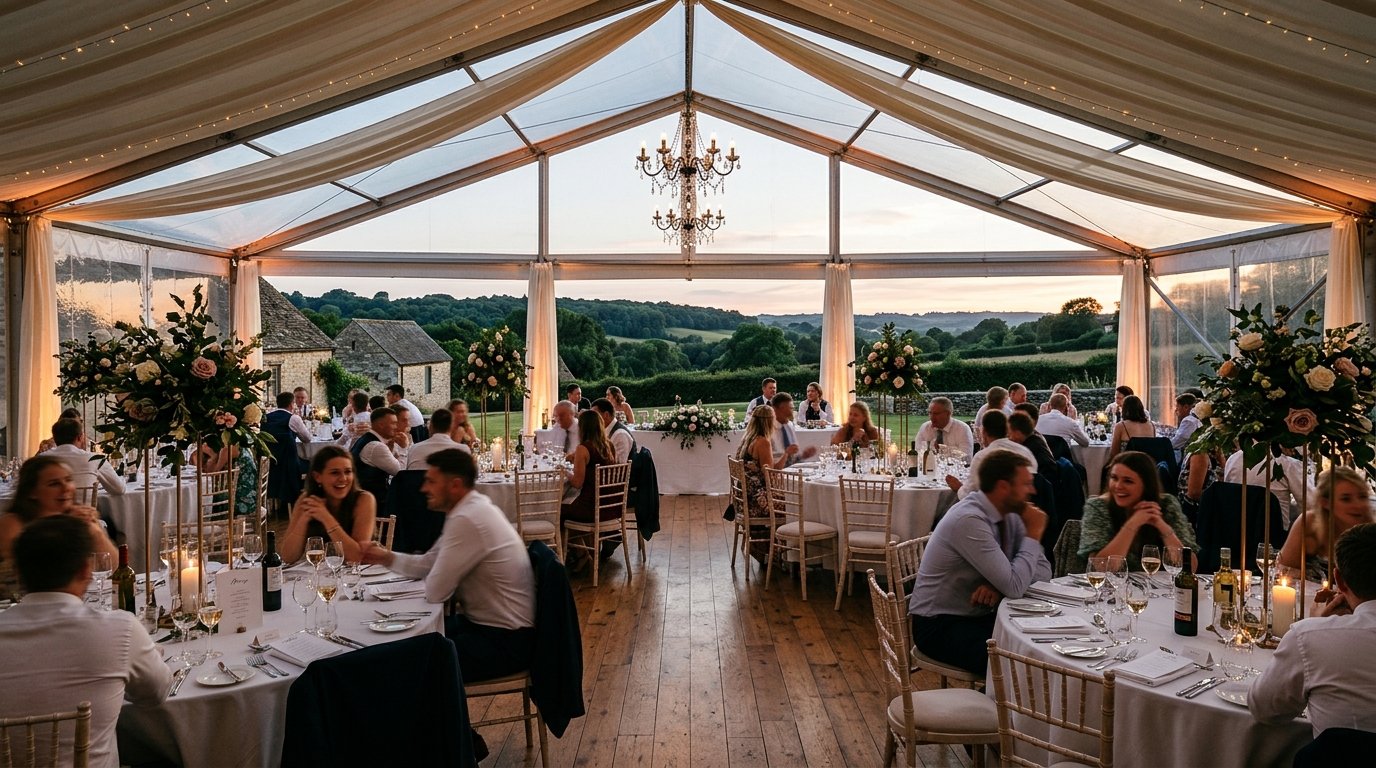
Clear-span marquees are the most versatile outdoor wedding structure. No internal poles means unrestricted floor space. Transparent walls let guests see the surrounding landscape. Solid walls and heating make them viable in cooler weather.
Why couples choose clear-span:
- Views: Transparent panels frame the countryside like floor-to-ceiling windows.
- Space: No centre poles means more tables, a larger dance floor, or a different layout.
- Weather-proof: Solid walls, proper doors, and heating make them functional in all conditions.
- Professional feel: The clean lines and modular design work for both formal and informal styling.
The cost premium is significant: £4,000-£7,000 for hire alone, versus £2,500-£4,000 for a traditional marquee. But for a venue where the views are the point, the transparent walls justify the expense.
Insurance for outdoor weddings
Outdoor weddings carry weather risk that indoor venues do not. Wedding insurance is essential.
What to cover:
- Weather cancellation: If extreme weather makes the event impossible (not just inconvenient)
- Public liability: Required by most landowners. £2-£5 million cover, costing £50-£100.
- Marquee/equipment damage: Wind, rain, or accidental damage to hired structures
- Supplier failure: Caterer, generator, or toilet supplier not turning up
Budget £150-£350 for a policy covering an outdoor wedding.
The complete outdoor wedding budget
| Item | Budget Range |
|---|---|
| Site hire | £1,000-£5,000 |
| Marquee / structure | £2,000-£7,000 |
| Flooring and furniture | £1,000-£3,000 |
| Lighting | £300-£1,000 |
| Power (generator) | £300-£600 |
| Toilets | £400-£1,200 |
| Catering | £3,000-£6,000 |
| Bar / drinks | £1,500-£3,500 |
| Decoration | £500-£1,500 |
| Photography | £1,500-£3,000 |
| Entertainment | £800-£2,000 |
| Insurance | £150-£350 |
| Total (80-100 guests) | £12,000-£34,000 |
For how this fits into the bigger picture, see our wedding budget breakdown.
Is an outdoor wedding right for you?
An outdoor wedding suits you if:
- You love the idea of marrying under open sky, surrounded by nature
- You are comfortable with weather uncertainty and have planned for it
- You enjoy the planning process and do not mind coordinating multiple suppliers
- Your guest list is manageable (60-120 is the sweet spot for outdoor events)
- You have a venue with good access, flat ground, and power options
An outdoor wedding may not suit you if:
- Weather anxiety will dominate your planning period
- Many guests have mobility issues (uneven ground, distance between areas)
- You want a late-night party (noise curfews are stricter outdoors)
- You prefer a fixed, known cost with few variables
The best outdoor weddings are the ones where the couple planned for rain and got sunshine. The worst are the ones where they planned for sunshine and got rain. Be the first couple. Have the plan, pack the umbrellas, and then enjoy the day whatever the sky decides.
For a step-by-step planning framework that covers every venue type, read our how to plan a wedding guide.
Frequently asked questions
Can you legally get married outdoors in the UK?
Yes, since 2022 in England and Wales. The law was changed to allow civil ceremonies in the open air at licensed venues. However, you cannot marry in your own garden or a random field — the outdoor space must be part of an Approved Premises licence. Scotland has allowed outdoor ceremonies since 2002. Northern Ireland requires ceremonies in approved venues.
How much does an outdoor wedding cost in the UK?
An outdoor wedding costs £8,000-£20,000 total for 80-100 guests. Marquee or tipi hire is the biggest single cost at £2,000-£6,000 plus £2,000-£4,000 for flooring, furniture, lighting, and power. Add catering (£3,000-£6,000), toilets (£400-£800), and site hire (£1,000-£5,000). The total varies hugely depending on the structure type and how much you supply yourself.
What happens if it rains at an outdoor wedding?
You move to your backup plan. Every outdoor wedding in the UK must have one. This might be a marquee (ceremony inside instead of on the lawn), a nearby indoor room at the venue, or a covered structure. Couples without a rain plan end up stressed and guests end up wet. Budget for full weather cover even if you hope to use the outdoor space.
What is the best month for an outdoor wedding in the UK?
June, July, and August offer the warmest temperatures and longest daylight. June averages 16-19C with sunset after 9pm. July is the warmest month on average. September is a strong choice for milder crowds and lower prices. May is viable but cooler evenings require heating. Avoid April and October — the weather is too unpredictable.
Do you need a marquee for an outdoor wedding?
You need some form of covered structure for the reception, even in summer. Options include traditional marquees (£2,500-£5,000), tipis (£2,000-£4,500), clear-span structures (£4,000-£8,000), stretch tents (£1,500-£3,500), and sailcloth tents (£3,000-£6,000). The structure protects against rain, provides shade, and houses the reception.
What toilets do you need for an outdoor wedding?
Hire portable toilets at a ratio of 1 unit per 25-30 guests. Standard portable toilets cost £200-£400 for a weekend. Luxury toilet trailers with running water, mirrors, and heating cost £600-£1,200. Position them downwind, on level ground, with lighting for evening use. Your guests will remember bad toilets more than good flowers.
How do you get power for an outdoor wedding?
You need a generator or mains hook-up. A 30kVA generator (enough for lighting, catering, band, and toilets) costs £300-£600 to hire. Some venues offer mains power connections — check the amperage. Solar-powered festoon lights reduce generator dependence. Your caterer and entertainment provider will specify their power requirements.