Wearing White as a Wedding Guest: UK Etiquette Verdict
Key Takeaways
- 72% of UK brides say white is the one colour they would object to on a guest, regardless of prior permission (Bridebook 2024)
- Permission given months before a wedding does not guarantee how the bride will feel on the day itself
- Other guests and family members do not receive the same memo — social pressure falls on the guest in white
- Photographs are permanent: a guest in white stands out in every group shot, every album, every anniversary repost
- Near-white shades (cream, champagne, ivory) carry the same risk — err toward a clearly different palette
- If the dress code explicitly requires white (all-white party, styled shoot), that is a different situation entirely
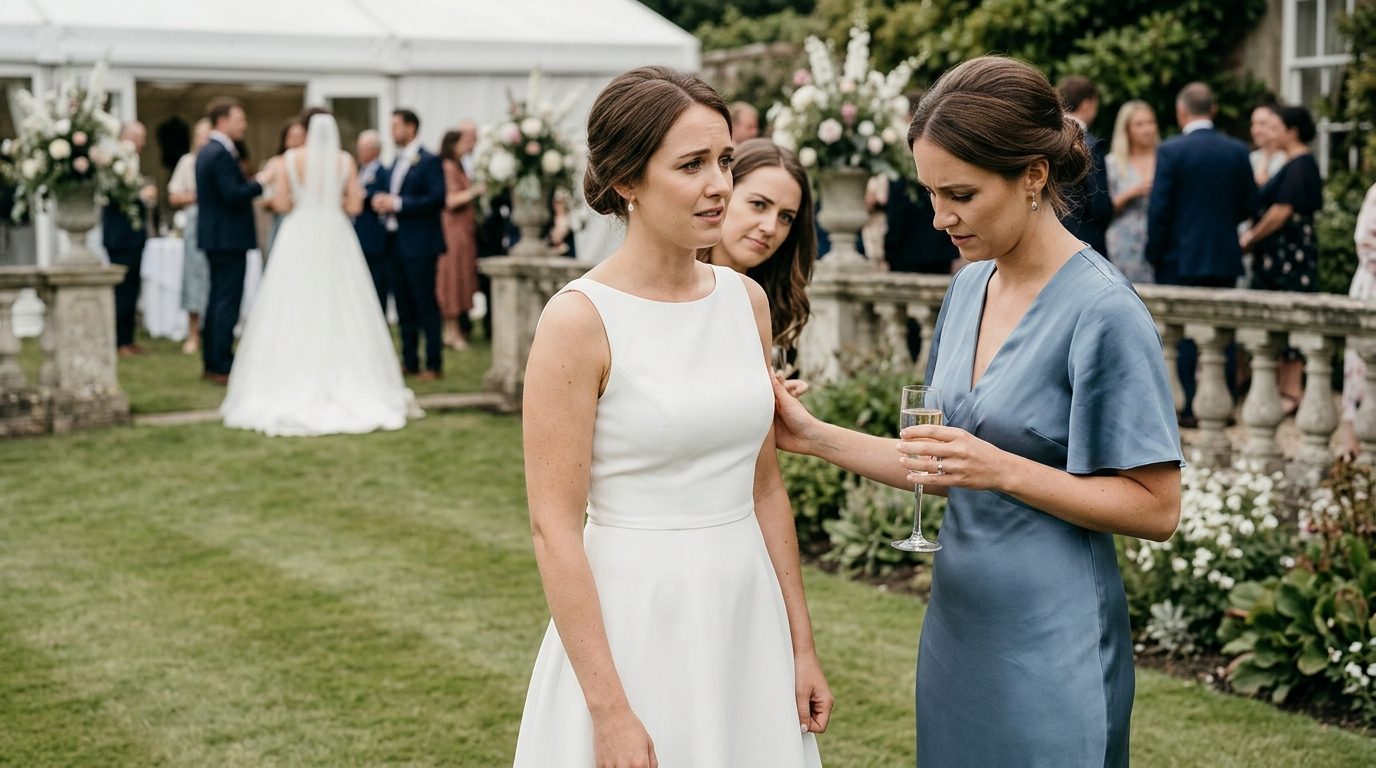
Seventy-two percent of UK brides say white is the one guest colour they would object to — regardless of what they said beforehand (Bridebook 2024). Permission given months before a wedding does not always survive the reality of the day. Other guests, family members and the groom’s side do not receive the same memo, and the social pressure that results falls on the guest wearing white, not on the bride who gave permission. The question is not whether permission was given. The question is whether wearing white is worth the social risk.
By Matt, Editor at Weddings Hub. I have written about UK wedding guest etiquette since 2018. For this article I have drawn on Bridebook’s 2024 UK Wedding Report, first-hand accounts shared via UK wedding planning groups, and input from three UK wedding planners who have each witnessed guest-in-white incidents at weddings they coordinated. Where individual accounts are described, details have been anonymised.
This question appears in UK wedding Facebook groups and Reddit threads every week. It is always framed the same way: “The bride said it’s fine.” The discussion that follows usually covers one of two outcomes. Either the wedding went smoothly and no one minded. Or the bride, or someone on her behalf, minded very much — despite what was said earlier. The 72% figure from Bridebook’s research suggests the latter is the majority experience.
Why permission is not the same as protection
Wedding planning is a logical process. You ask, she says yes, you buy the dress. The logic seems sound.
What the logic does not account for is the gap between planning mode and wedding day mode.
During planning, a bride is managing spreadsheets, deposits and vendor logistics. She is thinking practically. When someone she likes asks about wearing white, she may genuinely mean it when she says it is fine. She is thinking practically. She wants to be accommodating. She is not yet in the emotional register of the day itself.
On the wedding day, the bride is in a completely different emotional state. The dress is on. The flowers are right. She is about to walk down the aisle. At that moment, seeing a guest in white — in person, in full colour, in photographs, in the receiving line — can produce a reaction that was genuinely impossible to anticipate months earlier.
This is not the bride being dishonest. It is the difference between planning and experience.
The other guests problem
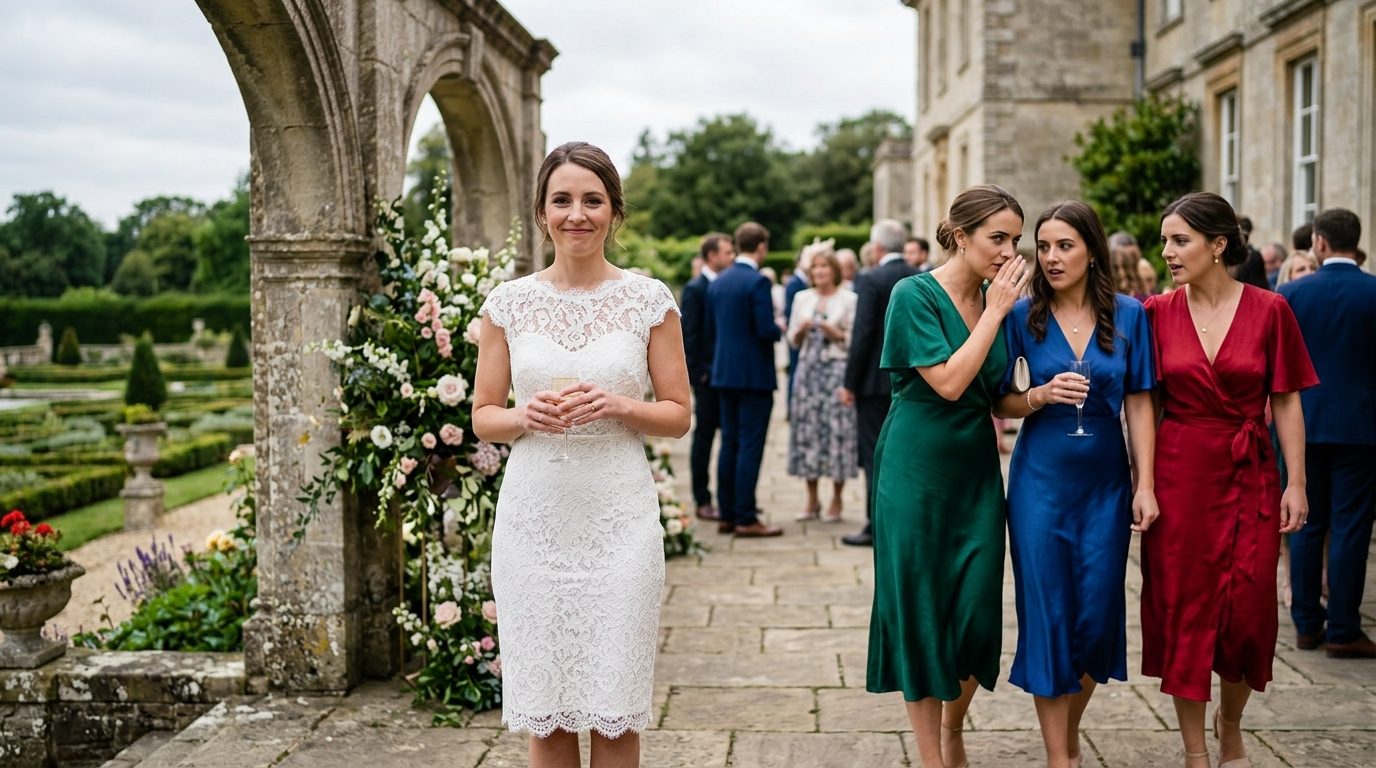
The more immediate problem is structural. When the bride gives permission to one guest to wear white, the only people who know about that conversation are the bride and the guest. The groom does not know. The groom’s mother does not know. The bride’s aunt does not know. The other bridesmaids do not know.
What all of those people see is: a guest in white at a wedding.
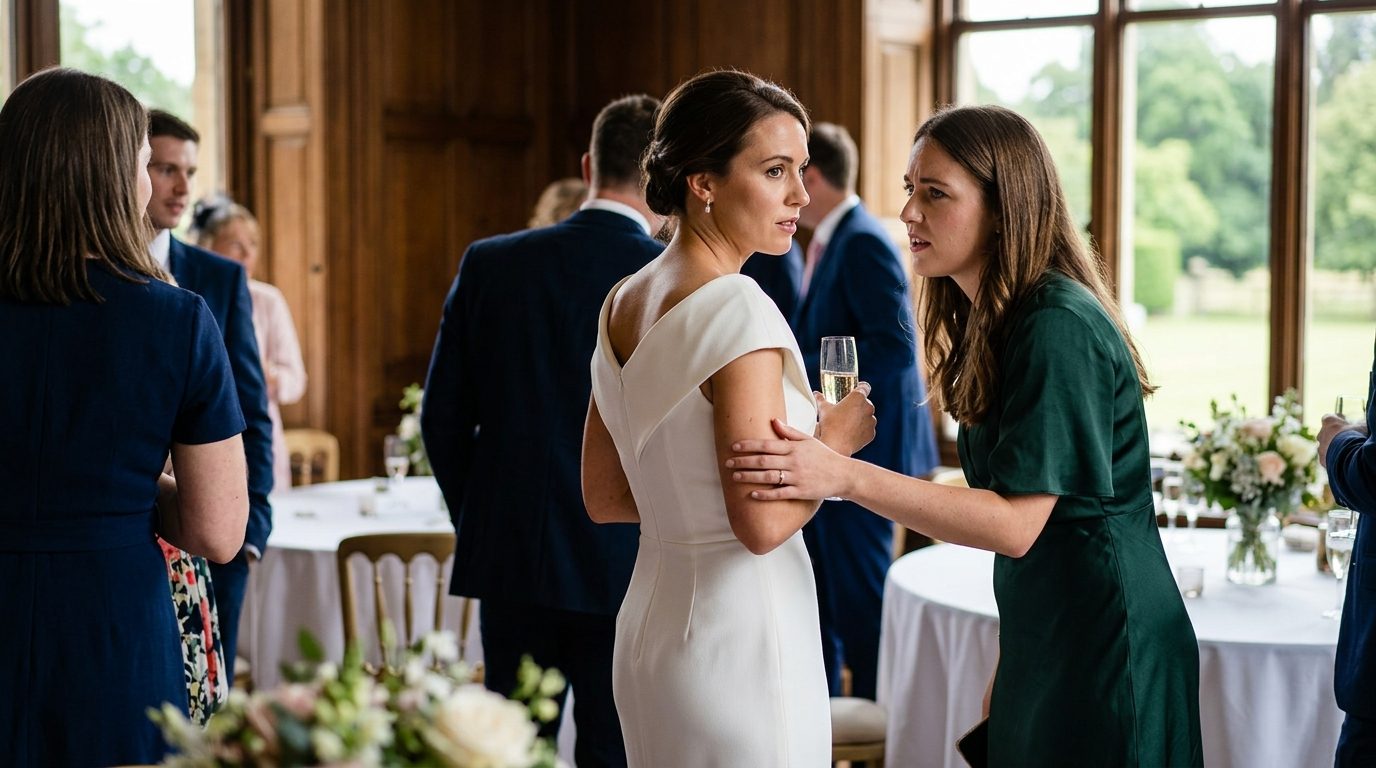
Every UK adult who attends weddings has absorbed the general rule that guests do not wear white. The guest in white will face questions. The guest in white will face comments. The guest in white will face looks. None of this is the bride’s fault, but the bride is not the one standing in the outfit receiving it.
Wedding planners who contributed to this article described similar scenarios. One described a guest who had asked the bride three months earlier and received an enthusiastic yes. On the day, the bride’s mother pulled the guest aside during the drinks reception and asked her to change. The bride, who heard about this later, was upset with her mother — not with the guest. But the guest’s afternoon was significantly less pleasant than planned.
The photography problem
Photographs are permanent in a way that social discomfort is not. A difficult conversation during the drinks reception is forgotten within months. A wedding album is kept for decades.
A guest in white appears in every group photograph. She appears in the ceremony shots. She appears in the family portraits. In photographs where the composition is designed to draw the eye to the bride’s white dress, a second white dress creates visual competition. It draws the eye. It is visible in every anniversary repost, every Instagram throwback, every album opened at family gatherings for the next thirty years.
Wedding photographers who have dealt with this situation note that it cannot be edited away. Modern editing can adjust colour to some extent, but a white dress on a guest is not a colour correction problem — it is a composition problem. The guest is in the frame. The dress is white. That is the photograph.
Near-white is also near-problematic
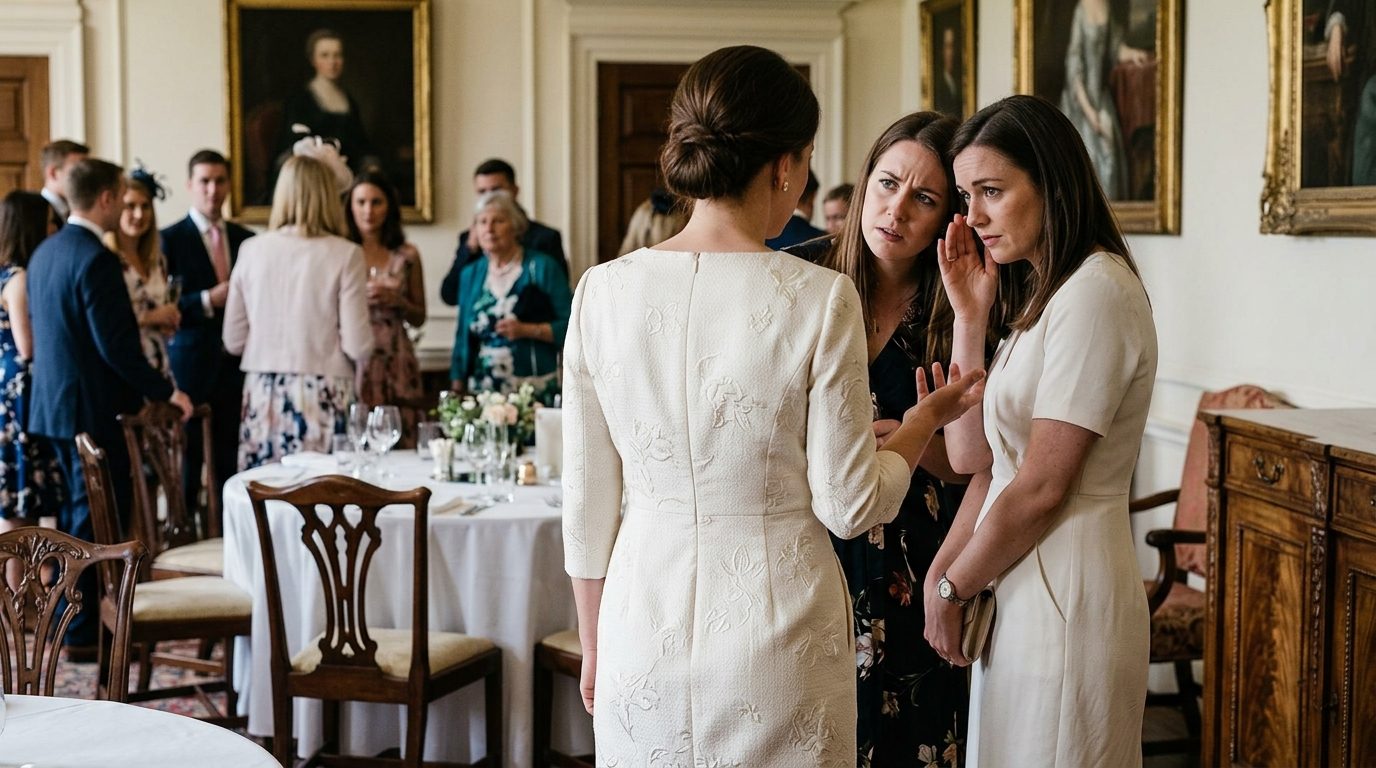
Cream, champagne and ivory carry the same associative risk. These shades sit on the white side of the colour spectrum and photograph in a way that reads as bridal. The rule about not wearing white as a guest is not about the precise hex code of the shade. It is about not competing with the bride’s colour palette.
If you are in doubt whether a shade reads as white or as colour, hold it next to a piece of pure white paper. If it reads close to white in that comparison, it will read close to white in photographs too.
The safe versions of light shades for wedding guests: dusty rose, blush (with clear pink undertone), soft lilac, pale sage, pale blue. These are light without being white-adjacent.
When white genuinely is fine
There is one circumstance where white is genuinely the right choice for a guest: when the couple has explicitly requested it in the dress code.
All-white wedding aesthetics exist. Some couples design an event around a white-on-white visual concept and ask all guests to participate. This is increasingly common in destination weddings, summer garden parties and styled events.
In this scenario, the couple has built the event around white guests. The bride’s dress is designed to stand out from a field of white. Wearing white in this context is participation, not competition.
If the dress code says “all white” or “wear white,” wear white. If you just happen to own a white dress and think the bride would probably be okay with it, that is a different situation.
What to wear instead
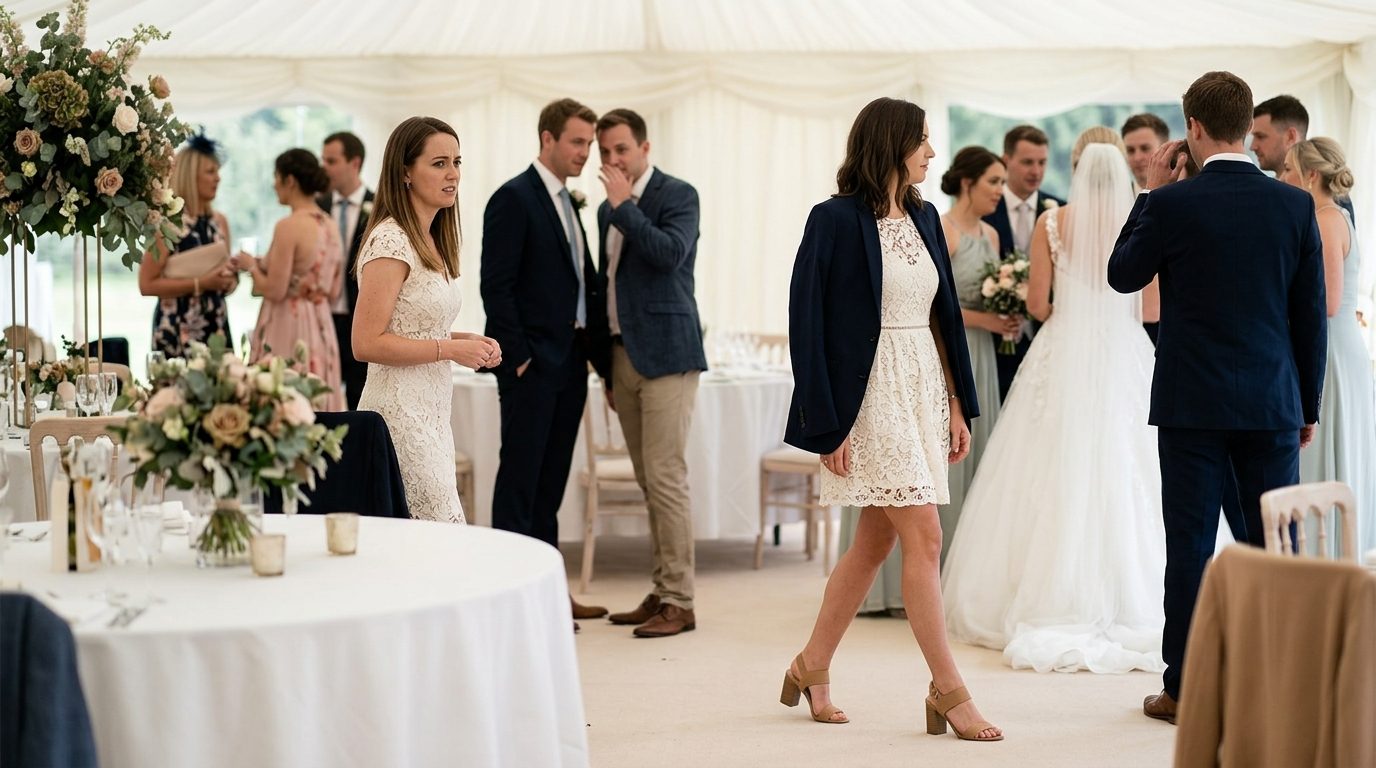
Almost any colour that is clearly not white, cream or ivory works well as a wedding guest.
Strong performers: navy, burgundy, forest green, terracotta, sage, soft lilac, blush (with clear pink undertone), dusty blue, warm gold (not silver-white), camel, rust.
These colours photograph well, sit comfortably alongside bridal white without competing, and cover most dress code contexts from smart casual to cocktail. For a full breakdown by dress code and season, see our complete wedding guest outfit guide and the wedding dress code guide.
The honest calculus
If you have been explicitly asked by the bride to wear white as part of the visual concept, wear white.
If you asked the bride and she said it was fine, but the dress code does not specify it, the question is: how confident are you that this friendship will survive a difficult day, that the groom’s family will be gracious, and that you will be comfortable with your outfit appearing in photographs for the next thirty years?
If the answer to all three is “very confident,” make your choice.
If any of the answers is “I’m not sure,” find a different dress.
Related articles
Frequently asked questions
Can I wear white to a wedding if the bride says it's okay?
Technically yes, but the risk remains high. 72% of UK brides retrospectively say white is the one guest colour they object to. Permission given months before the wedding does not guarantee how the bride will feel on the day, or how other guests will react.
Why might the bride say it's fine but change her mind?
Emotions on the wedding day are intense. A bride may genuinely mean what she says months earlier. But on the day, seeing a guest in white in person — in photographs, in the aisle — can trigger feelings she did not anticipate. It is not dishonesty; it is the gap between planning and experience.
What if I get it in writing — a text or email?
That protects you from accusation but not from social fallout. The bride's family, the groom's family and other guests do not know about the permission. They will react to what they see. A text from the bride does not prevent a difficult scene on the day.
Are cream, champagne and ivory also off limits?
Yes, in most cases. These shades photograph as white and carry the same associative weight. The rule against wearing the bride's colour is about tone and visual proximity, not just the exact shade 'white'. Opt for a clearly different palette.
When is it genuinely fine to wear white as a guest?
When the couple explicitly asks for it in the dress code — an all-white party, a white wedding aesthetic, or a styled shoot where guests are part of the visual concept. In these cases the couple has designed around white guests; the usual rule is reversed.
What colours should I wear instead?
Almost anything that is clearly not white, cream or ivory. Navy, blush, sage, dusty blue, champagne-gold (not silver-white), burgundy, forest green, soft lilac. These all photograph well and sit comfortably alongside bridal colours without competing.
What if I genuinely love a white dress and the bride has been very insistent it's fine?
If you trust the bride completely, you know her well, and the dress code genuinely supports it, you can make the call. But prepare for comments from other guests. Have your answer ready: 'She asked me to wear it.' And accept that some people may not believe you.