Planning an Asian Wedding: The Venue Essentials
Key Takeaways
- Asian weddings typically need capacity for 150-500+ guests — most standard UK wedding venues are too small
- Catering is the biggest logistical requirement: halal kitchens, specialist caterers, and 4-7 course menus are standard
- Multi-day celebrations (mehndi, sangeet, ceremony, reception) need flexible venue bookings across 2-4 days
- Mandap or stage setup requires ceiling height of at least 4 metres, floor protection, and fire safety clearance
- Budget £15,000-60,000+ for venue hire alone depending on guest count, location, and number of events
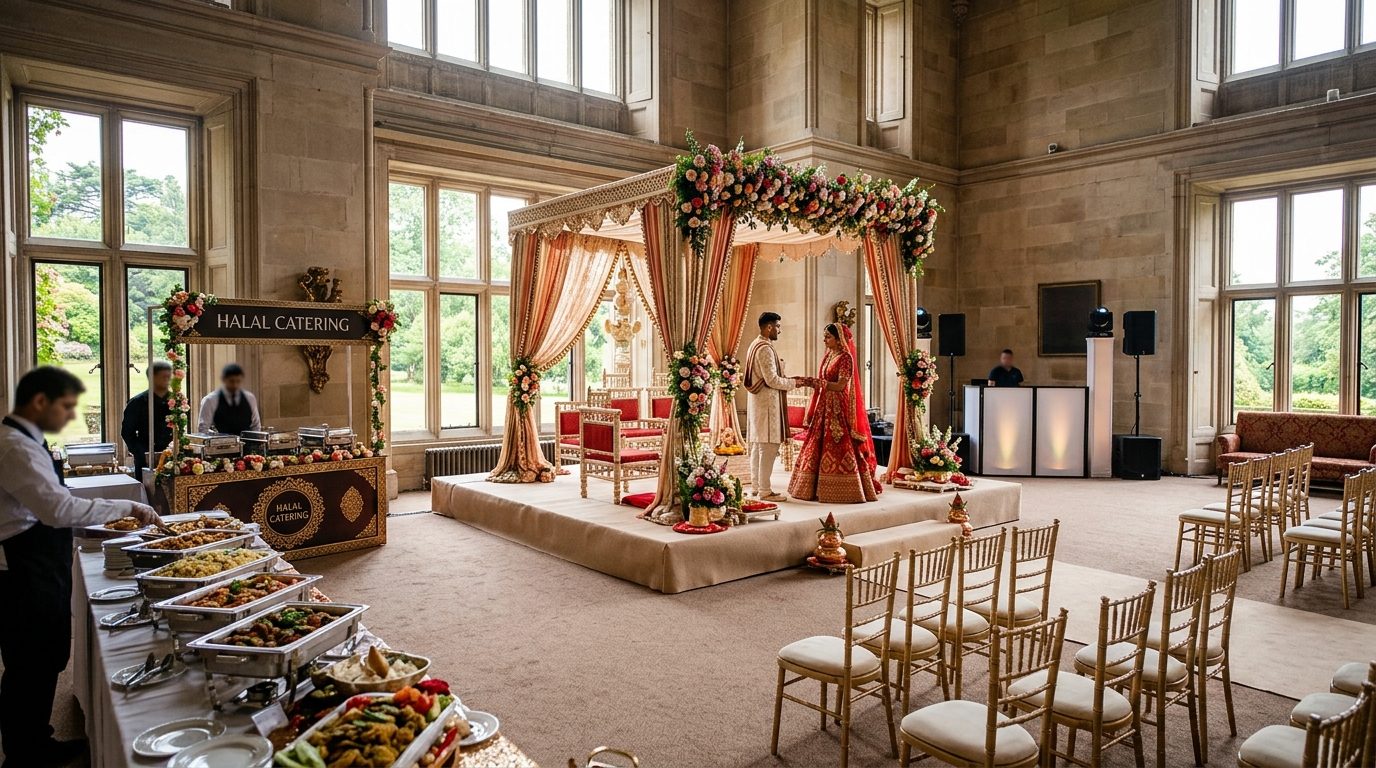
Asian weddings in the UK operate on a different scale to the typical 80-guest, one-day celebration. Guest lists of 300 are modest. Catering involves specialist kitchens serving 4-7 courses. Ceremonies require specific structures, fire clearance, and hours of setup. Music needs a sound system that can fill a room for 500 people. And the wedding itself may run across 2-4 days, each event requiring its own venue booking.
Finding a venue that understands all of this — not just accepts it — is the difference between a wedding that runs smoothly and one that fights against the building at every step.
This guide covers the practical requirements for Asian wedding venues in the UK, from capacity and catering to mandap space, sound systems, parking, and multi-day bookings.
Guest capacity: the first filter
Guest count is the single most important factor for Asian wedding venues, and it eliminates most options immediately.
| Wedding Size | Typical Guests | Venue Type Needed |
|---|---|---|
| Intimate | 100-150 | Large function room, boutique hotel ballroom |
| Medium | 200-300 | Dedicated banqueting suite, large hotel ballroom |
| Large | 300-500 | Purpose-built banqueting hall, exhibition space |
| Very large | 500+ | Arena-style venue, marquee on private land |
A standard UK wedding venue built for 100-120 guests will not work. Not just because of the seated capacity, but because of the infrastructure behind it: kitchen output, toilet provision, cloakroom space, bar service speed, and parking. A venue that “can seat 300” but has a kitchen designed for 100 will serve cold food to the last 200 guests.
What to check beyond headline capacity:
- Seated capacity at round tables, not theatre-style rows. Round tables of 10 are standard for Asian wedding receptions.
- Kitchen capacity. Can the kitchen produce 300+ meals simultaneously, or will they stagger service over 90 minutes?
- Toilet provision. The recommended ratio is 1 toilet per 50 guests for women, 1 per 100 for men. A venue with 4 cubicles cannot serve 300 guests.
- Cloakroom and lobby space. 300 people arriving within 30 minutes creates a bottleneck. Is there space to queue without blocking fire exits?
For more on venue selection criteria, see our how to choose a wedding venue guide.
Catering requirements
Catering for an Asian wedding is not the same as ordering a three-course set menu from the venue’s kitchen. It involves specialist caterers, dietary requirements that go beyond vegetarian/vegan, and menu expectations that most in-house kitchen teams cannot meet.
Halal and dietary considerations
| Requirement | What it means for the venue |
|---|---|
| Halal kitchen | All meat prepared according to Islamic law. Many venues do not have halal certification — external caterers solve this |
| Vegetarian (Jain/Hindu) | Strictly no meat, fish, eggs, or in some cases onion and garlic. Requires separate cooking equipment |
| Multiple courses | 4-7 courses are standard, requiring staggered kitchen output and more serving staff |
| Live cooking stations | Chaat, dosa, or tandoori stations add theatre but need power, ventilation, and floor protection |
| Dessert tables | Mithai, gulab jamun, jalebi — served on separate display tables, often supplied by a specialist sweet shop |
The external caterer question: Most Asian weddings use specialist external caterers rather than the venue’s in-house team. This is a deal-breaker at many venues, which insist on in-house catering. Ask upfront: “Do you allow external caterers, and is there a kitchen hire fee?”
External catering fees (charged by the venue for use of the kitchen and facilities) typically range from £5-15 per head. On a 300-guest wedding, that is £1,500-4,500 on top of the caterer’s own charges.
Menu expectations
A standard Asian wedding menu serves 4-7 courses, often with both meat and vegetarian options at every table. This is not a choice between chicken or fish. It is a full spread.
Typical menu structure:
- Starters — samosas, pakoras, kebabs, chaat (often as canapés during the drinks reception)
- Soup or salad course
- Main course 1 — lamb or chicken curry with rice and naan
- Main course 2 — vegetarian (paneer, dal, vegetable curry)
- Side dishes — raita, pickles, poppadoms, salads
- Dessert — gulab jamun, kheer, mithai selection, plus a Western option (often cake)
- Fruit and tea/coffee
Budget £40-80 per head for specialist Asian catering in 2026. Premium caterers in London charge £80-120 per head.
Ceremony requirements
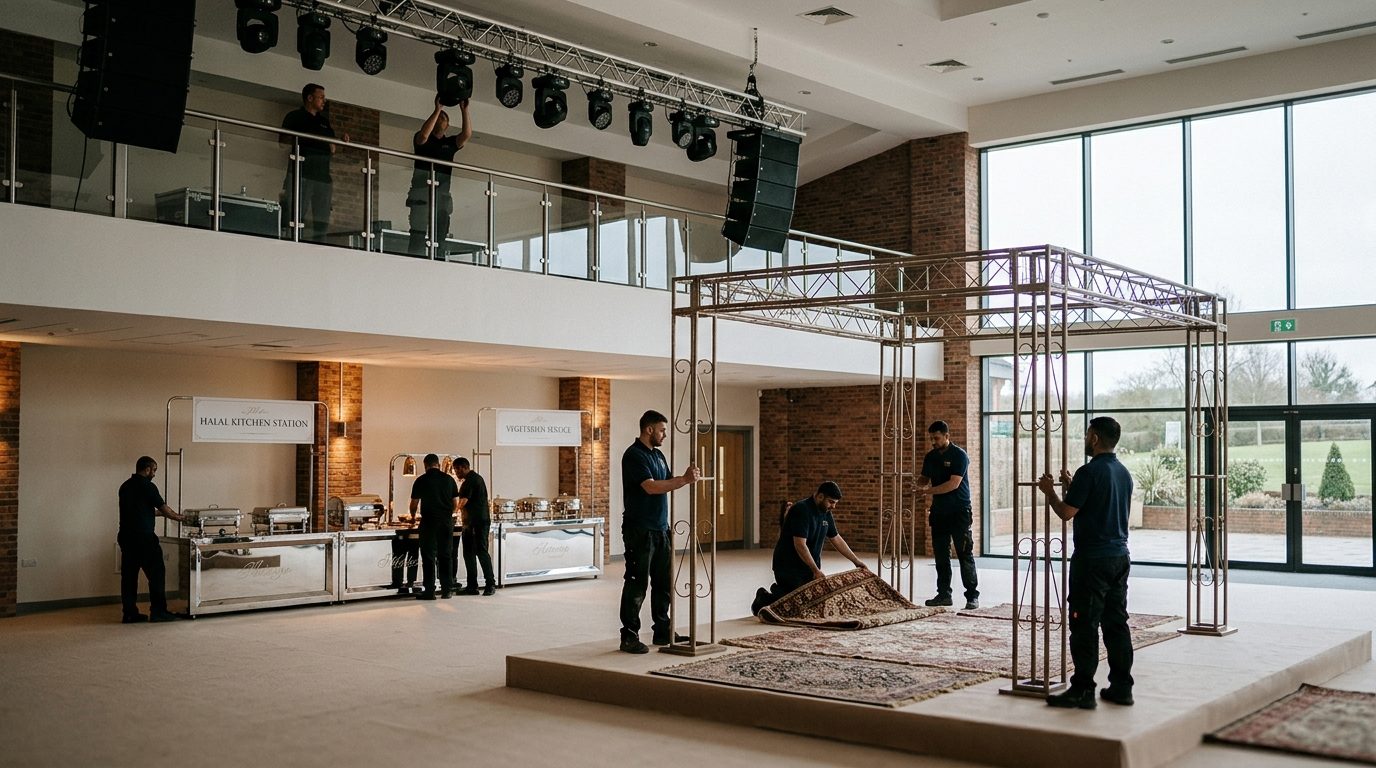
Different Asian wedding traditions have different ceremony requirements. The venue needs to accommodate the specific format — not just offer “a nice room.”
Hindu ceremonies
- Mandap: A four-pillar canopy, typically 3x3m base, 3-4m tall. Needs ceiling clearance, a flat floor, and space around it for guests to see.
- Sacred fire (Agni/Havan): A small controlled flame in a metal kund. Triggers fire alarm concerns at most venues. Ask whether the venue has hosted Hindu ceremonies with fire before. Venues with experience will have a fire risk assessment and a protocol for isolating alarms.
- Duration: Hindu ceremonies last 1-3 hours. The venue needs to accommodate guests sitting for this duration — comfortable seating, climate control, and toilet access.
- Floor protection: The mandap, fire kund, and flower decorations require floor coverings to prevent damage. Check whether the venue charges for floor protection.
Muslim ceremonies (Nikah)
- Segregation options: Some families require separate seating or separate rooms for male and female guests. The venue needs partitioning capability or two function rooms.
- Imam and witnesses: The ceremony itself is simpler structurally — no mandap or fire — but requires a quiet, dignified space.
- Prayer facilities: A clean, quiet room for prayers (wudu facilities are appreciated but not always available).
- No alcohol in ceremony space: Some families request alcohol-free areas during the Nikah. Check whether the venue can zone this.
Sikh ceremonies
- Gurdwara or venue? Many Sikh weddings hold the Anand Karaj ceremony at a Gurdwara, then move to a separate venue for the reception. If the ceremony is at the venue, it needs space for the Guru Granth Sahib, a stage or platform, and seating with a central aisle.
- Langar (communal meal): Some Sikh weddings include a langar after the ceremony — a communal vegetarian meal served to all guests. This requires a separate serving area and a simple menu.
- Shoe removal: Guests remove shoes for the ceremony. The venue needs a cloakroom or designated area for footwear storage.
Multi-day celebrations
Asian weddings are rarely one-day events. The celebration typically spans 2-4 days, each with its own format, guest list, and venue requirements.
| Event | When | Guests | Venue Needs |
|---|---|---|---|
| Mehndi | 1-3 days before | 50-150 (mostly women) | Informal space, floor seating, colourful decor, music |
| Sangeet | 1-2 days before | 100-300 | Dance floor, sound system, stage for performances |
| Wedding ceremony | Wedding day | 150-500+ | Mandap/stage, ceremony space, catering |
| Reception | Wedding day (evening) | 200-500+ | Banqueting hall, DJ/band, dance floor |
| Walima | Day after (Muslim) | 100-300 | Formal dinner setting |
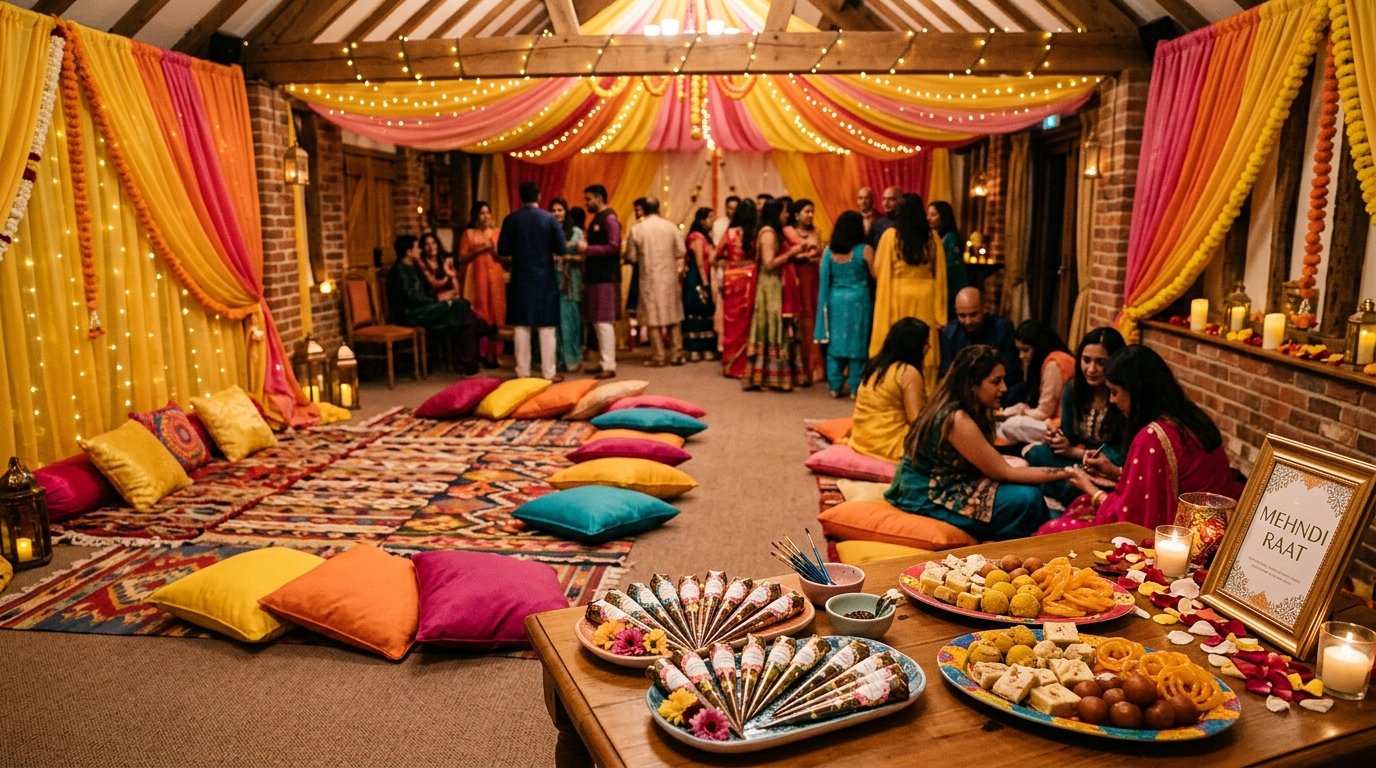
Booking strategy: Some venues offer multi-day packages that cover the mehndi, ceremony, and reception at a combined rate. This is usually cheaper than booking each day separately. Ask whether a 2-3 day block booking comes with a discount.
If the venue cannot host all events, book the mehndi at a smaller, more affordable venue (a community hall, a restaurant private room, or even a large family home) and save the main venue for the ceremony and reception.
Our guide to how to plan a wedding covers timeline management for multi-event celebrations.
Decor and setup requirements
Asian wedding decor operates at a scale that most UK venue coordinators have never seen. The transformation of a blank function room into a fully draped, lit, and staged banqueting hall takes 6-12 hours and involves a specialist decor team.
What the venue needs to support
| Element | Venue Requirement |
|---|---|
| Ceiling draping | Rigging points or a suspended ceiling grid strong enough for fabric |
| Wall draping | Wall space free of fire exits, artwork, or fixed furniture |
| Stage/mandap | Floor area of 5x5m minimum, electrical supply for lighting |
| Lighting (uplighters, spotlights) | Multiple power outlets around the room, dimmer switches |
| Centrepieces (tall candelabras, floral) | Table size and spacing to accommodate large centrepieces |
| Entrance arch | Doorway width and height to fit a 3m decorative arch |
| Flower walls and backdrops | Wall space behind the top table or stage, typically 3-5m wide |
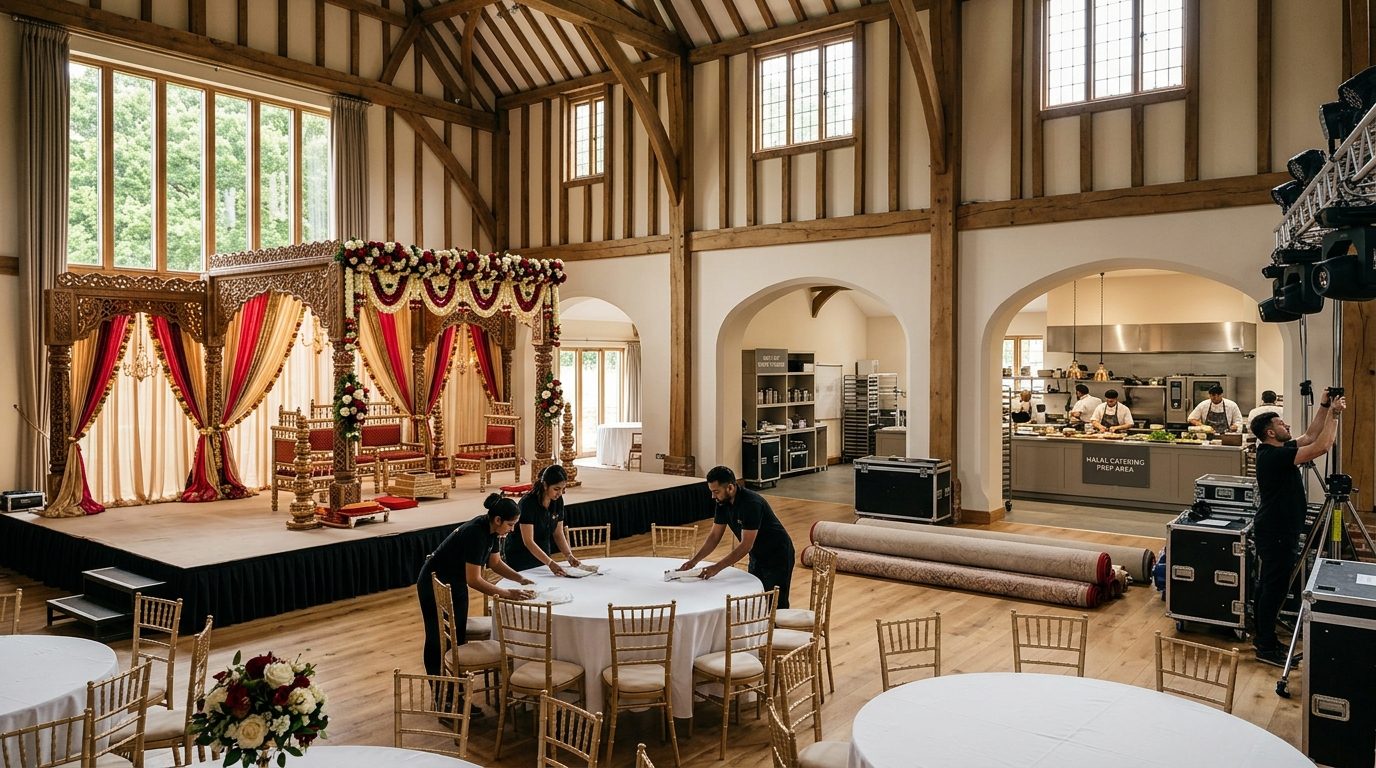
Setup access is critical. A full Asian wedding decor setup takes a minimum of 6 hours. If the venue only allows access from 8am on the wedding day and the ceremony starts at 2pm, the decor team has 6 hours minus catering setup time. That is tight. Venues that offer access from the evening before, or from 6am on the day, are significantly easier to work with.
Decor costs: Professional Asian wedding decor starts at £2,000-5,000 for basic draping and centrepieces. A full transformation with mandap, stage, flower walls, ceiling draping, and lighting runs £5,000-15,000+. London prices are higher.
For more on decoration approaches, see our DIY wedding decorations guide — though Asian wedding decor at scale typically requires professional teams.
Sound systems and music
Music is central to Asian weddings. From the mehndi night with Bollywood tracks to the reception with a live band and DJ, the sound system needs to fill a large room without distortion.
What to check:
- In-house PA system: Does the venue have built-in speakers capable of filling a 300-500 person room? Most do not.
- DJ/band power requirements: A full Asian wedding DJ setup needs 20-30 amps of dedicated power. A live band needs more. Confirm the venue’s electrical capacity.
- Sound limiters: Some venues have sound limiters that automatically cut the music when it exceeds a decibel threshold. This is a deal-breaker for Asian wedding receptions where Dhol drums and Bollywood music are part of the celebration. Ask about the decibel limit and whether it can be adjusted.
- Noise curfew: When does the music have to stop? 11pm is too early for most Asian wedding receptions. Midnight or 1am is the minimum.
- External noise restrictions: Is the venue in a residential area with noise complaints history? This matters for outdoor events and mehndi nights.
A professional Asian wedding DJ costs £500-1,500. A live band (Bollywood, bhangra, or classical) costs £1,500-5,000+. A Dhol drummer for the ceremony entrance costs £200-500.
Parking and transport
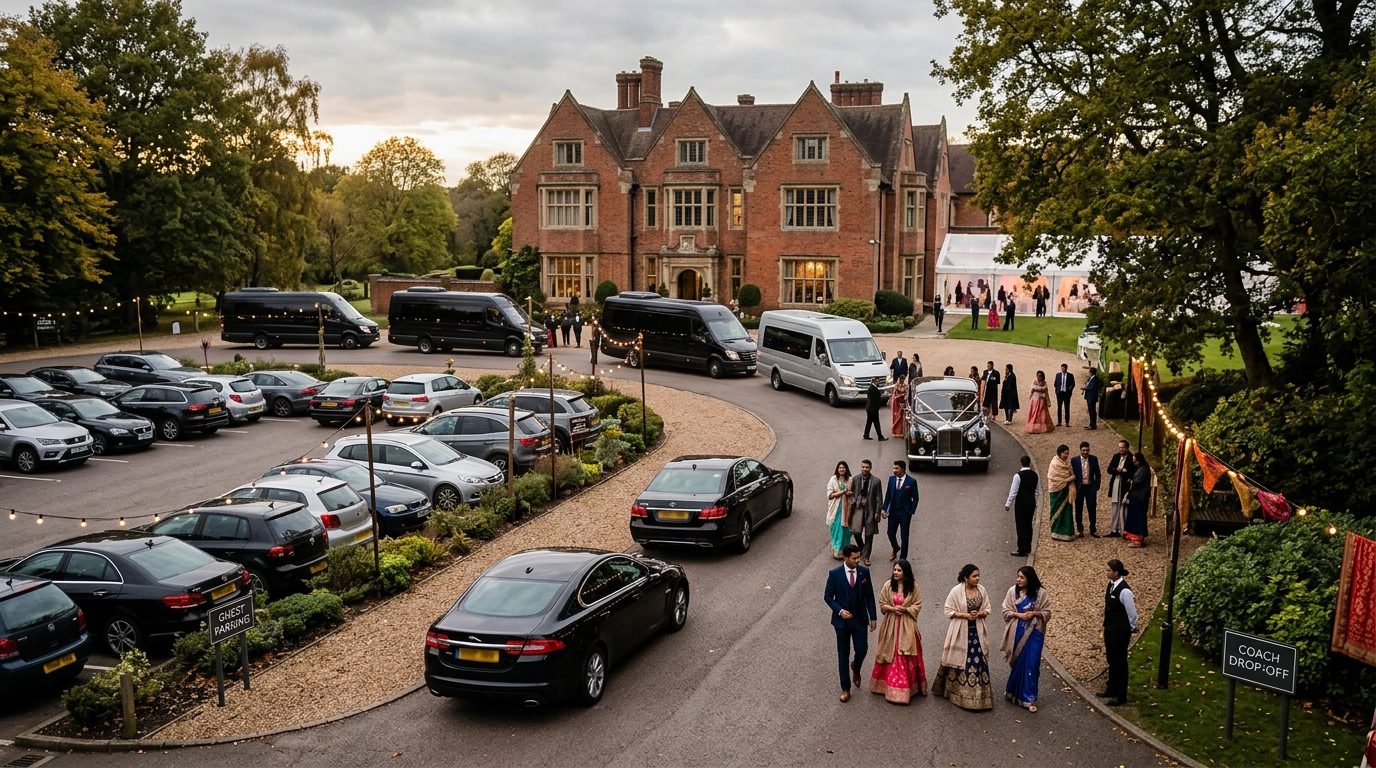
Parking is one of the most overlooked logistics at large Asian weddings. Three hundred guests arriving by car, many from outside the local area, need significant parking infrastructure.
The maths:
- 300 guests arriving in couples/families = 100-150 cars
- Average parking space: 2.4m x 4.8m
- 150 cars need approximately 1,700 square metres of parking — more than the floor area of most venues
Solutions:
| Option | Cost | Best For |
|---|---|---|
| Venue with large car park | Included | Banqueting halls, hotels, purpose-built venues |
| Overflow parking on venue grounds | £200-500 (ground protection) | Country estates, farms with field access |
| Nearby public car park | Free-£500 (reserved section) | City centre venues |
| Shuttle bus from remote car park | £300-800 | Venues with limited parking |
| Valet parking service | £500-1,500 | Premium weddings, venues with awkward access |
Include parking information on your invitations. A map showing the venue, the car park, and any overflow areas prevents 150 phone calls on the morning of the wedding.
Bride entrance and photography
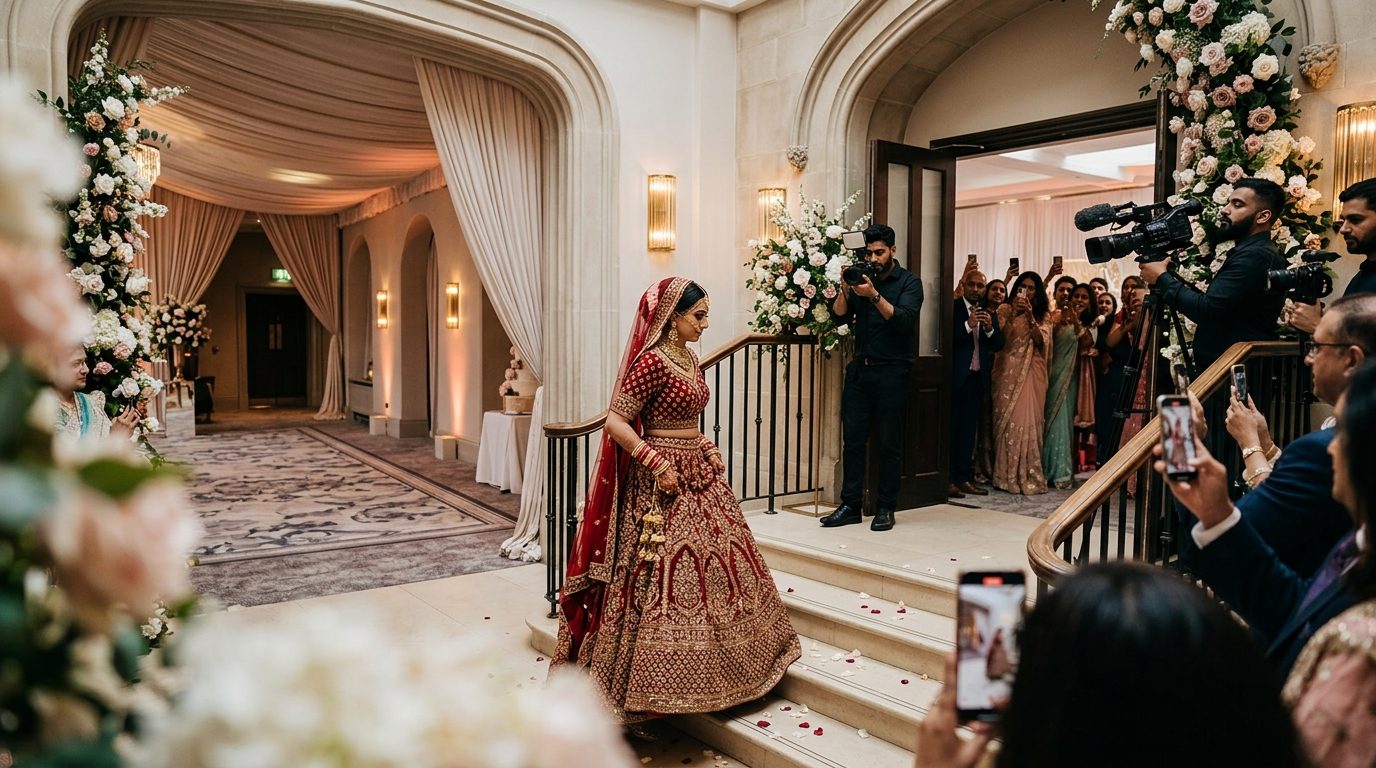
The bride’s entrance is a focal point of many Asian weddings. This is not a quiet walk down the aisle — it is a choreographed moment with music, lighting, and often a floral canopy or palanquin.
Venue requirements for a grand entrance:
- Double doors or a wide entrance — the bride and her attendants need space to walk through side by side
- A clear aisle — at least 2 metres wide, from the entrance to the stage or mandap
- Lighting control — the ability to dim the room and spotlight the entrance
- Height clearance — if the bride enters under a floral canopy (phool ki chaadar), the doorway needs at least 2.5m clearance
Photography considerations:
Asian wedding photography requires more coverage than a standard wedding. The mehdi, the ceremony, the entrance, the reception — each event generates hundreds of photos. Check whether the venue has:
- Good natural light in the ceremony room (important for mandap photos)
- Attractive outdoor areas for couple portraits
- Space for a photographer to move freely during the ceremony without blocking guests’ views
- A well-lit entrance area for the bride’s arrival shots
Budget overview
Asian wedding venue costs scale with guest count, location, and the number of events. Here is a realistic budget framework for 2026:
| Component | Budget Range | Notes |
|---|---|---|
| Ceremony venue hire | £3,000-15,000 | Depends on capacity and location |
| Reception venue hire | £5,000-20,000 | If separate from ceremony |
| Mehndi venue | £500-3,000 | Community hall to hotel function room |
| Catering (per head) | £40-120 | Specialist Asian caterer, 4-7 courses |
| External catering fee | £1,500-4,500 | If venue charges for kitchen use |
| Decor | £2,000-15,000 | Mandap, draping, lighting, flowers |
| DJ/music | £500-5,000+ | DJ, Dhol, live band |
| Photography/videography | £2,000-8,000 | Multi-day coverage |
| Parking/transport | £0-1,500 | Valet, shuttles, overflow management |
Total venue-related costs for a 300-guest Asian wedding: £15,000-60,000+
For overall wedding budgeting, see our wedding budget breakdown and average wedding cost UK guides.
The venue checklist for Asian weddings
Before booking any venue, run through this checklist:
- Can the venue seat your full guest count at round tables?
- Does the venue allow external caterers?
- Is there a halal-certified kitchen or can your caterer bring their own equipment?
- Is the ceiling height at least 4 metres for mandap/stage setup?
- Does the venue allow fire ceremonies (Hindu weddings)?
- Can the venue provide segregated areas if needed?
- Is there setup access the evening before or from 6am?
- Does the venue have a sound limiter? What is the decibel limit?
- What is the latest music can play?
- How many parking spaces are available?
- Can the venue accommodate multiple events over 2-4 days?
- Is there a corkage fee if you supply your own drinks?
- Does the venue have experience hosting Asian weddings?
That last point matters most. A venue that has hosted 50 Asian weddings knows the setup times, the catering logistics, the fire ceremony protocol, and the parking flow. A venue hosting its first will learn on your wedding day. Ask for references from previous Asian wedding couples and look for photos from real events, not stock images.
See our full list of questions to ask your wedding venue for more detail.
Frequently asked questions
How many guests does a typical Asian wedding have?
150-500 guests is the normal range for Asian weddings in the UK. Some extend well beyond 500. The number reflects cultural expectations around family and community — not inviting someone can cause offence. Planning for this scale requires venues with banqueting capacity, not standard function rooms designed for 80-120.
Do Asian wedding venues need a halal kitchen?
Not necessarily a halal kitchen, but halal catering is essential for Muslim weddings. Many venues allow external caterers, which is often the best option. Specialist Asian wedding caterers bring their own equipment, staff, and halal-certified ingredients. Check whether the venue charges a fee for external catering — some add £5-15 per head.
How much does an Asian wedding venue cost in the UK?
Venue hire for an Asian wedding ranges from £3,000 to £20,000+ per event. A banqueting suite for 300 guests in the Midlands costs £5,000-10,000. A large London hotel ballroom for 500+ guests costs £12,000-20,000. Multi-day bookings (mehndi + wedding + reception) multiply the cost by 2-4 times.
What is a mandap and what space does it need?
A mandap is the ceremonial canopy used in Hindu and some Sikh weddings. It typically measures 3x3 metres at the base and stands 3-4 metres tall. The venue needs at least 4 metres of ceiling height, a flat floor area of 5x5 metres minimum (including seating for the couple and pandit), and clearance from fire safety equipment for the sacred fire.
Can I have a fire ceremony (Agni) at my wedding venue?
Some venues allow it, but many do not. The sacred fire is a small, controlled flame in a metal container, but it triggers fire alarm and insurance concerns. Ask venues specifically about fire ceremonies before booking. Those experienced with Hindu weddings will have a fire risk assessment and a protocol for temporarily isolating fire alarms in the ceremony area.
Do I need separate areas for male and female guests?
For some Muslim weddings, yes. Segregated seating or separate rooms for male and female guests are required by certain Islamic traditions. Check whether the venue can partition a large space with draping or screens, or whether it has two separate function rooms with independent access. Not all Asian weddings require segregation — discuss your family's preferences early.
How do I manage parking for 300+ guests?
Parking is a genuine logistical challenge at large Asian weddings. Look for venues with at least 150 parking spaces or on-site overflow parking on grass. If the venue car park is too small, arrange shuttle buses from a nearby car park, or include parking instructions and a map with your invitations. Valet parking adds £500-1,500 but prevents chaos.