Winter Weddings UK 2026: Ideas, Costs & Best Venues

Key Takeaways
- Winter wedding venues (November-February) typically cost 25-40% less than peak summer Saturdays
- January and February are the cheapest months to marry in the UK — some venues cut Saturday rates by half
- Winter florals are cheaper — seasonal stems like amaryllis, hellebores, and eucalyptus cost 30-40% less than summer peonies
- The biggest risk is not snow — it is low light. Brief your photographer on the 2-3 hour window of usable natural light
- Heating a large venue or marquee in winter adds £500-£2,000 to your catering bill — confirm it is included before you sign
Why more UK couples are choosing winter weddings
The shift towards winter weddings has accelerated since 2020, driven by three factors: venue availability for popular dates is vastly better, pricing is genuinely lower, and the aesthetic suits the maximalist, romantic sensibility of 2020s weddings better than bleached summer light.
The aesthetic case is also strong. Candlelit receptions, dark floral palettes, fur stoles, black-tie formality, and the drama of bare trees — none of these belong to summer. A barn venue in June often requires heavy florals and lighting to look distinctive; the same barn in November looks cinematic with candles alone.
What a winter wedding costs compared with summer
The savings are real but unevenly distributed across the budget.
| Cost item | Summer (June Saturday) | Winter (January Saturday) | Typical saving |
|---|---|---|---|
| Venue hire (100 guests, full day) | £4,500-£8,000 | £2,800-£5,500 | 30-40% |
| Catering per head | £65-£120 | £65-£120 | Minimal |
| Florals (100-guest wedding) | £1,800-£3,500 | £1,100-£2,200 | 30-40% |
| Photography | £1,800-£3,200 | £1,600-£2,800 | 10-15% |
| Live band or DJ | £1,200-£2,500 | £1,000-£2,000 | 10-20% |
| Total (estimate) | £20,000-£25,000 | £14,000-£17,000 | 25-35% |
The venue saving is the headline — but note that catering per head stays flat year-round at most UK venues. A winter Friday can push venue savings further: some venues offer Friday packages in January and February at 40-50% below their Saturday peak rate.
The December exception: December is not winter pricing. Festive demand means December Saturdays at popular venues often match summer rates. If your goal is cost saving, December is the wrong choice. If your goal is a festive atmosphere, December is excellent — just budget accordingly.
The cheapest months to get married in the UK
| Month | Typical venue pricing | What to know |
|---|---|---|
| January | Off-peak minimum | Quietest month, best venue availability, lowest prices |
| February | Off-peak minimum | Valentine’s Day peak in first two weeks, but mid-month is cheapest |
| November | Off-peak | Some venues run autumn pricing through to month end |
| March | Shoulder | Prices begin rising from mid-month at popular venues |
| October | Shoulder | Often only 10-15% below peak at scenic venues |
| December | Near-peak | Festive demand narrows the saving |
For maximum savings, January and February are reliably the cheapest months. Emma and Tom, who married at Hazel Gap Barn in Nottinghamshire on 18 January 2026, paid £2,400 for exclusive Saturday venue hire — a venue that charges £4,800 on peak summer Saturdays. “We saved the difference and spent it on a better photographer and a proper honeymoon,” Emma told WeddingsHub.
Winter wedding venues UK: what to look for
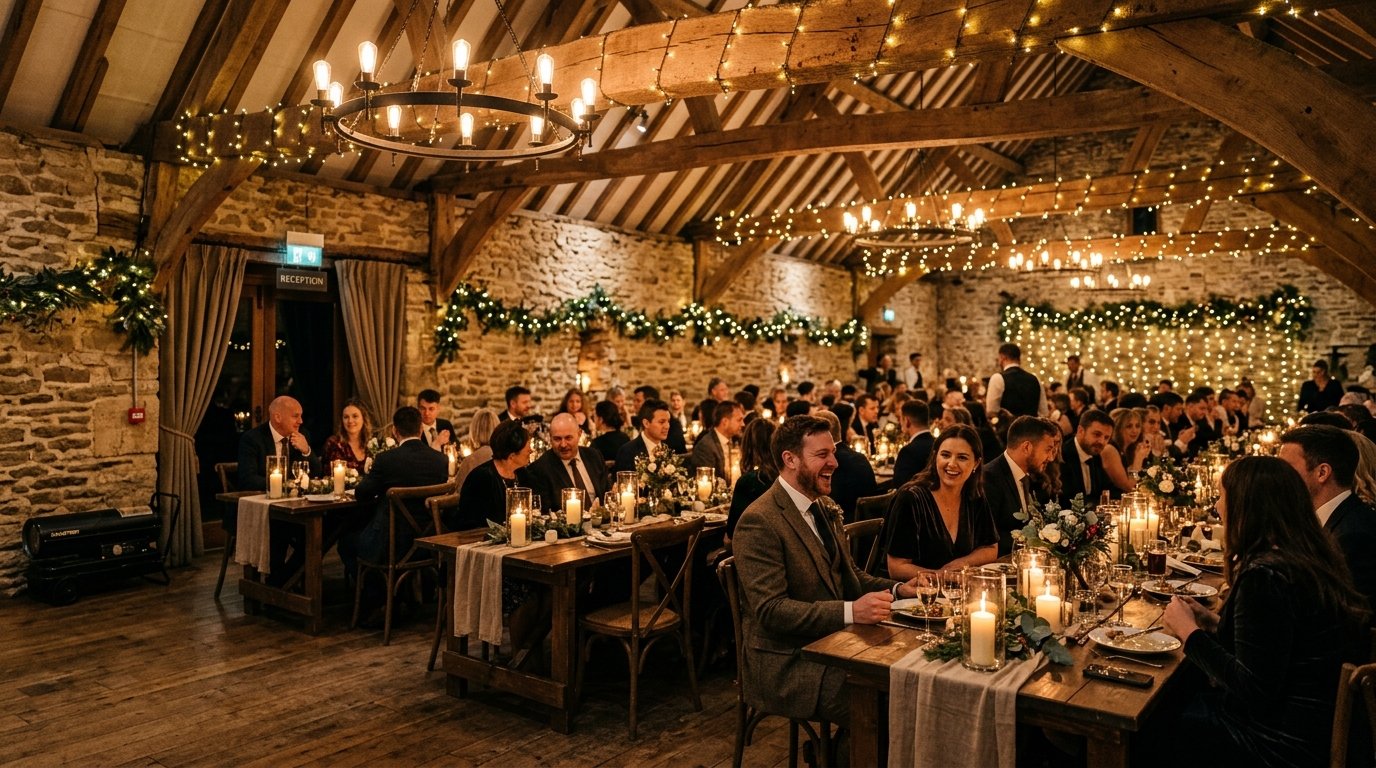
 Not every venue suits a winter wedding. The key characteristics to prioritise:
Good natural light inside. Low winter light means that venues with large windows — barn conversions, glasshouse spaces, orangeries — create better photographs than stone buildings with small windows. Ask to see the photographer’s images of the ceremony space at the time of year you plan to marry.
A working fireplace or statement heating. Gas patio heaters are adequate. A working inglenook fireplace is exceptional. Venues with log fires create a natural social focal point for winter weddings that functions better than anything a stylist can fabricate.
Covered external space. Guests will need to move between buildings or access parking areas. Venues with covered walkways or large porches handle this gracefully. Venues where guests must walk 200 metres across open ground in December struggle, regardless of how well they’re dressed.
On-site accommodation. Winter transport is less predictable — late nights on rural roads in December are less appealing than summer equivalents. Venues with a block of bedrooms nearby allow guests to stay over, which changes the tone of the evening entirely.
Winter wedding venue types that work particularly well
- Barn conversions: Stone and timber retain heat, dark woods complement winter palettes, and candlelight transforms these spaces. The UK has more barn wedding venues per head than any comparable country — use the abundance.
- Country house hotels: The combination of formal interiors, established lighting, and on-site accommodation is ideal for winter. Many run inclusive winter wedding packages from £8,000-£15,000 for 80-100 guests.
- City venues (arthouse, industrial): Dark interiors, strong artificial lighting, and proximity to hotels for guests who don’t drive suit winter well. Urban venues are also less affected by weather.
- Stately homes: Many English Heritage properties and National Trust houses offer winter hire rates below their summer equivalents. Chatsworth, Blenheim Palace (non-exclusive partnerships), and similar estates are worth approaching directly.
Avoid large outdoor venues (gardens, vineyards, cliff-top spaces) as primary ceremony spaces in winter — the ceremony itself needs to be weather-proof even if the view is beautiful.
Winter wedding florals: what’s available and what it costs
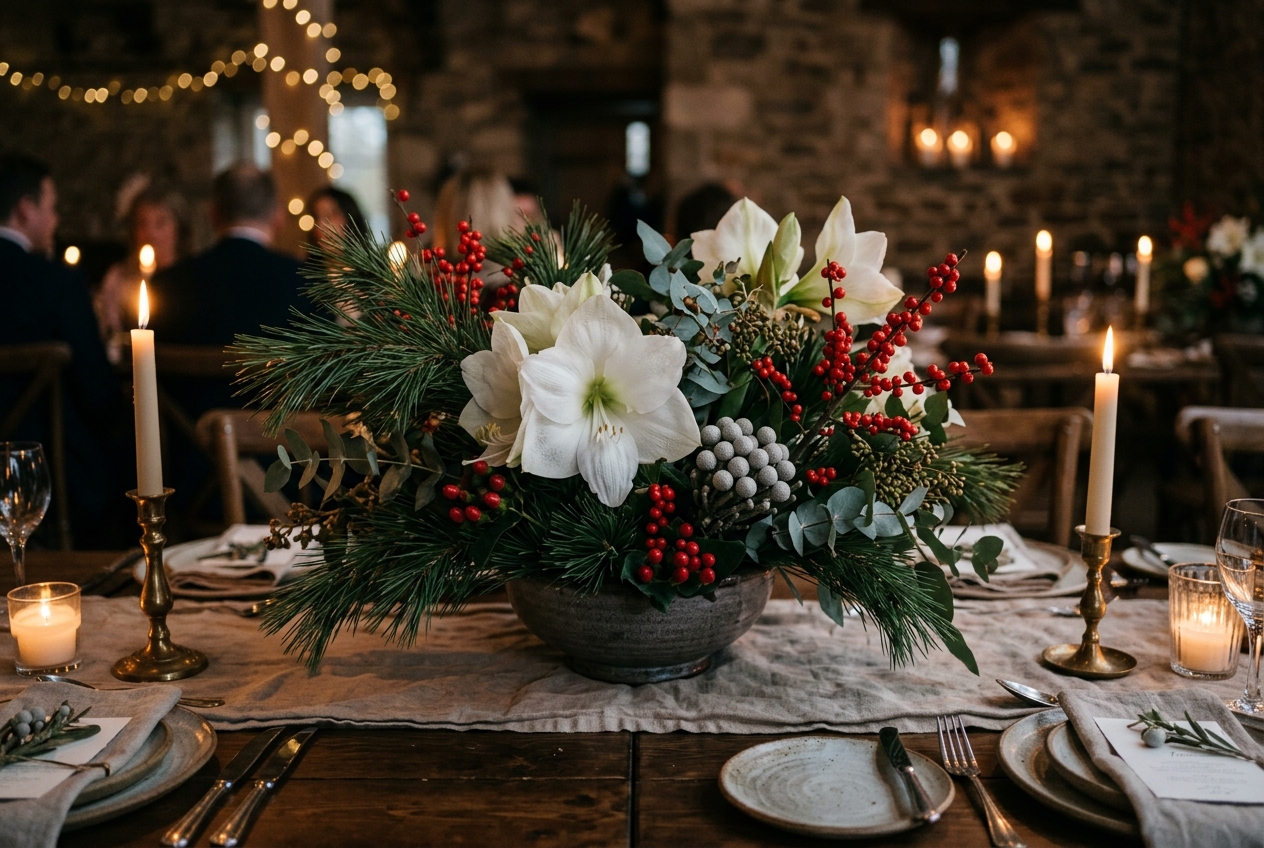
Winter is not a floral desert. The stems available between November and February are genuinely beautiful — and cheaper.
| Stem | Winter availability | Cost per stem (UK 2026) |
|---|---|---|
| Amaryllis | November-February | £3-£6 |
| Hellebores | December-March | £4-£8 |
| Anemones | October-February | £1.50-£3 |
| White roses | Year-round | £2-£4 |
| Eucalyptus | Year-round | £1.50-£3 per branch |
| Ranunculus | January-April | £2-£4 |
| Dried botanicals | Year-round | £1-£5 |
The strongest winter palettes use depth rather than pastels: deep burgundy, forest green, dusty white, and champagne. Dried elements — eucalyptus, pampas grass, honesty discs, dried alliums — add texture and hold up well in warm indoor venues without wilting.
Winter wedding photography: the light problem and how to solve it
The single most important practical challenge for winter weddings is natural light. UK sunset in January is around 4pm. In November it is 4:30pm. This creates a 2-3 hour window for outdoor photography between the end of the ceremony and darkness.
The solution: Plan your timeline around the light, not the other way around.
A workable winter wedding timeline for a ceremony starting at 1pm:
- 1:00pm — ceremony (indoors)
- 2:00pm — drinks reception (indoors, with outdoor access if mild)
- 2:30-3:30pm — couple portrait session outdoors (golden hour is often 3-3:45pm in mid-winter)
- 4:00pm — guests seated for wedding breakfast
- 4:00-6:30pm — wedding breakfast (window to exterior still usable for group shots at start)
Brief your photographer explicitly on what you want from outdoor time. The best winter wedding images use the low-angled winter sun, bare trees silhouetted against pink skies, and frost or mist on lawns. These are distinctly seasonal images that summer cannot replicate — but capturing them requires specific timing.
For couples concerned about light, supplement with a photographer who is skilled in flash and low-light indoor work. Reception candlelight at 7pm photographs beautifully with the right equipment; it requires direct flash or off-camera lighting handled with restraint.
What winter wedding guests should wear
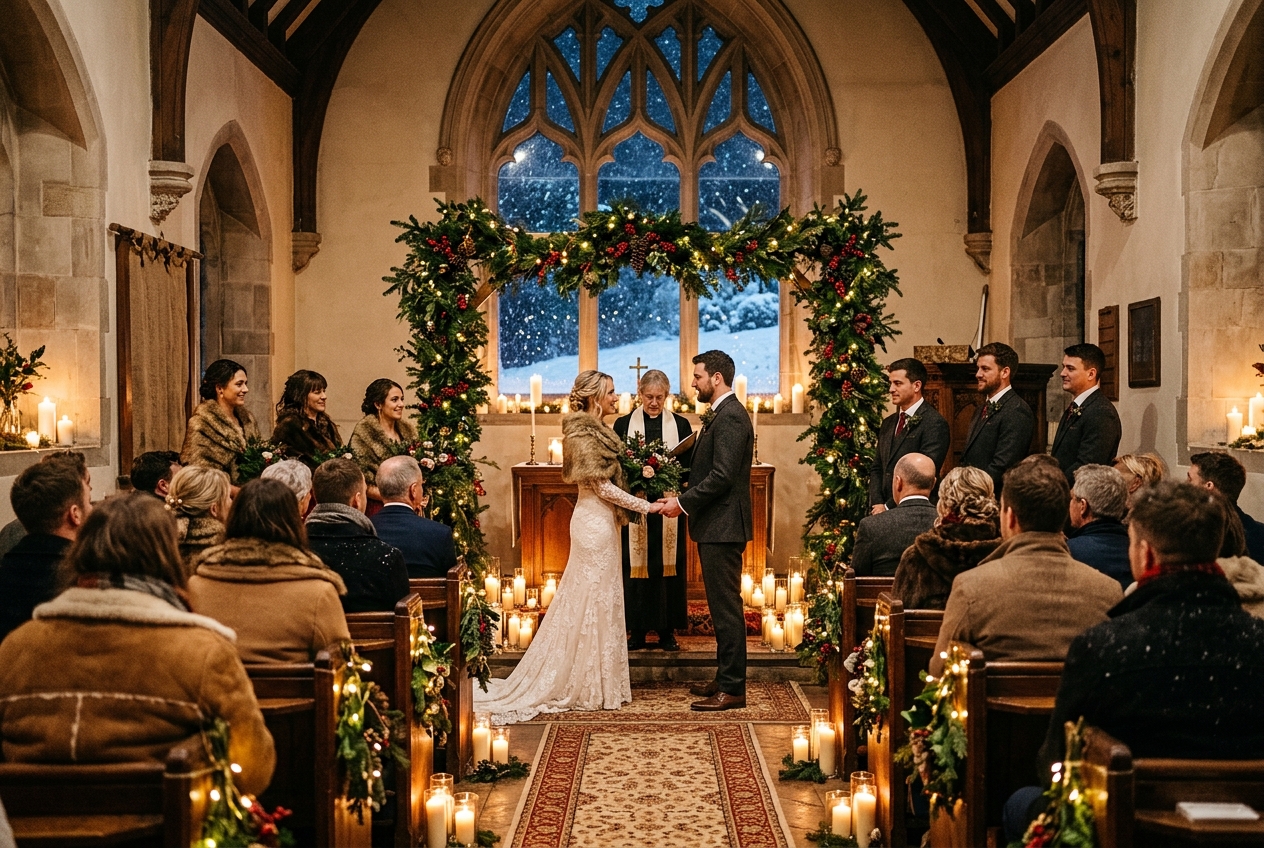
 Guest dress code for winter weddings needs more guidance than summer equivalents. Include a note on your invitations or wedding website:
“The ceremony will be held in our venue’s heated hall. There is a short covered walk between the ceremony and reception spaces. Please dress warmly — the grounds are beautiful in winter, and we’ll have a short window for photographs outside.”
For women: cocktail dresses in velvet, silk, or heavier fabrics with a tailored coat, faux-fur wrap, or velvet blazer. Knee-high boots or block-heeled courts are practical on potentially frosty ground. Avoid very thin fabrics or bare legs in an unheated church setting.
For men: a three-piece suit, morning suit, or black-tie depending on formality. A wool overcoat is appropriate for the arrival and movement between venues.
If your wedding involves any outdoor element — a church with a walk to the reception, a drinks reception with outdoor heating, or a formal garden photograph — say so on the invitation. Guests who are cold become guests who leave early.
The first-hand cost breakdown: a real UK winter wedding
Hannah and Jack married at The Old Rectory, a licensed venue in rural Wiltshire, on 8 February 2026. Guest count: 85.
| Item | Cost |
|---|---|
| Venue hire (full Saturday, exclusive) | £2,800 |
| Catering (3-course dinner, evening buffet) | £6,200 |
| Photography (8 hours) | £1,900 |
| Florals (ceremony + reception) | £1,400 |
| Live band (4-piece, 2 sets) | £1,600 |
| Cake | £480 |
| Stationery | £180 |
| Hair and make-up (bride + 3 bridesmaids) | £640 |
| Transport | £290 |
| Celebrant | £380 |
| Total | £15,870 |
“We looked at a summer Saturday at the same venue: the hire was £4,500,” Hannah told WeddingsHub. “That £1,700 saving alone paid for the band. We got everything we wanted — open fire, candlelit dinner, frost on the lawn for photos — and spent £4,000 less than we would have in July.”
Heating: the cost couples forget
Venue heating is the sleeper cost of winter weddings. Many venues include heating in their hire fee; others do not, or charge extra for prolonged use of wood burners, gas heating, or underfloor heating in outbuildings.
Before you sign any winter venue contract, ask:
- Is venue heating included in the hire fee?
- Who supplies fuel for the fireplaces, and what is the cost?
- Is the catering area (kitchen and service area) also heated?
- What heating provisions are there for the outdoor drinks reception or smoking area?
Venues that have not pre-heated a stone barn for a February wedding can take hours to reach a comfortable temperature. Confirm that the venue will be heated from at least 4 hours before your guests arrive — not from 1 hour before.
Budget £300-£800 in additional heating costs if they are not included, and up to £1,500-£2,000 for large converted barns or tithe barns with high ceilings and poor insulation.
Winter wedding FAQs
How much does a winter wedding cost in the UK?
A winter wedding typically costs 25-40% less than a summer Saturday wedding at the same venue. Venue hire on a January or February Saturday can be £1,000-£3,000 cheaper than a June equivalent. Florals cost 30-40% less in winter. Overall, a 100-guest winter wedding in the UK averages £14,000-£17,000 compared with £20,000-£25,000 in peak summer.
What months count as winter for wedding pricing?
Most UK wedding venues define their off-peak pricing as November to February, with some extending it to include early March and late October. January and February are cheapest. December is an exception — festive demand means December Saturdays often match or exceed summer pricing at popular venues. If budget is the driver, aim for January, February, or early November.
What are the best winter wedding themes in the UK?
The most popular UK winter wedding themes are: festive (candlelight, gold, deep red, berry tones), Nordic or hygge (fir branches, frosted glass, fur throws, cosy fireside), dark romantic (burgundy, navy, black-tie formality), and winter botanical (dried seed heads, eucalyptus, white hellebores). Avoid themes that lean too heavily on snow imagery — UK winters rarely deliver it reliably outside Scotland.
What do winter wedding guests wear in the UK?
Winter wedding guests typically wear cocktail or formal attire plus a warm layer — a tailored coat, velvet blazer, or wrap for women; a three-piece suit or morning suit for men. Include a note on your invitations along the lines of “the ceremony will be in a heated church with a short outdoor walk between venues — please dress warmly.” This removes the guesswork and prevents guests arriving underprepared.
How do you get good winter wedding photos in the UK?
The key constraint is usable natural light. In January, UK sunset is around 4pm — meaning your couple portraits must happen between 1pm and 3:30pm or use artificial lighting. Brief your photographer specifically on this window. The best winter wedding light occurs 30-60 minutes before sunset — a golden haze through bare trees or frost on a lawn reads beautifully in photographs.
Do winter weddings need a marquee?
Usually not — most couples getting married in winter choose indoor venues precisely to avoid the heating costs and structural complexity of a winter marquee. If you do want a marquee in winter, budget an additional £2,000-£4,000 for a heated structure with flooring and lining, on top of standard marquee hire. Some marquee companies stop operating between December and February due to ground conditions.
What flowers work best at winter weddings in the UK?
The most reliable and cost-effective winter wedding flowers in the UK include: amaryllis (available November-February, £3-£6 per stem), white or blush hellebores (£4-£8 per stem), eucalyptus (available year-round, £1.50-£3 per stem), white roses and spray roses, waxflower, and dried botanical elements. Avoid peonies, sweet peas, and garden roses — they are not in season in winter and cost 50-100% more when imported.
Related reading:
Frequently asked questions
How much does a winter wedding cost in the UK?
A winter wedding typically costs 25-40% less than a summer Saturday wedding at the same venue. Venue hire on a January or February Saturday can be £1,000-£3,000 cheaper than a June equivalent. Florals cost 30-40% less in winter. Overall, a 100-guest winter wedding in the UK averages £14,000-£17,000 compared with £20,000-£25,000 in peak summer.
What months count as winter for wedding pricing?
Most UK wedding venues define their off-peak pricing as November to February, with some extending it to include early March and late October. January and February are cheapest. December is an exception — festive demand means December Saturdays often match or exceed summer pricing at popular venues. If budget is the driver, aim for January, February, or early November.
What are the best winter wedding themes in the UK?
The most popular UK winter wedding themes are: festive (candlelight, gold, deep red, berry tones), Nordic or hygge (fir branches, frosted glass, fur throws, cosy fireside), dark romantic (burgundy, navy, black-tie formality), and winter botanical (dried seed heads, eucalyptus, white hellebores). Avoid themes that lean too heavily on snow imagery — UK winters rarely deliver it reliably outside Scotland.
What do winter wedding guests wear in the UK?
Winter wedding guests typically wear cocktail or formal attire plus a warm layer — a tailored coat, velvet blazer, or wrap for women; a three-piece suit or morning suit for men. Include a note on your invitations along the lines of 'the ceremony will be in a heated church with a short outdoor walk between venues — please dress warmly.' This removes the guesswork and prevents guests arriving underprepared.
How do you get good winter wedding photos in the UK?
The key constraint is usable natural light. In January, UK sunset is around 4pm — meaning your couple portraits must happen between 1pm and 3:30pm or use artificial lighting. Brief your photographer specifically on this window. The best winter wedding light occurs 30-60 minutes before sunset — a golden haze through bare trees or frost on a lawn reads beautifully in photographs. Candlelit receptions also photograph well but require a photographer experienced in low-light indoor work.
Do winter weddings need a marquee?
Usually not — most couples getting married in winter choose indoor venues precisely to avoid the heating costs and structural complexity of a winter marquee. If you do want a marquee in winter, budget an additional £2,000-£4,000 for a heated structure with flooring and lining, on top of standard marquee hire. Some marquee companies stop operating between December and February due to ground conditions.
What flowers work best at winter weddings in the UK?
The most reliable and cost-effective winter wedding flowers in the UK include: amaryllis (available November-February, £3-£6 per stem), white or blush hellebores (£4-£8 per stem, statement focal flowers), eucalyptus (available year-round, £1.50-£3 per stem), white roses and spray roses, waxflower, and dried botanical elements including pampas grass, dried alliums, and seed heads. Avoid peonies (May-June only), sweet peas (summer only), and garden roses at their best May-September.