Wedding Party Suits 2026: Coordinated vs Individual

Key Takeaways
- 52% of UK grooms now choose coordinated-but-not-identical suits for their wedding party — up from 31% in 2022
- Full matching suits (identical fabric, colour, cut) have fallen to 29% of UK wedding party bookings in 2026
- The most popular approach: groom in one suit, groomsmen in a complementary but different colour or fabric
- Average groomsman suit hire cost UK 2026: £140-£185 per person. Buying mid-range: £220-£380
- Three-piece suits for the groom with two-piece for groomsmen is a clean visual signal used by 34% of couples
- Tweed and texture-mix suits now appear at 18% of UK country house and barn weddings
The two main approaches: matching vs coordinated
The question every groom faces is whether his wedding party should look like a uniform or a curated group. The industry has moved firmly toward curation.
Fully matching suits
Identical fabric, colour, cut, and tie for every member of the wedding party including the groom. This approach is now chosen by 29% of UK couples — still a significant segment, but no longer the default.
Where matching works best:
- Military or black-tie weddings where uniformity is expected
- Very formal country house ceremonies with a strict dress code
- Small wedding parties (two groomsmen) where coordination is simpler
- Families with a strong traditional preference
The visual risk: When the groom and all groomsmen wear identical suits, the groom can disappear into the group. Photography of the processional and ceremony can make it hard to identify who is who without a distinct visual cue.
Coordinated-but-distinct suits
Same colour family or formality level, but with deliberate differences between the groom and groomsmen. Now the majority approach at 52% of UK bookings. The most common configurations:
- Groom in three-piece, groomsmen in two-piece (same colour and fabric)
- Groom in a different but complementary colour (slate blue groom, charcoal grey groomsmen)
- Different lapel style (groom in peaked lapel, groomsmen in notch)
- Different fabric (groom in herringbone or textured wool, groomsmen in plain)
For a shared-colour example, see Drew Afualo and Pili Tanuvasa’s dark-chocolate wedding party. Their dresses and suits connected visually without identical cuts.
Individual style (each person chooses their own)
Fully individual looks — each groomsman wears a suit they own or choose — make up 19% of UK bookings. This approach is most common at relaxed barn weddings and outdoor summer ceremonies with a “smart casual” dress code. It requires a colour guide or mood board to avoid visual chaos.
What UK grooms are actually wearing in 2026
| Colour | Groom share | Groomsmen share |
|---|---|---|
| Navy | 38% | 41% |
| Slate / steel blue | 16% | 15% |
| Charcoal grey | 14% | 18% |
| Mid-grey | 10% | 11% |
| Sage green | 7% | 6% |
| Warm stone / oat | 6% | 4% |
| Burgundy / deep wine | 5% | 3% |
| Other | 4% | 2% |
Navy remains dominant but its share has declined steadily from 51% in 2021. The move is toward slate blue and non-neutral tones — particularly sage green, which has doubled its share since 2023.
The three-piece signal
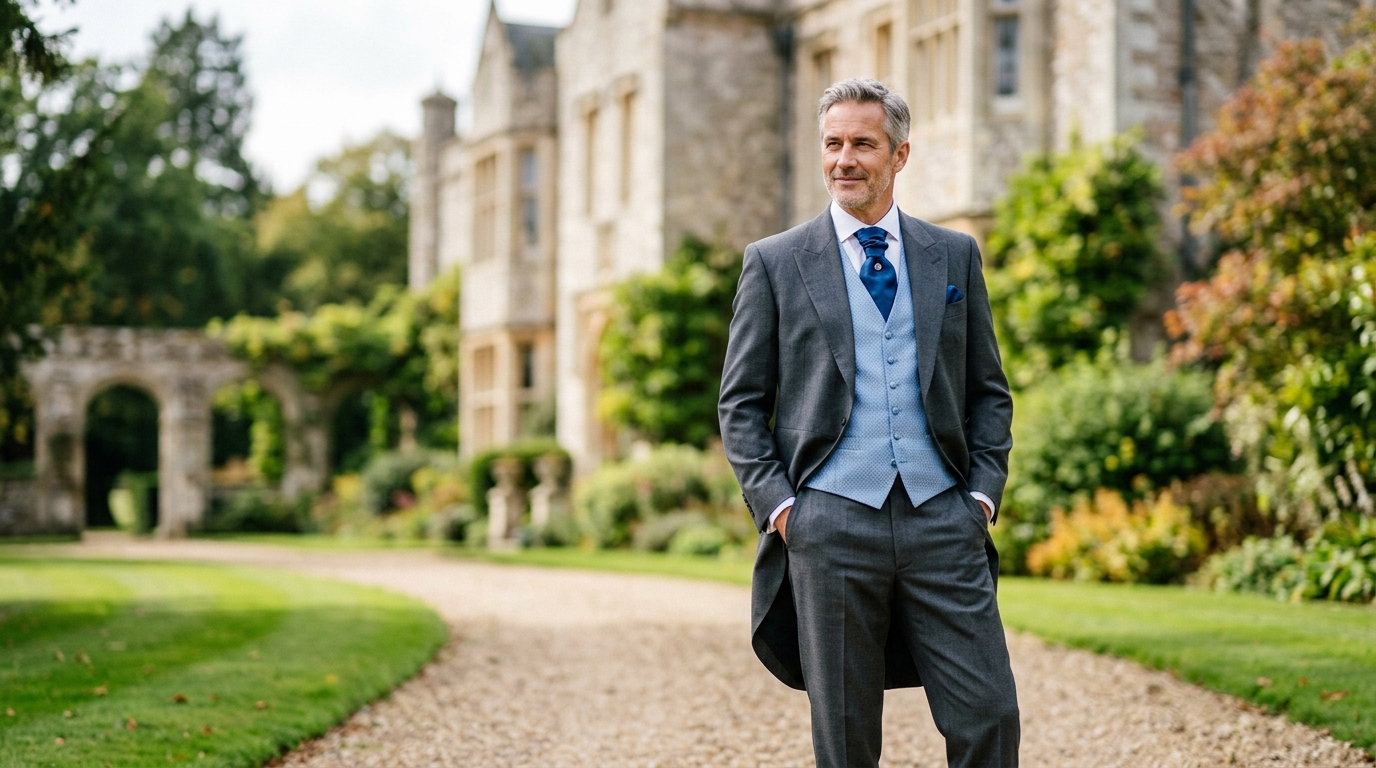
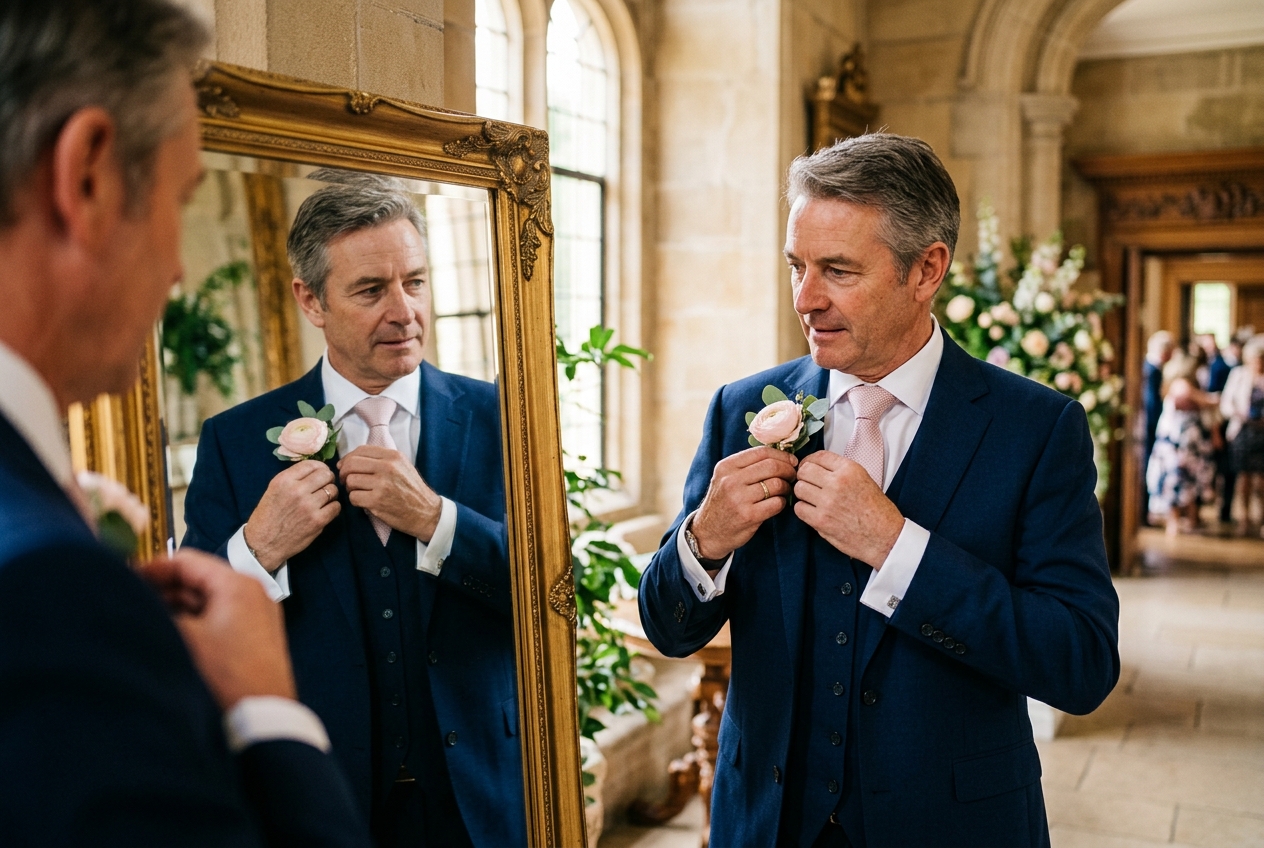 Using a three-piece suit (jacket, trousers, waistcoat) for the groom while groomsmen wear two-piece is the most common visual hierarchy technique, now used at 34% of UK weddings.
The waistcoat does the work of making the groom immediately identifiable at a distance — in ceremony photographs, in processional video, at the altar. It is a clear visual signal that does not require a different colour or dramatic style change.
Making the three-piece work:
- The waistcoat should be the same fabric as the suit, not a contrasting material
- Matching trousers and jacket to the groomsmen’s fabric creates visual cohesion — only the waistcoat differs
- The groom’s tie or pocket square can incorporate the wedding colour more prominently than the groomsmen’s
For detailed guidance on groom-specific styling, see the groom suit guide covering 2026 fabric and colour options.
Suit hire vs buying: 2026 costs
The hire vs buy decision is driven by budget, body shape, and whether the suit will be worn again.
Groomsmen suit hire costs
| Hire company tier | Cost per person (full day) |
|---|---|
| High street hire (Moss Bros, Slaters) | £140-£175 |
| Independent menswear hire | £145-£185 |
| Premium hire (bespoke-fit hire) | £190-£280 |
For a group of four groomsmen, total hire costs range from £560 to £740 for high-street hire. Summer Saturday dates in May, June, and July are the most in-demand — book 10-12 weeks ahead.
Buying suits for groomsmen
| Brand tier | Cost per two-piece suit |
|---|---|
| High street (Next, M&S, ASOS) | £150-£250 |
| Mid-range (Reiss, Ted Baker, Hugo Boss) | £280-£450 |
| Premium (Paul Smith, Hackett) | £500-£900 |
Some UK grooms buy suits for all groomsmen as a thank-you gift. At mid-range prices, this runs to £1,120-£1,800 for four groomsmen. More commonly, groomsmen buy their own suit in a specified style and colour — the groom contributes a tie or pocket square to tie the looks together.
Tweed and texture-mix: the 2026 country suit trend
At barn weddings, country house venues, and outdoor rural ceremonies, tweed and textured wool suits are now appearing at 18% of UK wedding parties. This represents a meaningful shift from plain wool or poly-blend suits that previously dominated.
The most common texture-mix approach in 2026:
- Groom in a heritage tweed or herringbone three-piece
- Groomsmen in a plain charcoal or dark grey two-piece
- Ties or pocket squares in a tartan or heritage pattern linking the looks
UK tailors supplying this category include Magee 1866, the Edinburgh Woollen Mill’s bespoke division, and regional Scottish and Irish heritage tailors. Lead times for bespoke tweed suits are 14-18 weeks — longer than standard tailoring.
For context on the broader range of formal men’s options, see the father-of-the-bride suit trends UK guide and the father of the groom outfit guide.
Colour coordination: the 2026 rules
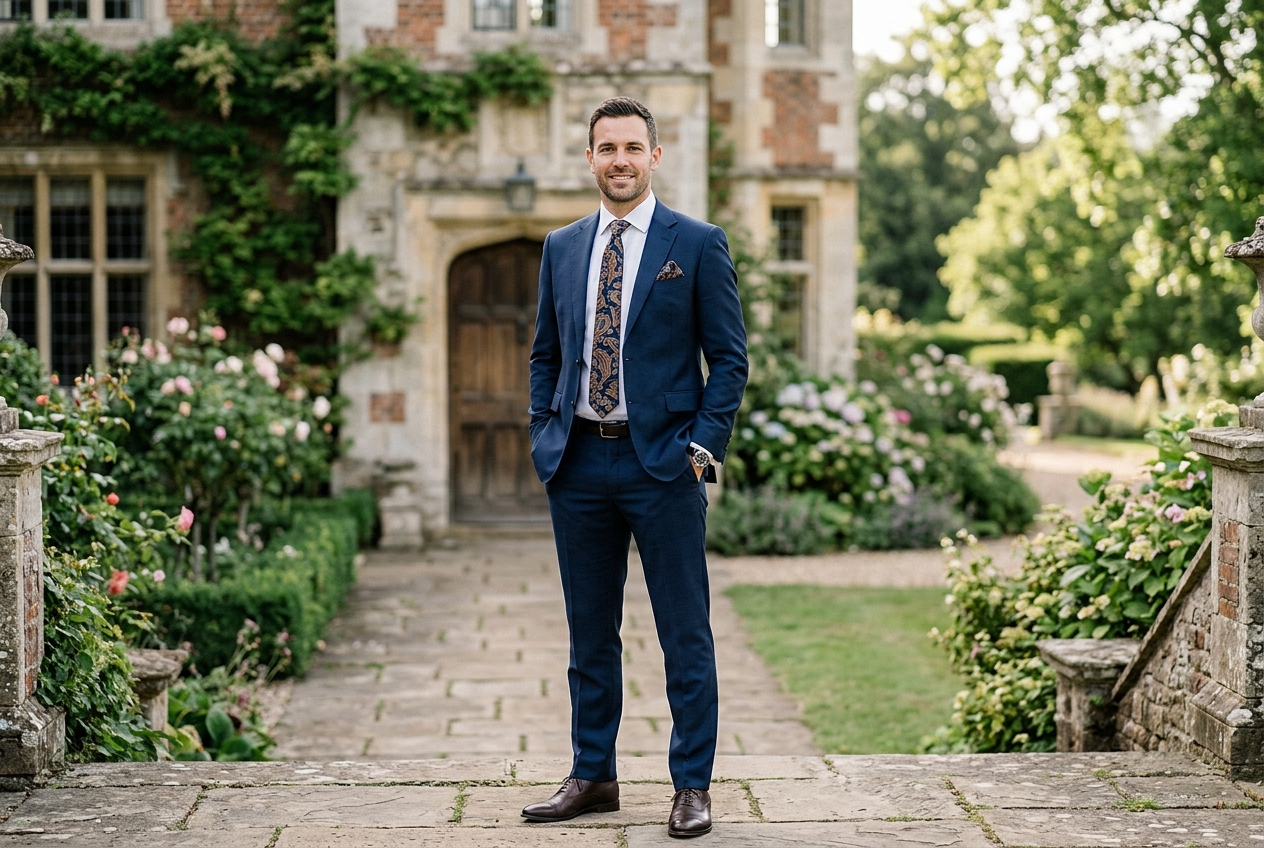
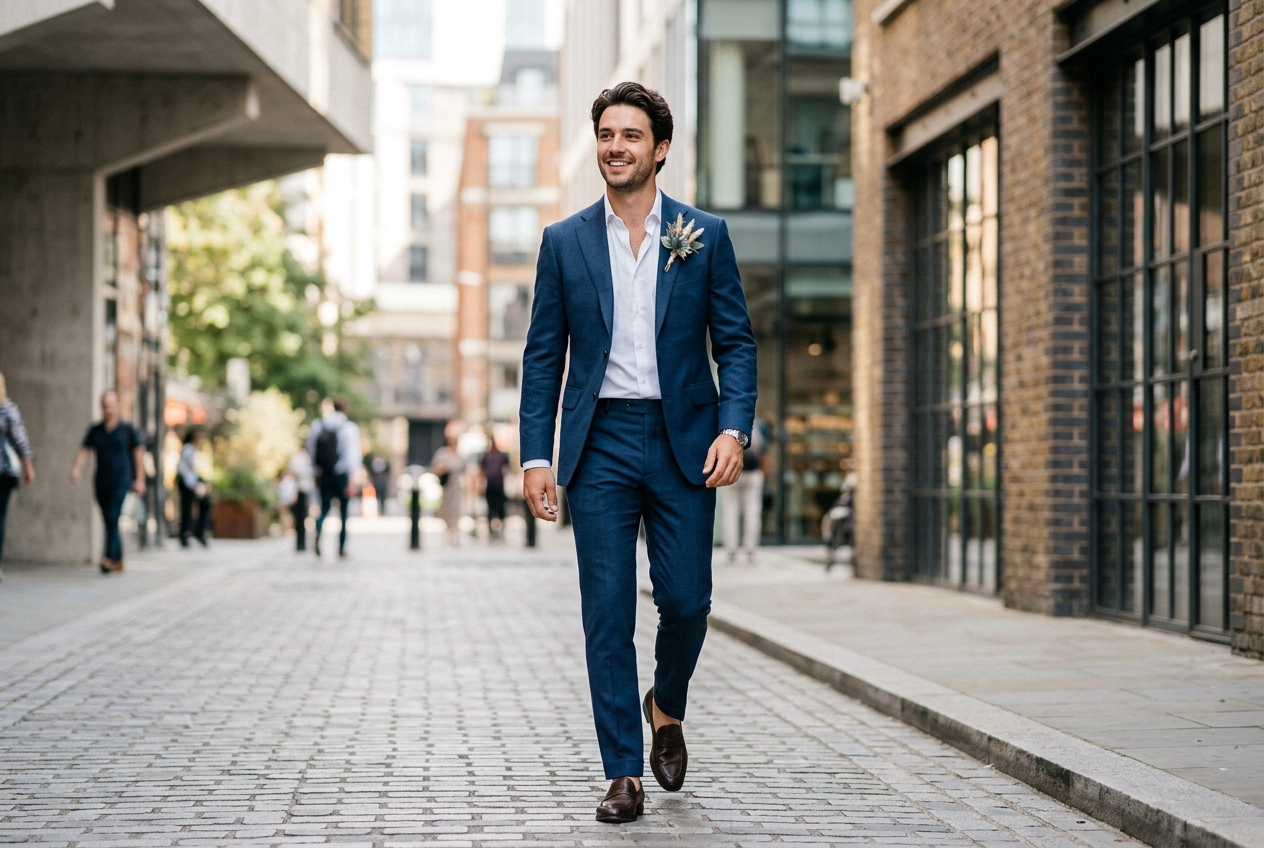 Getting colour right across a wedding party requires understanding which combinations work and which clash visually.
Colour pairings that work
Navy + charcoal: Classic, always professional. The groom in navy, groomsmen in charcoal reads as intentional without looking identical.
Slate blue + mid-grey: A softer pairing, appropriate for summer outdoor weddings. Slate blue has strong Pinterest and editorial momentum in 2026.
Burgundy + charcoal: A bold 2026 pairing, suited to autumn and winter weddings. Works at castle, manor house, and formal urban venues.
Colour combinations that create problems
- Two similar blues that weren’t coordinated: Different shades of navy from different hire companies photograph as mismatched rather than intentional
- Black and dark navy together: Near-impossible to distinguish in evening reception photographs
- Pastels and dark suits in the same party: The contrast is too stark and reads as unplanned
The key rule: all suits should come from the same hire company or the same retailer when possible. Small batch-to-batch colour variations between suppliers are invisible to the eye in a fitting room but very visible in photographs.
Ties and pocket squares: the coordination layer
Once the suit colour and cut are decided, ties and pocket squares are the simplest way to pull the wedding party together.
Standard approach: All groomsmen wear the same tie in the wedding colour. The groom wears a different tie in a complementary or more prominent shade.
2026 variations:
- Knit ties: Growing at relaxed and barn weddings. The groom wears a woven silk; groomsmen wear knit versions of the same colour
- Matching pocket squares, different ties: Less common, but effective when groomsmen are wearing individual suits
- No ties, open collar: Chosen at 12% of UK weddings in 2026, usually at outdoor venues with a relaxed dress code
Avoid the matching tie-and-pocket-square sets sold by most hire companies — they read as generic rather than thoughtful. Ask the hire company for separate pieces and coordinate them deliberately.
A real 2026 wedding party
James and Sophie, married at a North Yorkshire barn venue in May 2026, used the coordinated approach described in this guide. James wore a three-piece mid-grey Reiss suit (£420, bought). His four groomsmen hired two-piece mid-grey suits from a Leeds menswear company at £155 per person (£620 total). Each groomsman wore a sage green tie chosen by Sophie; James wore a pocket square in the same sage green with a white linen tie.
The visual result: James was immediately distinguishable at the altar due to the waistcoat, the looks read as a cohesive group, and no two outfits were identical enough to cause confusion. Total wedding party menswear cost: £1,040 (groom’s bought suit plus four hired groomsmen suits).
Related articles
Frequently asked questions
Should groomsmen wear the same suit as the groom?
Most UK couples in 2026 choose coordinated but distinct suits: same colour family, different cut or detail. Identical suits are less common now, at 29% of bookings.
What suits are trending for wedding parties in the UK in 2026?
Navy and slate blue remain the dominant wedding party colours. Sage green, warm stone, and deep burgundy are growing. Texture-mix tweed suits are gaining at barn and country house weddings, now at 18% of rural bookings.
How much does it cost to hire suits for a wedding party in the UK?
Groomsmen suit hire in the UK costs £140-£185 per person for a full-day hire in 2026. Buying off-the-rack suits (Next, M&S, ASOS) costs £150-£250. Mid-range brands (Reiss, Ted Baker) cost £280-£450.
What is the difference between coordinated and matching wedding party suits?
Matching means identical fabric, cut, and colour for every member. Coordinated means the same colour family or formality level but with deliberate differences — the groom might wear a three-piece, groomsmen a two-piece. Coordinated is now the majority approach.
How do you make the groom stand out from the groomsmen?
Three common approaches: groom wears a three-piece suit while groomsmen wear two-piece; groom wears a different but complementary colour; groom has a distinct lapel style or fabric while groomsmen wear plain. A floral or buttonhole difference alone is not enough.
What colour suits work for a wedding party in summer 2026?
Navy, slate blue, and mid-grey work at any UK venue. For outdoor summer weddings, lighter options — stone, pale grey, or cream linen — photograph well and read as appropriate. Avoid black in summer outdoor settings.
How far in advance should groomsmen book their suits?
For hired suits, book 10-12 weeks ahead for summer Saturday dates. For bought suits requiring alterations, allow 8-10 weeks. Made-to-measure for the groom needs 12-16 weeks minimum.