Wedding Invitations UK 2026: Costs, Wording & Trends
A set of 80 printed invitations (the UK average guest count) costs between £180 and £850 depending on print method. Digital invitations average £45-£95. Three formats dominate in 2026: letterpress (growing 34%), digital suite (growing 89%), and vellum overlay (growing 120%). Lead times for bespoke stationery run 8-12 weeks. Wedding invitation costs vary by print method more than by design complexity.
Key Takeaways
- 80-invite digital print set: £180-£340. Letterpress 80 invites: £480-£850
- Digital invitations growing 89% year-on-year — now chosen by 31% of UK couples
- Order invitations 10-12 weeks before they need to land — allow 4 weeks for printing
- Vellum overlay invitations are 2026's fastest-growing stationery trend: up 120% on Pinterest
- Send save-the-dates 8-12 months ahead; formal invitations 6-8 weeks before the wedding
What UK wedding invitations cost in 2026
Wedding invitation costs vary by print method more than by design complexity. The print method you choose — digital, letterpress, foil-stamping, or engraving — determines the price range before any design discussion starts.
Cost by print method (80 invitations)
| Print method | Cost range (80 invites) | Lead time | Best for |
|---|---|---|---|
| Digital print | £180-£340 | 1-2 weeks | Most couples, tight timelines |
| Letterpress | £480-£850 | 5-7 weeks | Tactile luxury, thick cotton paper |
| Foil stamping | £380-£650 | 4-6 weeks | Metallic text, premium feel |
| Engraving | £650-£1,200 | 8-10 weeks | The most formal, rarest option |
| Digital invitation | £45-£95 | 24-48 hours | Speed, eco, cost saving |
| Vellum overlay | £280-£520 | 3-5 weeks | 2026 trend, soft translucent layer |
What the total stationery budget covers
The £485 average covers more than just the invitations. Full wedding stationery typically includes:
- Save-the-date cards: £80-£140 for 80
- Formal invitations (with envelopes): £180-£380 for 80
- RSVP cards: £60-£90 for 80
- Information inserts (travel, accommodation, registry): £40-£80
- On-the-day stationery (order of service, menus, table plan, place cards, table numbers): £90-£160
- Thank-you cards: £50-£90 for 80
The on-the-day stationery package is where most couples underestimate spend — menus (printed for every seat) and table plans (often A1 or A2 format, framed) add £90-£160 to the stationery budget that couples who think only about invitations do not account for.
When to send wedding invitations
Getting the timing right prevents the two most common UK wedding invitation mistakes: sending too late (guests have other commitments) and sending too early (guests lose the card or forget the details).
The UK invitation timeline
12 months before: Finalise guest list and mailing addresses. For couples using a wedding website, set it live now.
8-12 months before: Send save-the-date cards or digital saves. For peak season (May-September) weddings, 8-12 months is appropriate. For off-peak (October-April), 4-6 months is sufficient.
10-12 weeks before invitations are needed: Place your order with the stationery designer. Bespoke letterpress requires 8 weeks of production time. Even digital print takes 1-2 weeks — add 2-3 weeks for writing, stuffing, addressing, and posting.
6-8 weeks before the wedding: Formal invitations arrive with UK guests. For destination or long-distance guests, 10-12 weeks ahead.
RSVP deadline: Set 4-5 weeks before the wedding. Caterers need final numbers 3-4 weeks out; your seating plan requires 2-3 weeks.
2-3 weeks before: Chase any outstanding RSVPs. One reminder is acceptable. Two is the maximum.
How to word UK wedding invitations
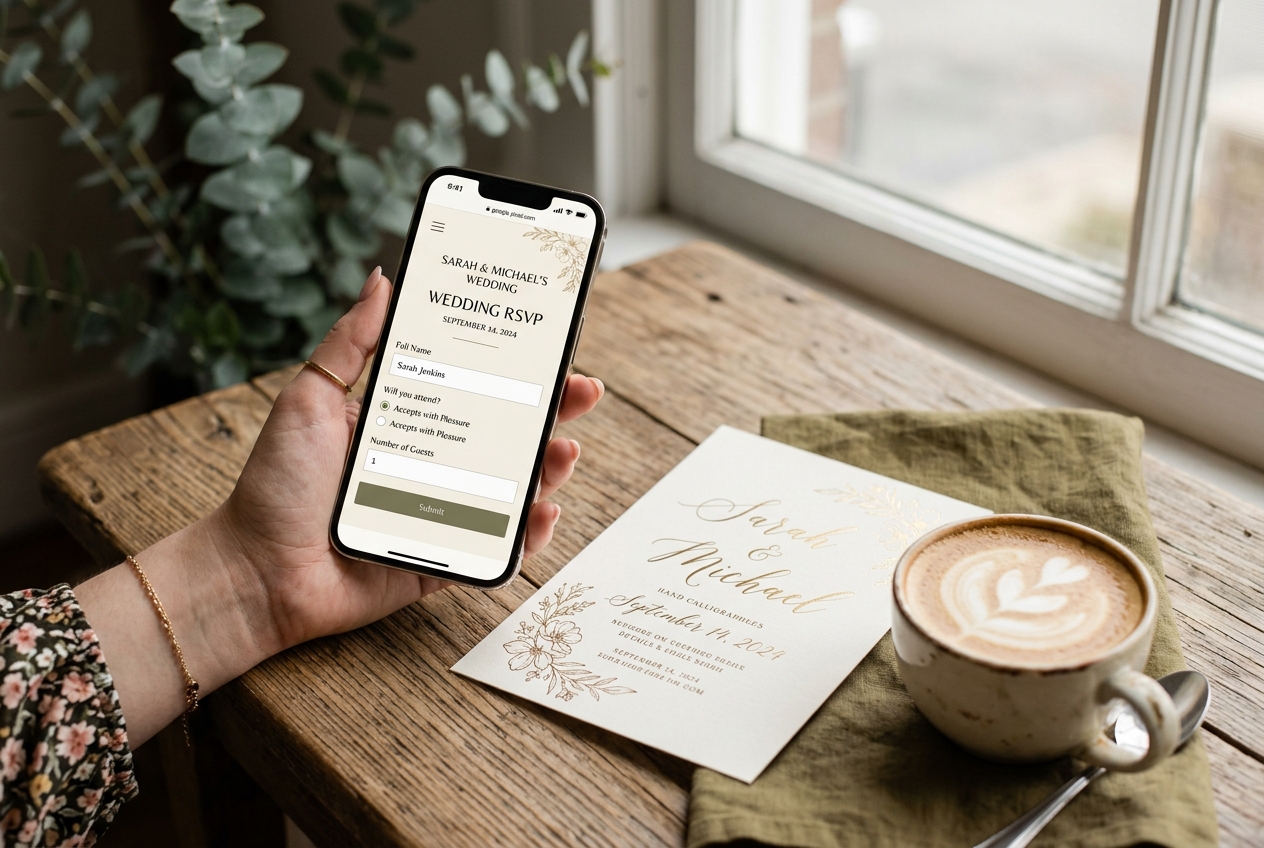
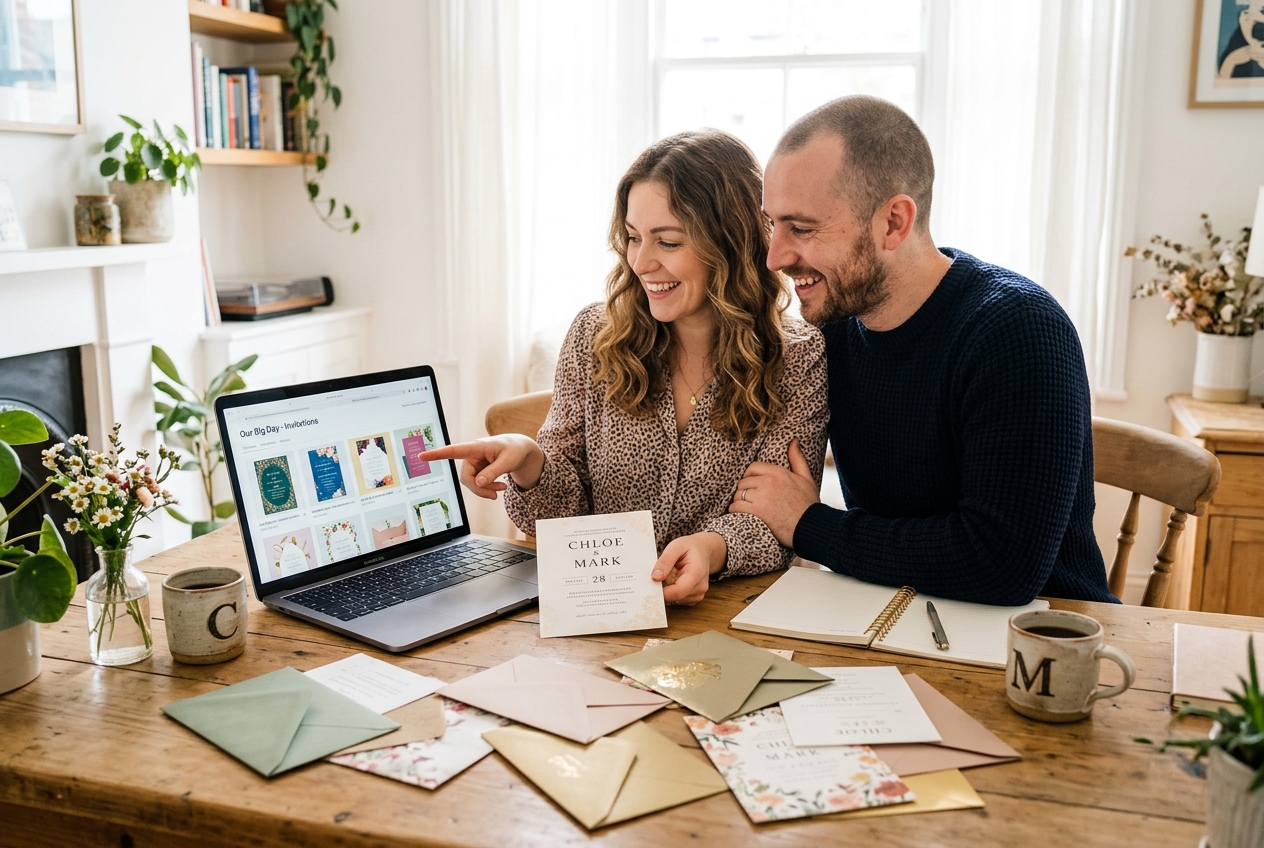 Wedding invitation wording has relaxed significantly. Formal Victorian phrasing (“Mr and Mrs Richard Thornton request the pleasure of your company”) now accounts for fewer than 20% of UK wedding invitations. Modern couples predominantly use first names and plain English.
Modern (now the majority approach)
Sarah Williams and James Thornton invite you to celebrate their wedding
Saturday, 12 September 2026 at 2pm
Kilworth House Hotel North Kilworth, Leicestershire LE17 6JE
Followed by dinner and dancing
RSVP by 1 August 2026 sarah.james2026.com
Traditional (formal, third person)
Mr and Mrs Richard Williams request the pleasure of your company at the marriage of their daughter Sarah Louise Williams to James Edward Thornton, son of Mr and Mrs David Thornton
at Kilworth House Hotel Saturday, 12 September 2026 at 2 o’clock
Contemporary (for couples hosting themselves)
We’re getting married.
Sarah + James 12 September 2026, 2pm Kilworth House Hotel, Leicestershire
We’d love you to join us. RSVP by 1 August: sarah.james2026.com
How to address UK wedding invitations
Addressing is the area where most couples receive conflicting advice. These are WeddingsHub’s recommendations based on current UK practice:
Married couples
- Traditional: Mr and Mrs James Thornton
- Modern (increasingly preferred): James and Sarah Thornton
- Both names on one line; do not separate
Unmarried couples living together
- James Thornton and Sarah Williams (alphabetical or personal preference)
- Never “Mr and Mrs” unless they have the same surname
Single guests
- Ms Sarah Williams (modern default for women of any age unless you know Dr/Prof/other title applies)
- Mr James Thornton
- Miss is appropriate if the guest uses that title
Plus-ones not yet known
- Sarah Williams and Guest (acceptable, not rude)
- Once confirmed, write the actual name on the inner envelope
Families with children
- The Thornton Family (if all children are invited)
- James and Sarah Thornton with a separate inner envelope listing children if some are invited and some are not
- Never assume children are invited because parents are
Titles and professional addresses
- Dr Sarah Williams (medical or academic doctorate — use when known)
- Professor James Thornton and Dr Sarah Williams (both titles, both names)
- For clergy: The Reverend James Thornton or as they prefer — ask
The 5 biggest UK wedding invitation trends for 2026
3. Letterpress on thick cotton paper (up 34%)
Letterpress printing — where type is pressed into thick paper, leaving an indented impression — was the dominant printing method until offset printing replaced it in the 20th century. Its revival reflects a general luxury goods pattern: the physical experience of thick, heavy paper with impressed text is perceived as more premium than the flat surface of digital print. 300gsm or 400gsm cotton paper (Crane’s Lettra is the standard reference) is the carrier. Letterpress invitations typically weigh more than 10g — often requiring large-letter postage. Budget £480-£850 for 80 invitations and factor in the postage uplift.
4. Wax seals (up 67%)
Wax seals on envelope flaps — once confined to formal correspondence and document authentication — have become one of the most-requested wedding stationery additions. Stamp kits from £18-£45, wax sticks from £8-£15 for 30 uses. The effect is striking and personalised. Practical note: wax seals can crack in postal machinery — place sealed envelopes inside a plain outer envelope to protect them. Many UK stationery suppliers now offer wax seal application as an add-on service at £0.80-£1.20 per invitation.
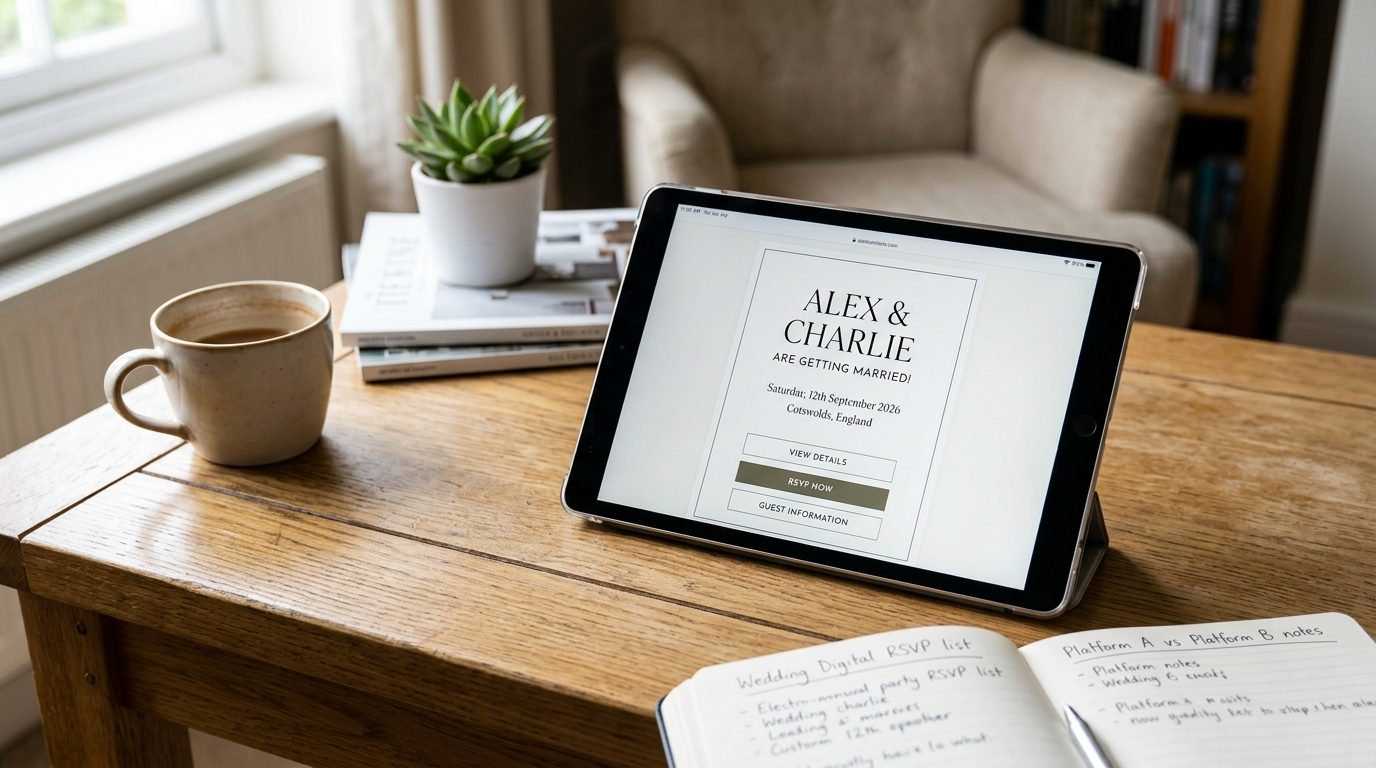
Digital invitations: platform comparison

| Platform | Cost for 80 guests | RSVP tracking | Custom domain | Paper backup |
|---|---|---|---|---|
| Paperless Post | £59-£85 | Yes | No | Yes (printed cards) |
| Joy | Free-£45 | Yes | Yes (paid) | Yes |
| Withjoy | Free-£65 | Yes | Yes (paid) | Yes |
| Zola | Free-£55 | Yes | Yes | Yes |
| Greenvelope | £65-£95 | Yes | No | No |
All five platforms allow unlimited design revisions before sending. Joy and Withjoy include a full wedding website within the same package — making them effectively free alternatives to dedicated wedding website builders.
What NOT to include in the invitation
Three things couples frequently put in their invitation that stationery etiquette advises against:
-
Gift registry or cash fund details — Include a separate insert card or put this information on your wedding website only. The invitation is not a shopping list. Most guests find a registry URL in the main invitation card inappropriate.
-
Dietary restriction requests — Ask about dietary requirements on the RSVP card, not the invitation.
-
Dress code explainers — State the dress code in brief (“Black tie”, “Smart casual”, “Garden party attire”). Do not explain what each term means in the invitation itself. If guests need guidance, link to your wedding website.
Related articles
For how to address envelopes specifically, see our dedicated how to address wedding invitations guide. For the full 2026 stationery trends picture, see wedding stationery trends 2026. For save-the-date timing alongside venue bookings, see the complete UK wedding planning checklist. For digital invitation platforms tested alongside AI tools, see AI wedding planning tools 2026.
Frequently asked questions
How much do wedding invitations cost in the UK?
UK wedding invitations cost £180-£850 for a set of 80, depending on print method. Digital print (the most common) runs £180-£340 for 80. Letterpress runs £480-£850 for 80. Foil-stamped invitations cost £380-£650 for 80. Digital invitations (no printing) cost £45-£95 for a full digital suite. Average total UK stationery spend (invitations, RSVP cards, on-the-day stationery): £485.
When should I send wedding invitations in the UK?
Send formal invitations 6-8 weeks before the wedding for UK guests; 10-12 weeks for guests travelling internationally or from Scotland/Northern Ireland to England. Send save-the-dates 8-12 months ahead for peak season weddings (May-September); 4-6 months ahead for off-peak weddings. Order invitations 10-12 weeks before they need to land — allow 4 weeks for bespoke printing, 1-2 weeks for digital print, plus 2 weeks for writing and posting.
What should UK wedding invitations include?
UK wedding invitations should include: the couple's names, the date and time of the ceremony, the venue name and full address, a dress code if applicable, RSVP details (return address or link) and a reply-by date, and any practical notes (parking, accommodation nearby, child policy). Do not include registry or gift list details in the invitation itself — send those with a separate insert or on your wedding website. Include a map or directions card for venue locations outside major towns.
What is the correct way to address UK wedding invitations?
For married couples: 'Mr and Mrs James Thornton' (traditional) or 'James and Sarah Thornton' (modern, increasingly preferred). For unmarried couples: 'Mr James Thornton and Ms Sarah Williams'. For single guests: 'Miss Sarah Williams' or simply 'Sarah Williams'. For plus-ones: write 'Sarah Williams and Guest'. For children invited: 'The Thornton Family' or name each child individually — 'James and Sarah Thornton and Lily and Tom'. Use full first names — avoid initials. Write the address in full; do not abbreviate street types.
What are the biggest wedding invitation trends for 2026?
The five biggest UK wedding invitation trends for 2026 are: vellum overlays (translucent vellum sheet over the invitation, up 120% on Pinterest), digital suites (growing 89% year-on-year), letterpress on thick cotton paper (growing 34%), wax seals on envelope flaps (growing 67%), and illustrated venue maps as inserts. The dominant colour shift is away from pure white towards warm ivory, terracotta, and sage green — reflecting the same Paloma Hues and Tomato-Core palette trends in wider wedding aesthetics.
Should I send digital or physical wedding invitations?
Both work — the choice depends on your guest list and aesthetic. Digital invitations (Paperless Post, Joy, Zola, Withjoy) cost £45-£95 for a full suite, allow easy RSVP tracking, and reduce environmental impact. They are increasingly accepted — 31% of UK couples chose digital invitations in 2025. However, older guests (60+) and guests who value formality often prefer a physical invitation. A hybrid approach works well: physical invitations for parents, grandparents, and formal guests; digital save-the-dates for the wider guest list.
How do I word wedding invitations for divorced parents?
Where divorced parents share hosting duties, list each parent on a separate line without 'and': 'Jonathan Thornton / Catherine Williams / together with the family of James Anderson'. Where one parent is hosting: 'Mr Jonathan Thornton requests the pleasure of your company at the marriage of his daughter Sarah'. Where both parents and step-parents are involved, a simpler modern approach is to use just the couple's names: 'Sarah Williams and James Thornton invite you to celebrate their wedding'. This avoids family complexity entirely and is now the majority approach for UK weddings with divorced parents.