Wedding Fairs Near Me: How to Find & Prepare
Key Takeaways
- Check WeddingFairs.com, Guides for Brides, and your shortlisted venues' websites for upcoming events
- Venue open days are the most useful type of fair — and they're always free
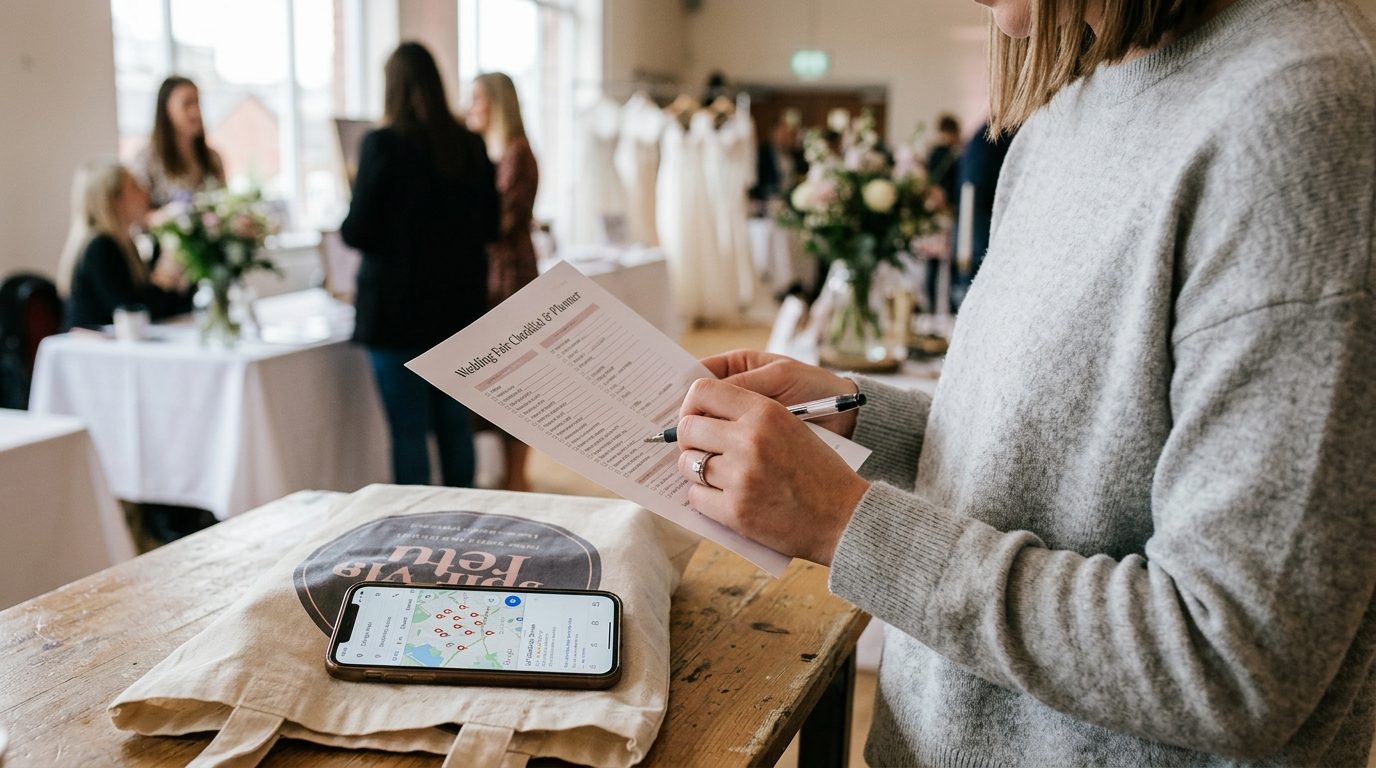
- Bring a charged phone, a tote bag, your approximate budget, guest count, and date
- Make a shortlist of suppliers to visit before you go — don't wander aimlessly
- Never book on the spot — take details home, compare quotes, and decide with a clear head
Searching “wedding fairs near me” on Google gives you a wall of results — directories, organiser pages, venue sites, and sponsored ads. It’s hard to know which fairs are worth the trip and which are a room of ten stands with nothing relevant.
This guide cuts through the noise. It tells you where to search, what types of fair exist, how to prepare properly, and exactly what to bring so you get genuine value from every visit.
Where to find wedding fairs
Online directories
These are the most comprehensive searchable databases of UK wedding fairs:
| Directory | Best For | How to Search |
|---|---|---|
| WeddingFairs.com | Regional and local fairs | Browse by region or search by city |
| Guides for Brides | All types including their own events | Search by area, filter by organiser |
| WeddingDates | Calendar view of all fairs | Browse by month |
| UKBride | Fairs with community discussion | Browse by region |
Venue websites
If you have a venue shortlist (even a rough one), check each venue’s events page directly. Venue open days are the most useful type of wedding fair, and many aren’t listed on third-party directories.
Social media
Follow these on Instagram and Facebook for event announcements in your area:
- Your regional wedding fair organisers (see our 2026 UK fairs calendar for names)
- Your shortlisted venues
- Local wedding magazines and blogs
- Search the hashtag #weddingfair + your county (e.g., #weddingfairyorkshire)
Wedding magazines
Your County Wedding magazine, Brides, and regional wedding publications list upcoming fairs. Pick up a free copy from bridal shops, or check their websites.
Types of wedding fair explained
Not all fairs are the same. Understanding the difference saves you time.
Venue open days (free, 1-2 hours)
A single venue opens its doors, sets up rooms as if for a real wedding, and invites recommended suppliers to exhibit. You tour the venue, taste the food, meet the photographer they work with, and ask questions.
Why they’re the most useful: You see the actual space you’d get married in, set up properly, with the suppliers who know it best. No other fair type gives you this.
When to go: After you’ve narrowed your venue shortlist to 2-3 options.
Local and regional fairs (free-£10, 2-3 hours)
30-80 suppliers in a hotel ballroom, conference centre, or large venue. Mix of venues, photographers, caterers, florists, DJs, and dress shops. Often include a catwalk show and cake tasting.
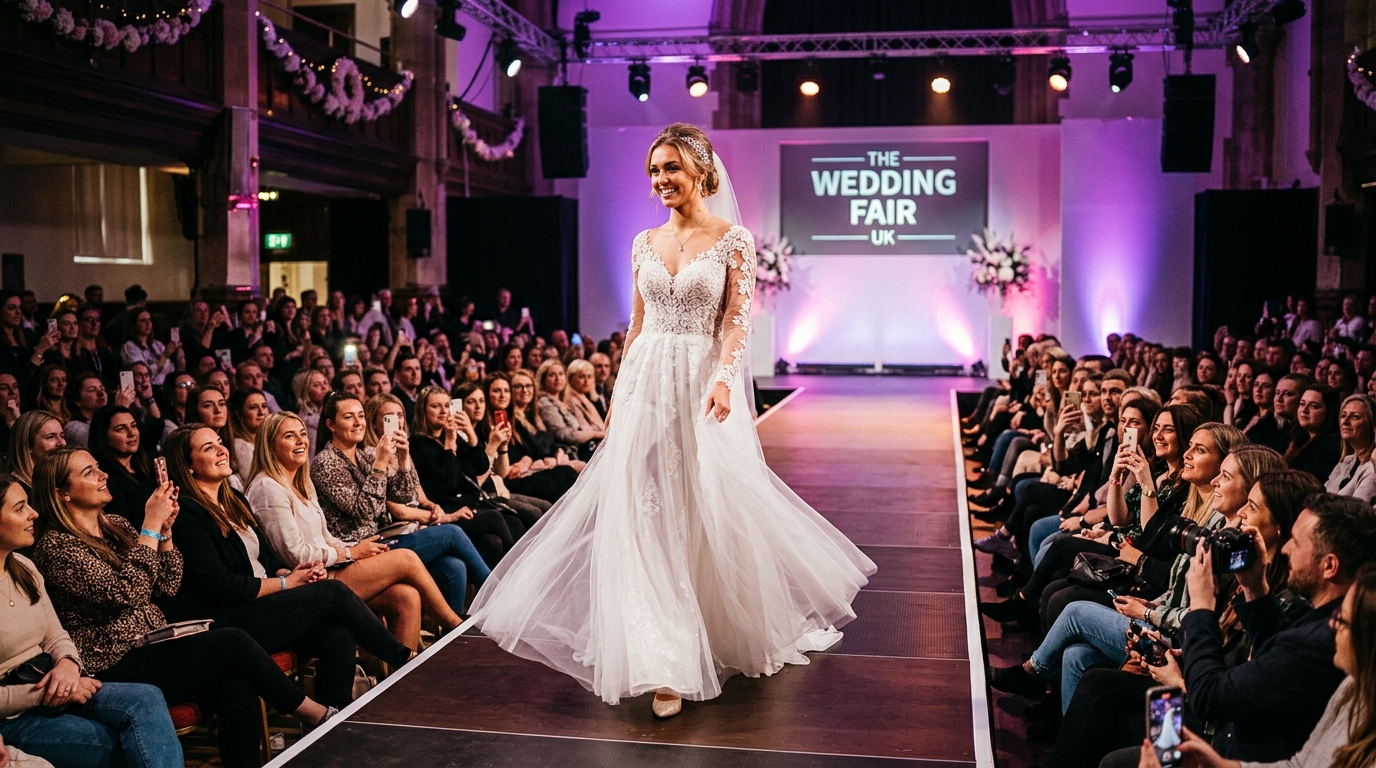
Why they’re good: Broad exposure to local suppliers. Great for comparing prices and styles. Often have exclusive fair-day discounts.
When to go: Early in your planning, before you’ve booked most suppliers.
National exhibitions (£10-25, 3-5 hours)
Major ticketed events at exhibition centres (ExCeL London, NEC Birmingham, EventCity Manchester). 100-300+ exhibitors, live entertainment, multiple catwalk shows, celebrity appearances.
Why they’re good: Sheer scale. You’ll see suppliers, trends, and ideas you wouldn’t find locally. Good for dresses — many bridal designers exhibit exclusively at national shows.
When to go: Very early in planning for inspiration, or when you’re specifically dress shopping.
Luxury / boutique fairs (£10-30, 2-3 hours)
Curated events with a small number of premium suppliers. Held at high-end venues. Sometimes invitation-only.
Why they’re good: Quality over quantity. Every supplier has been vetted. Less overwhelming than a large exhibition.
When to go: If your budget is higher and you want exclusive suppliers.
How to prepare
Going to a wedding fair without preparation is like going to a supermarket without a list — you’ll wander for hours and come home with nothing useful.
Before you go
Know your basics:
- Your approximate wedding date (or at least the season/year)
- Approximate guest count
- Approximate budget (even a rough range)
- Your venue (if booked) or venue type (if not)
- Which suppliers you still need to book
Research the exhibitors: Most fairs publish their exhibitor list online 1-2 weeks before. Scan the list and pick 5-10 suppliers you specifically want to visit. Without a target list, you’ll drift.
Prepare your questions: Have 3-5 questions ready for each supplier category. For example:
- Photographers: “Can I see a full wedding gallery, not just highlights?”
- Caterers: “What’s the all-in per-head price including staff?”
- Venues: “What’s the total cost for a Saturday in [month]?”
Our questions to ask guides have full checklists for every supplier type.
What to bring
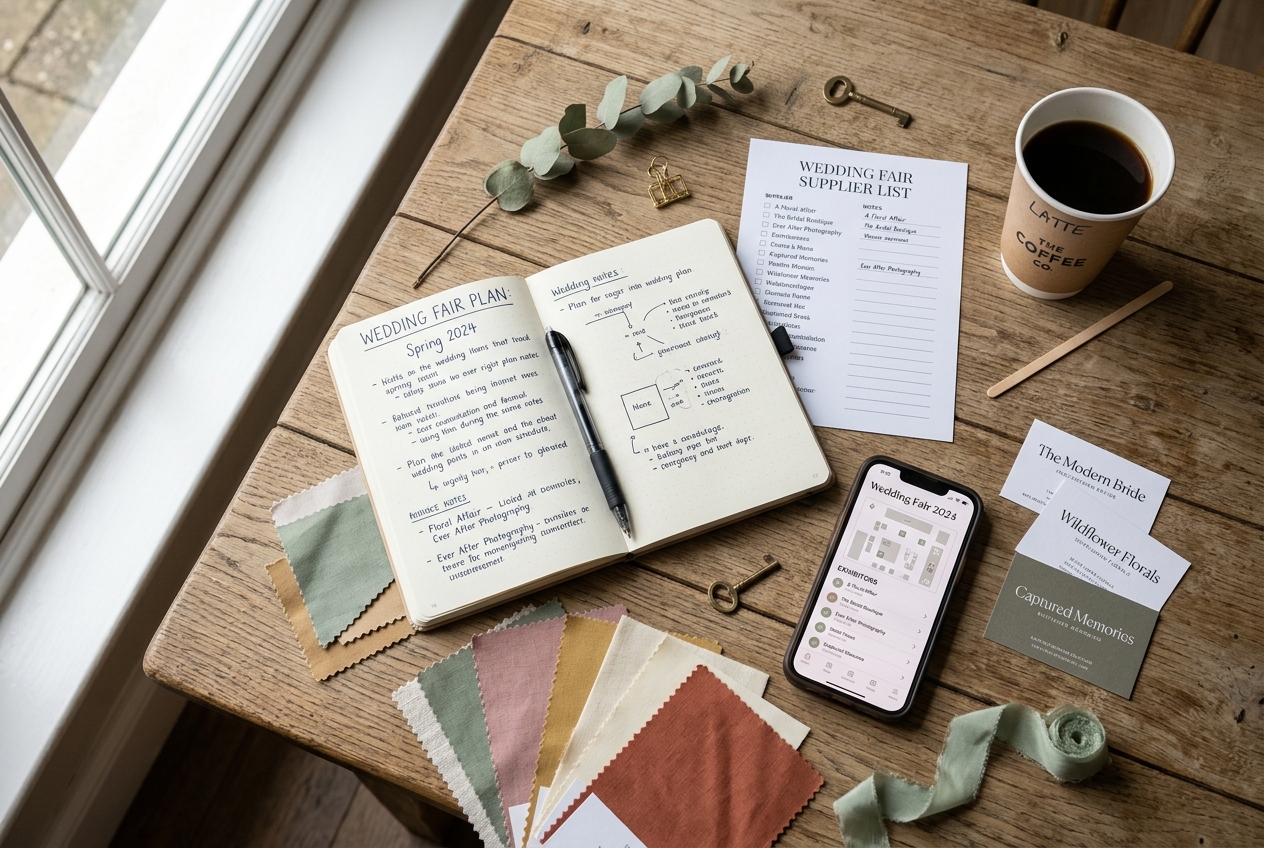
Essential:
- Fully charged phone (for photos, notes, and social media)
- Tote bag or large handbag (you’ll collect brochures, samples, and goody bags)
- Comfortable flat shoes (you’ll be on your feet for 2-4 hours)
- Your budget and guest count written down
- Your target supplier list
Helpful:
- Colour swatches or fabric samples if you’ve chosen a colour scheme
- Pinterest mood board saved on your phone to show suppliers your vision
- Pen and small notebook as a backup to phone notes
- A water bottle (large exhibition halls get warm)
- Layers you can add or remove (outdoor queuing then warm indoor halls)
Leave at home:
- High heels (unless you’re specifically trying on dresses)
- More than one or two companions (too many opinions create confusion)
- Your chequebook or credit card mentality (see “don’t book on the spot” below)
At the fair
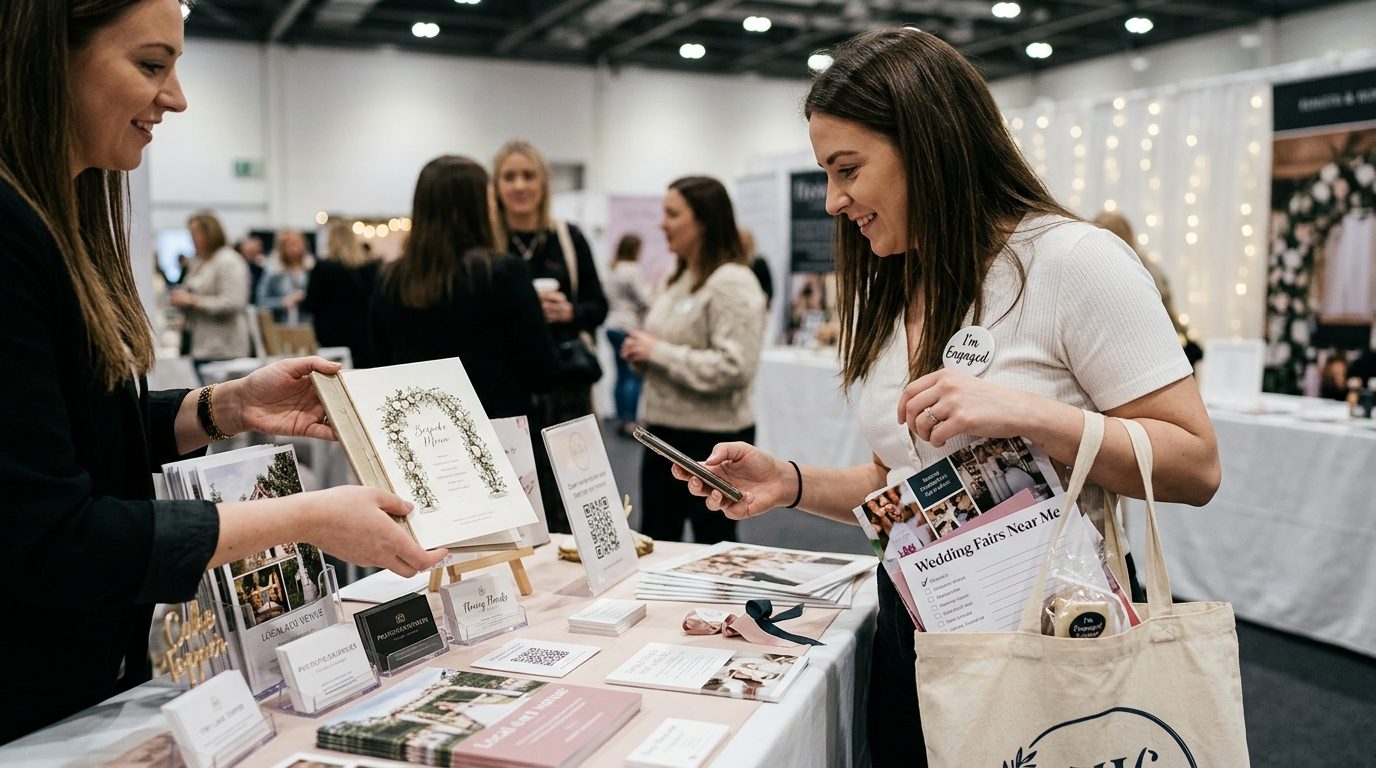
Make the most of your time
Start with your target list. Visit the 5-10 suppliers you’ve pre-selected first, while you’re fresh and the stands are less crowded (especially if you arrive early).
Take photos of everything. Photograph price lists, portfolio pages, stand displays, and business cards. By your third fair, you won’t remember which florist quoted what — photos solve this.
Ask about fair-day offers. Many suppliers offer 5-15% discounts for bookings made at or within a week of the fair. Ask every supplier you’re interested in. But don’t let the discount pressure you into a rushed decision.
Taste everything. Cake tasting stations, canape samples, cocktail demos — try them all. It’s free, it’s fun, and it helps you understand what different caterers and cake makers can do.
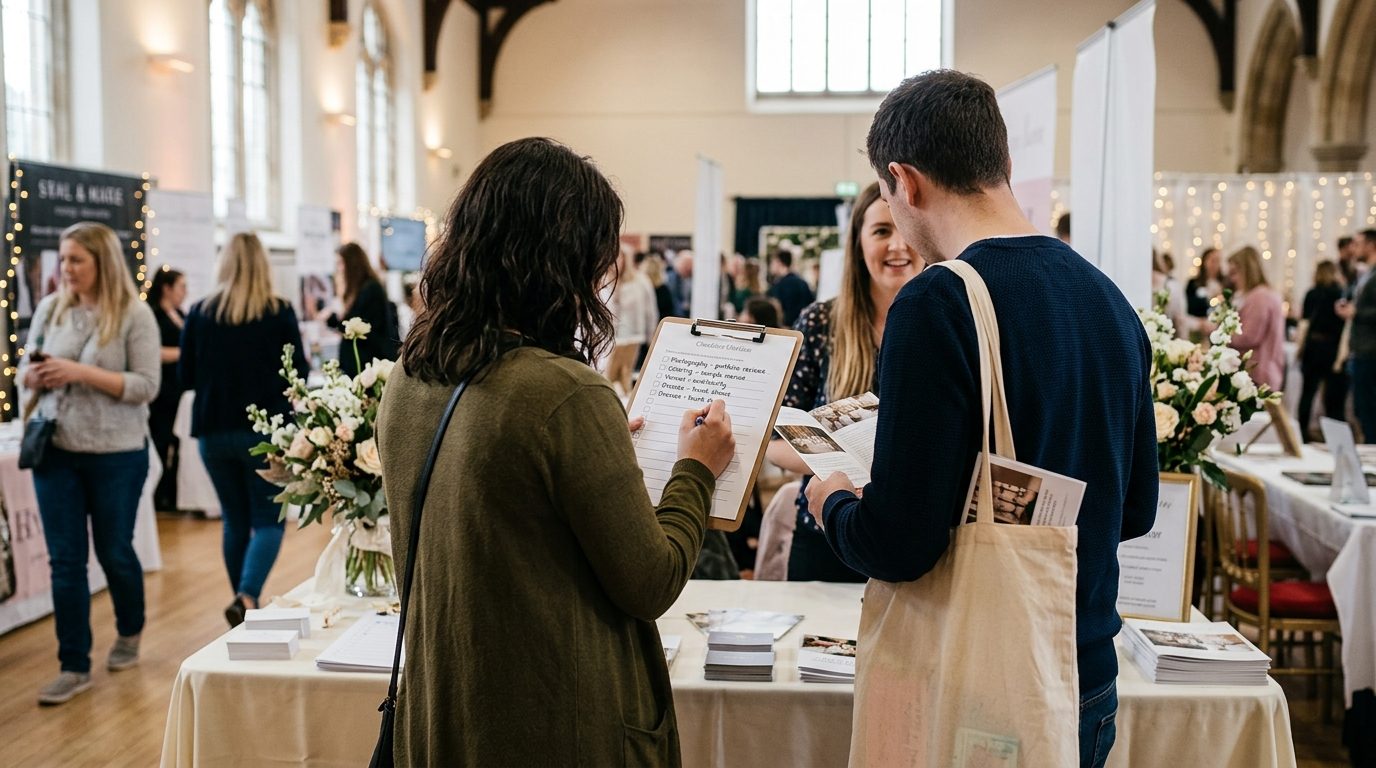
Watch the catwalk. Even if you’ve already chosen your dress style, catwalk shows reveal trends, new designers, and ideas for bridesmaids, grooms, and mothers of the bride.
Be honest with suppliers. Tell them your budget, your date, and what you’re looking for. A good supplier will tell you honestly whether they can help — and if they can’t, they’ll often recommend someone who can.
Don’t book on the spot
This is the most important rule. Wedding fairs create a buzz — emotional excitement, time pressure, “today only” offers. It’s designed to make you book before you’ve properly compared options.
Instead:
- Collect all the information
- Go home
- Compare at least 3 suppliers per category
- Read reviews online
- Contact your top choice the following week
- Book with confidence
A legitimate fair-day discount will almost always be honoured if you call within 7 days. If a supplier insists the price expires the moment you leave the stand, that’s a red flag.
After the fair
The evening after the fair is the most important part. Your notes are fresh, your photos are recent, and you haven’t yet forgotten what impressed you.
Same evening:
- Sort all brochures and business cards into “interested” and “not interested” piles
- Review your photos and add notes to each
- Create a simple spreadsheet: supplier name, category, approximate price, notes, star rating (1-5 gut feeling)
Within one week:
- Email or call your top 3 suppliers per category
- Request written quotes
- Check reviews on Weddings Hub, Google, and social media
- Compare quotes side by side
Within two weeks:
- Make your bookings
- Pay deposits to secure your date
- Get everything in writing (contract, what’s included, payment schedule, cancellation terms)
How many fairs should you attend?
Two or three is ideal:
- One large fair (regional or national) for breadth and inspiration — early in your planning
- One or two venue open days for your shortlisted venues — once you’ve narrowed your options
- Optionally, one more local fair if you still have supplier gaps
Beyond three fairs, you’ll see the same suppliers, hear the same pitches, and experience diminishing returns. Your time is better spent contacting individual suppliers directly.
Further reading
- Wedding Fairs 2026: UK Dates & Locations — our full calendar
- Is a Wedding Fair Worth It? — honest pros and cons
- Questions to Ask Your Wedding Venue — take this to venue open days
Browse wedding suppliers on Weddings Hub by category and region.
Frequently asked questions
How do I find wedding fairs near me?
Search WeddingFairs.com or Guides for Brides by your postcode or county. Follow regional wedding fair organisers on Instagram and Facebook for announcements. Check the events pages of any venues on your shortlist — venue open days are often not listed on third-party directories.
What should I bring to a wedding fair?
Bring a fully charged phone (for photos and notes), a tote bag (for brochures and samples), colour swatches or Pinterest screenshots of your style, your approximate budget and guest count, comfortable shoes, and a notebook or use your phone's notes app. Don't bring too many people — one or two companions maximum.
Are wedding fairs free?
Local wedding fairs and venue open days are almost always free. Regional exhibitions are typically free with advance registration (£5-10 on the door without). National shows charge £10-25 per ticket, with VIP options at £25-45. Always pre-register online — it's rarely worth paying walk-up prices.
How long do wedding fairs last?
Venue open days run 1-3 hours. Local and regional fairs run 3-5 hours. National exhibitions run all day (typically 10am-5pm Saturday, 10am-4pm Sunday). Plan to spend 1-2 hours at a venue open day, 2-3 hours at a regional fair, and 3-5 hours at a national show.
Should I go to a wedding fair before choosing a venue?
Yes. A large regional or national fair before choosing a venue lets you see venue marketing materials, compare styles, and sometimes tour multiple venues from one location. However, venue-specific open days are most valuable after you've narrowed your venue shortlist to 2-3 options.