Wedding Dietary Requirements UK: How Many Is Too Many?
Key Takeaways
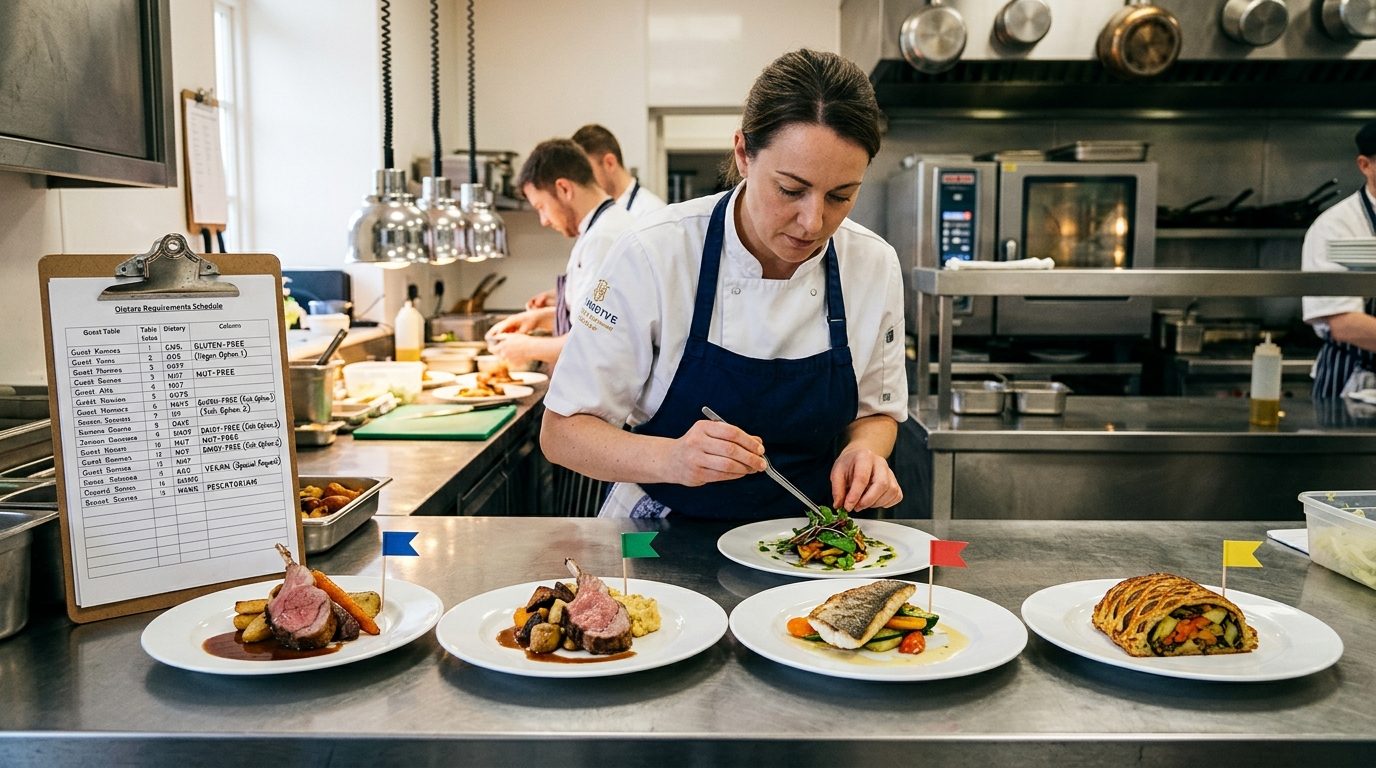
- The average UK wedding with 100 guests generates 26 dietary flags: typically 8 vegetarian, 5 gluten-free, 4 vegan, 3 halal, 2 kosher, 1 nut allergy, and 3 other
- Caterers typically charge a £4-£8 per-head premium for weddings with more than 20% dietary complexity — budget an extra £400-£800 for a 100-guest wedding
- The most common legitimate pushbacks from caterers: more than 15% strict vegan without advance notice, more than 10% halal where a halal-certified kitchen is required, and mixed nut-free plus nut-included menus
- The most misunderstood category: gluten-free requests, where 60% of guests who request GF are reducing gluten by preference rather than managing coeliac disease — separate kitchen protocols only apply to medically diagnosed coeliac guests
Why dietary requirements at weddings have risen so fast
Five years ago, a UK couple could expect one or two guests to mention a dietary restriction. Today, it is closer to one in four.
Several trends have converged to produce this.
Plant-based eating has gone mainstream. The Vegan Society recorded a 40% increase in UK vegans between 2020 and 2025. Flexitarians who eat plant-based outside of specific social events often avoid meat entirely at formal dinners. The overlap between veganism and wedding attendance — younger urban professionals — is significant.
Gluten awareness has expanded beyond coeliac disease. Non-coeliac gluten sensitivity (NCGS) is now a recognised clinical category, and dietary awareness campaigns have led many people to reduce gluten as a general health measure. This has produced a large cohort of guests who tick “gluten-free” on an RSVP without having a medical diagnosis.
Faith-based dietary requirements are increasingly clearly communicated. UK couples feel more comfortable asking Muslim and Jewish guests about their specific requirements rather than assuming. Halal and kosher requests have grown accordingly.
Food allergy awareness has increased. Following high-profile legal cases including the 2016 Natasha’s Law precursor events and the 2019 Food Information for Consumers Regulation changes, hosts — and guests — are more aware of the need to declare serious allergies.
| Dietary requirement | % of guests declaring | % of all weddings affected |
|---|---|---|
| Vegetarian | 8.2% | 94% |
| Gluten-free (any reason) | 5.1% | 87% |
| Vegan | 4.3% | 81% |
| Halal | 3.1% | 34% |
| Nut allergy (any severity) | 2.2% | 76% |
| Dairy-free | 1.8% | 68% |
| Kosher | 0.9% | 12% |
| Other (FODMAP, Jain, etc.) | 1.4% | 41% |
The “any severity” nut allergy figure includes mild intolerances — severe anaphylactic nut allergies requiring epi-pen-level precautions affect roughly 0.4% of the UK adult population.
What the numbers mean for your caterer
A 100-guest wedding with the average dietary distribution above generates approximately:
- 8 vegetarian mains required
- 5 gluten-free adaptations
- 4 vegan mains
- 3 halal-certified meals
- 2 nut-aware meals (with 0.4 guests statistically at anaphylactic risk)
- 2 dairy-free adaptations
- 1 kosher meal (at the 12% of weddings affected)
- 1-2 other specific requirements
Most UK caterers can handle this volume with straightforward menu planning. The complications arise when:
Multiple requirements overlap in a single guest. A guest who is vegan, gluten-free, and nut-allergic requires a dish designed specifically for that combination — not just a vegan dish that happens to contain gluten, or a gluten-free dish that uses almond flour. Each overlap reduces the pool of compliant dishes significantly.
Halal requirements meet a non-certified kitchen. Halal certification requires the use of halal-certified meat, separate utensils, and a segregated preparation area. A caterer without certification cannot produce compliant halal meals — they can only remove pork and alcohol, which is insufficient for observant Muslim guests.
The nut-free requirement meets a nut-inclusive menu. A severe nut allergy requires eliminating tree nuts entirely from the kitchen during food preparation for that guest — which is incompatible with a dessert menu that includes almond praline for other guests. Some caterers will produce a completely nut-free wedding; others will plate a separately prepared nut-free dessert. Either way, there is additional cost and planning involved.
The gluten-free question: preference vs medical necessity

 This is the most misunderstood distinction in wedding catering.
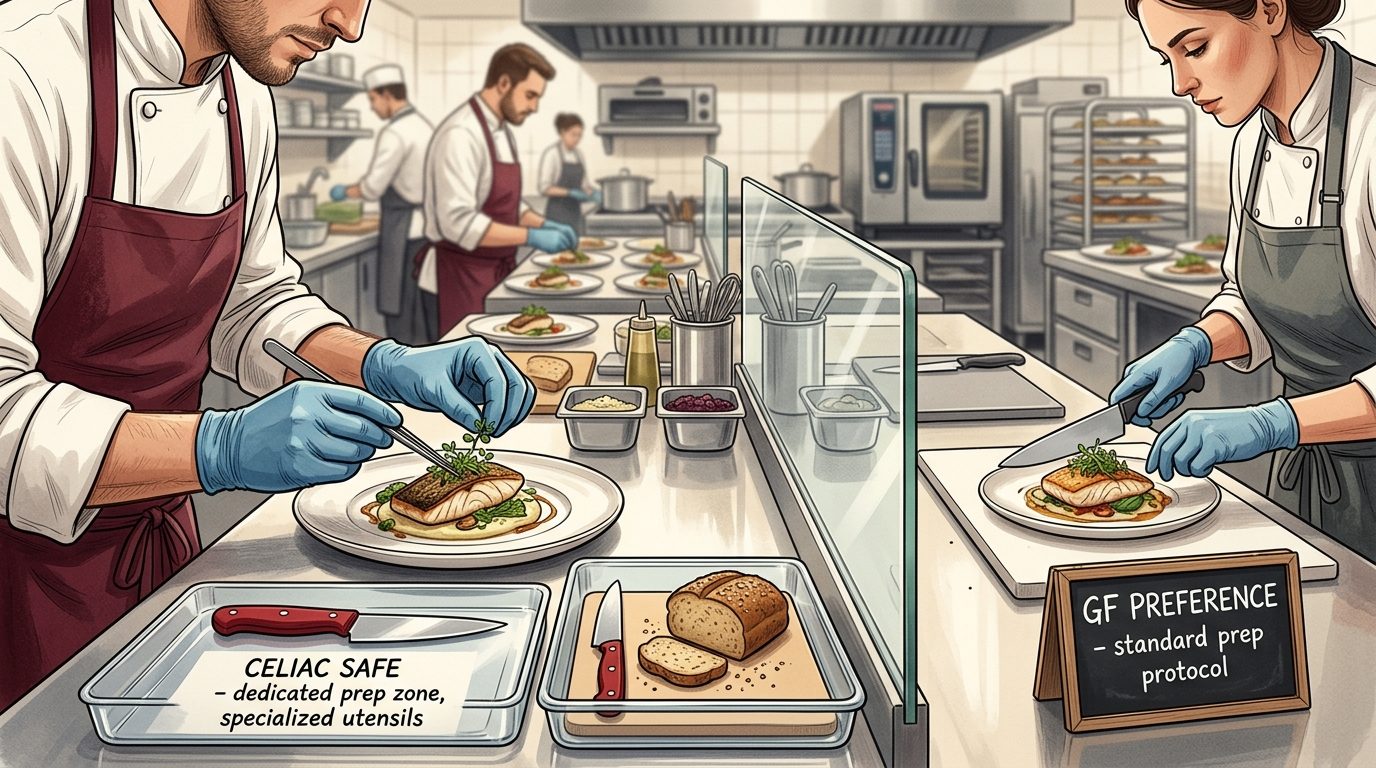
Coeliac disease is an autoimmune condition. Even trace amounts of gluten — from a shared chopping board, a spoon used in a gluten-containing dish — can trigger an immune response. Catering for a coeliac guest requires separate preparation surfaces, dedicated utensils, and ideally a physically separated kitchen area or a separate production shift.
Non-coeliac gluten sensitivity is a recognised clinical condition that causes real symptoms but without the same immune response or intestinal damage as coeliac disease. Cross-contamination at trace levels is typically tolerable.
Gluten reduction by preference is a lifestyle choice with no medical basis. The dish does not need to be produced in a separate kitchen — it simply needs to avoid obvious gluten sources (bread, pasta, flour-thickened sauces).
The practical implication: ask guests who declare gluten-free whether they have diagnosed coeliac disease. Your caterer needs this information to plan kitchen protocols. It is not intrusive — it is a practical question with direct catering consequences.
The case for a single inclusive menu
Several UK caterers now offer an alternative to dietary tracking: a menu designed to be inherently inclusive.
A typical inclusive-menu approach looks like this:
- Canapes: vegetable-based, no nuts, no gluten (naturally gluten-free via rice crackers, blinis made with buckwheat)
- Starter: a roasted vegetable terrine or ceviche-style dish (vegan, gluten-free, dairy-free, nut-free)
- Main: a whole roasted cauliflower or similar centrepiece dish alongside a separately prepared protein option (chicken, fish) — both gluten-free and dairy-light
- Dessert: a panna cotta made with oat cream (dairy-free, gluten-free) or a sorbet flight
This eliminates 70-80% of dietary complexity at source. The trade-offs: no beef or lamb option, no bread course, no cream-heavy sauces. Some guests may find the departure from a traditional UK wedding banquet jarring.
First-hand example: 120 guests, 34 dietary flags
A couple we worked with in March 2026 (James and Priya, London, 120 guests) had an unusually high dietary complexity:
- 12 vegetarian (10% of guest list — higher than average, reflecting a predominantly professional south Asian guest list)
- 8 vegan
- 6 gluten-free (2 confirmed coeliac, 4 preference)
- 5 halal
- 2 nut allergy (1 anaphylactic, 1 mild)
- 1 dairy-free
- 34 total flags — 28% of the guest list
Their caterer (an independent London company) quoted an additional £7 per head for dietary complexity management: £840 on a base quote of £14,400. They also required a 10-week cutoff for dietary submissions, with a £20 per guest surcharge for changes inside that window.
The couple chose to simplify their canape selection (eliminating nut-based items entirely) and chose a menu that was inherently halal-friendly for the main course (a lamb main using halal-certified meat for the full guest list). This reduced their per-head dietary premium to £4 and eliminated the risk of plating errors on the night.
When to push back — and when not to
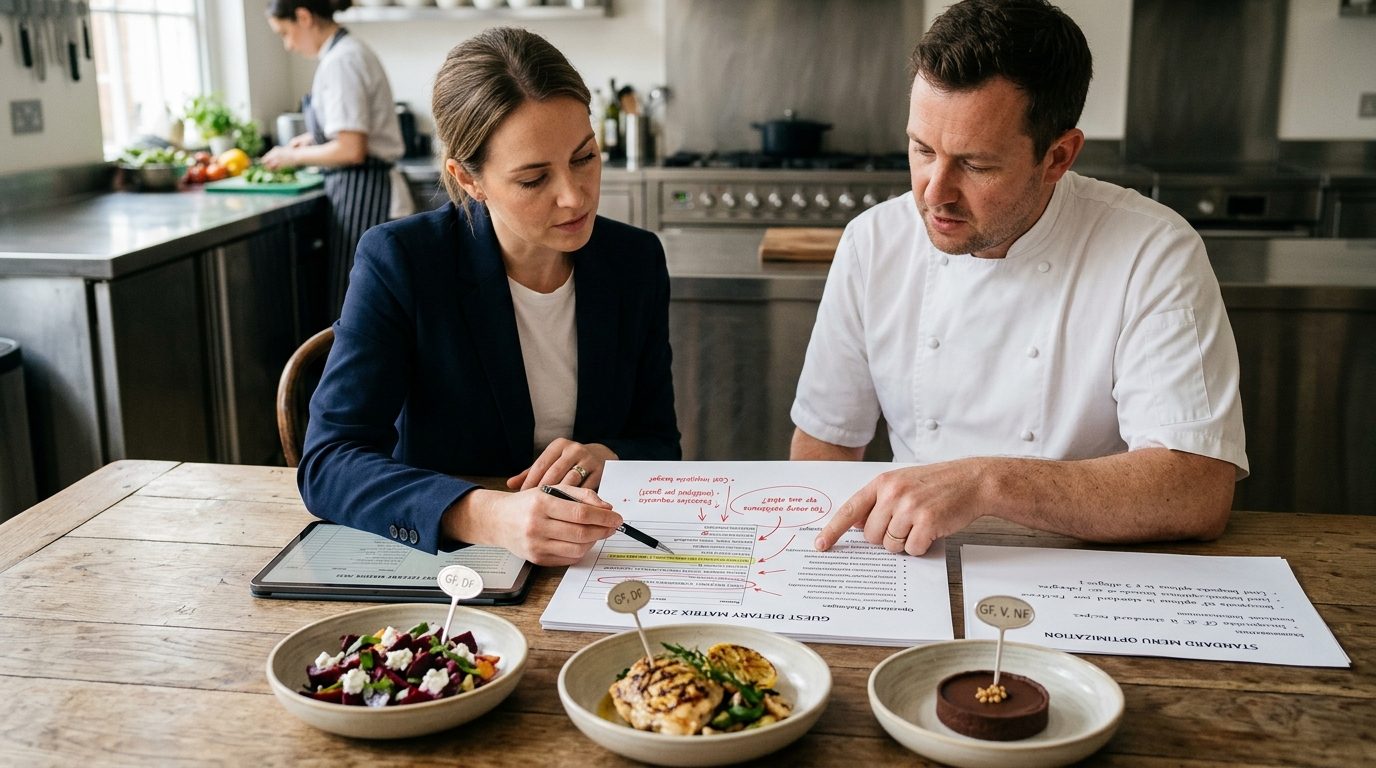
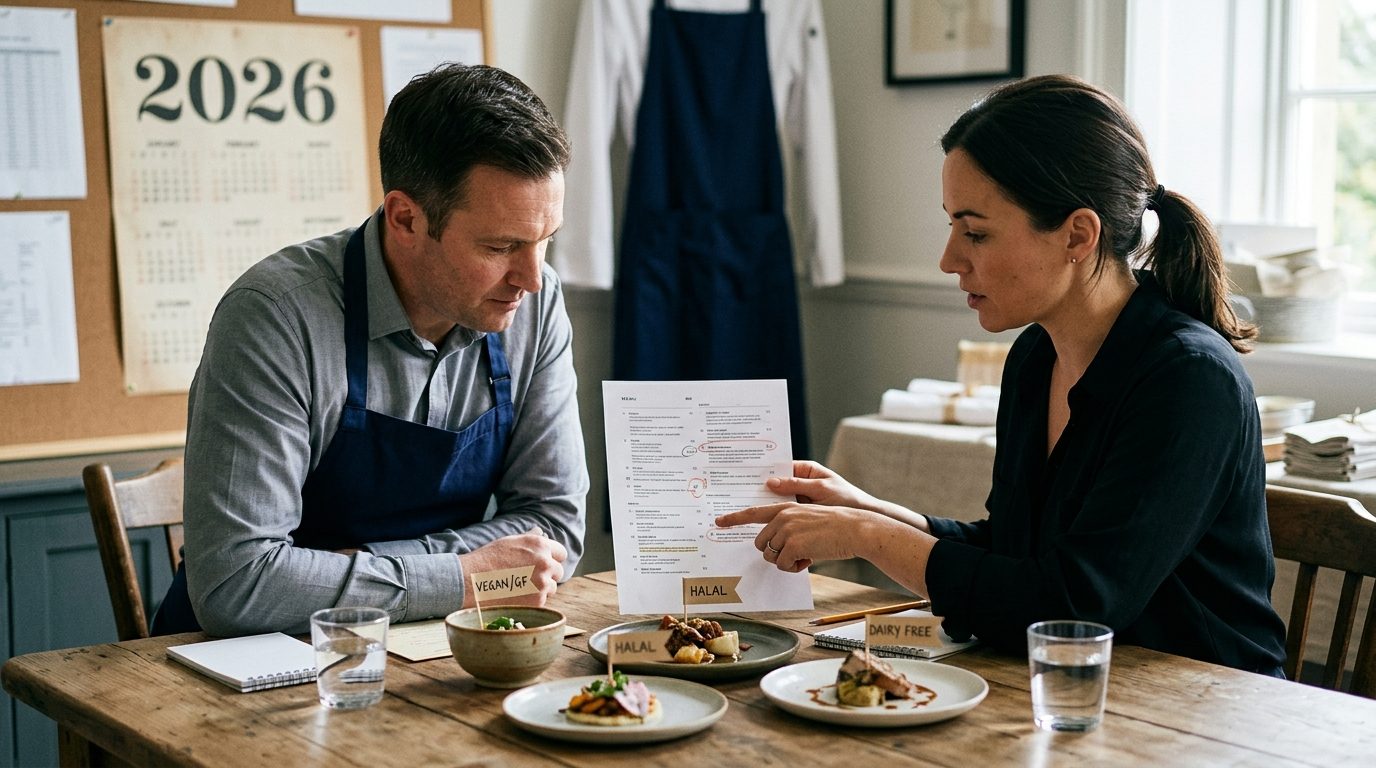 Some couples worry about seeming demanding if they ask for limits on late dietary changes or query the cost of dietary management. This is misplaced — a clear dietary policy is good catering practice.
Reasonable to push back on:
- Late dietary changes submitted within 2 weeks of the wedding without a medical emergency reason
- Extremely complex overlapping requirements from non-dietary-restricted guests (a guest who decides to “try veganism” two weeks before the wedding)
- Requests from guests to serve a meal that violates another guest’s medically required allergen-free environment
Not reasonable to push back on:
- A guest’s confirmed coeliac diagnosis
- Halal requirements from Muslim guests
- Severe nut allergies requiring kitchen-level precautions
- Any medically required accommodation under the Food Information Regulations 2014
Under the 2014 regulations, food businesses (which your caterer is) must provide accurate allergen information for all food served. A caterer who tells you they will “just make sure it doesn’t have nuts in it” without implementing kitchen-level precautions for an anaphylactic guest is leaving you and themselves legally exposed.
Practical timeline for dietary management
| When | Action |
|---|---|
| 12 weeks before wedding | Send RSVPs with clear dietary fields — include categories and a free-text box |
| 10 weeks before | Hard cutoff for dietary submission communicated in RSVP |
| 10 weeks before | Pass dietary list to caterer, flag coeliac and anaphylactic requirements specifically |
| 8 weeks before | Confirm caterer has reviewed and flagged any planning implications |
| 6 weeks before | Final opportunity for guests to flag medical-necessity changes without surcharge |
| 4 weeks before | Cutoff for changes — late-change fee applies |
| 2 weeks before | Final confirmed dietary list sent to caterer in writing |
| 1 week before | Confirm seating plan annotations match dietary requirements |
What your catering contract should say
Before signing, check your catering contract covers:
- Dietary cutoff date — the date after which changes incur additional cost
- Late-change fee — specified per guest or per change
- Allergen protocol — how the caterer handles anaphylactic allergies specifically
- Halal and kosher certification — whether they hold these or can source certified meals from a compliant supplier
- Liability clause — who is responsible if a guest suffers an allergic reaction due to a plating error
A caterer who cannot answer direct questions about allergen protocols should not be handling a wedding where guests have declared severe allergies.
Related articles
- The Average UK Wedding Now Costs £21,990: Which Number Is Right?
- Tasting-Menu Wedding Receptions: When the Food IS the Event
- Caviar Carts & Roaming Oyster Shuckers: The Catering Trend From US to UK
- Weekday Weddings UK: The Real Cost Saving on Tuesday-Thursday Bookings
- 56% of UK Couples Overspend Their Wedding Budget — Where the Money Actually Goes
- Wedding Venue Red Flags You’d Be Mad to Ignore
Frequently asked questions
How many dietary requirements does a typical UK wedding have?
For a 100-guest wedding, that is roughly 26 dietary flags. Common breakdown: 8 vegetarian, 5 gluten-free, 4 vegan, 3 halal, 2 kosher, 1 nut allergy, and 3 other (dairy-free, low-FODMAP, Jain, etc). The total varies significantly by guest demographics — younger guest lists and urban weddings run higher; rural, older, or family-heavy guest lists run lower.
Can a caterer refuse to accommodate dietary requirements at a wedding?
A caterer can contractually decline specific requests that fall outside their certified capability — for example, a caterer without halal certification cannot produce compliant halal meals. Beyond capability, caterers can set reasonable limits in their terms of service. However, for medically required accommodations (anaphylactic nut allergies, coeliac disease), UK food business operators are legally required under the Food Information Regulations 2014 to provide accurate allergen information — and courts have treated failure to do so seriously in food allergy fatality cases.
What is the difference between a gluten-free preference and coeliac disease at a wedding?
Coeliac disease is an autoimmune condition triggered by any gluten cross-contamination — requiring separate preparation surfaces, utensils, and ideally a segregated kitchen area. A gluten-free preference is a dietary choice without medical necessity. Ask your caterer to flag which guests have medical necessity versus preference — it affects kitchen logistics and cost significantly.
How should I collect dietary requirements from guests?
Include a clear dietary field on your RSVP — digital RSVPs via your wedding website work best. Offer categories (vegetarian, vegan, gluten-free, halal, kosher, nut allergy, dairy-free, other) plus a free-text field. Set a hard deadline of 8 weeks before the wedding for dietary information. Anything submitted after 4 weeks typically incurs additional caterer costs. Follow up with any guests who have not responded by the 10-week mark — do not leave it to the caterer to chase.
What should I do if a guest adds a dietary requirement late?
Contact your caterer immediately and expect to pay a late-change fee — typically £15-£40 per affected guest if changes come in within 4 weeks of the wedding. Most caterers can accommodate single late changes. Multiple late changes or a change to a complex requirement (halal, severe nut allergy) within 2 weeks of the wedding may require significant negotiation. Your catering contract should specify the cutoff date and late-change fee — read this carefully before signing.
Can I design a menu that avoids all the main allergens?
Yes. A plant-based, gluten-free menu naturally avoids the 14 major UK allergens in most cases (though cross-contamination risk remains). Many 2026 UK couples choose a menu that is inherently vegetarian and dairy-light, eliminating 70-80% of dietary complexity at source. The trade-off is that guests who want a traditional roast or seafood main may be disappointed. Some caterers now offer a single-menu approach — one dish that works for everyone — as an alternative to complex dietary tracking.
How much do dietary requirements add to wedding catering costs?
For a 100-guest wedding with 26 dietary flags, that is an additional £400-£800. Costs rise further for medically required accommodations: a fully nut-free kitchen adds roughly £300-£600 in staff time and replanning. Halal-certified meals from a certified supplier typically run £8-£12 more per head than standard catering where a non-certified caterer is used.