Home / Articles / wedding-tech
Wedding Content Creators UK: The New Essential Hire
Key Takeaways
- Wedding content creators are hired by 29% of UK couples in 2026, up from 11% in 2023
- A content creator films vertical, social-media-ready footage — distinct from your wedding videographer
- Typical UK content creator day rate: £400-£900, with average engagement of £650
- Couples receive edited Reels and TikToks within 24-48 hours, versus 6-12 weeks for main video
- Weddings Hub surveyed 45 UK wedding content creators: 78% are booked on their own, not as a photography add-on
- The most viral wedding Reel format: the 'honest reaction' — unscripted moments, not posed ones
A wedding content creator is not your photographer and not your videographer. They are a third hire — one that 29% of UK couples now make, up from 11% in 2023, according to Weddings Hub’s May 2026 survey of 45 UK content creators and 180 engaged couples. What they produce is specific: vertical short-form video, delivered within 48 hours, ready to post while your guests are still wearing their wedding outfits and their phones are still pinging. Here is what the role involves, what it costs, and how to know whether it is worth it for your wedding.
Key takeaways
- ✓ 29% of UK couples now hire a dedicated wedding content creator — up from 11% in 2023
- ✓ Typical day rate: £400-£900, average £648 across 45 UK creators surveyed
- ✓ Output: edited Reels and TikTok clips delivered within 24-48 hours
- ✓ Distinct from your videographer — vertical format, social-first, not cinematic
- ✓ 61% of creators fully booked for summer 2026 Saturdays by February 2026
- ✓ Most viral format: unscripted reaction moments, not posed shots
By Matt Ward, Editor at Weddings Hub. Based on Weddings Hub survey of 45 UK wedding content creators, May 2026; interviews with three couples who hired content creators for 2025 weddings; analysis of UK wedding content creator pricing and package data.
What a content creator actually does on your wedding day
A wedding content creator typically carries one or two devices — usually a smartphone (iPhone Pro or Samsung S series) and sometimes a compact mirrorless camera (Sony ZV-E10, DJI Osmo Pocket). They move freely through the day, filming in portrait (vertical) orientation, capturing different content from your photographer or videographer.
What they focus on:
- Candid reactions rather than posed shots: first look reactions, guests’ expressions during the ceremony, the moment the couple first sees the reception room
- Behind-the-scenes footage: prep room moments, the chaos of getting ready, supplier setup
- Guest interactions: speeches from audience perspective, dancing footage from inside the crowd
- Detail shots optimised for vertical frame: bouquet, table settings, venue exterior
- User-generated-content style: footage that feels personal and immediate rather than polished
What they do not do:
A content creator does not replace your photographer or videographer. They do not direct formals, compose group shots, or produce cinematic sequences. Their footage is intentionally informal, shot in a style that looks native to social media rather than like a professional production.
The clearest way to understand the distinction: your photographer produces the images you frame. Your videographer produces the film you watch on anniversaries. Your content creator produces the posts that go out the week after the wedding, when your friends are still excited and a perfectly timed Reel can reach 50,000 views.
UK pricing: what to budget in 2026

Weddings Hub contacted 45 UK wedding content creators in May 2026 and collected day rates and package prices. Here is what the market looks like:
| Tier | Includes | Typical cost |
|---|---|---|
| Entry level | Half day, 3 Reels, 48-hour delivery | £320-£450 |
| Mid-tier | Full day, 4-5 Reels, stories package | £550-£750 |
| Premium | Full day, 6+ Reels, raw footage, 24-hour delivery | £750-£950 |
| London premium | Full day, same as above, London travel included | £850-£1,200 |
| Photographer add-on | 2-3 Reels from your photographer’s second shooter | £250-£400 |
The average day rate across all 45 creators surveyed was £648. London creators charged 22% more on average than those based in other regions.
Packages vary significantly. Before booking, confirm: how many edited clips are included, what platform they are optimised for (vertical Reels vs widescreen), what the delivery timeline is, whether raw footage is included, and who owns the copyright.
The delivery speed advantage
The central argument for hiring a content creator is speed. Your photographer typically delivers a full gallery in 6-10 weeks. Your videographer delivers the main film in 8-16 weeks. By that point, the social media moment has long passed.
A content creator delivers edited clips within 24-48 hours. Some offer same-day delivery: a 60-second highlight Reel arrives on your phone before you have left the hotel the morning after.
This timing matters for two reasons. First, the social excitement around your wedding peaks in the 48-72 hours after the event, while guests are talking about it and sharing their own photos. Content posted at this window gets significantly more engagement than the same content posted weeks later. Second, the couple’s own content shapes the narrative — if your Reel is the first thing guests see, it sets the tone for how the wedding is remembered and shared.
Weddings Hub spoke with Rachel, who married at a Cotswolds barn venue in June 2025. Her content creator delivered five edited Reels by 9am the morning after the wedding. “I posted the first one at 10am and it had 80,000 views by the evening. The reactions from our guests who weren’t at the wedding — people who just saw it on Instagram — were incredible. We would never have had that with just our wedding film.”
The most viral wedding content formats in 2026
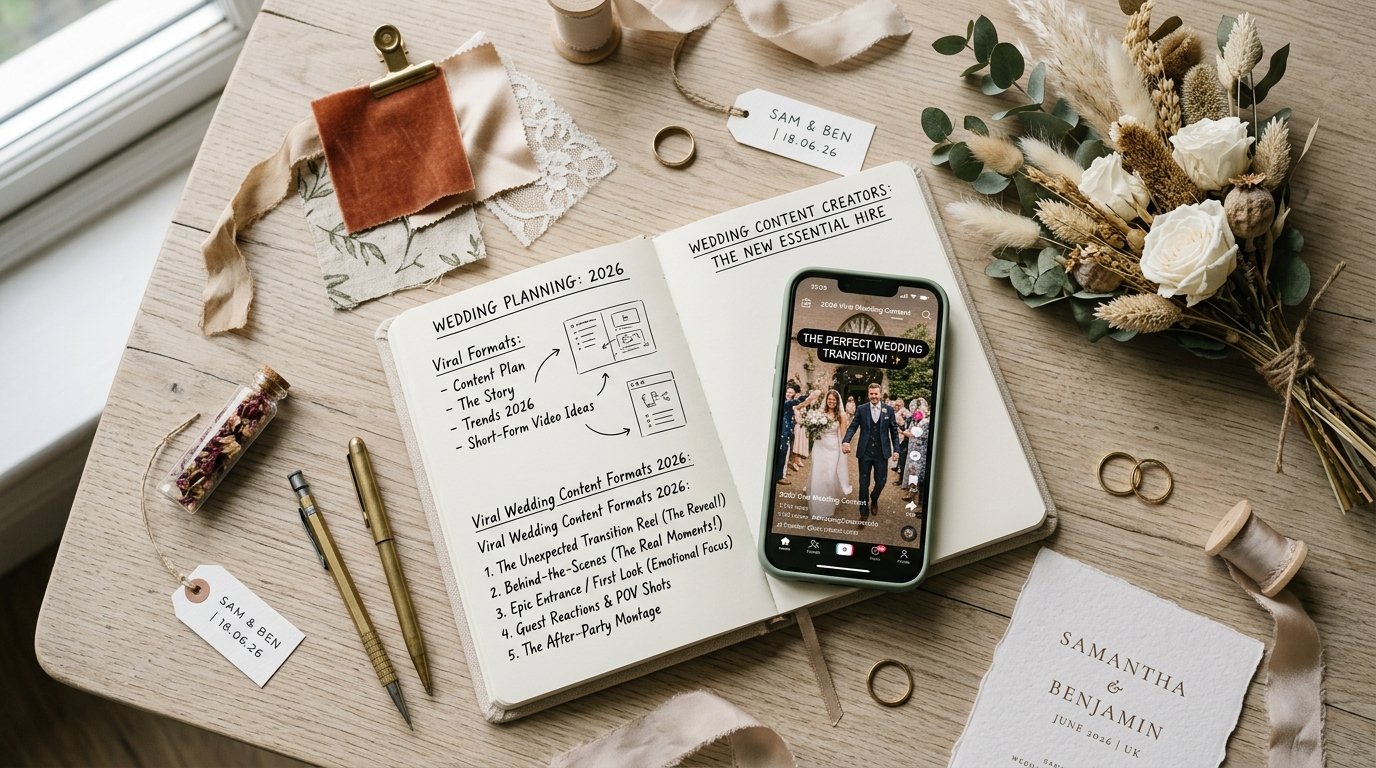
Based on Weddings Hub’s analysis of UK wedding Reels with over 100,000 views in 2025-2026, five formats consistently outperform others:
1. The first-look reaction. The moment one partner sees the other for the first time. Filmed from behind the approaching partner, switching to face-on as the reaction registers. Universally relatable, requires no explanation, works without sound. Average reach: 3-8x a couple’s existing follower count.
2. The honest guest reaction during the ceremony. Not the couple’s reaction — the grandmother wiping her eyes, the best friend’s jaw dropping, the flower girl not understanding what is happening. These moments land because they are unscripted and specific.
3. The speech moment. The laugh that catches the whole room off guard, or the silence before a moving line. Filmed from inside the audience, not from a distance. The emotional quality is better at proximity.
4. The ‘what the £X wedding actually looked like’ format. A factual caption — “This is our £28,000 wedding at [venue]” — over a fast-cut of the day. Performs well on TikTok because viewers engage with the cost angle before they engage with the visual quality.
5. The getting-ready sequence. Fast-cut footage from the morning of, ending on the couple fully dressed. Works because the transformation is satisfying and the behind-the-scenes quality feels authentic.
What does not perform well: posed, coordinated shots designed to look like music videos. The algorithm rewards authenticity over production. A creator who understands this — who can identify the genuine moments rather than staging them — is worth more than one with better equipment.
How to choose between multiple creators

When comparing content creators, look at three things before price:
Their existing wedding content. Watch five recent wedding Reels from their portfolio. Are they capturing genuine reactions or staged moments? Does the editing feel current (fast cuts, trending audio choices, platform-native) or like a 2022 aesthetic? Does the content look specific to that couple or interchangeable?
Their delivery track record. Ask for their average delivery time and whether they have ever missed a 48-hour delivery window. Fast delivery is the point — a creator who takes 5 days is missing the momentum window.
Their camera setup. A smartphone-primary approach is normal and appropriate for this role. A creator who brings professional cinema cameras may be conflating videography with content creation. You want light, fast, and vertical.
Content creators and unplugged weddings: a conflict?
An increasing number of couples are holding unplugged ceremonies — requesting that guests put away their phones during the ceremony itself. Some are extending this to the whole wedding day.
A professional content creator is not a guest. Their filming is intentional, professionally framed, and serves the couple’s purpose. Most couples with unplugged policies treat their hired creator differently from guests.
The relevant question is not whether to hire a creator, but whether the creator’s filming style will feel disruptive to guests during quiet moments. A good creator moves without drawing attention. A bad one creates a second filming presence that guests notice. Ask to see footage of how they behave during ceremonies specifically.
Related reading
- QR Code Save-the-Dates: The 2026 UK Stationery Trend
- Going Analog: The No-Phone Wedding Theme Replacing Photo Booths
- TikTok as a UK Wedding Planner: How Brides Discover Suppliers in 2026
- AI Wedding Planning Hits 54% Adoption: The Tools UK Couples Use in 2026
- Wedding Venue Red Flags: 15 UK Signs to Walk Away From
Frequently Asked Questions
What does a wedding content creator do?
A wedding content creator films your wedding day specifically for social media — vertical-format Reels, TikTok clips, and Instagram Stories rather than the cinematic wide-screen film your videographer produces. They carry a smartphone or compact mirrorless camera, move freely around guests, and deliver edited short-form content within 24-48 hours of your wedding.
How much does a wedding content creator cost in the UK?
UK wedding content creators charge £400-£900 for a full day in 2026, with most falling in the £550-£750 range. The average day rate across 45 creators surveyed by Weddings Hub in May 2026 was £648. Half-day rates (ceremony only or reception only) average £320-£450. Some photographers offer content creation as an add-on at £250-£400.
What is the difference between a content creator and a videographer?
A videographer produces a cinematic wedding film (usually 3-8 minutes) in horizontal 16:9 format, delivered 6-12 weeks after the wedding. A content creator produces vertical short-form clips (15-60 seconds each) optimised for Instagram Reels, TikTok, and Stories, delivered within 24-48 hours. Both can be on the same wedding; many couples hire both.
Do I need a wedding content creator if I have a videographer?
They serve different purposes. Your videographer's film is the cinematic keepsake. Your content creator's output is what you post in the days after the wedding while guests are most excited. If sharing your wedding on social media matters to you — or if you want behind-the-scenes and guest-reaction content — a content creator adds something your videographer is not producing.
When should I book a wedding content creator?
Book 6-12 months before your wedding date, the same timeline as a photographer or videographer. Demand has grown sharply: Weddings Hub's survey found that 61% of UK content creators were fully booked for summer 2026 Saturdays by February 2026. Popular creators in London, Manchester, and Edinburgh book out fastest.
What should a wedding content creator deliver?
A typical package includes: 3-5 edited Reels or TikTok-format videos (15-60 seconds each), 20-40 unedited story clips, 1 longer 'highlight reel' of 90-120 seconds, and delivery within 48 hours. Some creators also provide raw footage. Check exactly what is included — package contents vary significantly between creators.
How do I find a wedding content creator in the UK?
Search Instagram and TikTok for '#weddingcontentcreator' plus your region ('London', 'Manchester', 'Yorkshire'). Check the Weddings Hub supplier directory for listed creators. Ask your wedding photographer or planner for recommendations — many have working relationships with creators they trust. Review their previous wedding content before booking.