Religious + Humanist Wedding: How to Do Both Legally
Key Takeaways
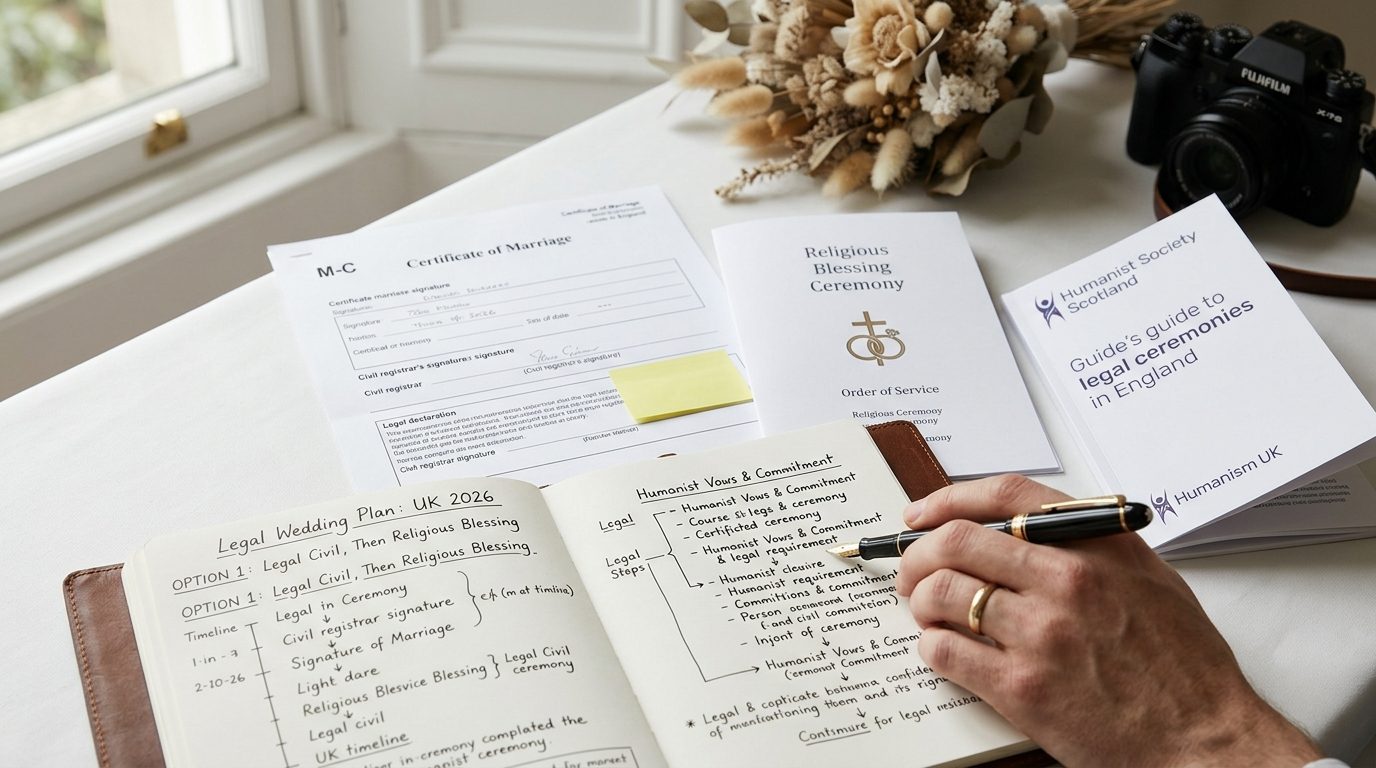
- England and Wales do not permit a single ceremony that is both legally binding AND humanist — couples must choose one legal route and add the other as a blessing
- Most popular approach: brief civil ceremony at register office (legal) + humanist ceremony at venue (celebratory)
- Route 2: Church of England ceremony (legal) with humanist-style readings and personal vows woven in, where the vicar permits
- Route 3: Legally binding humanist ceremony in Scotland + English blessing or party on a later date
- Route 4: Legal ceremony abroad where humanist marriages are recognised, then celebrate in England
- Humanist UK celebrant fees run £700-£1,200; register office add-on costs £57-£150 extra
Why the conflict exists
In England and Wales, a legally binding marriage can take place in three ways:
- Civil ceremony — at a register office or approved premises, conducted by a registrar
- Church of England or Church in Wales ceremony — in a consecrated building, conducted by an authorised minister
- Other religious ceremony — in a registered building with a registrar present
Humanist ceremonies fit none of these categories. Humanist UK is not a religious organisation. Its celebrants are not registrars. Under the current law, their ceremonies carry no legal force.
This is not a global position. Scotland has recognised humanist ceremonies since 2005. Northern Ireland since 2018. The Republic of Ireland since 2012. The United States, Canada, Australia, and New Zealand all recognise humanist ceremonies in some or all jurisdictions. The Law Commission recommended England and Wales catch up in 2022 — but the legislation has not yet passed.
Until it does, couples who want a humanist ceremony in England or Wales face a structural choice: either combine two separate ceremonies, or change their wedding location.
Route 1: Register office (legal) + humanist ceremony (celebratory)
This is the approach used by most humanist couples in England and Wales. It has been standard practice for decades.
How it works:
Both parties attend their local register office at least 28 days before the wedding date to give notice of marriage. Cost: £35 per person (£70 total). The register office posts the notice for 28 days.
A date is booked for the civil ceremony. Most couples choose a weekday, 1-7 days before their main wedding day. The civil ceremony is brief — 15-30 minutes — and can be witnessed by as few as two people. Cost: £57-£150 depending on the local authority, for the ceremony slot.
On the main wedding day, the humanist celebrant conducts the full ceremony at the chosen venue. This ceremony can be as long, as personal, and as meaningful as the couple wishes. There are no legal constraints on content, music, vows, or structure. Guests attend only the humanist ceremony.
The advantages:
- Maximum freedom in the main ceremony
- Any venue, any outdoor setting, any structure
- Full personalisation of vows, readings, music
- No religious content required or implied
- The humanist ceremony is what guests see and remember
The disadvantages:
- Two ceremony days to manage (though the register office day is low-key)
- The couple is technically married before their “wedding day”
- Some couples feel the emotional climax of exchanging vows comes earlier than expected
Many couples reframe this: the register office visit is the legal formality, equivalent to signing a contract. The humanist ceremony is the wedding. The two are emotionally and logistically distinct.
The register office ceremony can also be made meaningful in its own right. Some couples dress up, invite close family, and photograph the moment. Others keep it entirely quiet. Both approaches work.
For full detail on the mechanics, see our guide to humanist weddings in England and Wales.
Route 2: Church of England ceremony with humanist elements
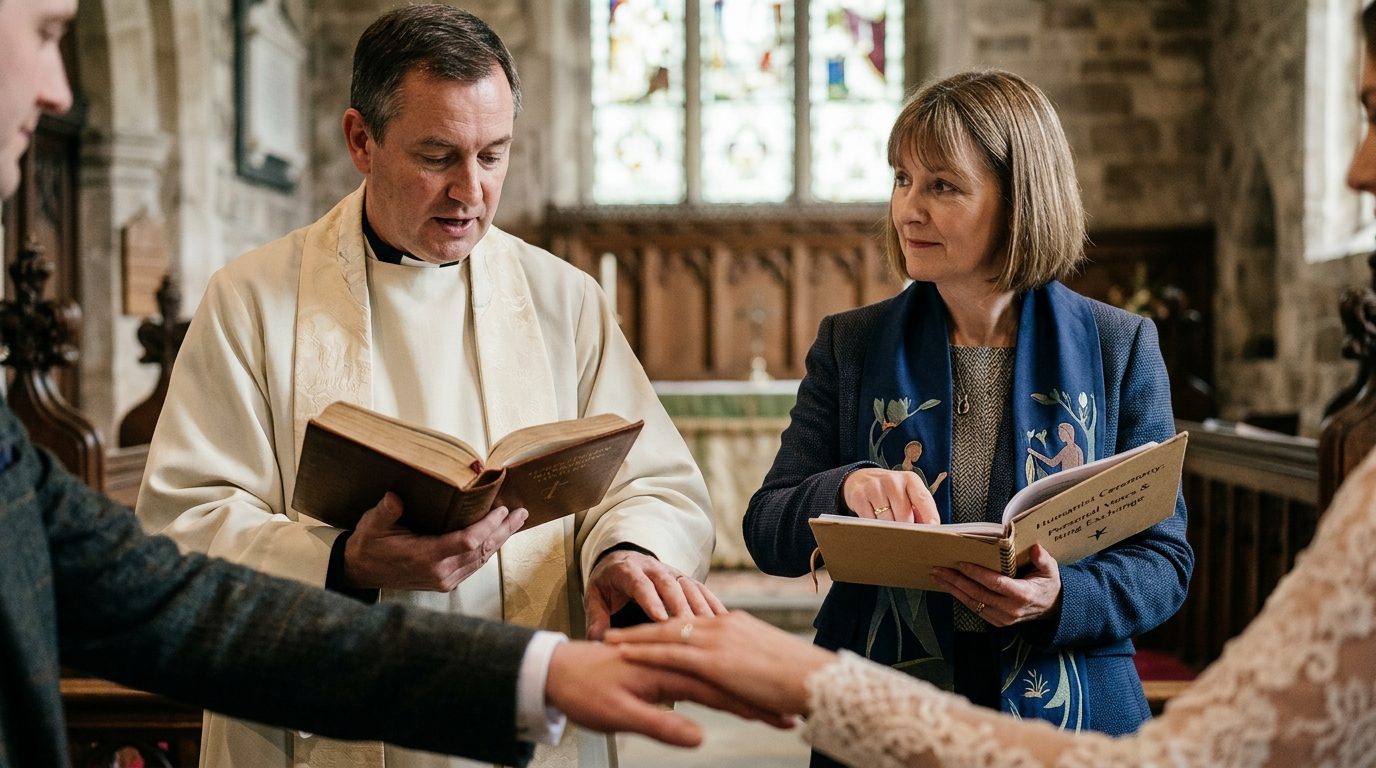
If one or both partners has a connection to the Church of England, a church wedding with thoughtfully chosen elements can feel meaningful to couples who do not consider themselves traditionally religious.
What the Church of England ceremony allows:
The core structure is fixed by the Common Worship or Book of Common Prayer liturgy: the calling of banns, the declaration of intent, the vows, the giving of rings, and the blessing. A minister cannot omit these elements.
What is often negotiable (depending on the individual vicar):
- Non-religious readings alongside or after the required religious reading
- Secular music (many churches permit popular music alongside hymns)
- Personal reflections by the couple or their guests
- Non-religious poetry or prose in the service sheet
What is generally not possible:
- Replacing the prescribed vows with entirely personal vows
- Removing all religious content from the ceremony
- Having a humanist celebrant co-officiate the legal ceremony
How to approach this with a vicar:
Be honest. Tell the vicar what you are hoping for — a ceremony that feels personal and partly secular — before you commit to the church. A sympathetic vicar who has experience with non-regular churchgoers will often work creatively within the liturgical constraints. One who is less comfortable with this will say so, and you can find an alternative.
The starting point for a Church of England ceremony is qualifying. You typically need to be on the electoral roll of the parish, live in the parish, have been baptised or confirmed there, or have a family connection. Some couples qualify through a parent or grandparent’s connection.
Route 3: Legal humanist ceremony in Scotland + English celebration
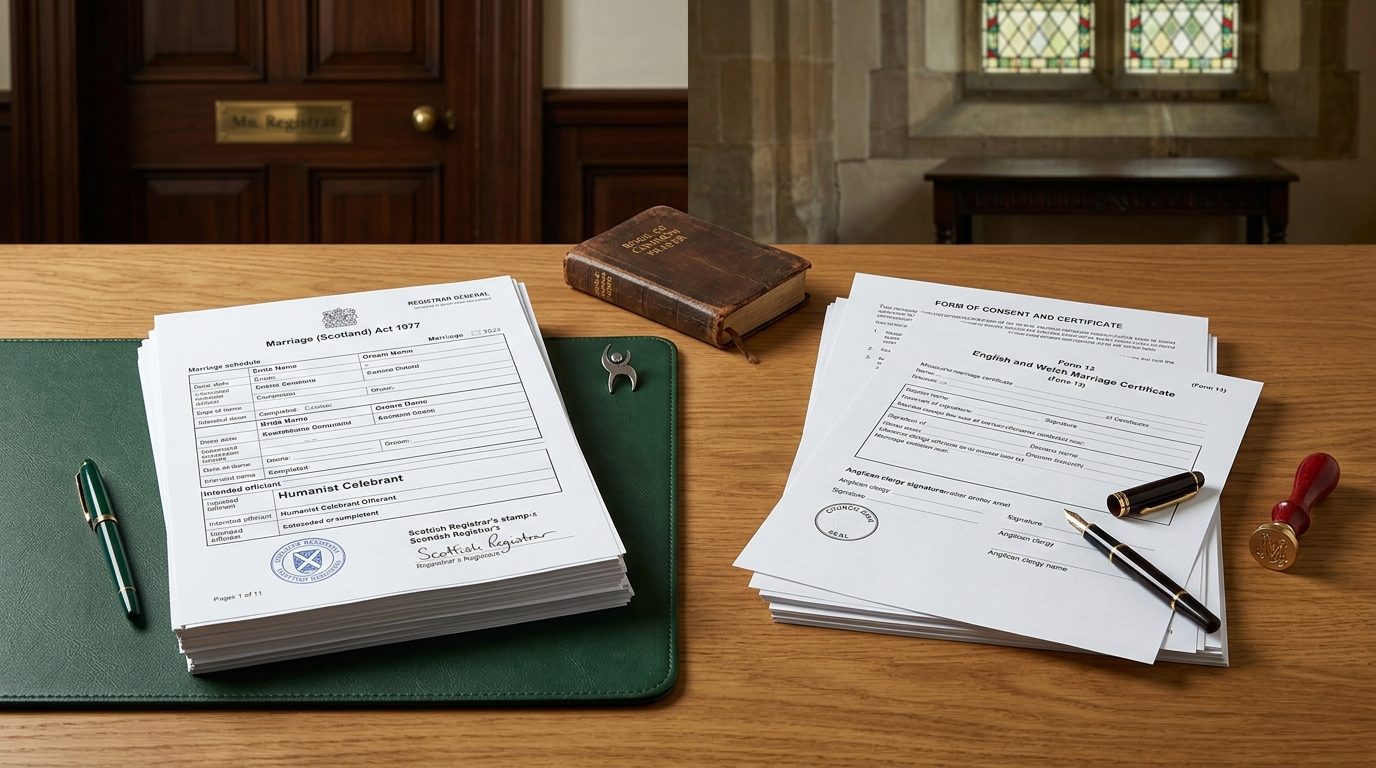
This route requires more logistical effort but gives couples a legally binding humanist ceremony on a meaningful occasion, followed by a celebration with family and friends closer to home.
How it works:
The couple chooses a Scottish location for their humanist ceremony — a Highland venue, a castle, a loch-side setting, a city hotel. They book a Humanist Society Scotland celebrant, who is authorised to conduct legally binding ceremonies.
The Scottish ceremony is the legal wedding. It results in a Scottish marriage certificate. That certificate is fully recognised in England, Wales, and everywhere else in the UK and internationally.
The couple then holds a second event in England — typically described as a “blessing,” a “party,” or a “celebration” — with the friends and family who could not travel to Scotland. A humanist celebrant, a minister, or no officiant at all can conduct this second gathering. It requires no licence and carries no legal requirements.
Why couples choose this route:
The Scottish humanist ceremony can be small and intimate — just the couple and a handful of close family and friends — in a spectacular location. The English celebration can be large. Many couples find this structure attractive: a meaningful, quiet legal ceremony, followed by a big party.
Scotland also has extraordinarily beautiful ceremony locations that are not available in England under the current legal framework. A ceremony on a Scottish beach or hillside is legally possible in Scotland; the same ceremony in England would require the two-ceremony approach anyway.
What to budget:
A Humanist Society Scotland ceremony for the couple and a small party (2-10 guests), including the celebrant fee, giving-notice costs (to the local Scottish registrar), and a modest Scottish venue, might cost £2,000-£5,000. The English celebration is budgeted separately.
Route 4: Legally binding humanist ceremony abroad + English blessing
Several countries outside the UK permit humanist or secular ceremonies that are legally binding without a religious or civil registrar: Ireland (since 2012), New Zealand, Australia, Canada, many US states, Denmark, and others.
If the couple holds a legally binding humanist ceremony in one of these jurisdictions and registers the marriage properly, that marriage is recognised in England and Wales as valid. They can then hold any form of blessing, celebration, or party in England with no legal requirements at all.
This route makes most sense if the couple has a connection to the country in question, or if there is a specific overseas location that matters to them. Organising a legally valid ceremony abroad purely to get around England’s restriction is possible but adds significant complexity.
For couples already considering a destination wedding, this route can combine both purposes — see our guide to destination weddings in Portugal and Greece wedding venues for examples of countries where this approach works.
Comparing the four routes
| Route | Legal in England? | Humanist? | Two dates needed? | Approximate additional cost |
|---|---|---|---|---|
| Register office + humanist | Yes | Yes | Yes | £127-£220 |
| CoE + humanist elements | Yes | Partial | No | Nil |
| Scotland humanist + English blessing | Yes | Yes | Yes | £2,000-£5,000+ |
| Abroad + English blessing | Yes | Yes | Yes | Significant |
For most couples in England, Route 1 — register office plus humanist ceremony — is the practical default. It is low cost, logistically straightforward, and gives the couple maximum freedom in their main ceremony.
What the humanist ceremony itself looks like
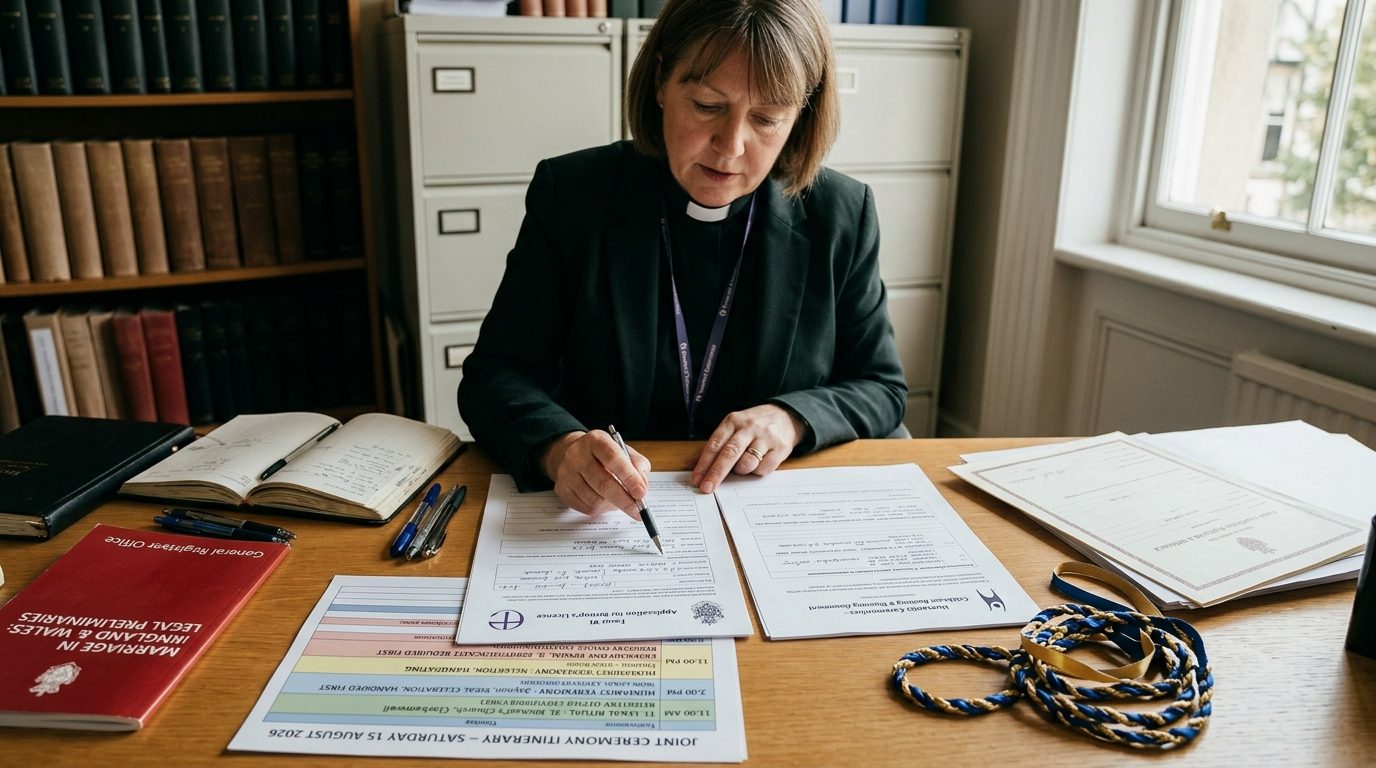
A humanist ceremony conducted by a Humanist UK-accredited celebrant is typically structured around the couple’s own story, values, and relationship. The celebrant meets the couple multiple times before the wedding to build the ceremony collaboratively.
A typical structure:
- Welcome by the celebrant — introducing the humanist approach to commitment
- The couple’s story — how they met, what they value about each other, told in narrative
- First reading — chosen by the couple (poetry, prose, personal writing)
- Optional music or moment of reflection
- Exchange of personal vows — written by the couple themselves
- Ring exchange or other symbolic act
- Second reading or musical moment
- Closing declaration and celebration
The ceremony has no fixed length, no prohibited content, and no required elements beyond the couple’s own choices. A typical ceremony runs 30-45 minutes. Many couples include children, pets, readings by friends, or ceremonial elements from other cultures.
As of May 2026, there are approximately 350 Humanist UK-accredited celebrants across England and Wales. Fees run £700-£1,200. Book 12-18 months ahead for popular regions and summer dates.
Planning your combined ceremony
If you choose Route 1 — the most common approach:
Step 1 (12+ months out): Book your venue and your humanist celebrant simultaneously. Confirm the venue holds no restrictions on humanist ceremonies (virtually all venues are fine with this).
Step 2 (12+ months out): Check your local register office’s availability and how far in advance they book. Some popular register offices fill their ceremony slots 6-9 months out.
Step 3 (28+ days before the legal ceremony): Give notice of marriage at your local register office. Both parties attend. Book the ceremony date.
Step 4 (legal ceremony day): Attend the register office with your two witnesses. The ceremony takes 15-30 minutes. Celebrate privately if you wish.
Step 5 (wedding day): Your humanist ceremony proceeds at your venue. Your guests see the wedding you planned.
For more on the planning process, see the wedding planning timeline and how to plan a wedding guides.
Frequently asked questions
Can you have a religious and humanist ceremony at the same time in England?
Not in a single legally binding ceremony. England and Wales require either a civil or religious legal ceremony. You can add a humanist element as a non-legal blessing, or hold two separate ceremonies — a legal civil or religious one and a humanist celebration.
What is the most common approach for couples who want both in England and Wales?
The most common approach is a brief civil ceremony at the register office (weekday, 15-30 minutes, legally binding) followed by a full humanist ceremony at the chosen venue on the wedding day. Guests attend the humanist ceremony. The register office part is often treated as a private formality.
Can a Church of England vicar include humanist elements in the ceremony?
A Church of England ceremony follows a prescribed liturgy. The core vows and structure are fixed. However, many vicars permit non-religious readings, secular music, and personal reflections alongside the required religious elements. The extent of flexibility depends on the individual vicar. A fully humanist ceremony in a church is not possible.
Can I have a legally valid humanist wedding in Scotland and then celebrate in England?
Yes. A humanist ceremony in Scotland conducted by an authorised Humanist Society Scotland celebrant is legally valid. The resulting Scottish marriage certificate is fully recognised throughout the UK. Couples can then hold a blessing, party, or celebration ceremony in England on a separate date.
What does a two-ceremony humanist wedding cost compared to a single ceremony?
The additional cost of the register office ceremony is modest: £70 for giving notice (£35 per person) plus £57-£150 for the ceremony slot itself. Total additional cost: £127-£220. This compares to a humanist celebrant fee of £700-£1,200 for the main ceremony. The register office element is a small addition to overall wedding costs.
Can I have a Jewish or Muslim wedding ceremony that is also legally binding?
Jewish weddings have a long-standing exemption under the Marriage Act 1949 and can be legally binding without a registrar present. Muslim nikah ceremonies are not automatically legally binding in England and Wales — couples must hold a separate civil ceremony as well. Sikh and Hindu ceremony buildings can apply for approved premises status, with a registrar present.
What is a blessing ceremony and how does it differ from a legal ceremony?
A blessing ceremony has no legal force. It is a celebration, recognition, or blessing of a marriage that has already been legally formed elsewhere. Many couples who marry quietly at a register office hold a blessing ceremony with friends and family at a venue of their choice. A blessing can be conducted by any minister, celebrant, or officiator — it requires no licence.