Muslim Wedding (Nikah) UK: The Complete Guide
Key Takeaways
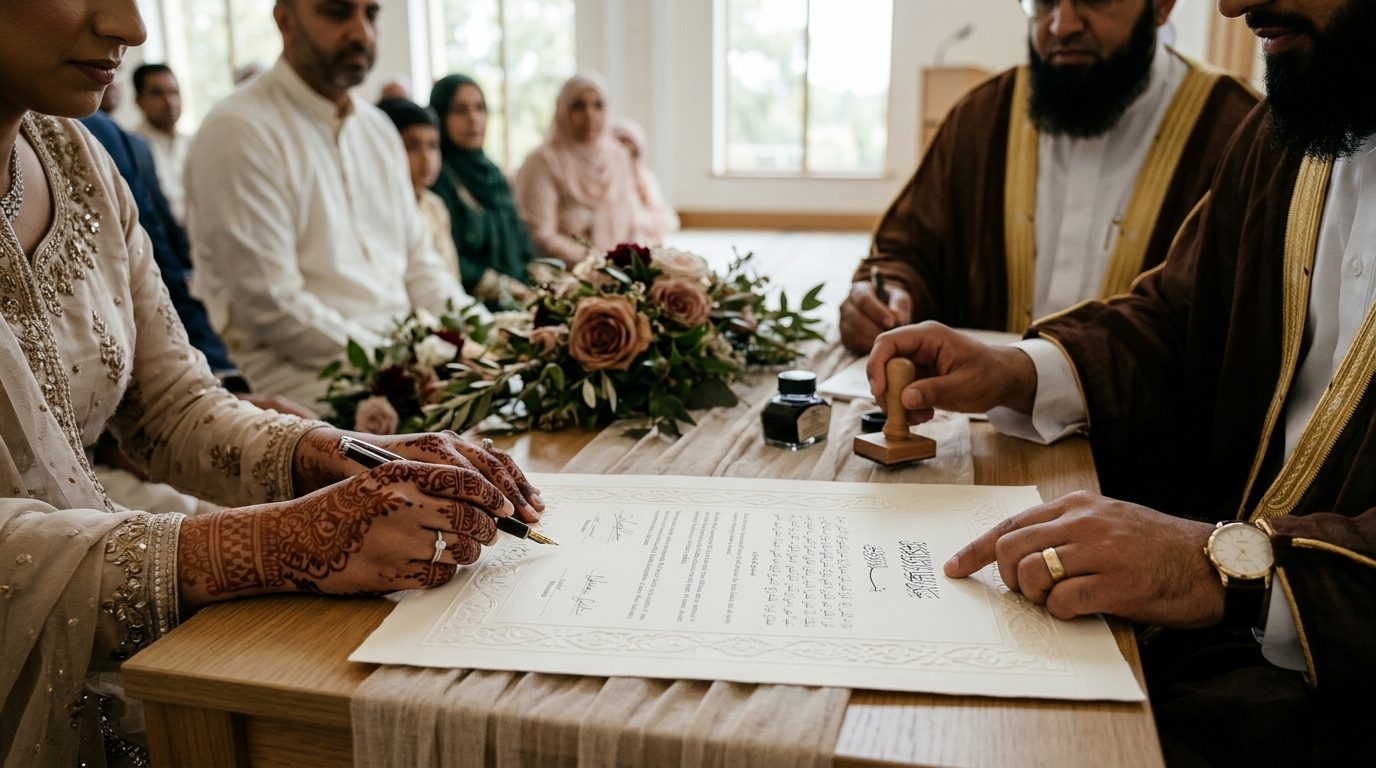
- The Nikah is the Islamic marriage contract — it requires an offer (Ijab), acceptance (Qubool), a mahr (gift from groom), and two Muslim witnesses
- A Nikah performed in England and Wales is not automatically legally recognised — most Muslim couples also complete a civil ceremony at a register office
- The UK has approximately 3.9 million Muslim residents — the largest non-Christian religious group — spanning diverse cultural backgrounds including Pakistani, Bangladeshi, Arab, and Somali communities
- Nikah ceremonies can be performed in mosques, at home, in a hotel, or any agreed location — there is no requirement for a religious building
- Guests should dress modestly — women should cover their hair, arms, and legs; men should wear smart attire
Muslim weddings in the UK combine the spiritual solemnity of the Nikah — one of Islam’s most sacred acts — with celebrations that reflect the enormous diversity of the UK’s 3.9 million Muslim residents. Pakistani, Bangladeshi, Arab, Somali, Turkish, and West African Muslim communities each bring distinct cultural traditions to the Islamic framework of the Nikah ceremony. The result is a wedding landscape that ranges from intimate home ceremonies to multi-day celebrations for 600 guests at banquet halls. This guide covers the Nikah ceremony itself, the UK’s complex legal recognition picture, what guests need to know, and how much a UK Muslim wedding typically costs.
What is the Nikah?
The Nikah (from the Arabic for “union” or “joining”) is the Islamic marriage contract. It is the moment of marriage in Islamic law — a contract rather than a sacrament, but deeply sacred in its implications and consequences. Unlike some other religious traditions, the Nikah does not require a mosque, a religious official of a particular rank, or a specific physical setting. It can be performed at home, in a mosque, in a hotel, or outdoors, as long as the essential conditions are met.
The essential elements of a valid Nikah are:
1. Offer and acceptance (Ijab wa Qubool): The groom or his representative makes an offer of marriage; the bride or her representative accepts it. Both must be present, or their representatives (Wakeel) must be authorised. The acceptance is spoken aloud, typically three times to confirm.
2. Mahr: A mandatory gift from the groom to the bride, agreed before or at the Nikah. The mahr is the bride’s exclusive property. It can be prompt (paid immediately), deferred (paid later), or a combination. There is no minimum or maximum amount — it should be agreed in good faith and meaningful to both parties.
3. Two Muslim witnesses (Shahideen): Two adult Muslim men (or, in some scholarly opinions, one man and two women) must witness the Ijab wa Qubool and attest to the contract.
4. Wali (guardian) for the bride: In most Islamic legal schools (madhabs), the bride’s father or nearest male relative serves as her Wali — her guardian who acts on her behalf in the marriage contract. In Hanafi jurisprudence (followed by most South Asian Muslims), an adult woman of sound mind may contract her own marriage without a Wali; in Shafi’i, Maliki, and Hanbali jurisprudence, the Wali is required. In practice, most UK Muslim families involve the Wali regardless.
5. Freedom of consent: Both parties must consent freely to the marriage. A Nikah under duress is invalid under Islamic law.
The Nikah is typically solemnised by an Imam (Islamic scholar or prayer leader) who leads the ceremony, recites Quranic verses, and witnesses the contract. Many mosques have Imams who perform Nikah ceremonies; it is also possible to arrange an independent Islamic marriage celebrant.
Legal recognition in England and Wales
This is the most important practical issue for UK Muslim couples.
A Nikah ceremony performed in England and Wales is not legally recognised as a marriage under the Marriage Act 1949 unless it takes place in premises registered for marriages and before an authorised person (typically a civil registrar). This applies even if the ceremony is conducted by an Imam at a registered mosque.
Most UK Muslim couples address this in one of two ways:
Option 1 (most common): Separate civil ceremony at a register office. The couple books a civil ceremony at their local register office — a brief, formal process involving the exchange of legal vows before a registrar and two witnesses. This typically takes 15-30 minutes. It can be done privately, without any celebration, in the days before or after the Nikah. The fee is £46 for notice of marriage plus the register office ceremony fee (typically £57-£100 per person at a local council office).
Option 2: Combined legal and religious ceremony. A small number of mosques in the UK are registered as wedding premises under the Marriage Act and can host legally valid ceremonies. If the mosque is registered AND the Imam is authorised as a ‘authorised person’ for marriages, the Nikah can also constitute the legal marriage. However, most UK mosques are not registered in this way. Always confirm registration status with the mosque before assuming.
The legal reform picture: The Law Commission’s 2022 review recommended allowing religious-only ceremonies to be legally recognised without a separate civil element, but no legislation has been passed as of June 2026. Reform may come in the next Parliament — couples should follow Government announcements.
Why this matters in practice: Without a legal marriage, couples lack the legal protections of marriage in the UK — including property rights, inheritance rights, and financial claims on divorce. Many UK Muslim women have faced serious consequences after Nikah-only marriages broke down. If you are planning a Nikah, always also complete a civil ceremony.
For more on UK marriage law, see our guide to legal marriage reform UK 2026.
The Nikah ceremony: what to expect
Before the ceremony
Notice of marriage: If the couple is also having a civil ceremony, they must give notice at their local register office at least 28 days before the ceremony date. Both parties attend separately (or together), show ID, and pay the notice fee. The notice is publicly displayed for 28 days before the marriage can proceed.
Mehr negotiation: In the days or weeks before the Nikah, the couple and their families agree the mahr — its form, amount, and payment schedule. This is sometimes negotiated between the two families, though in modern UK practice, many couples negotiate it themselves.
Segregation arrangements: Depending on the family’s tradition, the venue may be set up with separate areas for men and women, or the ceremony may be mixed-gender. The hosts will communicate this in advance. When in doubt, ask.
The Nikah ceremony itself
A typical UK Nikah ceremony runs as follows:
Recitation of Quran: The ceremony opens with verses from the Quran — typically Surah Al-Fatiha and short surahs. The Imam may deliver a brief khutbah (sermon) about the importance of marriage in Islam, the rights and responsibilities of husband and wife, and prayers for the couple.
Ijab wa Qubool: The central act of the Nikah. The Imam asks the groom (or his Wakeel) to make the offer of marriage; the groom accepts, stating: “I accept this Nikah with [bride’s name] for the mahr of [amount/item], in accordance with the Sunnah of the Prophet (PBUH).” The bride’s Wali then accepts on her behalf, or she accepts herself. This exchange is repeated three times for confirmation.
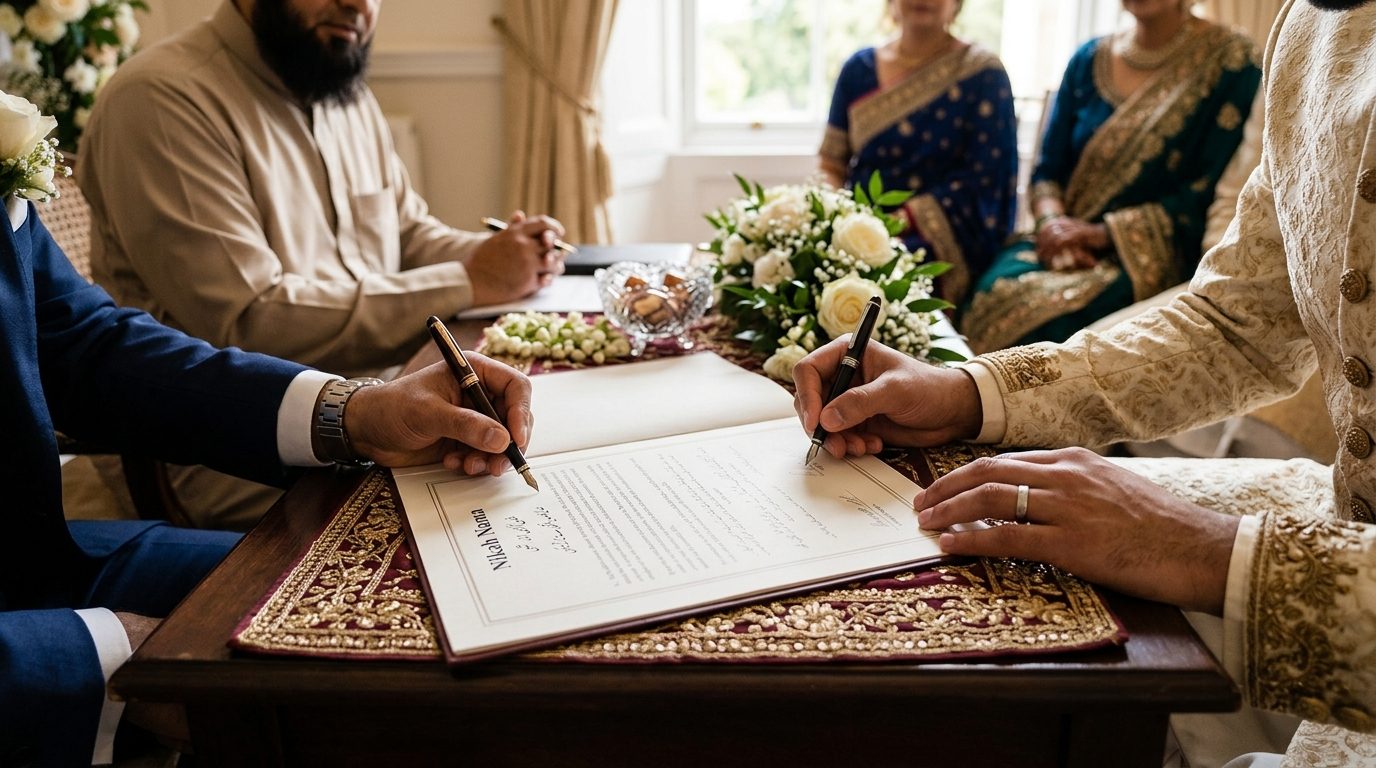
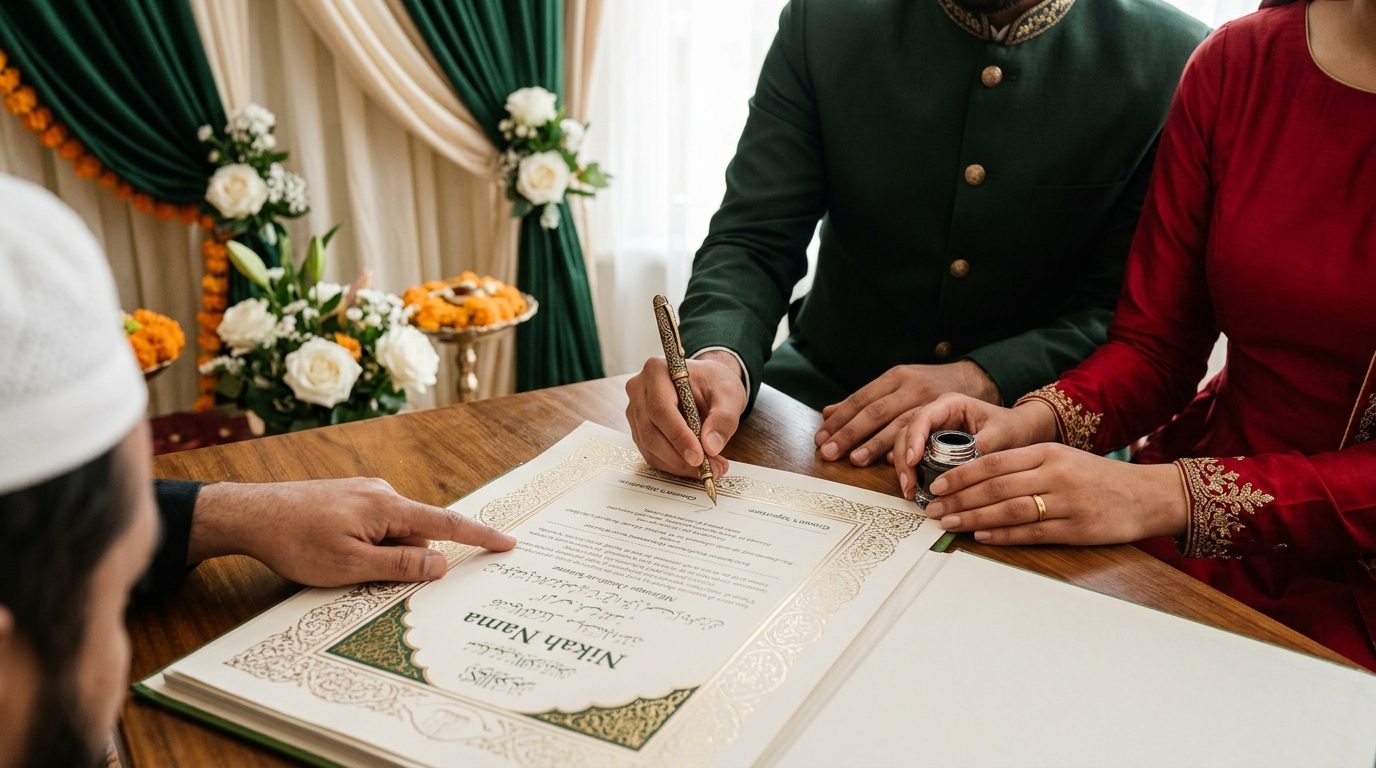
Signing the Nikah contract (Aqd): The Nikah contract — specifying the bride and groom’s names, the mahr, and the date — is signed by both parties and the witnesses. In the UK, this is often a printed document prepared by the mosque or a specialist Islamic marriage contract service.
Du’a (supplication): The Imam offers a prayer for the couple, asking for blessings, love, mercy, and a strong marriage. The congregation says “Ameen.”
Mahr presentation: The groom presents the prompt mahr — whether money, gold, or another agreed gift — to the bride.
The Nikah ceremony itself typically lasts 20-45 minutes. It is quiet, reverent, and — depending on family tradition — may be attended by close family only (women in some traditional settings), or by the full guest list.
Pakistani and Bangladeshi Muslim weddings
 The largest Muslim communities in the UK are Pakistani (approximately 1.6 million) and Bangladeshi (approximately 600,000). South Asian Muslim weddings share many features with Hindu weddings in their multi-day format:
| Day/Event | What happens |
|---|---|
| Mehndi (1-2 days before) | Henna night for the bride and female guests |
| Nikah day (morning/midday) | Islamic marriage ceremony in mosque or venue |
| Baraat (groom’s procession) | Groom arrives with family and friends |
| Reception (evening) | Main celebration dinner with all guests |
| Walima (day after) | Wedding feast hosted by groom’s family |
| Rukhsati | Bride’s farewell from her family |
Food: All food at a Muslim wedding must be halal. Alcohol is not served. Soft drinks, juices, and mocktail bars are standard — increasingly elaborate mocktail menus are common at UK Muslim weddings in 2026. See our guide to mocktail bars at UK weddings for ideas.
Music: There are different scholarly opinions on music at weddings. Many Pakistani and Bangladeshi Muslim families have no music restrictions at the reception — Bollywood music, a dhol player, and a DJ are all common. More religiously conservative families may limit music or prefer nasheeds (Islamic devotional songs) in place of conventional music. Discuss expectations with the host family before assuming.
Arab Muslim weddings in the UK
Arab Muslim communities in the UK — predominantly from Egypt, Morocco, Tunisia, Algeria, and the Gulf states — tend to hold smaller, less multi-day events than South Asian Muslim weddings, though this varies significantly by family.
Key characteristics:
- Guest lists: Typically 100-300 guests (smaller than South Asian Muslim weddings)
- Venue: Often a hotel ballroom, banquet hall, or restaurant
- Music: Often includes Arabic music and the Zaffa — a celebratory procession into the reception hall with music and dancing
- Gender segregation: Varies widely — Egyptian and North African families tend to hold mixed-gender events; Gulf Arab families are more likely to hold segregated celebrations
- Dress: Guests are expected to dress modestly but elegantly — formal evening wear for women (with coverage of arms and legs), suits for men
Somali Muslim weddings in the UK
The UK’s Somali Muslim community (approximately 150,000, concentrated in London, Bristol, Sheffield, and Leicester) has a distinct wedding tradition:
- The Shaash: A ceremony in which the bride is dressed by female relatives and friends, receiving gifts and blessings. It is the pre-wedding female celebration.
- The Nikah: Typically brief and conducted in a mosque, attended primarily by close family.
- The Kariimo: The main wedding reception, often held in a community hall with 100-300 guests. Music, dancing, and an elaborate dinner are standard.
- Traditional dress: Somali brides often wear a dirac (a long, flowing garment in bright colours) rather than a white dress. Guests wear bright, festive dress.
What guests need to know
Dress code
Modest dress is the universal requirement across Muslim communities:
- Women: Cover your hair (a headscarf, dupatta, or wide-brimmed hat all work; the host family will appreciate the gesture). Cover your arms (long sleeves or a jacket). Cover your legs (trousers or a long dress/skirt). Avoid tight or low-cut clothing.
- Men: Smart formal dress — a suit and tie, or a traditional kurta pyjama. No shorts. Avoid very casual clothing.
- Shoes: Remove shoes before the prayer area or mosque. Many venues have designated shoe storage near the entrance.
- Colours: Bright colours are welcome at most Muslim wedding receptions. White is not associated with mourning (unlike Hindu tradition) but is generally less appropriate for guests at a Pakistani or Bangladeshi wedding.
Alcohol and dietary requirements
Muslim wedding receptions do not serve alcohol. Soft drinks, fruit juices, and mocktail bars are standard. All food is halal. If you have specific dietary requirements, inform the hosts in advance — most caterers can accommodate vegetarian, vegan, or other requirements within a halal framework.
Gifts
Gift-giving customs vary by community. Pakistani and Bangladeshi families often prefer cash gifts (in envelopes given to the couple or their parents). Arab families may expect a gift brought to the wedding. A gift list is less common but increasingly used by younger UK Muslim couples. A cash gift of £50-£100 per person is typical; closer family members give more.
Photography and filming
In some mosques and at some families’ request, photography may be restricted during the Nikah ceremony itself. Check with the hosts or the Imam. At the reception, photography is generally welcome unless the event is gender-segregated, in which case photography in the women’s area should only be done by female photographers.
Venues for UK Muslim weddings
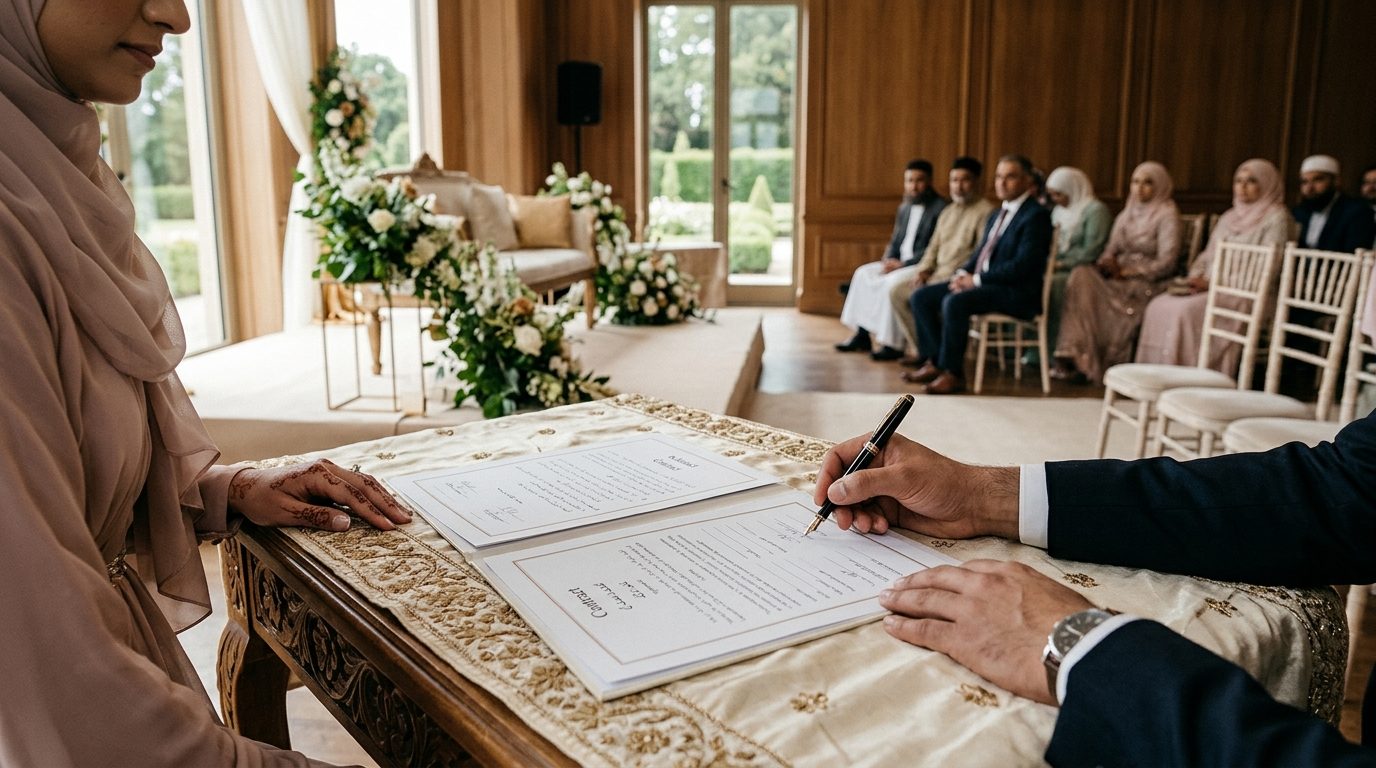
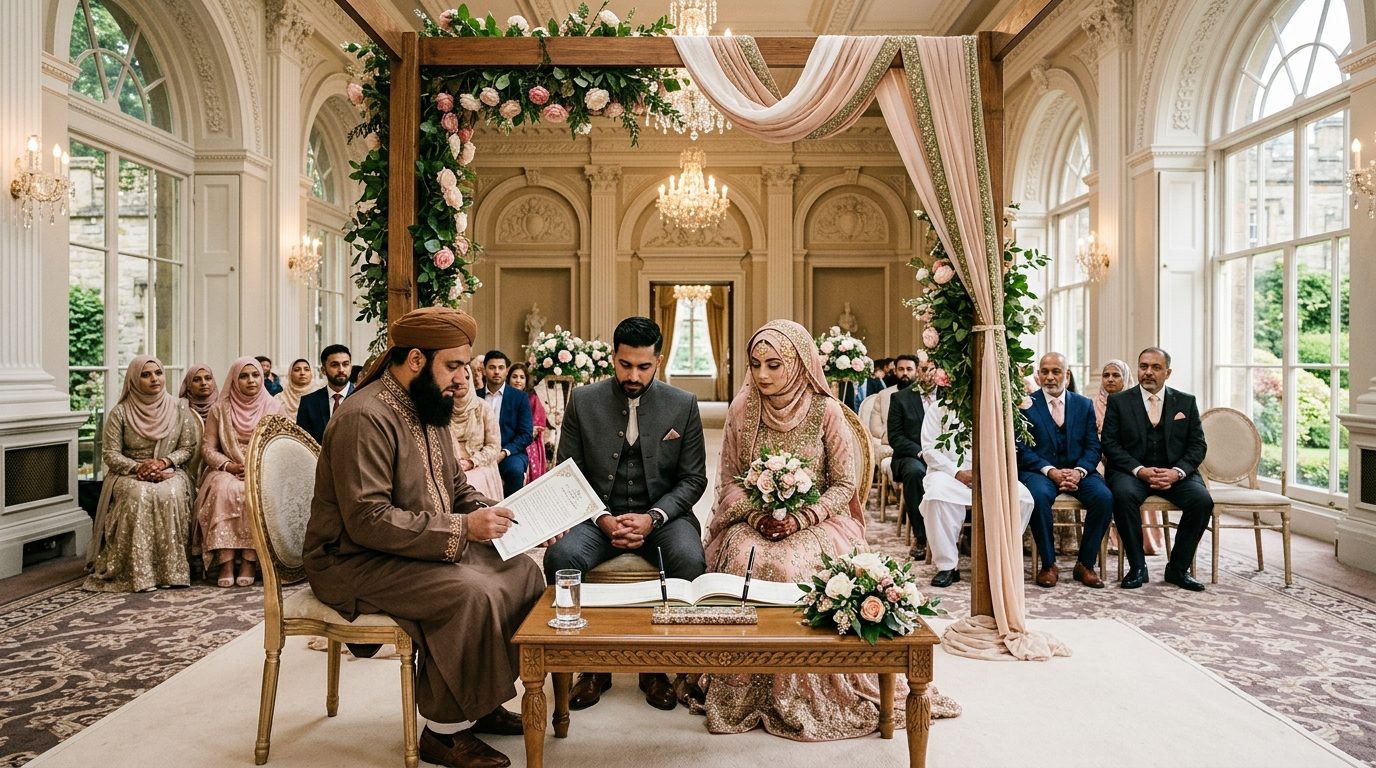 The choice of venue is shaped by whether the couple needs it to be halal-compliant (no alcohol served, halal-only catering).
Registered mosques: For couples who want to combine the Nikah with a legally valid ceremony, a registered mosque is the cleanest solution. Major UK mosques with wedding spaces include the East London Mosque, Birmingham Central Mosque, and Markazi Mosque, Bradford.
Halal banquet halls: Purpose-built Asian banquet halls in London, Birmingham, Manchester, and Leicester are the most common choice for Pakistani and Bangladeshi Muslim weddings. They are experienced in halal catering and multi-day event formats.
Hotels: Most major UK hotel chains can cater halal meals and are willing to operate as dry venues (no alcohol in the wedding space). Some hotel chains have experience managing separate gender areas.
Dry-hire venues: A blank-canvas venue where you bring your own caterers — useful for couples who need flexibility on the halal catering requirement.
For specific venue options, see best UK wedding venues 2026 and Asian wedding venues.
Costs
| Community | Typical guest count | Average total spend |
|---|---|---|
| Pakistani (multi-day) | 300-600 | £30,000-£55,000 |
| Bangladeshi (multi-day) | 250-500 | £25,000-£45,000 |
| Arab (single day) | 100-250 | £12,000-£28,000 |
| Somali (community hall) | 100-300 | £8,000-£18,000 |
| Mixed / UK-born (smaller event) | 80-150 | £10,000-£25,000 |
For context on managing wedding costs and budgeting, see our guides to how to budget for a wedding and real UK wedding budgets.
The Walima: the wedding feast
The Walima is the wedding feast that follows the Nikah, traditionally hosted by the groom’s family. It is described in the Hadith (sayings of the Prophet Muhammad) as a Sunnah — a recommended practice that announces the marriage to the community and expresses gratitude.
The Walima should ideally take place within three days of the Nikah. In UK practice, many couples hold the Walima the day after the wedding reception, inviting family and friends who were not at the main celebration, or inviting the same guests for a slightly smaller follow-up event.
Some couples choose to combine the reception and Walima into a single event — particularly where a fully separate event would be logistically or financially burdensome.
Comparing Muslim, Hindu, and Sikh wedding traditions
| Feature | Muslim (Nikah) | Hindu (Mandap) | Sikh (Anand Karaj) |
|---|---|---|---|
| Ceremony name | Nikah | Vivah / Mandap | Anand Karaj |
| Central ritual | Ijab wa Qubool, mahr | Saat Phere (7 rounds around fire) | 4 laavan around Guru Granth Sahib Ji |
| Legal recognition (E&W) | Not automatic — civil ceremony required | Not automatic — civil ceremony required | Recognised if Gurdwara is registered |
| Typical guest count | 100-600 (varies by community) | 300-600 | 200-500 |
| Duration | 1-5 days depending on community | 3-5 days | 2-3 days |
| Alcohol | Never served | Varies by family | Varies by family |
For more detail, see Hindu Wedding Traditions UK and Sikh Wedding Traditions UK.
Frequently asked questions
Is a Nikah legally recognised in the UK?
A Nikah ceremony alone is not legally recognised in England and Wales under the Marriage Act 1949. To be legally married, Muslim couples must also have a civil ceremony at a register office or in a venue registered for civil marriages. Some mosques in the UK are registered as wedding venues and can host legally valid civil marriages alongside the Nikah, but this is not universal. The Law Commission has recommended reform to allow religious-only ceremonies to be legally recognised, but legislation has not yet passed. Always confirm your mosque's registration status.
What is the mahr in a Muslim wedding?
The mahr (also called mehr or sadaq) is a mandatory gift from the groom to the bride, stipulated in the Nikah contract. It is the bride's exclusive property and cannot be taken back. The mahr can be money, gold, jewellery, property, or any agreed item of value. The amount and form is agreed between the couple (and their families) before the Nikah. Some couples agree a prompt mahr (paid immediately) and a deferred mahr (paid later, or in the event of divorce). The mahr symbolises the groom's commitment and responsibility.
What should non-Muslim guests wear to a Muslim wedding?
Non-Muslim guests should dress modestly. Women should cover their hair (a headscarf or dupatta), cover their arms (long sleeves or a jacket), and ensure their legs are covered (trousers or a long skirt/dress). Men should wear smart formal attire with no shorts. Avoid tight or revealing clothing. At the mosque or prayer hall, shoes must be removed. Bright colours are appropriate — there are no specific colour restrictions as at Hindu or Sikh weddings. Follow the lead of other guests and the hosts.
What is the Walima at a Muslim wedding?
The Walima is the wedding feast hosted by the groom's family, typically held the day after the Nikah or within three days of the ceremony. It is a Sunnah (a practice of the Prophet Muhammad) and is considered an important part of the Islamic wedding tradition. The Walima announces the marriage to the community. In the UK, the Walima is often combined with the main reception and held on the same evening as the Nikah, or on the following day. It is typically a large celebration with food, family, and community.
Can a Muslim wedding be mixed-gender?
This depends on the couple's tradition and level of religious observance. Some Muslim communities hold fully segregated weddings — separate rooms or areas for men and women. Others hold mixed-gender events. Many UK Muslim couples, particularly those from South Asian or Arab backgrounds who are more culturally assimilated, hold mixed-gender receptions with a separate prayer area for the Nikah. The couple's families will set the tone — follow their lead when attending as a guest.
What is the Rukhsati at a Muslim wedding?
The Rukhsati is the bride's farewell from her family at the end of the wedding events — the moment she formally leaves to begin her life with her husband. It is an emotional ceremony in many South Asian Muslim traditions, particularly Pakistani and Bangladeshi weddings. The bride's parents and family bid farewell as she departs. The Rukhsati is often accompanied by Quranic recitation, prayers, and the scattering of flower petals. It mirrors the Hindu Vidaai in its emotional significance.
How much does a Muslim wedding cost in the UK?
UK Muslim weddings average £20,000-£40,000, though costs vary widely by cultural background and scale. South Asian Muslim weddings (Pakistani, Bangladeshi) with large guest lists of 300-600 tend to cost £30,000-£55,000 including the Mehndi, Nikah reception, and Walima across multiple days. Arab and Somali Muslim weddings may be smaller and more modest, with costs from £8,000-£20,000. The civil ceremony adds minimal cost (£46-£90 for notice of marriage, plus registrar fees).