Jewish Wedding Traditions UK: The Complete Guide
Key Takeaways
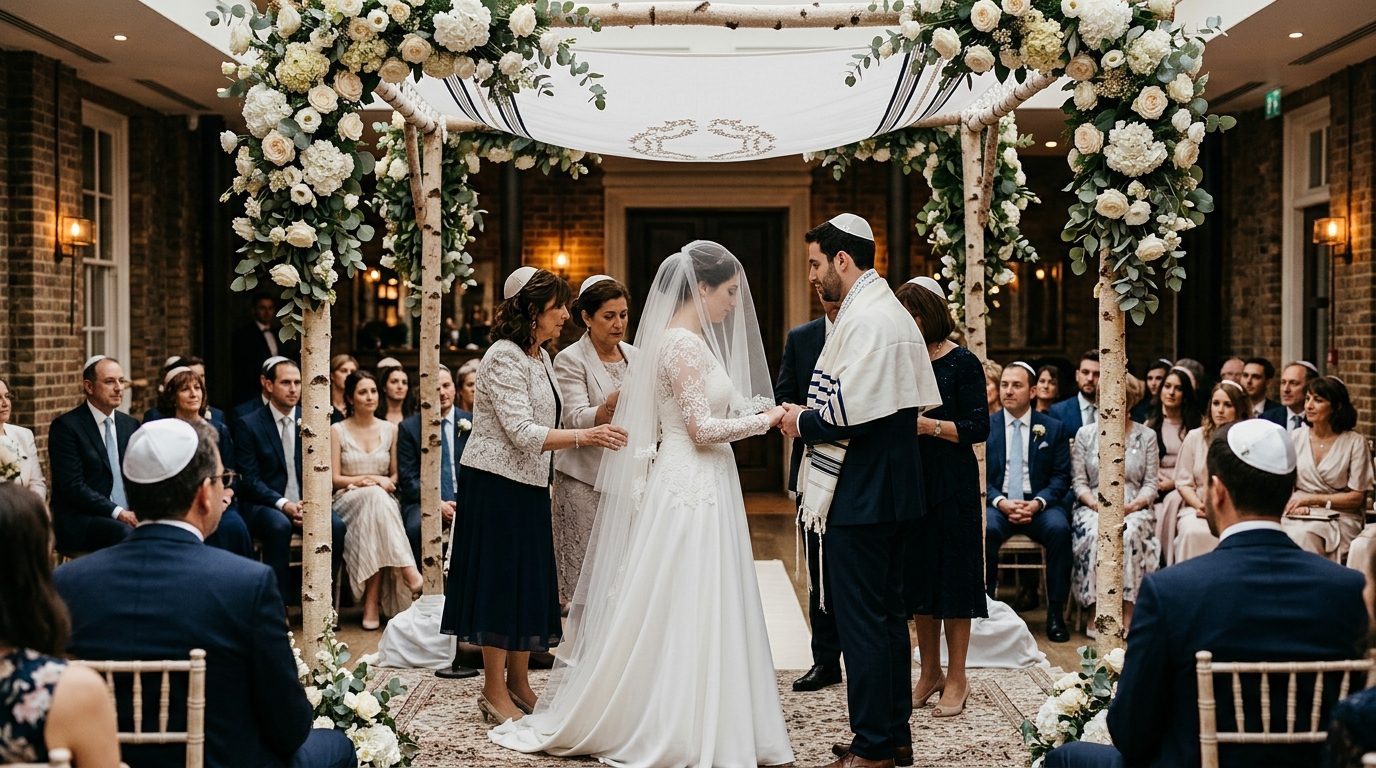
- The chuppah (wedding canopy) symbolises the couple's new home — the ceremony takes place beneath it
- The ketubah is a Jewish marriage contract signed before the ceremony; in the UK it has no legal standing but enormous cultural significance
- UK Jewish weddings are legally recognised only if a separate civil registration is completed — most synagogues handle this within the ceremony
- The Sheva Brachot (seven blessings) are recited under the chuppah — a central spiritual element of the ceremony
- Breaking the glass at the end of the ceremony is a universal Jewish wedding custom — guests shout 'Mazal Tov' as it shatters
Jewish weddings in the UK combine ancient ritual, deep symbolism, and celebratory joy in a ceremony structure that has been largely unchanged for centuries. The UK has approximately 280,000 Jewish residents, concentrated in North London (particularly Golders Green, Hampstead, and Edgware), Manchester, Leeds, and Glasgow. The British Jewish wedding has developed its own character — typically large, lively, and extraordinarily well-catered — while maintaining the core ritual elements that connect couples to millennia of tradition. This guide covers every element of the ceremony, what non-Jewish guests need to know, and what to expect if you are planning or attending a Jewish wedding in the UK.
Jewish denominations and their differences
Jewish weddings in the UK are not all the same. The denomination of the couple’s synagogue significantly affects the ceremony style, gender roles, and what is required of guests.
| Denomination | Characteristics | Gender roles | Kippah for male guests? |
|---|---|---|---|
| Orthodox | Strictly traditional, men and women often seated separately | Groom-focused ceremony, bride does not speak | Expected |
| Masorti / Conservative | Traditional but more egalitarian than Orthodox | Mixed seating, bride often participates more | Expected |
| Reform | Egalitarian, modern English-language elements | Equal roles, both partners participate fully | Optional |
| Liberal | Most progressive, strong egalitarian approach | Equal or couple-defined roles | Optional |
If you are a non-Jewish guest and are uncertain which denomination the synagogue belongs to, the safest assumptions are: bring a head covering if male, dress modestly (covered shoulders at least), and arrive on time.
The pre-ceremony: Kabbalat Panim and Bedeken
Jewish wedding ceremonies typically begin with two pre-ceremony rituals.
Kabbalat Panim (receiving faces): The bride and groom receive their guests separately before the ceremony. The groom holds a reception in one room, typically surrounded by male friends and family, singing and toasting. The bride holds a separate reception, receiving female family and friends. This separation continues an ancient tradition of the couple not seeing each other immediately before the ceremony.
The Signing of the Ketubah: The ketubah (marriage contract) is signed before the ceremony, typically by two male witnesses in Orthodox tradition, or by any two witnesses in Reform and Liberal ceremonies. The rabbi or officiant reads the text of the ketubah aloud. This is a solemn legal-within-Jewish-law moment, typically in a quiet room away from the reception noise.
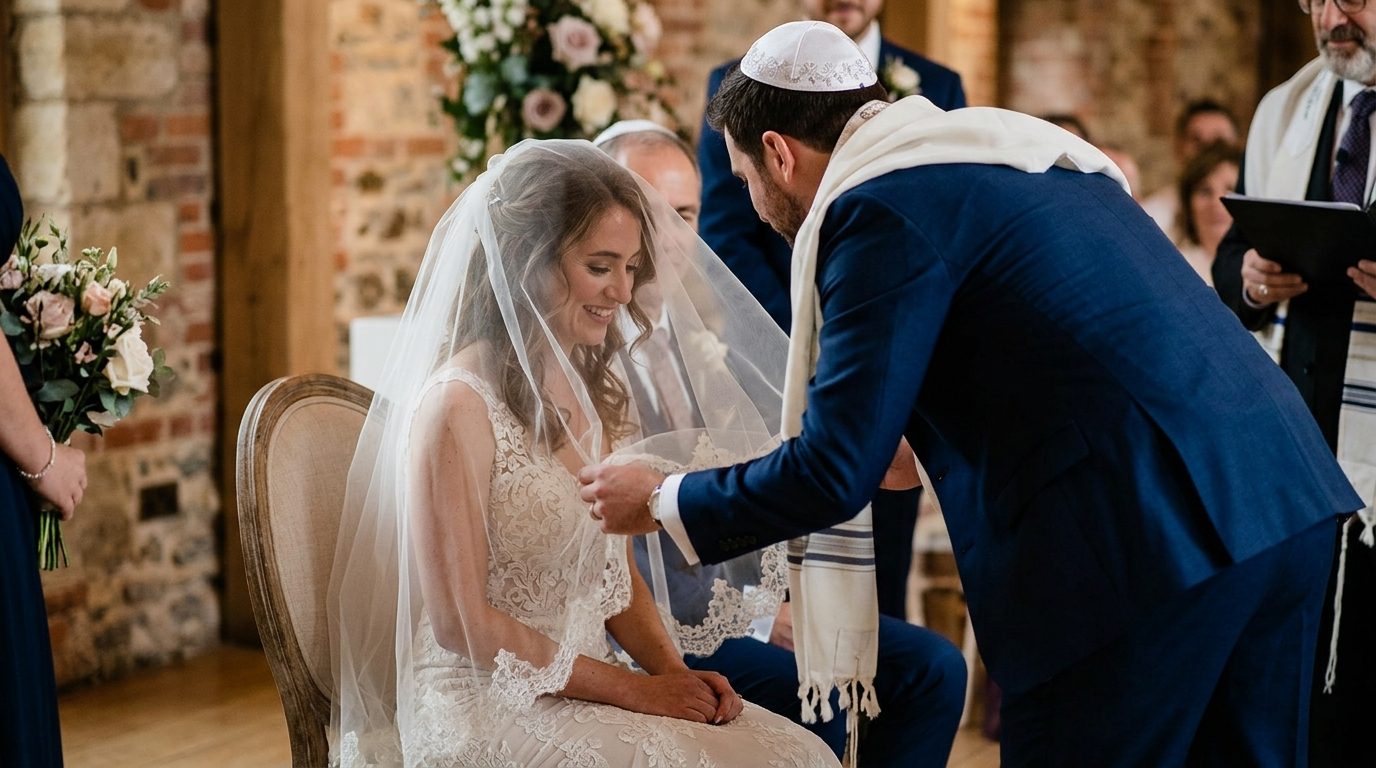
Bedeken (veiling ceremony): The groom, led by singing family and friends, processes to where the bride is seated and lowers her veil over her face. This is often the first time the couple have seen each other on the wedding day (at more traditional ceremonies). The groom’s veiling of the bride traces back to the biblical story of Jacob, who was deceived into marrying Leah because he could not see her face. The bedeken is emotional and personal — often one of the most private and touching moments of the day.
The chuppah ceremony
 The chuppah (wedding canopy) is the ceremonial and symbolic heart of the Jewish wedding. Everything that follows takes place beneath it.
The processional: In Ashkenazi (Eastern European Jewish) tradition, the bride is escorted down the aisle by both parents; the groom by both parents. The order varies by family and denomination. At the end of the processional, the bride circles the groom (typically three or seven times, depending on tradition). This circling symbolises the creation of a new family unit around the groom, or in egalitarian ceremonies, the couple’s encircling of each other.
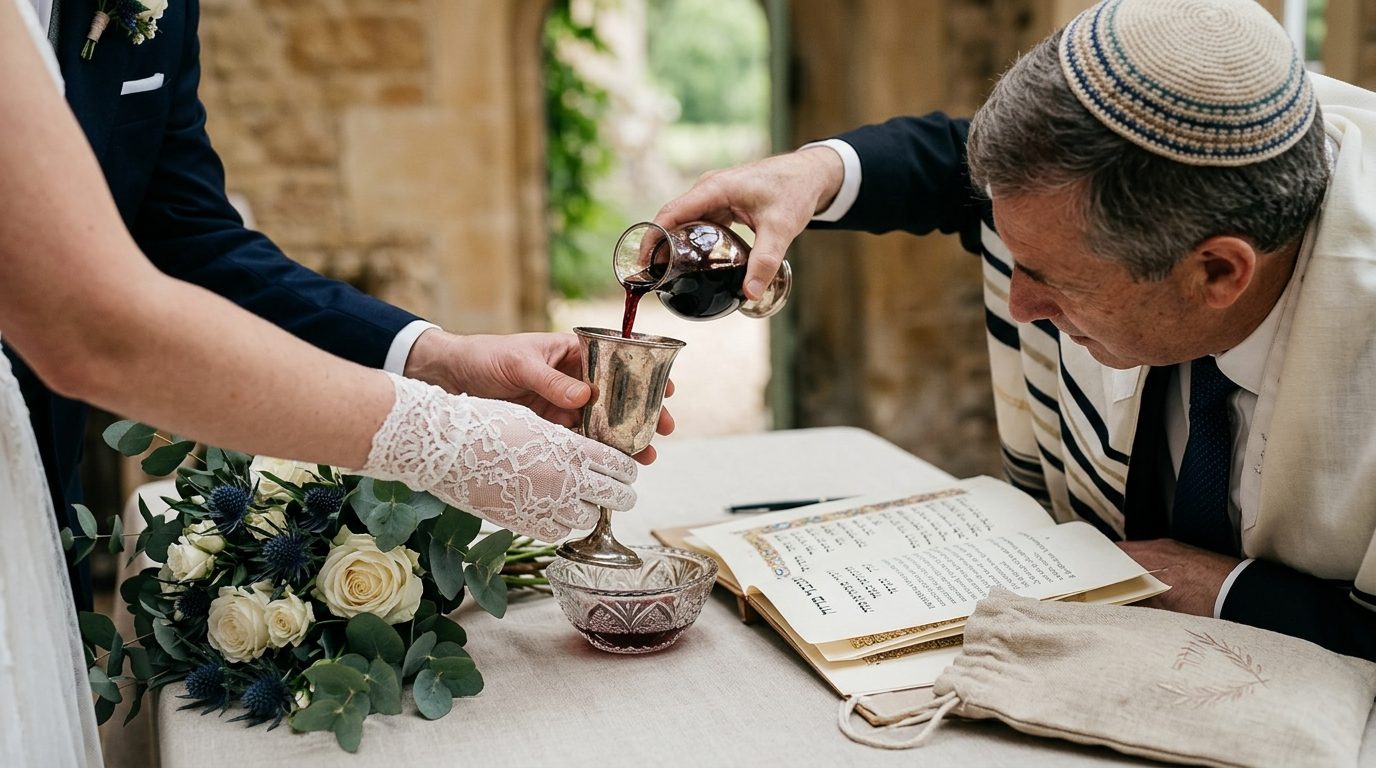
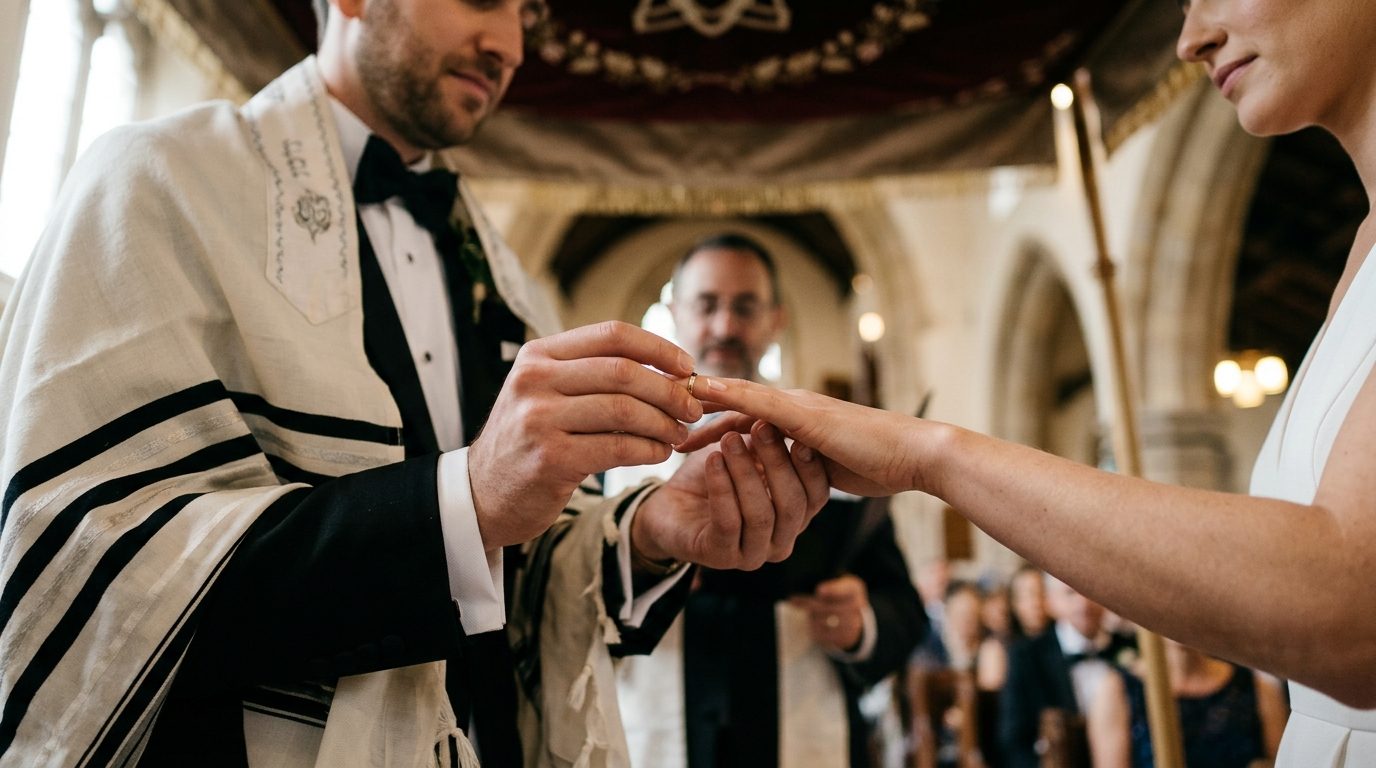
Kiddushin (betrothal): The first section of the ceremony, which makes the couple formally betrothed. The rabbi recites a blessing over wine and both partners drink. The groom places a plain gold ring on the index finger of the bride’s right hand and recites the Harei At formula: “Harei At Mekudeshet Li B’taba’at Zo K’dat Moshe V’Yisrael” — “Behold, you are sanctified to me with this ring, according to the law of Moses and Israel.” At egalitarian ceremonies, the bride also recites a declaration and places a ring on the groom.
The ketubah reading: The officiant reads the ketubah aloud under the chuppah.
Sheva Brachot (seven blessings): The seven blessings are the spiritual heart of the ceremony. Seven blessings praising God and celebrating love, joy, and the creation of a Jewish home are recited over a second cup of wine. These are often divided among honoured family members or guests — being asked to recite one of the blessings is a significant honour. At the end, both partners drink from the wine cup.
Breaking of the glass: A cloth-wrapped glass is placed before the groom (or, at egalitarian ceremonies, both partners). The groom stamps on it. As it shatters, guests shout “Mazal Tov!” This ends the ceremony. The meaning of the custom is debated — the destruction of the Temple in Jerusalem, the recognition that even in joy sorrow exists, the irreversibility of the marriage — but its function is clear: a moment of noise, joy, and release after the solemnity of the ceremony.
What non-Jewish guests need to know
Arrive on time. Jewish wedding ceremonies begin at the stated time. Unlike some cultural weddings where a stated start time is approximate, Jewish ceremonies often begin punctually.
Head coverings for men. At Orthodox and Masorti ceremonies, men are expected to wear a kippah (also called a yarmulke) during the ceremony. These are typically provided at the entrance in a basket. It is a sign of respect to wear one. At Reform and Liberal ceremonies it is optional but welcomed.
Modest dress for women at Orthodox ceremonies. Covered shoulders, no bare arms, no very short skirts. A wrap or jacket is appropriate for the ceremony and can be removed at the reception.
No food before the ceremony at some Orthodox weddings. Some Orthodox couples fast on the morning of their wedding day as a form of personal atonement, beginning their married life fresh. If fasting, they cannot eat until the ceremony ends. Guests are not typically asked to fast, but being aware of this explains why some families seem particularly eager for the reception to begin.
Mixed seating. At Orthodox synagogues, men and women often sit separately during the ceremony — men on one side, women on the other, sometimes with a mechitzah (partition) between them. This is not a comment on your worth as a guest; it is a religious observance. Follow the usher’s guidance on seating.
What to say. “Mazal Tov” (congratulations) is always appropriate. “L’chaim!” (to life!) is the traditional toast. “Shabbat Shalom” is only appropriate on Saturdays or Fridays at sunset.
The reception: music, dancing, and the kosher table
Jewish wedding receptions are famous for their energy. Two traditions define most Jewish wedding receptions in the UK:
The hora: An energetic circle dance, usually to traditional klezmer music or Israeli folk songs. The newly married couple are lifted on chairs and paraded around while guests dance below. The hora is loud, joyful, and absolutely participatory — non-Jewish guests are encouraged to join. If you are not sure of the steps, watch for two seconds and join in — there are no wrong moves.
Kosher catering: At Orthodox and many Conservative Jewish weddings, all food must be kosher — prepared according to Jewish dietary law. This means: no pork or shellfish; meat and dairy are not served at the same meal (if meat is served, no butter, cream, or dairy desserts appear until a sufficient time has passed). Kosher catering in the UK costs 30-50% more than standard catering and must be supplied by a caterer with current kosher certification. At Reform and Liberal weddings, full kosher catering is less common — many choose vegetarian menus or work with non-kosher caterers.
Legal recognition of Jewish marriage in the UK
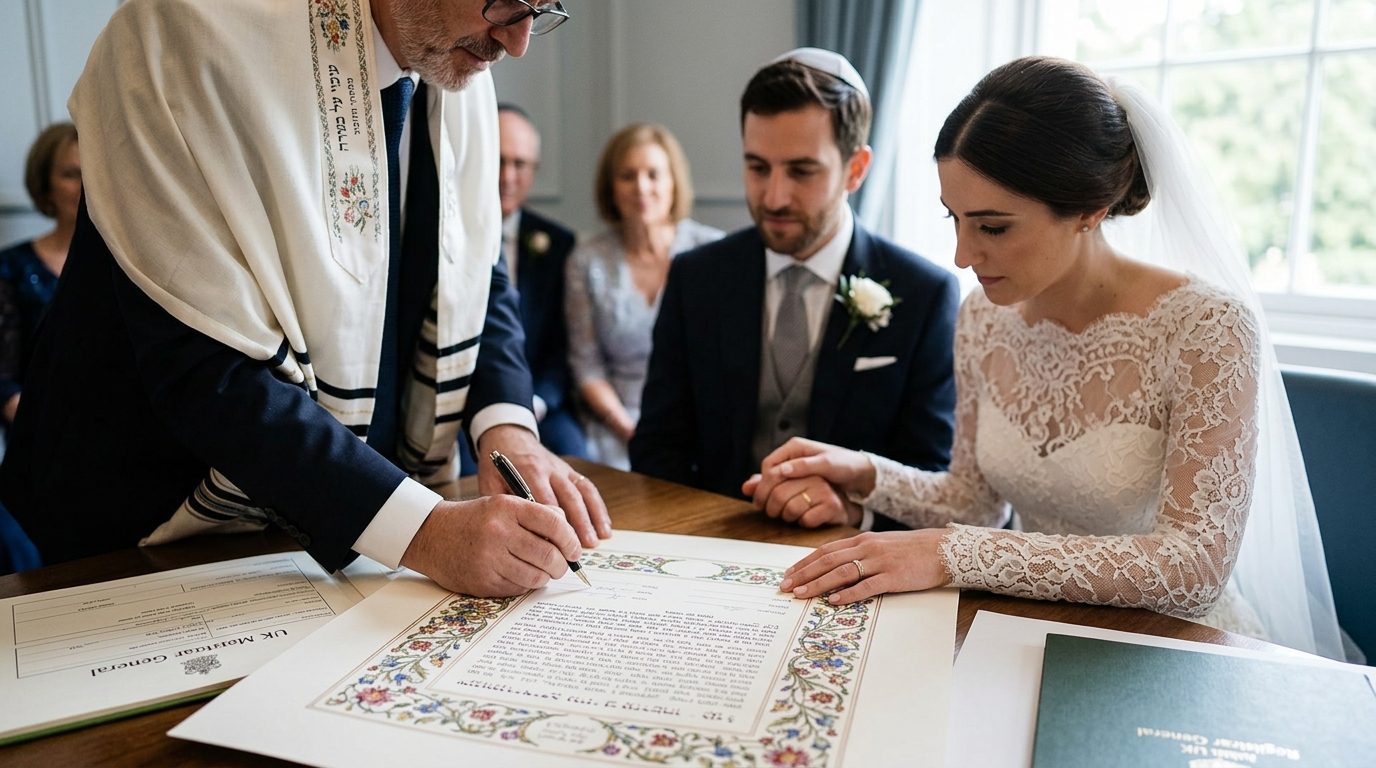 In England and Wales, a Jewish marriage ceremony conducted in a registered synagogue is legally valid as a marriage, provided:
- The synagogue is registered by the Registrar General
- The secretary of the synagogue (or another authorised person) certifies the marriage
- Notice has been given to the local register office
Most established UK synagogues — including those affiliated with the United Synagogue, Federation of Synagogues, Spanish and Portuguese Synagogue, and Reform and Liberal movements — are registered. Smaller independent minyanim (prayer groups) or private settings may not be registered. Always confirm before booking.
If the ceremony takes place in a non-registered setting, or in a private home, the couple must separately complete a civil ceremony at a register office.
What a UK Jewish wedding costs
| Cost item | Typical range |
|---|---|
| Synagogue hire and officiant | £500-£2,500 |
| Chuppah (decorated floral canopy) | £1,500-£5,000 |
| Kosher catering (per head, evening) | £80-£140 |
| Reception venue hire (150-300 guests) | £5,000-£15,000 |
| Band (klezmer or Jewish-aware band) | £2,500-£5,000 |
| Photography and videography | £3,000-£7,000 |
| Flowers and décor | £3,000-£10,000 |
| Ketubah (custom artwork) | £200-£800 |
| Total estimate (200 guests) | £35,000-£55,000 |
The cost above the UK national average (£21,990) is explained by three factors: larger guest numbers (a full Simcha — celebration — with extended family commonly runs to 150-300), kosher catering surcharge, and the tradition of multi-day celebration (including Sheva Brachot dinners for seven evenings post-wedding).
Jewish wedding traditions FAQ
What is a chuppah at a Jewish wedding?
A chuppah is the wedding canopy under which a Jewish marriage ceremony takes place. It consists of a cloth or floral canopy held up by four poles, symbolising the new home the couple will create together. The open sides represent the importance of hospitality. It is one of the most photographed elements of a Jewish wedding.
What is a ketubah?
The ketubah is a Jewish marriage contract, traditionally written in Aramaic, that outlines the groom’s obligations to the bride. It is signed by witnesses before the ceremony and read aloud during it. In the UK, the ketubah has no legal standing — legal marriage registration happens separately. Many couples commission a beautiful illustrated ketubah as a piece of art for their home.
Is a Jewish wedding legally recognised in the UK?
Yes, if the ceremony takes place in a registered synagogue and the marriage is recorded by an authorised person. Most established UK synagogues are registered for marriages. If the synagogue is not registered, a separate civil ceremony at a register office is needed for legal recognition. Confirm your synagogue’s registration status when booking.
What should non-Jewish guests wear to a Jewish wedding?
Non-Jewish guests should wear smart formal attire. Men attending an Orthodox or Conservative Jewish wedding should cover their head with a kippah — these are provided at the entrance. Women should avoid bare shoulders at Orthodox ceremonies. At Reform and Liberal ceremonies, dress code is less strict but smart formal is always appropriate.
What happens at the breaking of the glass?
At the end of the ceremony, the groom stamps on a glass wrapped in cloth. As it shatters, guests shout “Mazal Tov.” The tradition represents the destruction of the Temple in Jerusalem and acknowledges that even in joy, sorrow exists. It signals the couple is officially married.
What is the bedeken ceremony?
The bedeken is the veiling ceremony, just before the chuppah. The groom walks to where the bride is seated and lowers her veil over her face. It traces back to the biblical story of Jacob and is often the couple’s first meeting on the wedding day at traditional ceremonies. It is tender, often emotional, and a significant pre-ceremony tradition.
How much does a Jewish wedding cost in the UK?
UK Jewish weddings average £35,000-£55,000. The higher cost reflects large guest lists of 150-300 guests, kosher catering requirements (30-50% more expensive than standard catering), and multi-day celebrations including Sheva Brachot dinners.
Related reading:
- Legal Marriage Reform UK 2026: What Engaged Couples Need to Know
- Sikh Wedding Traditions UK: The Complete Guide
- Are Humanist Weddings Legally Recognised in England & Wales?
- Wedding Catering Cost per Head UK 2026
- The Average UK Wedding Now Costs £21,990
- How to Have a Religious + Humanist Wedding (Legally)
Frequently asked questions
What is a chuppah at a Jewish wedding?
A chuppah (pronounced khu-PAH) is the wedding canopy under which a Jewish marriage ceremony takes place. It consists of a cloth or floral canopy held up by four poles, symbolising the new home the couple will create together. The open sides represent the importance of hospitality. The chuppah can be decorated with flowers, fabric, or personal items. It is one of the most photographed elements of a Jewish wedding.
What is a ketubah?
The ketubah is a Jewish marriage contract, traditionally written in Aramaic, that outlines the groom's obligations to the bride. It is signed by two witnesses before the ceremony (not by the couple themselves in Orthodox tradition). Modern Liberal and Reform Jewish couples often use more egalitarian versions. The ketubah is then read aloud during the ceremony. In the UK, the ketubah has no legal standing — legal marriage registration happens separately. Many couples commission a beautiful illustrated ketubah as a piece of art for their home.
Is a Jewish wedding legally recognised in the UK?
Yes, if the ceremony takes place in a registered synagogue and the marriage is recorded by an authorised person (typically the secretary or rabbi of the synagogue, who is licensed as a superintendent registrar). Most established UK synagogues are registered for marriages. If the synagogue is not registered, a separate civil ceremony at a register office is needed for legal recognition. Always confirm your synagogue's registration status when booking.
What should non-Jewish guests wear to a Jewish wedding?
Non-Jewish guests should wear smart formal attire — a suit and tie for men, a cocktail dress or formal outfit for women. Men attending an Orthodox or Conservative Jewish wedding should cover their head with a kippah (also called a yarmulke) — these are typically provided at the entrance. At Liberal or Reform ceremonies, wearing a kippah is optional but appreciated. Women should avoid bare shoulders at Orthodox ceremonies; a wrap or jacket is appropriate.
What happens at the breaking of the glass?
At the end of the ceremony, the groom (and sometimes both partners at egalitarian ceremonies) breaks a glass wrapped in cloth by stamping on it. As the glass shatters, guests shout 'Mazal Tov' (congratulations). The tradition has several interpretations: it represents the destruction of the Temple in Jerusalem; it acknowledges that even in joy, sorrow exists in the world; or it signals the irreversibility of the marriage. It is the moment the couple is officially married.
What is the bedeken ceremony?
The bedeken (veiling ceremony) takes place just before the ceremony, usually in a separate room. The groom, accompanied by family and friends singing, walks to where the bride is waiting and lowers her veil over her face — a gesture tracing back to the biblical story of Jacob. This is a tender, often emotional moment and a significant part of the pre-ceremony traditions. Some couples choose not to see each other before the chuppah and use the bedeken as their first meeting on the wedding day.
How much does a Jewish wedding cost in the UK?
UK Jewish weddings average £35,000-£55,000, significantly above the UK national average. The higher cost reflects large guest lists (often 150-300 guests at a full Simcha), kosher catering requirements (typically 30-50% more expensive than standard catering), and multi-day celebrations. Some Orthodox communities hold Sheva Brachot celebrations for the seven evenings following the wedding, each hosted by different family members or friends.