Hindu Wedding Traditions UK: The Complete Guide
Key Takeaways
- A UK Hindu wedding typically spans 3-5 days of events, from Mehndi and Sangeet to the Mandap ceremony and reception
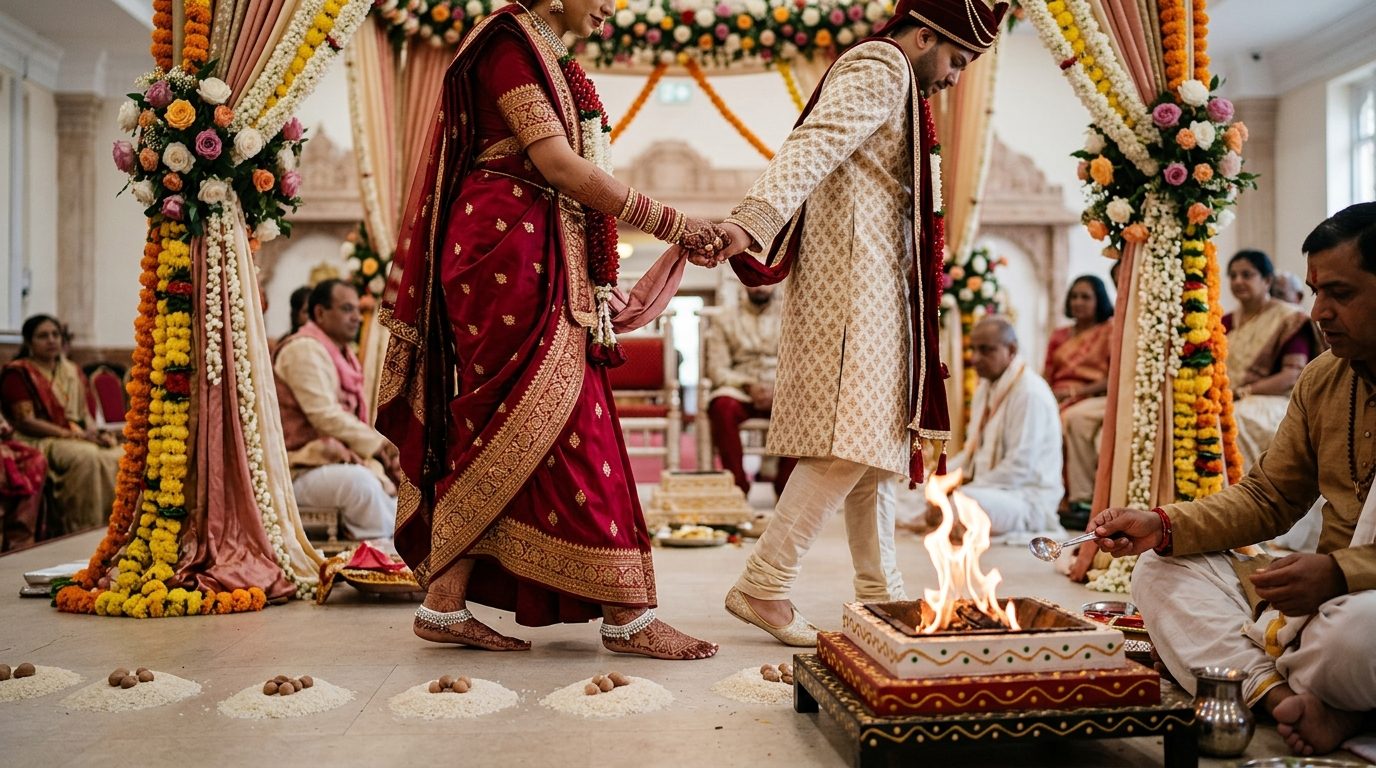
- The Saat Phere — seven rounds around the sacred fire — is the defining moment of the Hindu marriage ceremony
- Hindu wedding ceremonies are not automatically legally recognised in England and Wales — most couples hold a separate civil ceremony
- Guests should wear bright colours — red, pink, orange, gold — and avoid white (associated with mourning) and black
- The UK's Hindu population is approximately 1 million, with the largest communities in London, Leicester, Birmingham, and Bradford
Hindu weddings in the UK are among the most visually spectacular and ritually complex of any tradition — typically spanning three to five days, involving hundreds of guests, and incorporating ceremonies that connect couples to thousands of years of tradition. The UK has approximately one million Hindu residents, with the largest concentrations in London (particularly Wembley, Harrow, and Tooting), Leicester, Birmingham, Bradford, and Manchester. British Hindu weddings have evolved over three generations to blend Vedic ritual with contemporary celebration, often incorporating elements from multiple regional Indian traditions — Gujarati, Punjabi, Tamil, Bengali — alongside thoroughly British venue choices and reception formats. This guide covers every ceremony from the pre-wedding Mehndi to the post-wedding Vidaai, what non-Hindu guests need to know, and what a UK Hindu wedding typically costs.
The UK Hindu wedding: a 3-5 day overview
A full Hindu wedding encompasses a sequence of ceremonies, each carrying distinct ritual significance. The exact combination depends on the family’s regional heritage, level of religious observance, and practical constraints. Below is a common structure for a UK Hindu wedding:
| Day | Event | Nature |
|---|---|---|
| 2-3 days before | Haldi (turmeric) ceremony | Purification ritual for bride and groom |
| 1-2 days before | Mehndi (henna night) | Bride’s henna ceremony, women’s celebration |
| Evening before | Sangeet night | Music, dancing, family gathering |
| Wedding morning | Baraat procession | Groom’s arrival with dhol and dancing |
| Wedding morning | Jai Mala | Exchange of flower garlands, families meet |
| Wedding ceremony | Mandap ceremony | Vedic ceremony around sacred fire, Saat Phere |
| Wedding evening | Reception | Dinner, speeches, entertainment |
| Day after | Vidaai / Doli | Bride’s farewell from her family home |
Not all families observe every element. Smaller or more Westernised Hindu families may hold just a Mehndi, the Mandap ceremony, and a combined reception. More traditional families — particularly from Gujarati or Punjabi backgrounds — may hold five or more separate events over three days.
Pre-wedding ceremonies
The Haldi ceremony
The Haldi (turmeric) ceremony typically takes place two to three days before the wedding. A paste of turmeric, sandalwood, rosewater, and chickpea flour is applied to the bride’s (and sometimes the groom’s) face, neck, arms, and feet by family members and close friends. Turmeric is considered auspicious and purifying in Hindu tradition; the ceremony is believed to bring good luck and make the skin glow before the wedding.
In the UK, the Haldi ceremony is usually a small, informal event at the family home. Guests wear old or inexpensive clothes — the turmeric paste stains. The mood is joyful and playful, with family members competing to smear the paste most liberally. Photographs from the Haldi ceremony — bright yellow turmeric against colourful clothing — are often among the most shared of the wedding.
The Mehndi ceremony
The Mehndi ceremony is one of the most anticipated pre-wedding events. Henna artists are hired to apply intricate designs to the bride’s hands and feet, often incorporating the groom’s initials hidden within the pattern. The ceremony is attended primarily by women and typically takes place in the family home or a hired venue.
In the UK, Mehndi nights have grown into significant celebrations in their own right — often lasting four to six hours, with a DJ or live music, dancing, food, and professional Mehndi artists attending to guests as well as the bride. Good Mehndi artists in London, Leicester, and Birmingham charge £300-£800 for bridal Mehndi alone.
The depth of colour the henna achieves is a topic of much family discussion. In tradition, the deeper the final colour, the more the groom loves his bride.
The Sangeet night
The Sangeet (meaning “music together” in Sanskrit) is an evening celebration that brings both families together for dance, music, and food. It is one of the most social events of the Hindu wedding schedule and often the one that non-Hindu guests find most exhilarating.
The centrepiece of the Sangeet is typically a series of choreographed dance performances. Family and friends spend weeks preparing routines — usually to Bollywood songs, though Western pop mashups are increasingly common. The bride and groom’s respective families “compete” in an affectionate battle of performances. Professional choreographers can be hired in most UK cities with significant South Asian communities; packages typically run £500-£1,500 for 8-10 weeks of group sessions.
A live dhol player, a DJ, or a Bollywood band provides music between performances. Catering is typically Indian street food or a buffet. The Sangeet can accommodate 100-300 guests and often runs until midnight.
The Mandap ceremony
The Mandap is the sacred canopy under which the Hindu marriage ceremony takes place. It is the visual and spiritual centrepiece of a Hindu wedding — a decorated structure of four posts and an ornate roof, often covered in flowers, fabric, and lights, beneath which the priest (Pandit) leads the couple through the Vedic rituals.
Arriving at the ceremony: the Baraat
The groom arrives at the ceremony venue in a Baraat — a procession accompanied by family, friends, and a dhol drummer (or sometimes a full band). In India, the groom traditionally rides a white horse. In the UK, the horse is often replaced by a decorated car, though horse Baaraat processions are still common in venues with outdoor space. The procession dances its way to the entrance, typically accompanied by loud Bollywood music and much celebration.
At the entrance, the bride’s mother greets the groom and performs the Swagatam — a welcoming ceremony. The bride’s family escorts the groom to the Mandap.
The Jai Mala (exchange of garlands)
Before the ceremony begins under the Mandap, the bride and groom exchange flower garlands — the Jai Mala. This is both a formal welcome and a moment of gentle theatre: the groom’s friends and family often lift him to prevent the bride from placing the garland around his neck, while the bride’s friends lift her in response. The Jai Mala exchange is often one of the most photographed and laughed-about moments of a Hindu wedding.
The Vedic ceremony under the Mandap
Once seated under the Mandap, the Pandit leads the couple through a series of Vedic rituals that vary by regional tradition (North Indian, South Indian, Gujarati, Bengali, etc.), but typically include:
Ganesh Puja: An invocation to Lord Ganesh, remover of obstacles, to bless the beginning of the marriage ceremony.
Kanyadan: One of the most emotionally significant moments of the ceremony. The bride’s father places her hand in the groom’s, symbolically giving his daughter to the groom. The groom accepts responsibility for her wellbeing. In modern UK Hindu weddings, both parents often take part in the Kanyadan together.
Vivah Homa: The sacred fire (Agni) is lit in a copper vessel. The fire serves as a witness to the marriage vows. Both the priest and the couple make offerings of ghee and grains into the fire throughout the ceremony. The fire represents purity, the divine, and the home the couple will create together.
Panigrahana: The groom clasps the bride’s hand as an act of acceptance and protection. Vedic mantras are chanted.
The Saat Phere (seven sacred rounds): The culminating ritual of the Hindu ceremony. The couple walk seven times around the sacred fire, connected by the bride’s dupatta (scarf) tied to the groom’s shirt. Each round represents a vow:
- Pray for nourishment and a prosperous life together
- Pray for physical and mental strength
- Pray for wealth, material prosperity, and spiritual growth
- Pray for happiness, blessings, and harmony in life
- Pray for children, a long family line, and happiness in parenthood
- Pray for good health and long life
- Pray for friendship, companionship, and understanding
After the seventh round, the couple is considered married in the eyes of the Hindu faith.
Sindoor and Mangalsutra: Following the Saat Phere, the groom applies sindoor (red vermilion powder) to the parting of the bride’s hair — a symbol that she is now a married woman. He then places a Mangalsutra (a sacred black-and-gold beaded necklace) around her neck. Both the sindoor and the Mangalsutra are traditional markers of a married Hindu woman.
Ashirvad: The ceremony concludes with blessings from the Pandit and from the couple’s parents and elders. Guests shower the couple with flower petals.
Legal recognition in England and Wales
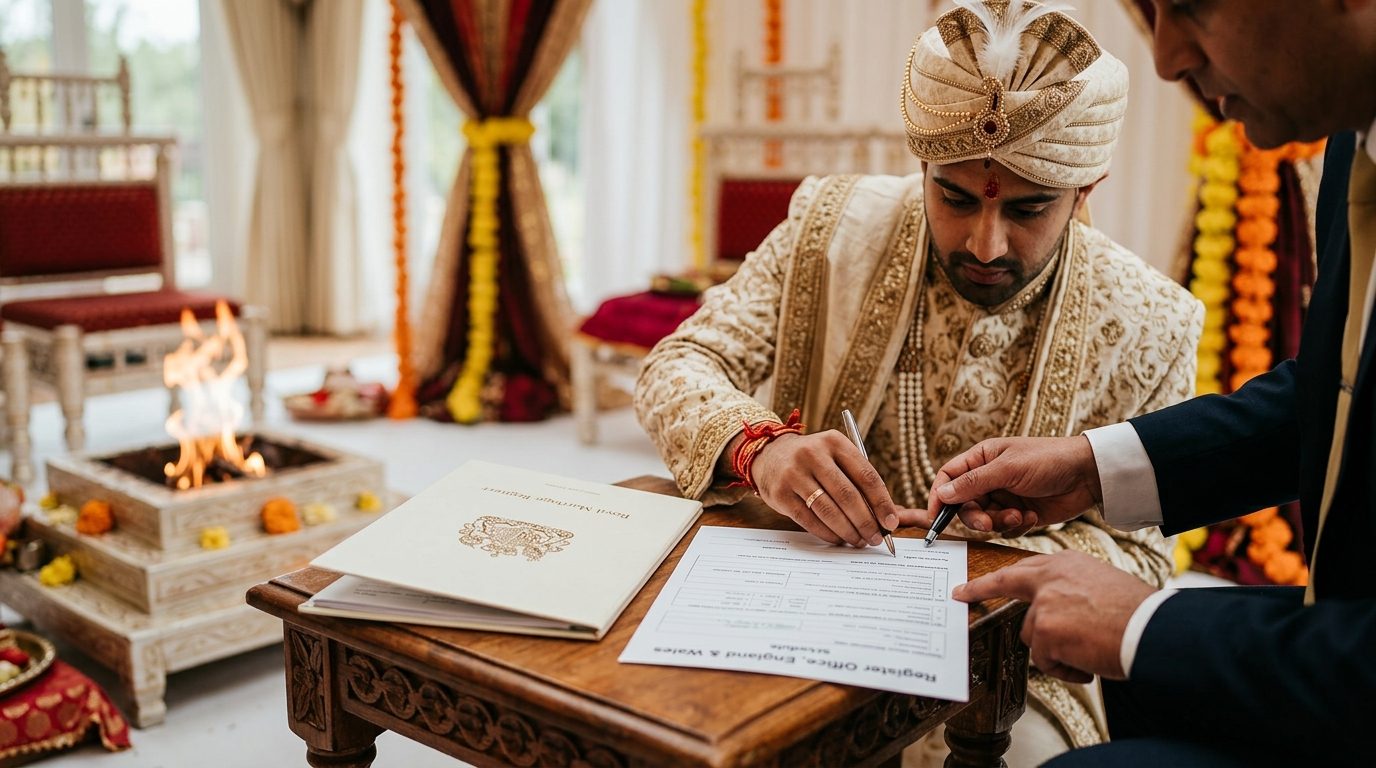
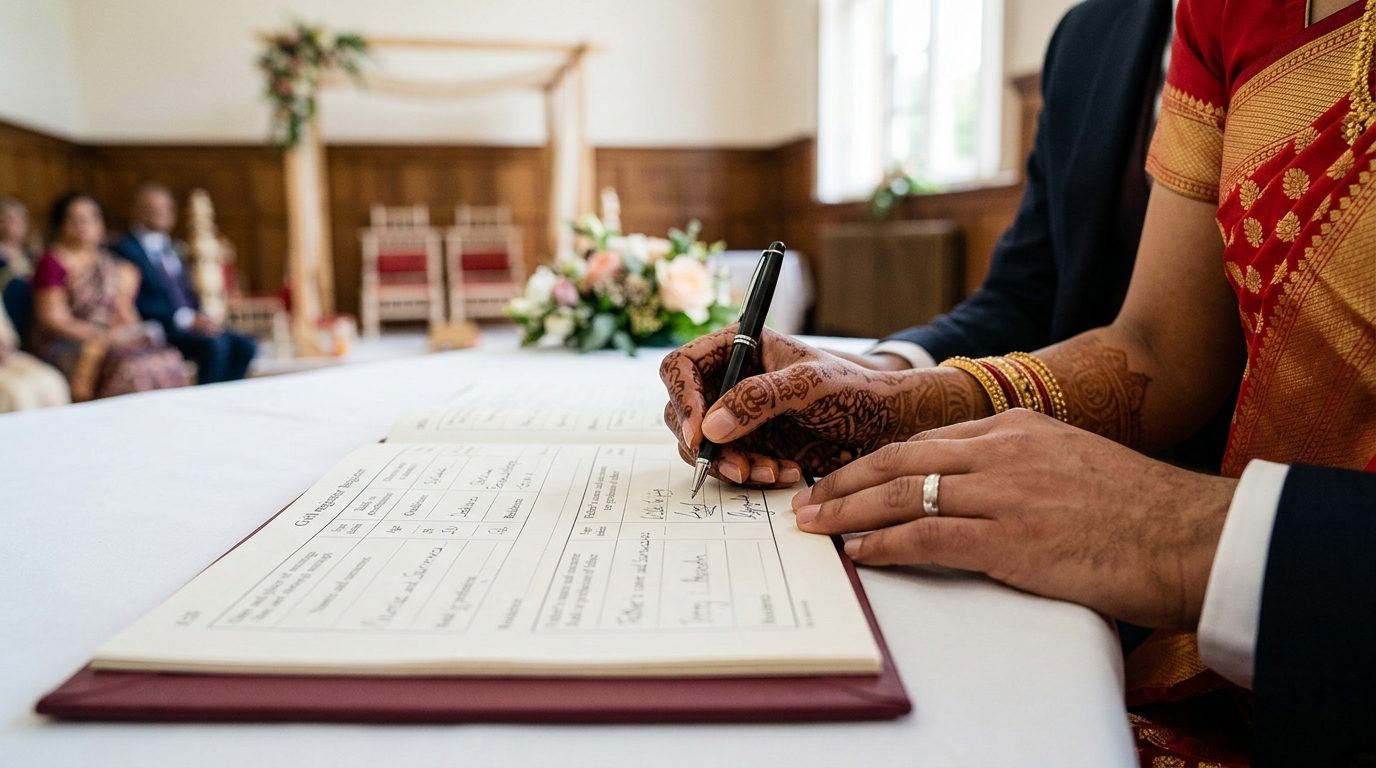 Hindu ceremonies are not automatically legally recognised in England and Wales. Under the Marriage Act 1949, a marriage is legally valid only if it takes place in registered premises before an authorised person, or if a civil ceremony is also completed.
Most UK Hindu couples handle this in one of two ways:
Option 1: Separate civil ceremony. The couple attends a register office in the days before or after the Mandap ceremony to complete the legal paperwork. This is the most common approach and keeps the religious ceremony purely ceremonial.
Option 2: Register the ceremony venue. Some Hindu community halls and temples in the UK are licensed as wedding venues and can host legally valid ceremonies. If the venue has a licence and a registrar is present, the Mandap ceremony can be legally recognised. Check with your local council and venue.
For couples planning to be legally married at a register office before or after the Mandap ceremony, it is worth noting that the civil ceremony can be kept extremely brief — just the exchange of vows and signatures before a registrar — and does not need to be a separate celebration. Many couples treat it as a private family moment the day before the Mandap.
What guests need to know
Dress code
Hindu weddings call for bright, festive dress. The standard guidance:
- Wear: Red, pink, orange, yellow, gold, purple, emerald green, royal blue, turquoise
- Avoid: White (associated with mourning in Hindu culture), all-black outfits (traditionally inauspicious)
- Women: A saree, salwar kameez, anarkali, or lehenga are always appropriate and warmly welcomed. Smart Western dress in bright colours is also fine. Cover shoulders in the ceremony space.
- Men: A kurta pyjama, sherwani, or smart Western suit is appropriate. Indian formal wear is welcomed.
- Shoes: Remove shoes before the ceremony space (Mandap area). Many venues provide a shoe storage area near the entrance.
Timing
Hindu weddings often start later than the invitation time suggests. An invitation saying 11am for the ceremony typically means the ceremony begins around 12:00-12:30pm. The reception may run until midnight or beyond. Plan accordingly — this is not an event to rush to leave.
Gifts
Cash gifts are standard at Hindu weddings. Monetary gifts are typically placed in envelopes and given directly to the couple or their parents. Gift lists are less common than at Western weddings, though some younger British Hindu couples do maintain one. A cash gift of £50-£100 per person is typical; for close family, £100-£250 is more common.
Venues for UK Hindu weddings
Finding a venue large enough for a Hindu wedding — and one that can accommodate the specific requirements of the Mandap, the sacred fire, and multi-day events — is one of the most significant logistical challenges.
Banquet halls: Purpose-built Indian banquet halls in London, Leicester, Birmingham, and Manchester are the most common choice. They are familiar with the event format, can accommodate 300-600 guests, have kitchens that can handle Indian catering, and are often willing to allow open flames for the Vivah Homa.
Hotels: Many large UK hotels can accommodate Hindu weddings, but you will need to confirm they can permit a sacred fire (the Vivah Homa) — not all will. The Marriott, Hilton, and Radisson chains have experience with South Asian weddings at many of their larger properties.
Country house venues: Increasingly popular for the photogenic setting. A marquee on the grounds can accommodate the Mandap and is usually able to accommodate an open fire. Country house venues require a specialist Indian caterer to be brought in.
Gurdwaras or temples: Some Hindu temples in the UK have event spaces for receptions, but the main Mandap ceremony typically requires a venue large enough for the full guest list.
For guidance on specific venue types, see our guides to barn wedding venues, country house wedding venues, and Asian wedding venues.
Music and entertainment
A Hindu wedding is never short on music. Typical elements include:
- Dhol: The double-sided drum played at the Baraat, the Sangeet, and during key ceremony moments. A live dhol player adds enormous energy.
- Bollywood DJ: Essential at the reception — a DJ who knows both classic Bollywood and contemporary tracks.
- Live Bollywood band: Premium choice for the Sangeet and reception; expect to pay £2,000-£5,000 for a five-piece band.
- Classical music: A harmonium or tabla player during the Mandap ceremony creates an atmosphere of reverence.
- First dance: An increasing number of British Hindu couples incorporate a Western-style first dance at the reception.
Food and catering
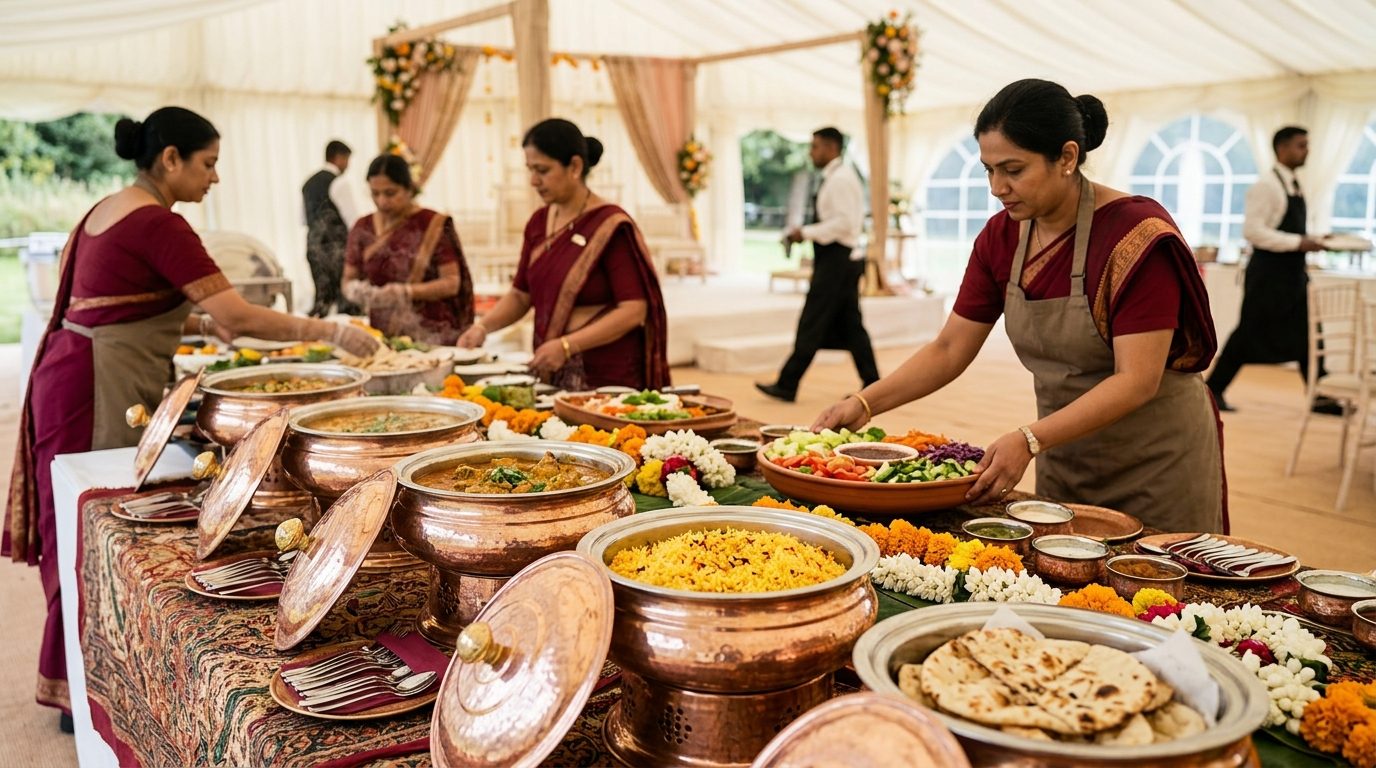
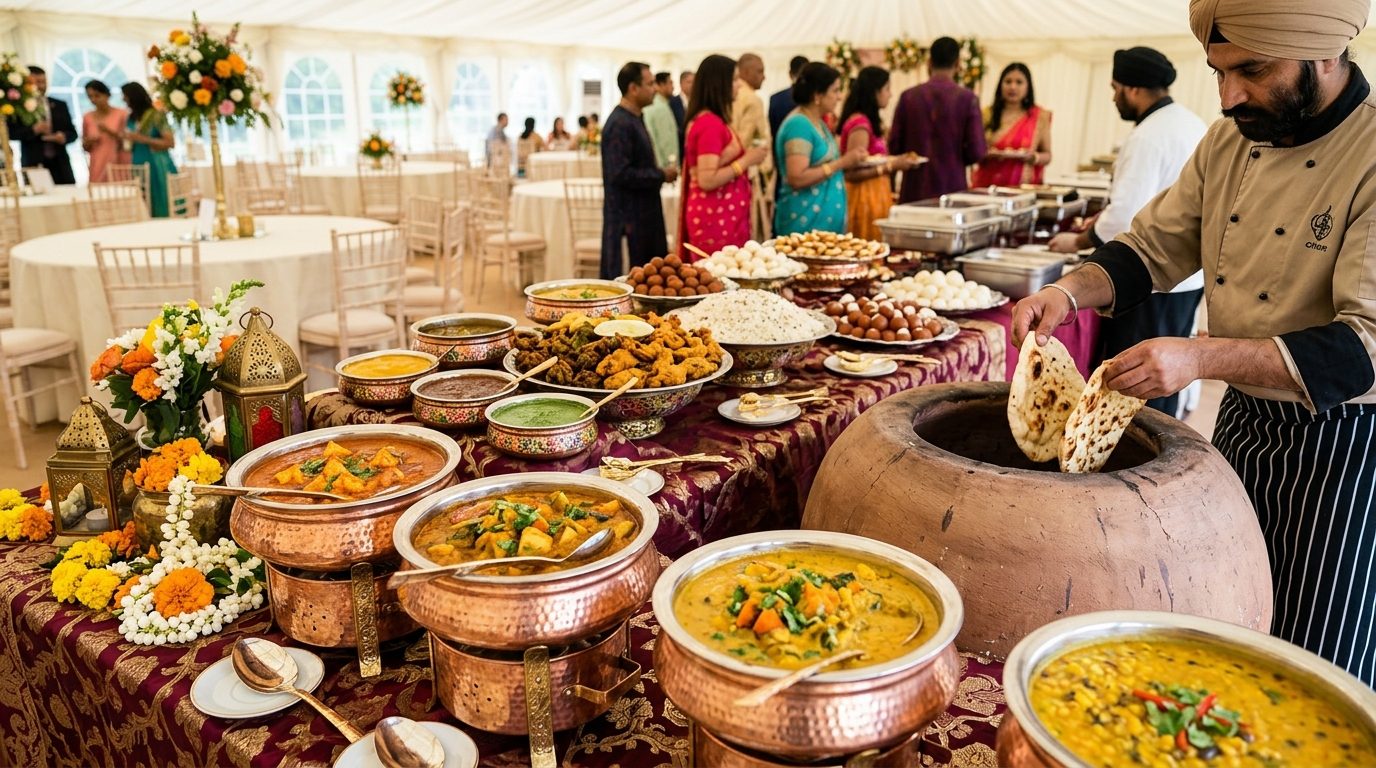 Hindu wedding catering is typically Indian in style and always plentiful. Key considerations:
- Vegetarian vs non-vegetarian: Many Hindu families are vegetarian. A fully vegetarian menu is respectful and practical — many Hindu caterers specialise in this.
- Jain catering: Some Hindu families are Jain (no root vegetables including onion and garlic) — confirm dietary requirements early.
- Kosher / halal considerations: If you have guests from other faith backgrounds, liaise with your caterer about labelling or separate sections.
- Per-head catering cost: Indian wedding catering in the UK typically runs £60-£120 per head for a full dinner. Multi-event catering across Mehndi, Sangeet, and reception can push total catering costs to £25,000-£40,000 for a 300-guest wedding.
Costs: what to expect
| Item | Typical cost |
|---|---|
| Venue hire (3 events) | £8,000-£15,000 |
| Catering (per head × 350) | £20,000-£35,000 |
| Décor (Mandap, Mehndi, Sangeet) | £5,000-£15,000 |
| Photography and videography | £3,500-£8,000 |
| Entertainment (dhol, DJ, band, choreographer) | £3,000-£7,000 |
| Bridal outfit (lehenga or saree + jewellery) | £3,000-£10,000 |
| Groom’s outfit (sherwani, suit) | £800-£3,000 |
| Pandit (priest fees) | £500-£1,500 |
| Flowers | £2,000-£5,000 |
| Total | £45,800-£99,500 |
Couples who limit the guest list to 150-200 and hold 2-3 events rather than 4-5 can bring the total to £20,000-£35,000. For more context on managing wedding costs, see our guide to how to budget for a wedding and the average UK wedding cost breakdown.
Comparing Hindu, Sikh, and Jewish wedding traditions
The UK’s three largest non-Christian wedding traditions — Hindu, Sikh, and Jewish — share some structural similarities (multi-day celebrations, large guest lists, strong family involvement) but differ significantly in ceremony content.
| Feature | Hindu | Sikh | Jewish |
|---|---|---|---|
| Ceremony name | Mandap / Vivah | Anand Karaj | Chuppah |
| Central ritual | Saat Phere (seven rounds around fire) | Four laavan (rounds around Guru Granth Sahib Ji) | Sheva Brachot under the chuppah |
| Legal recognition (E&W) | Usually separate civil ceremony needed | Recognised if Gurdwara is registered | Recognised if synagogue is registered |
| Typical guest count | 300-600 | 200-500 | 150-300 |
| Average UK cost | £40,000-£65,000 | £30,000-£45,000 | £35,000-£55,000 |
| Duration | 3-5 days of events | 2-3 days | 1-2 days |
For more detail on Sikh weddings, see Sikh Wedding Traditions UK: The Complete Guide. For Jewish weddings, see Jewish Wedding Traditions UK: The Complete Guide.
The Vidaai: saying goodbye
The Vidaai — the bride’s farewell from her family home — is one of the most emotionally charged moments of a Hindu wedding. As the bride prepares to leave with her new husband, she throws handfuls of puffed rice over her shoulder towards her parents — a symbolic gesture of thanksgiving and a prayer that prosperity follows her family. Family members weep; it represents the end of one chapter of the bride’s life and the beginning of another.
In the UK, the Vidaai typically takes place at the end of the reception or the following morning if the couple has stayed with family overnight. It has lost none of its emotional weight despite the fact that most British Hindu brides live close to their parents and will see them frequently.
Frequently asked questions
Is a Hindu wedding ceremony legally recognised in the UK?
A Hindu ceremony is not automatically legally recognised in England and Wales unless held in registered premises by an authorised person. Most UK Hindu ceremonies are religious-only and require a separate civil ceremony at a register office. Some Hindu community halls and temples are registered — check with your venue. In Scotland, a celebrant authorised under the Marriage (Scotland) Act can legally solemnise a Hindu marriage without a separate civil ceremony.
What is the Saat Phere in a Hindu wedding?
The Saat Phere are seven sacred circumambulations around the holy fire (Agni), performed by the couple during the Hindu wedding ceremony. Each round represents a vow: prosperity, strength, wealth, happiness, children, long life, and friendship and understanding. As the couple completes the seventh round, they are considered married. The Saat Phere is the legal and spiritual culmination of the Hindu wedding ceremony.
What should a non-Hindu guest wear to a Hindu wedding?
Non-Hindu guests should wear bright, festive colours — red, pink, orange, yellow, or gold are ideal. Avoid white (associated with mourning in Hindu culture) and black (traditionally avoided at celebratory occasions). Smart Indian dress such as a salwar kameez or saree for women is always appreciated. Western formal wear in bright colours is also fine. For the Mandap ceremony, cover your shoulders and avoid short hemlines. Remove shoes if asked before entering the ceremony area.
What is the Mehndi ceremony at a Hindu wedding?
The Mehndi ceremony typically takes place 1-2 days before the main wedding. Henna (mehndi) is applied to the bride's hands and feet in intricate patterns. The ceremony is a joyful pre-wedding celebration attended by women from both families. Music, dancing, and food mark the occasion. In traditional families, the Mehndi ceremony also includes prayers and songs. Guests may have small henna designs applied too. The depth of colour the henna achieves is said to represent the depth of the groom's love.
What is the Sangeet night at a Hindu wedding?
The Sangeet (meaning 'music' in Hindi) is an evening celebration usually held 1-2 days before the wedding. Families from both sides come together for music, dancing, and food. The highlight is often choreographed dance performances prepared by family and friends, typically to Bollywood songs. The Sangeet has become increasingly elaborate at UK weddings — many couples hire a choreographer and a live band or DJ. It is one of the most social and exuberant events in the wedding schedule.
What is the Baraat procession?
The Baraat is the groom's wedding procession to the ceremony venue. The groom traditionally arrives on a white horse (though a car or other mode of transport is often used at UK weddings), accompanied by male family members and friends dancing to dhol (drum) music. The Baraat is a joyful, noisy procession that signals the groom's arrival. At the venue, the bride's family welcomes the groom with the Jai Mala ceremony — the exchange of flower garlands between bride and groom.
How much does a Hindu wedding cost in the UK?
UK Hindu weddings average £40,000-£65,000, significantly above the national average of £21,990 (Hitched 2026). The higher cost reflects large guest lists (typically 300-600 guests), multiple events over 3-5 days (Mehndi, Sangeet, wedding ceremony, reception), elaborate décor (Mandap, flower walls, chandeliers), and catering across multiple events. Couples who hold a more modest ceremony with 150 guests and 2-3 events can expect to spend £20,000-£35,000.