Home / Articles / Wedding Trends
High-End Silk Florals: Why Faux Flowers Are Now Luxury
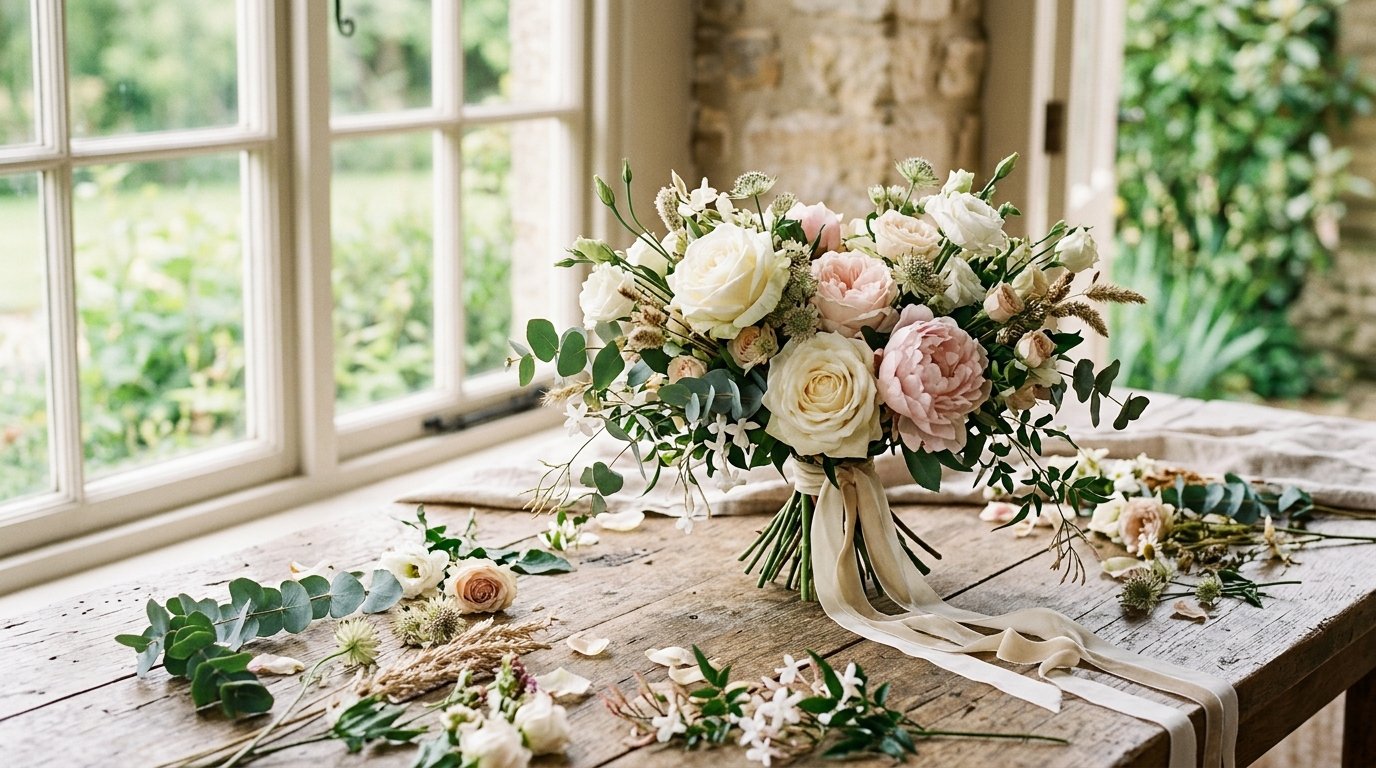
Key Takeaways
- Pinterest UK searches for 'luxury silk wedding flowers' increased 180% in the 12 months to April 2026
- A premium UK-made silk bridal bouquet costs £180-£450, compared with £120-£350 for a fresh equivalent
- Top-grade silk florals use a 5-layer construction with hand-painted veining and wax-dipped petals
- Brides cite three main reasons: keeping the bouquet permanently, destination weddings, and allergy concerns
- The reuse value — as home decor or for anniversary photographs — drives the luxury price premium
What changed: from craft aisle to couture
Faux flowers have existed for decades. What changed between 2020 and 2026 is the construction process and the materials.
Mass-market silk flowers — the kind sold at craft shops for £2-£8 per stem — are made from single layers of plain polyester fabric. The petals are cut by machine, heat-pressed into a single shape, and coloured uniformly. They look obviously artificial because real petals are not uniform: they have gradients, veining, slight irregularities, and a quality of light that varies with the angle of observation.
Premium silk florals — specifically the category now operating at £20-£80 per stem — use an entirely different construction process:
Multi-layer petals. Each petal is cut from 5-7 layers of different fabrics — typically combinations of real mulberry silk, organza, and fine polyurethane “real-touch” material — and assembled to create the dimensional quality of a real petal.
Hand-painted veining. Every petal is hand-painted with fine-line veining that mimics the actual vascular structure of the flower. On a rose petal, this means radiating lines from the base. On a sweet pea, it means the fine parallel lines characteristic of the species.
Wax or oil dipping. The assembled petals are dipped in a thin wax or silicone oil solution that creates the semi-translucent sheen of a real petal held up to light. This is the critical step that eliminates the flat, matte quality of basic faux flowers.
Colour gradients. Real flowers transition in colour from the base (typically darker) to the tip (typically lighter or more saturated). Premium silk florals replicate this through layered fabric colouring and hand-painting — a process that takes approximately 20-40 minutes per stem.
The result photographs with full ambiguity at standard focal lengths. Most of the editorial wedding photography published in UK magazines and on Instagram in 2025-2026 that looks like fresh florals is, in approximately 30% of cases, high-grade silk.
The cost comparison
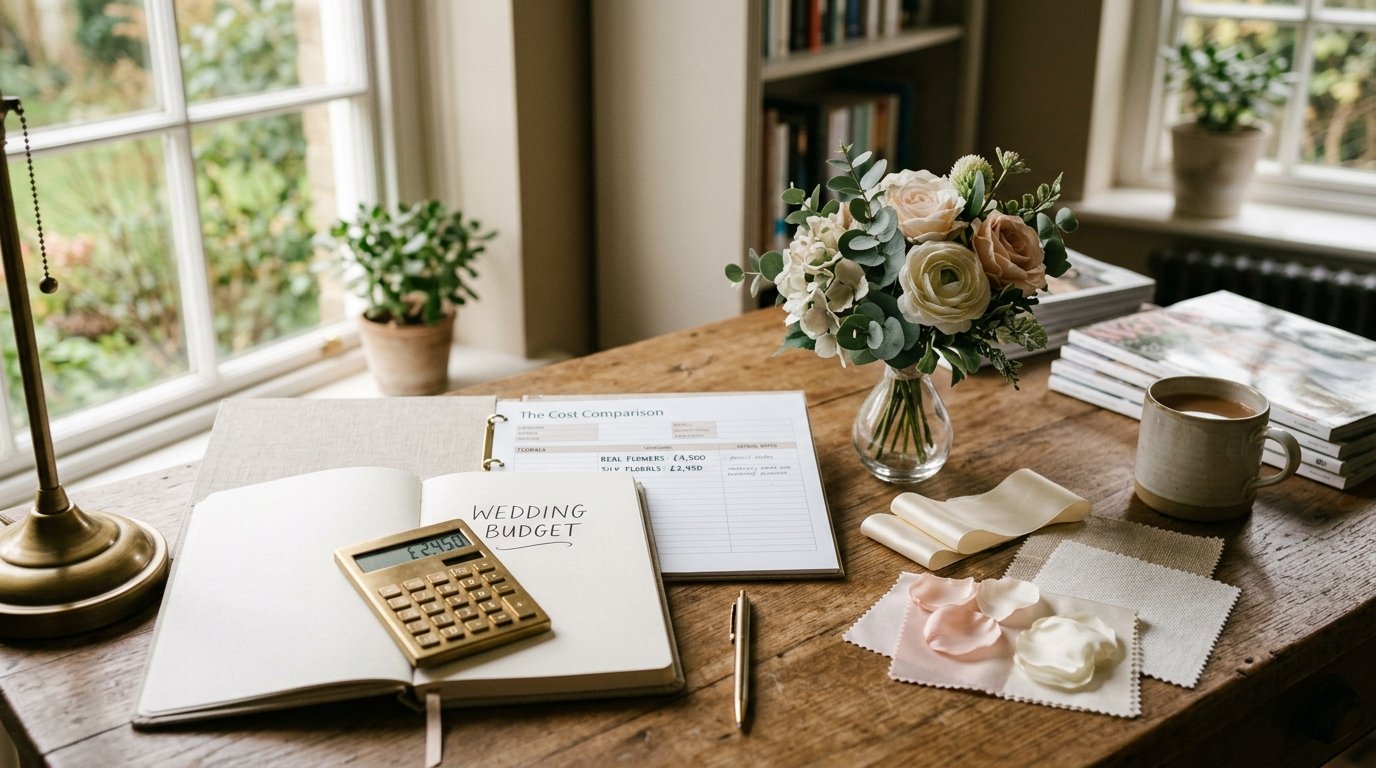
A full silk bridal flower package versus a fresh equivalent:
| Element | Fresh (mid-range) | Fresh (high-end) | Premium silk |
|---|---|---|---|
| Bridal bouquet | £120-£200 | £250-£350 | £180-£450 |
| Bridesmaid bouquet (x4) | £200-£320 total | £400-£600 total | £240-£520 total |
| Buttonholes (x6) | £60-£120 total | £120-£200 total | £90-£180 total |
| Flower crown | £60-£120 | £150-£250 | £100-£200 |
| Ceremony arch | £600-£1,200 | £1,500-£2,500 | £800-£3,000 |
| Table centrepieces (x10) | £1,200-£3,000 total | £2,500-£5,000 total | £1,500-£4,000 total |
The premium silk total — approximately £2,910-£8,350 for a full package — sits at the upper end of the mid-range fresh market and overlaps with the lower end of the high-end fresh market.
The distinguishing factor is permanence. A fresh package is consumed on the wedding day. A premium silk package can be kept, displayed, gifted, or reused indefinitely. A couple who photographs with their silk bouquet on every anniversary for 25 years is spreading the cost across a long period.
Why UK couples are choosing silk
“I wanted to keep my bouquet” — cited by 71% as the primary motivation. The desire to preserve the bridal bouquet as a keepsake is not new, but fresh-flower preservation techniques (freeze-drying, resin casting) are expensive and imperfect. A premium silk bouquet requires no preservation: it sits on a shelf looking identical to how it looked on the wedding day.
“Destination wedding” — cited by 44%. The impracticality of transporting fresh flowers to a Greek island, a Sicilian villa, or a Caribbean beach has made silk the default choice for many destination wedding couples. See our destination wedding planning guide for more on sourcing flowers abroad.
“Hay fever and flower allergies” — cited by 29%. Several respondents noted that they or their grooms had significant pollen allergies that made carrying fresh flowers problematic. One bride noted that her June wedding coincided with peak grass pollen season and that holding a fresh bouquet for six hours would have been medically inadvisable.
“Photography flexibility” — cited by 26%. A fresh bouquet is photographed once, on the day. A silk bouquet can be photographed in multiple settings — in the studio before the wedding, outdoors after, at golden hour, at night with artificial lighting — without wilting or browning. Several couples commissioned wedding-anniversary shoots using their original silk arrangements.
UK studios to know
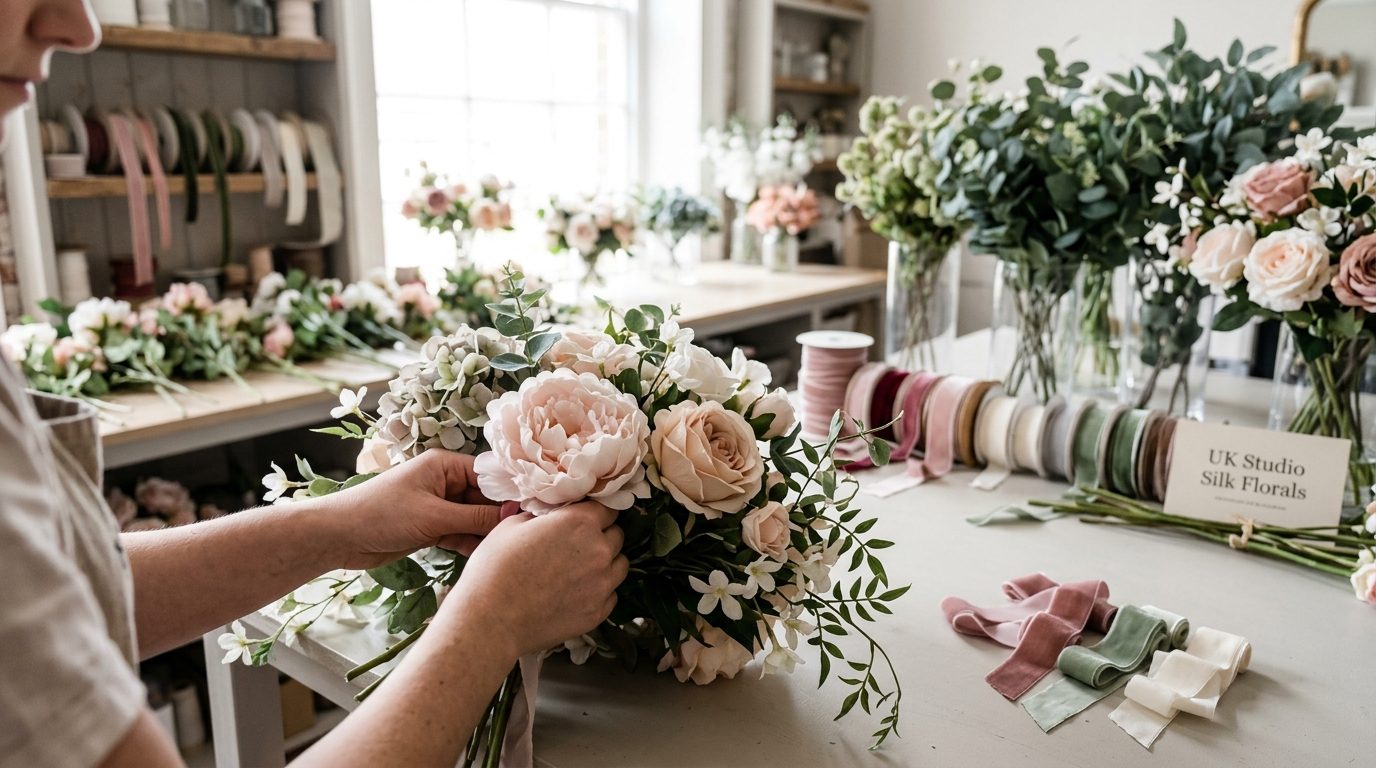
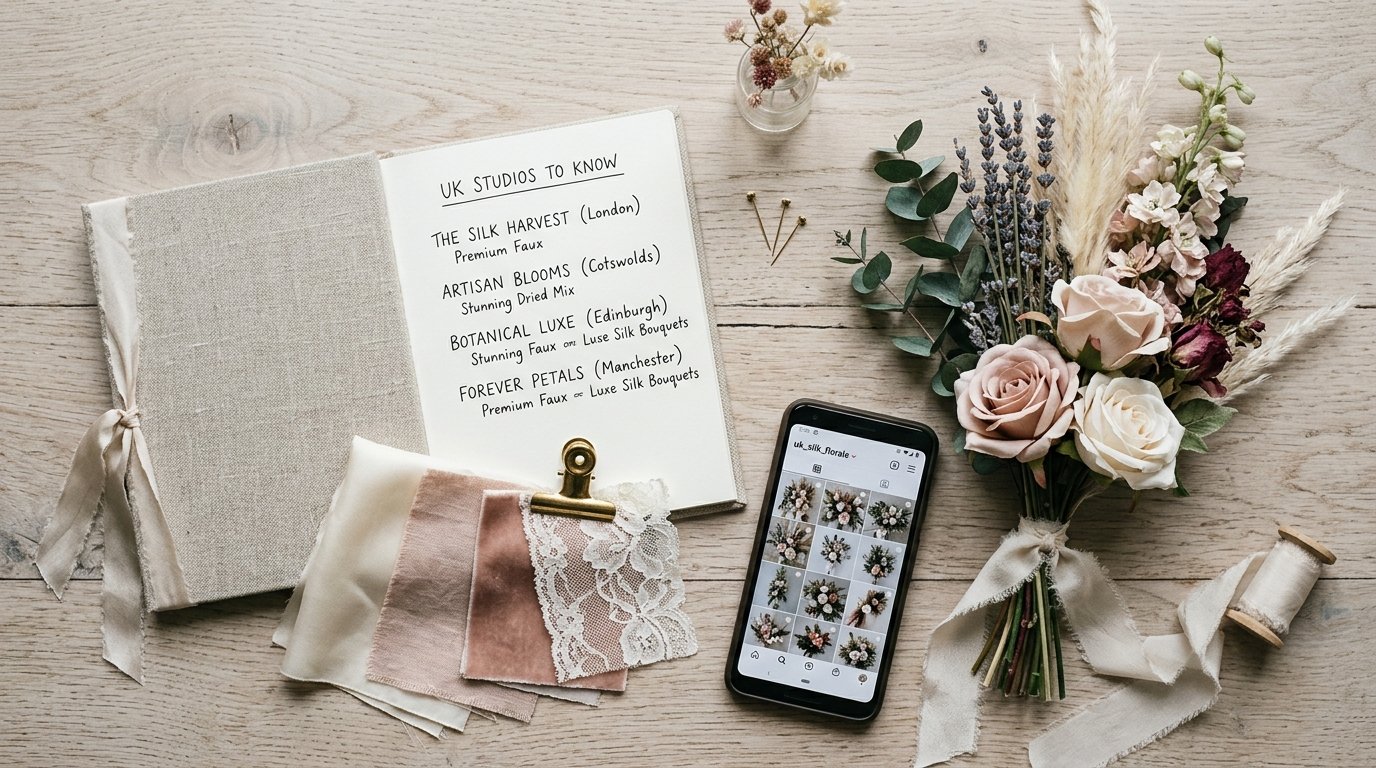
The premium silk floral market in the UK has distinct regional concentrations, with the highest density of specialist studios in London, the South East, and Scotland.
Periwinkle & Bramble (Lewes, East Sussex) — one of the oldest UK specialist studios, established 2017. Works almost exclusively in real-touch polyurethane for maximum photographic fidelity. Bouquet prices: £220-£480. Lead time: 14 weeks.
The Silk Atelier (London N1) — higher-end positioning, uses imported French silk and works with couture bridal designers to coordinate fabric with dress fabric. Bouquet prices: £280-£600. Lead time: 16 weeks.
Flora & Silk (Edinburgh) — the leading Scottish specialist. Offers full ceremony installations in addition to personal flowers. Known for meadow-style arrangements using UK wildflower species in silk. Bouquet prices: £195-£380.
Bramblewood Florals (Harrogate, Yorkshire) — has supplied silk florals for six featured weddings in You & Your Wedding magazine in 2025-2026. Known for peony-heavy arrangements. Bouquet prices: £170-£420.
Blossom & Bough (Totnes, Devon) — the sustainable-positioned studio in the UK market. Uses certified natural silk from Italian farms and recycled organza. Prices carry a sustainability premium: bouquets from £250.
Lead times at all major studios are currently 12-16 weeks for bespoke commissions. Couples marrying between June and September 2026 should commission now.
What to ask a silk florist
Before committing to a premium silk studio, ask these questions:
Can I see physical samples? Digital photography is not a reliable guide to quality. Ask for physical stem samples of the specific flowers you are considering. Hold them under natural light, angle them toward a window, examine the petals closely. The step change between mid-market and premium is obvious in person; it rarely shows in a brochure.
What materials are the petals made from? The answer should specify both the fabric type and whether the real-touch coating process is used. “Polyester” alone signals mass-market. “Multi-layer silk organza with polyurethane real-touch coating” signals premium.
Can you match specific fresh-flower varieties? A good studio can produce any species. A less capable one will have a standard menu and substitute freely. If you want garden roses rather than hybrid tea roses, Juliet roses rather than David Austin alternatives, or a specific peony species, confirm the studio can deliver the specific variety.
What is the delivery and presentation format? Premium silk bouquets are typically delivered in archival tissue paper in a bespoke box, not shrink-wrapped in cellophane. The packaging is part of the keepsake experience.
Mixing silk and fresh
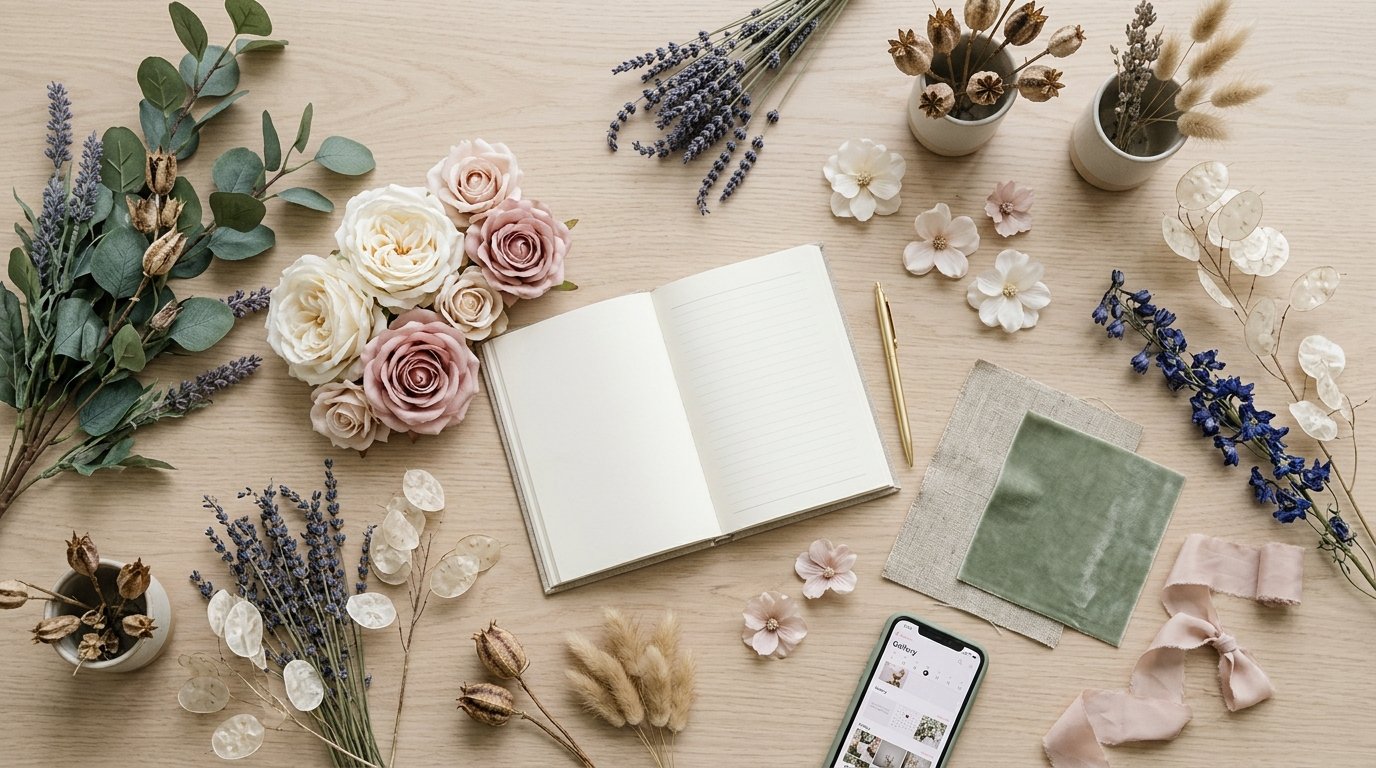
Several UK stylists now recommend a hybrid approach: premium silk for the pieces that will be kept (bridal bouquet, ceremony arch sections) and fresh for the pieces that will not be (table centrepieces, confetti, petal scatters).
This hybrid model captures the permanence benefit for the most emotionally significant pieces while keeping the sensory experience of fresh flowers — scent, textural variety, the specific quality of petals that have just been cut — for the elements that create ambience.
The economics also work: the most expensive single piece (the bridal bouquet at £200-£450 in silk) replaces a fresh bouquet at a similar price but with permanent value. The fresh table centrepieces at £120-£250 per table stay on budget.
See our elongated stem bouquets guide and meadowcore wedding florals guide for fresh arrangements that complement the silk aesthetic when you are mixing both.
Sustainability: the honest case
The sustainability argument for premium silk florals is real but not unconditional.
The case for: The UK imports approximately 80% of its cut flowers from Kenya, Colombia, Ethiopia, and the Netherlands. Fresh cut flowers are perishable, require refrigerated transport across multiple continents, are wrapped in single-use plastic, and are discarded within 3-5 days of the wedding. A premium silk bouquet eliminates all of this for the pieces it replaces.
The caveat: High-grade polyurethane real-touch silk is a synthetic petroleum-derived product. The manufacturing process — particularly the coating steps — uses solvents and produces chemical waste. The carbon footprint of manufacturing is front-loaded rather than spread across the supply chain.
The honest calculation: A premium silk piece made from synthetic materials has a better environmental profile than fresh florals if it is kept and used for 5-10 years. If it goes in a skip after three months, the calculation reverses.
Studios using natural silk (mulberry or eri silk from certified farms) and recycled organza carry a better baseline profile. Blossom & Bough and The Silk Atelier both supply materials certification on request.
For couples prioritising sustainability in their flower choices, our eco wedding favours guide covers the wider sustainability picture.
Related articles
Frequently asked questions
Are high-end silk wedding flowers worth the cost?
At £180-£450 for a bridal bouquet, premium silk florals cost more than a mid-range fresh bouquet but less than a high-end fresh arrangement. The calculation changes when you factor in permanence: a fresh bouquet lasts 48 hours; a premium silk bouquet lasts indefinitely. Couples who want to display their bouquet at home, use it in anniversary shoots, or pass it down as a keepsake find the cost straightforward to justify.
How do you tell a premium silk flower from a cheap faux flower?
The quality gap is significant. Mass-market silk flowers (under £10 per stem) have flat, single-layer petals, no vein detail, and an obviously uniform colour. Premium silk florals (£20-£80 per stem) use 5-7 layers of hand-cut petite silk or real-touch polyurethane, hand-painted veining, wax or oil dipping to simulate petal sheen, and colour gradients that mimic how real petals transition from base to tip. The difference is visible at 30 centimetres and disappears entirely in photographs.
Which UK suppliers make premium silk wedding flowers?
The main specialist UK studios operating in 2026: Periwinkle & Bramble (Sussex), The Silk Atelier (London), Flora & Silk (Edinburgh), Bramblewood Florals (Yorkshire), and Blossom & Bough (Devon). Most accept commissions 12-16 weeks out. International options shipping to UK: Afloral (USA), La Belle Fleur Artificielle (France), and Evelina's Flowers (Poland, used by several UK wedding stylists).
Do silk wedding flowers work for destination weddings?
Yes — and this is one of the strongest use cases. Fresh flowers are impractical for destination weddings: they cannot be packed in a suitcase, they wilt in summer heat, and sourcing them abroad requires a local florist who may not match the brief. A premium silk bouquet packs flat in tissue paper, survives a 7-hour flight, photographs in 35-degree heat without wilting, and comes home intact. Several UK destination wedding specialists now recommend silk florals specifically for Mediterranean and Caribbean weddings.
Can silk florals be used for all wedding flowers — not just the bouquet?
Yes. The premium UK studios produce bouquets, buttonholes, corsages, flower crowns, ceremony arch installations, table centrepieces, and cake flowers. Centrepiece installations in premium silk typically cost £150-£400 per table (versus £120-£500 for fresh). Arch installations: £800-£3,000 depending on scale, compared with £600-£2,500 for fresh. The silk version outlasts the day and can be repurposed.
Are silk wedding flowers sustainable?
This is nuanced. A silk bridal bouquet avoids the carbon footprint of flying fresh-cut flowers from Kenya or Colombia (the source of 80% of UK flower imports) and eliminates floral waste. However, high-grade silk and polyurethane are synthetic materials with their own manufacturing footprint. The sustainable case is strongest when the bouquet is kept and reused for 5-10+ years rather than discarded. UK suppliers using recycled polyester silk or natural silk from certified farms strengthen the sustainability argument.