Home / Articles / Wedding Trends
Botanical Maximalism: The Anti-Minimalist Wedding Trend

Key Takeaways
- Pinterest UK searches for 'maximalist wedding tablescape' increased 320% in the 12 months to April 2026
- Botanical maximalism directly reacts against the decade-long trend for minimal, white, and restrained wedding styling
- A full botanical maximalism tablescape typically costs £180-£500 per table from a specialist UK florist
- The trend is most associated with long-table banquet receptions rather than round-table formats
- Key elements: trailing greenery, stacked heights, multiple flower varieties, candles at different levels, layered tableware
Why minimalism is over
From approximately 2015 to 2022, UK wedding aesthetics were dominated by a clear set of preferences: white, grey, and blush as the dominant colours; negative space as the organising principle; single-species bouquets (white peonies, white ranunculus, white roses); and a general restraint in which “less is more” was the governing principle.
The roots of this aesthetic were partly practical — tight budgets after the 2008-2012 recession made restrained styling a necessity that was retroactively canonised as taste. They were partly driven by the early Instagram aesthetic, in which stark white backgrounds and simple arrangements photographed cleanly and legibly on small phone screens.
By 2023, the first significant counter-movements appeared. Meadowcore introduced the idea of wild, untamed florals. Maximalism as a general lifestyle aesthetic began trending on interior design accounts. And the economic conditions that had enforced restraint had somewhat eased — the generation now getting married in their late twenties and early thirties had more spending power than those who married in the 2015-2018 window.
By 2026, the counter-movement has consolidated into botanical maximalism: a coherent aesthetic with its own logic, heroes, and practical expressions that UK couples are adopting with genuine enthusiasm.
What botanical maximalism actually means

The defining principles:
1. More species, not more of one thing. A minimal tablescape uses three varieties of flower in large quantities. A maximalist tablescape uses twelve varieties in varied quantities. The diversity creates visual richness that uniformity cannot.
2. Height variation. Not one centrepiece per table. Multiple vessels at different heights — a tall centrepiece at the centre, medium-height arrangements flanking it, low bud vases with single stems, and trailing elements at table level. The eye moves across a maximalist table rather than fixing on a single point.
3. Trailing and draping. The defining visual element. Greenery — ivy, trailing philodendron, pothos, jasmine — trails over the edge of the table to floor level. Flowers spill out of arrangements rather than being contained. The arrangement defies its vessels.
4. Layered tableware. Multiple charger plates, varying napkin folds, mismatched vintage glassware, books or objects integrated into the arrangement. The table is styled as an inhabited space rather than a clean slate.
5. Candlelight at multiple levels. Tall tapers at the back, pillar candles in the middle, small votives scattered between the bud vases and trailing greenery at the front. Candlelight animated by movement (from AC vents or open windows) interacts with the botanical layering in a way that static centrepieces do not.
The plants and flowers
Trailing and draping plants
The signature element. The most commonly used trailing plants in UK botanical maximalism weddings:
Ivy (Hedera helix) — the original trailing plant. Available in dozens of varieties from simple green to variegated gold-and-green. Grows quickly and is cheap; a single 2m trail can be sourced from a UK plant nursery for £3-£8. The most accessible element of the style.
Pothos (Epipremnum aureum) — large, glossy, tropical-looking leaves with long trailing stems. Increasingly popular as a venue styling element. Available from garden centres from approximately £5-£15 per plant. Reusable: the plants can be returned to the couple’s home after the wedding.
Jasmine — scented trailing stems. The addition of scent to the visual layering is a characteristic of higher-end botanical maximalism styling. UK season: June-August for outdoor jasmine; indoor jasmine year-round.
Smilax (Asparagus asparagoides) — a fine-leaved, highly flexible trailing vine used exclusively for weddings and events. The standard draping vine for the botanical maximalism aesthetic. UK florist price: £3-£8 per metre; typically 30-50 metres per table used in draping arrangements.
Flowers
The botanical maximalism palette avoids single-species arrangements entirely. A well-executed botanical maximalism centrepiece will include a minimum of six to eight different species. Common combinations for 2026 UK weddings:
Foundation flowers (provide the main volume): dahlias, roses, peonies, and lisianthus
Mid-size accent flowers (provide variety): sweet peas, ranunculus, cosmos, zinnias, and anemones
Small filler flowers (provide texture): sweet William, scabious, cornflowers, and chamomile
Wildflower and meadow elements (provide character): cow parsley, foxgloves, and wild grasses
Foliage (provides the botanical framework): eucalyptus in multiple varieties, salal, soft ruscus, garden fern, and fresh herbs
The arrangement principle: mix species freely. Do not separate flowers by colour or type. The richness comes from unexpected adjacencies — a deep burgundy dahlia next to a pale lemon sweet pea next to a steel-blue thistle.
See our meadowcore wedding florals guide for how wildflower elements integrate into more structured arrangements.
The long-table question
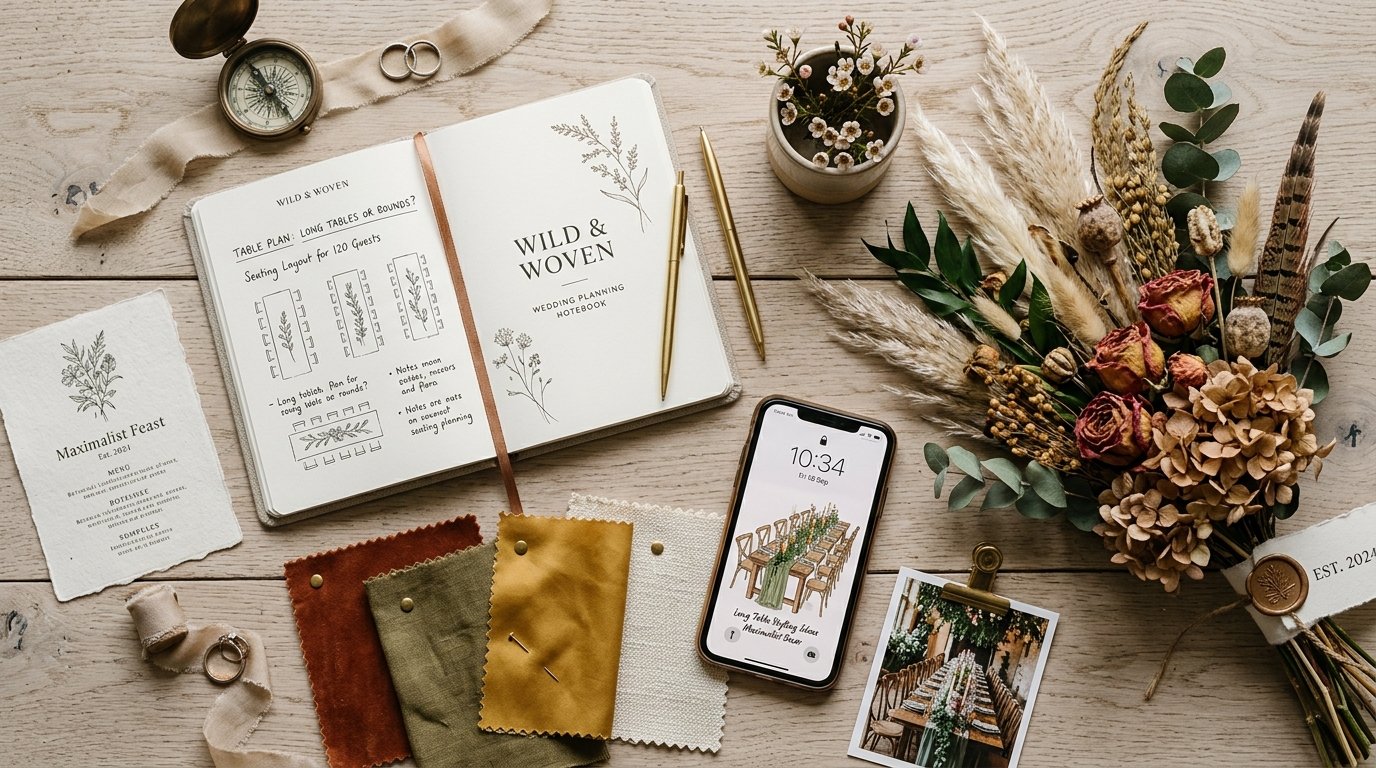
Botanical maximalism is most commonly executed on long banquet tables rather than circular tables. There are practical reasons for this.
Long tables create a continuous surface that trailing plants and draped greenery can span naturally. On a circular table, trailing plants fall off all edges symmetrically — which either requires a precise amount of draping from every direction (expensive) or creates an uneven result (less controlled).
Long-table banquets also create a specific visual experience: guests sit along the table and look at each other across the planting. The intimacy of this format — the sense of a shared garden table — is part of what botanical maximalism creates.
On circular tables, botanical maximalism is executed through tall, full central arrangements that create a canopy of foliage and flowers above the table, with low supplementary vessels. It works but requires more structural engineering.
Cost breakdown
A full botanical maximalism tablescape for a 10-table reception from a specialist UK florist:
| Element | Cost range |
|---|---|
| Trailing greenery (smilax, ivy, pothos) per table | £25-£80 |
| Centrepiece arrangements per table | £100-£280 |
| Supplementary bud vases and smaller arrangements per table | £30-£80 |
| Candle hire per table | £20-£60 |
| Styling time (per table, above standard) | £30-£80 |
| Total per table | £180-£500 |
| Total for 10 tables | £1,800-£5,000 |
The wide range reflects primarily the choice of flower varieties (imported hothouse blooms versus UK-seasonal wildflowers) and the density of the trailing greenery (smilax at high density, versus simpler ivy trails).
For couples managing costs: the UK wildflower and seasonal approach (Meadowcore flowers, UK-grown foliage, pothos and ivy from garden centres) delivers the botanical maximalism aesthetic at the lower end of the price range. The high end is reserved for arrangements using multiple imported species and dense smilax coverage.
DIY feasibility

Botanical maximalism is achievable as a DIY project for couples with two full days to dedicate to it.
The realistic DIY breakdown:
- Trailing plants: Source pothos, ivy, and trailing plants from garden centres 2-3 days before the wedding. These are available for £5-£15 per plant and reusable.
- Flowers: Order from a UK cut-flower farmer or the Flowers from the Farm network. Request mixed seasonal bunches rather than single varieties.
- Construction: Build the arrangement in situ at the venue on the morning of the wedding. Start with trailing plants, then add centrepiece vessels, then fill in with flowers, then scatter bud vases and candles.
- The risk: Botanical maximalism executed without experience can look cluttered rather than abundant. The difference between “lush and layered” and “messy and chaotic” is editorial control over which elements go where.
The most effective DIY approach: be deliberate about structure even within the apparent chaos. Every trailing stem should be placed, not just laid. Every bud vase positioned. The spontaneity is designed.
Venues that work
Converted glasshouses and greenhouse venues — the botanical aesthetic is most at home in a glass-enclosed garden space. Venues like Syon Park (Royal Botanic Gardens adjacent), Chiswick House, and various private greenhouse event spaces have hosted botanical maximalism receptions with the architecture reinforcing the styling.
Victorian dining rooms and library venues — ornate plasterwork, high ceilings, and dark wood bookcases create a backdrop that gives botanical maximalism the visual weight it needs. Too much architectural ornament competes; moderate architectural character supports.
Garden marquee and outdoor banquets — temporary structures allow the interior to be designed entirely around the table styling. With the right lighting, a marquee reception can achieve the full botanical maximalism experience.
Barn receptions — exposed timber, stone, and brick walls provide a neutral, high-texture backdrop. The natural materials complement the botanical elements rather than competing.
See our glass greenhouse weddings guide for venues where the botanical aesthetic is most naturally at home.
Related articles
Frequently asked questions
What is botanical maximalism in wedding styling?
Botanical maximalism is a wedding aesthetic that prioritises abundance, density, and layered visual complexity over restraint and negative space. Tables overflow with flowers, trailing greenery, and candles at multiple heights. It is a direct reaction to the minimal, white, and negative-space aesthetic that dominated UK wedding styling from about 2015 to 2022.
What does a botanical maximalism tablescape look like?
Long tables covered with trailing greenery, multiple centrepiece vessels at different heights, candles in varying sizes and positions, multiple flower varieties mixed freely, and personal items like books, fruits, or ceramics integrated into the arrangement. The effect is of a table that has been gathering objects and flowers over years rather than styled in one afternoon.
How much does a botanical maximalism tablescape cost?
A full botanical maximalism tablescape — including centrepieces, trailing foliage, candles, and floral accents — typically costs £180-£500 per table from a specialist UK florist. The wide range reflects whether the plants are cut flowers (more expensive, more fragile) or potted trailing plants (less expensive, more durable).
What flowers and plants are used in botanical maximalism?
There is no single flower — the aesthetic requires variety. A botanical maximalism table typically includes a minimum of five to eight different species. Common choices: roses in multiple colours, sweet peas, dahlias, wildflowers, mixed foliage (eucalyptus, ferns, ivy), trailing philodendron or pothos vines, and seasonal field flowers. The key is abundance and variety.
Does botanical maximalism work with a small wedding?
Yes — and it can be particularly effective at small weddings where a few tables can be styled with genuine density. The aesthetic is more achievable at 8-12 tables than at 40-table receptions where the floral budget per table tends to compress. A micro-wedding with 6 long tables in full botanical maximalism style creates a memorable impression with a manageable total budget.
What venues suit botanical maximalism?
Converted glasshouses and greenhouse venues, Victorian and Edwardian dining rooms, library venues, garden-party settings, and barn receptions. The style works best in spaces that can absorb visual complexity — rooms with plain walls, high ceilings, and neutral architectural character. Very ornate interiors compete with the arrangement.