GLP-1 Brides: Ozempic & the UK Wedding Dress Timeline
Key Takeaways
- Approximately 12% of UK brides using a dress designer or boutique in 2026 are on GLP-1 medication during their engagement
- GLP-1 drugs (semaglutide, tirzepatide) produce 8-15% bodyweight reduction on average over 6-12 months
- Standard bridal dress alteration tolerates 1-2 dress sizes of change; GLP-1 brides can change 3-4 sizes
- UK bridal boutiques are shortening ordering lead times from 6-8 months to 4-5 months for declared GLP-1 brides
- Alteration costs for GLP-1 brides average £280-£600 versus £80-£200 for a standard alteration
- Some boutiques now require a size-stabilisation confirmation before final ordering; others are offering flexible size guarantees
What GLP-1 drugs do to the body
GLP-1 receptor agonists — glucagon-like peptide-1 receptor agonists — are a class of medications originally developed for type 2 diabetes management that produce significant weight loss as a primary or secondary effect.
The main medications currently prescribed in the UK:
Semaglutide — sold as Ozempic (diabetes indication) and Wegovy (weight management indication). Administered by weekly self-injection. Average weight loss in clinical trials: 14.9% of bodyweight at 68 weeks (STEP 1 trial, 2021). The fastest-growing prescription in UK weight management since 2023.
Tirzepatide — sold as Mounjaro (UK). Dual GLP-1/GIP agonist with higher average weight loss than semaglutide alone. Average weight loss in trials: 20.9% of bodyweight at 72 weeks (SURMOUNT-1 trial, 2022). NICE approved for UK prescription from 2024.
Liraglutide — sold as Saxenda. Earlier generation, lower average weight loss (approximately 5-7% of bodyweight), administered by daily injection. Less commonly used by 2026 as semaglutide and tirzepatide have become available.
The weight loss is not linear. GLP-1 drugs produce rapid initial weight loss in the first 3-6 months, then a slower progression toward a new stable weight at 6-18 months, then weight maintenance. The rate of loss in the first 3 months can be significant: 3-6 kg per month is typical for semaglutide in the early phase.
For a bride who starts Wegovy at engagement and marries 14 months later, the total weight change between ordering the dress and wearing it could plausibly be 15-25 kg.
The timeline problem
The standard UK bridal dress ordering timeline is built for a different world.
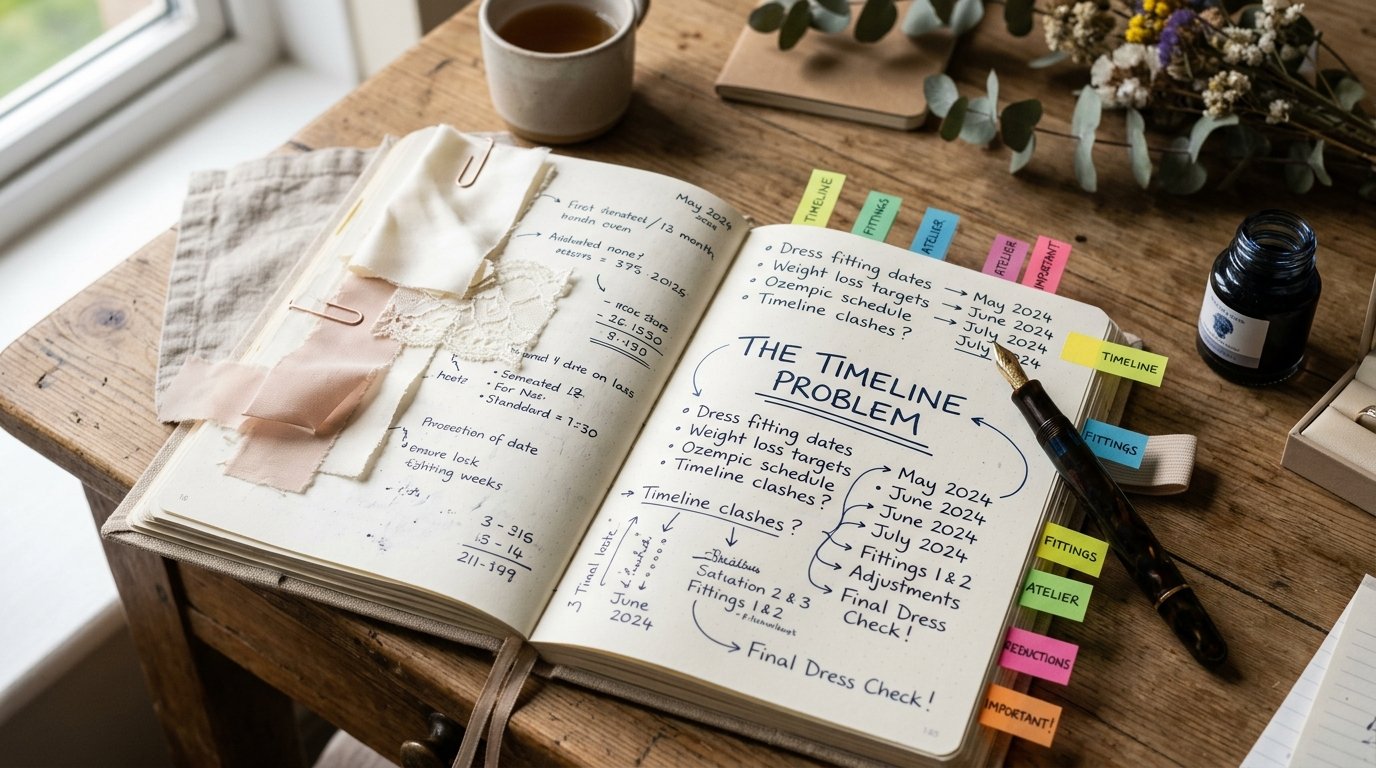
In the standard model: the bride visits a boutique 6-8 months before the wedding, tries on dresses, selects a style, and is measured. The boutique orders the dress in the manufacturer’s sizing nearest to her current measurements. The dress arrives 4-5 months later. Final fittings happen in the 6-8 weeks before the wedding, at which point a seamstress makes final adjustments — typically 1 dress size, occasionally 2.
This model tolerates natural weight fluctuation of approximately 3-8 kg in either direction. It does not tolerate the 15-25 kg weight loss that a GLP-1 bride may experience.
The specific failure points:
The ordering window is wrong. Ordering 6-8 months out means measuring the bride at the start of her fastest weight-loss phase — precisely when she looks least like she will look on the wedding day.
The alteration tolerance is exceeded. Reconstructing a dress 3-4 sizes down requires far more than standard alteration. The bodice may need to be entirely remade, the skirt re-cut, and structural elements (boning, corsetry, internal architecture) rebuilt for the new form. This is couture-level work, not standard alteration.
The cost is unexpected. Brides who budgeted £80-£200 for alterations may face £400-£700 in reconstruction costs — often discovered at the final fitting 6 weeks before the wedding, when there is no time to find an alternative.
How boutiques are adapting
UK bridal boutiques are responding to the GLP-1 challenge in several distinct ways:
Shortening the ordering lead time. Rather than the standard 6-8 months, boutiques working with GLP-1 brides are now recommending 4-5 months. The shorter window narrows the gap between the measurement date and the wedding date. For brides who began medication 6+ months before ordering, the weight loss may have largely plateaued by then.
Waiting for weight stability. Several boutiques — particularly those specialising in bespoke or made-to-measure dresses — are now asking GLP-1 brides to confirm weight stability before ordering. A 4-6 week period with less than 2 kg fluctuation is the typical threshold.
Offering flexible-size ordering. A small number of UK manufacturers — including a few UK-based made-to-measure services — now offer to make a dress in a deliberately larger size and plan for a more substantial alteration from the outset. This approach accepts reconstruction as the model rather than treating it as a failure.
GLP-1 package pricing. The boutiques that have adapted most fully have created a “GLP-1 package” — typically adding £150-£250 to the dress price to cover an extended alteration scope. The package is offered transparently to disclosed GLP-1 brides at the point of sale.
Design guidance. Well-informed bridal consultants are now steering GLP-1 brides toward designs that accommodate size change more easily — and away from styles that are difficult to reconstruct.
Dress styles that work better

The technical challenge of altering a dress for a GLP-1 bride is greatest when:
- The bodice is heavily boned and structured
- The skirt is fitted from hip to floor
- The back is a fixed zipper
It is least when:
- The back is corseted or has a lace-up closure
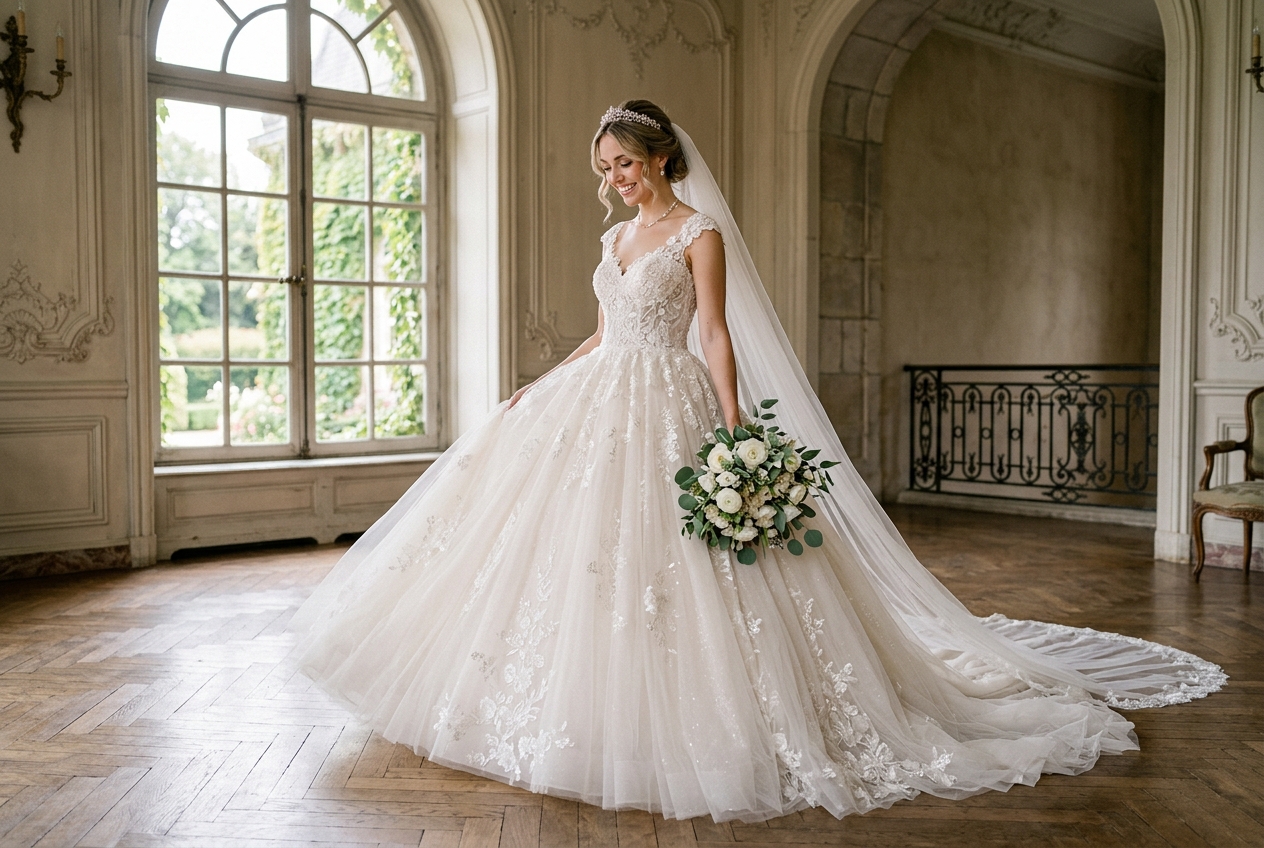
- The silhouette is A-line (fitted bodice, flared skirt from the waist)
- The dress is a two-piece
Corseted back. The single most practical design feature for a GLP-1 bride. A corseted back with lacing adjusts by 2-4 sizes without any reconstruction. It is also a more forgiving fit on the day: if the bride loses weight between the final fitting and the wedding (not uncommon on GLP-1 medication, which suppresses appetite even on the wedding day), the lacing simply tightens.
A-line silhouette. The A-line — fitted at the bodice, flared from the waist — requires alteration only in the bodice when the bride loses weight. The skirt, flaring naturally, requires no reconstruction. This is a more straightforward alteration than a fitted gown whose skirt also needs to be taken in.
Column or sheath gowns in structured fabric. Paradoxically, a straight-cut gown in a structured fabric (crepe, satin, scuba) can be easier to alter substantially than a gown with internal boning and complex seam construction. The structure comes from the fabric, not the engineering of the dress, and taking in the seams is a more linear alteration.
Bridal separates. A corset top paired with a separate skirt — a growing 2026 trend in its own right — allows each component to be sized and altered independently. See our bridal separates guide for options in this category.
Avoid heavily structured fitted gowns with fixed zips. A gown with internal boning, a fitted-hip skirt, and a back zip is the hardest to reconstruct for a significantly smaller body. The bodice boning must be entirely remade, the hip fitting re-cut, and the zip system often replaced.
The cost reality
Standard alterations for a UK wedding dress: £80-£200. This covers hemming, taking in side seams by 1 size, strap adjustments, and minor cosmetic changes.
GLP-1 alteration costs depend on the extent of reconstruction:
| Change | Work required | Estimated cost |
|---|---|---|
| 1 size smaller | Standard alteration | £80-£200 |
| 2 sizes smaller | Extended side seam, bodice adjustment | £150-£300 |
| 3 sizes smaller | Bodice rebuild, skirt re-cut | £280-£500 |
| 4 sizes smaller | Near-complete reconstruction | £400-£700 |
| Corseted back adjustment | Re-lacing, no reconstruction | £50-£120 |
Budget for alteration when on GLP-1 medication by adding £300-£500 to your expected alteration cost. This is a direct result of the medication’s success, not a problem — but it needs to be planned for.
What to tell your boutique
Disclosure is the most important action a GLP-1 bride can take.
The conversation: “I’m currently taking [medication name] for weight management, and I expect to continue losing weight over the next [X] months. I wanted to be transparent so we can discuss the best ordering timeline and approach.”
Most boutiques will appreciate this information and will adapt their recommendation accordingly. A small number of boutiques are not yet equipped to handle it — in which case, ask specifically what their policy is for significant weight changes and whether they offer any alteration contingency.
Questions to ask your boutique:
- What is your recommended lead time for a bride on GLP-1 medication?
- What is your alteration policy if I lose more than 2 sizes between ordering and the final fitting?
- Do you have a seamstress who has experience with significant reconstruction rather than standard alteration?
- Can you recommend dress styles that will accommodate a larger size change?
See our guide to finding a wedding dress in the UK for how to approach boutique consultations more broadly.
Practical planning checklist for GLP-1 brides
- Before booking a boutique: Check their alteration policy for significant size changes. If they do not have one, this is a signal.
- Ordering timeline: Target ordering 4-5 months before the wedding rather than 6-8 months, if your weight is still in active decline.
- Weight stabilisation: If possible, wait until your weight has been stable for 4-6 weeks before ordering. This is the measurement that matters most.
- Design selection: Prioritise corseted backs and A-line silhouettes. Avoid complex fitted gowns with extensive internal structure.
- Alteration budget: Add £300-£500 to your standard alteration estimate.
- Final fitting timing: Build in a contingency second final fitting if your wedding is in a period when continued weight loss is likely.
- Day-of: Have a trusted person check the fit before walking to the ceremony. A corseted gown can be tightened by a bridesmaid in minutes.
Related articles
Frequently asked questions
What is a GLP-1 bride?
A GLP-1 bride is an engaged person using a GLP-1 receptor agonist medication — such as semaglutide (Ozempic/Wegovy) or tirzepatide (Mounjaro) — for weight management during their engagement. These drugs produce significant weight loss, typically 8-15% of bodyweight over 6-12 months, which can cause a bridal dress ordered at the start of the engagement to be substantially too large by the time alterations are needed.
Does taking Ozempic affect bridal dress ordering?
Yes — significantly. Standard bridal dresses are ordered 5-8 months in advance based on the bride's measurements at the time of ordering. A bride who loses 2-3 stone on GLP-1 medication between ordering and final fitting may find the dress is 2-4 dress sizes too large. Standard alterations can manage 1-2 sizes. More than that requires significant reconstruction — remaking the bodice, re-cutting the skirt — which costs £280-£600 and may affect the design.
Should I tell my bridal boutique I'm taking GLP-1 medication?
Yes — the sooner the better. UK boutiques are adapting their processes for GLP-1 brides, but only if they know. Disclosure allows the boutique to adjust the ordering timeline, recommend ordering closer to the wedding, plan for a higher alteration budget, or suggest design choices (corseted backs, A-lines, column cuts) that accommodate significant size change more easily than fitted gowns.
What dress styles work best for brides on GLP-1 medication?
Styles that accommodate size change with less alteration: corseted or lace-up backs (adjust without reconstruction), A-line silhouettes (fitted at the bodice, flared skirt — the skirt requires no alteration if the bodice fits), column or sheath gowns in structured fabric (easier to take in than fitted-and-boned bodices), and two-piece separates (corset top can be re-laced; skirt requires minimal alteration). Avoid heavily boned and structured fitted bodices, which require full reconstruction when resized significantly.
What should I budget for alterations if I'm on GLP-1 medication?
Budget £280-£600 for alterations as a GLP-1 bride, versus the standard £80-£200. The additional cost reflects the extent of reconstruction needed when a dress changes by more than one size. Some boutiques include an alteration contingency in a GLP-1 package (typically £150-£250 extra on top of the dress price). Ask your boutique directly what their alteration policy is for significant size changes before you order.
When should I order my wedding dress if I'm taking GLP-1 medication?
Most UK bridal consultants now advise GLP-1 brides to order 4-5 months before the wedding rather than the standard 6-8 months. The shorter window means the measurements are taken closer to the bride's stable post-medication weight. If you are in the early phase of medication (first 3-6 months, when weight loss is fastest), waiting until your weight has stabilised before ordering is strongly advisable.