Getting Married Abroad: UK Couples' Legal Guide 2026

Key Takeaways
- A marriage legally performed abroad is automatically recognised in England, Wales, and Scotland if it meets local legal requirements
- The simplest countries for UK couples to marry legally: Cyprus, Malta, Gibraltar, Italy, Spain (Canary Islands), and Portugal
- Most countries require a Certificate of No Impediment (CNI) from your local register office — allow 3-4 weeks minimum
- Typical total cost of a legal destination wedding for 20 guests: £8,000-£18,000, compared with £20,000+ for an equivalent UK wedding
- You do not need to have a UK ceremony if you marry legally abroad — but a 'blessing' or party back home is popular with UK families
Is a marriage abroad legally recognised in the UK?
Yes — with conditions. Under English and Welsh law, a marriage performed abroad is legally valid if:
- Both parties were free to marry (i.e., unmarried or widowed or divorced)
- The marriage met the legal requirements of the country where it took place
- The ceremony was performed by someone authorised to solemnise marriages in that country
- The marriage was registered with local civil authorities
You do not need to register the marriage in the UK. When you return home, you are legally married. Your foreign marriage certificate is your legal proof of marriage, and UK institutions — banks, the DVLA, HMRC, NHS — all accept it.
The exception: If the marriage was performed in a country that does not legalise marriages between two people of the same sex, and you are a same-sex couple, the UK will recognise it as a civil partnership, not a marriage. Same-sex couples should choose countries where same-sex marriage is legal (Portugal, Spain, France, Italy, Malta, Netherlands, Cyprus — check current law as this changes).
The Certificate of No Impediment: what it is and how to get it
Most countries that are popular for destination weddings require UK citizens to provide a Certificate of No Impediment (CNI) — a document confirming that there is no legal obstacle to the marriage.
How to get a CNI in England and Wales:
- Both parties give notice of marriage at their local register office. You must have lived in the district for at least 7 days before giving notice.
- A 28-day waiting period applies (reduced in exceptional circumstances only).
- After 28 days, the CNI is issued. Cost: approximately £35 per person.
- The CNI is valid for 3-6 months in most countries — check the specific validity period for your destination.
Important: Some countries additionally require the CNI to be apostilled (authenticated by the Foreign, Commonwealth and Development Office). An apostille costs £30 and typically takes 5 working days via the FCDO Legalisation Office in Milton Keynes, or up to 20 working days by post. Always check whether your destination requires an apostille.
In Scotland: Couples use a different process — they apply for a certificate from the National Records of Scotland. The process takes a similar amount of time but the documentation differs.
In Northern Ireland: Contact the General Register Office for Northern Ireland for the equivalent document.
Allow a minimum of 8-10 weeks from starting the process to having usable documentation. Start earlier if you are unsure of your destination’s specific requirements.
The easiest countries for UK couples to marry legally
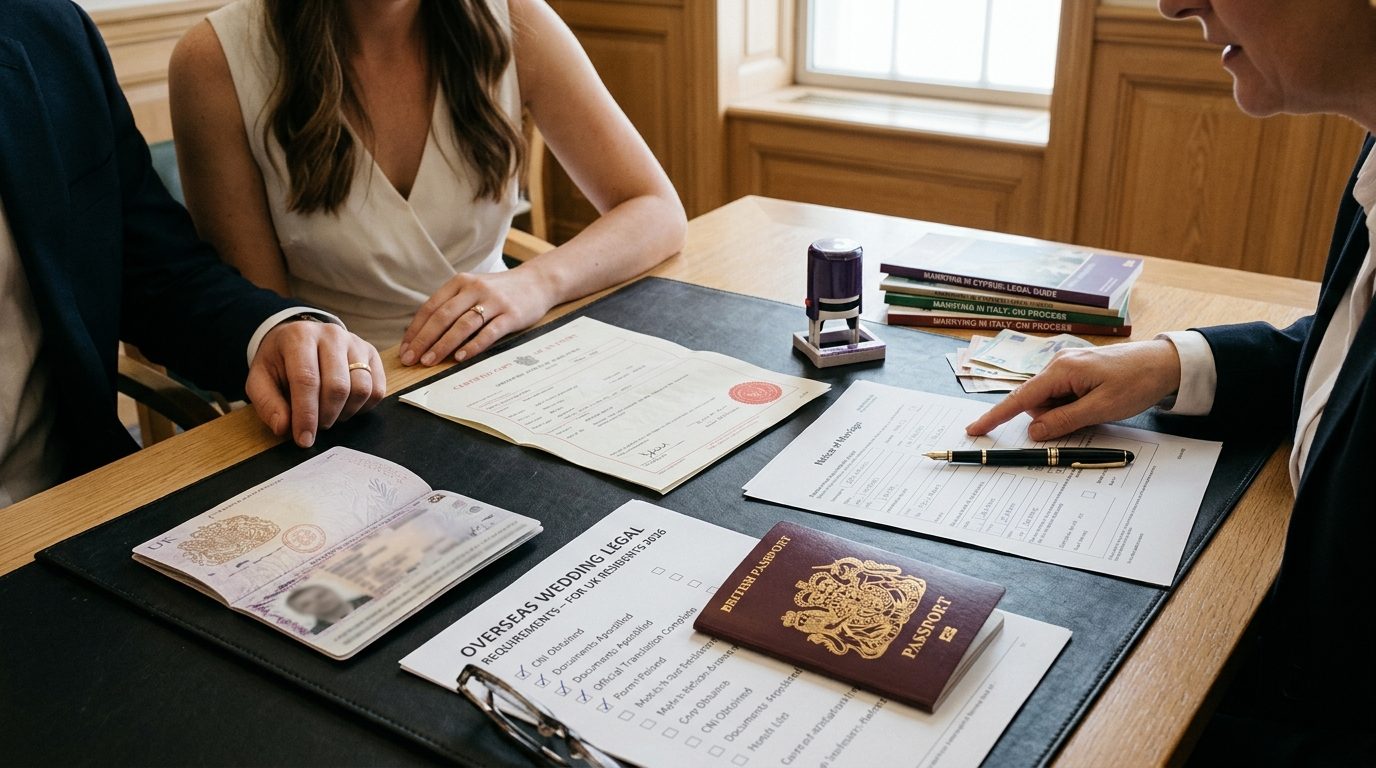
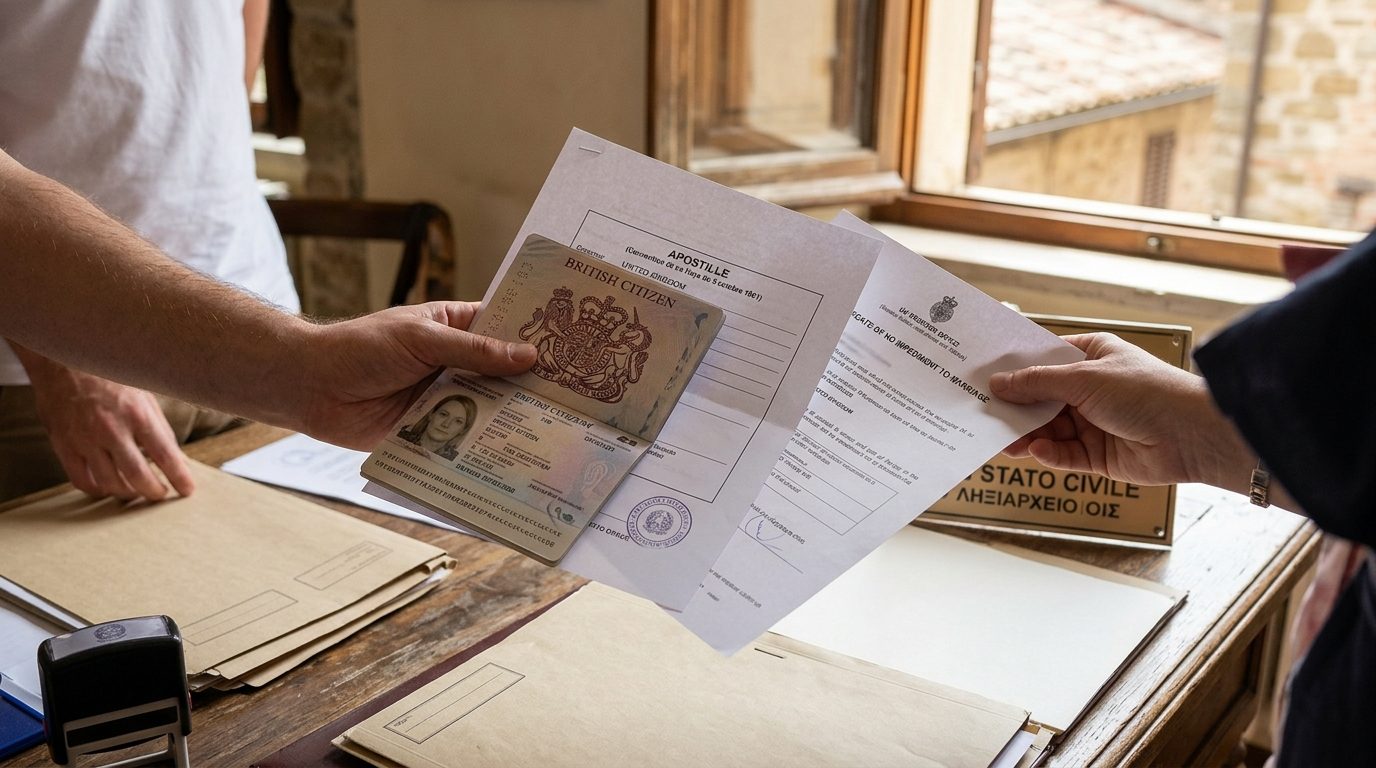 Not all destination wedding countries are equal in terms of documentation complexity.
| Country | Complexity | Key requirements | Popular regions |
|---|---|---|---|
| Gibraltar | Very low | British law, CNI only | Rock of Gibraltar |
| Malta | Low | CNI, English-language process | Valletta, Gozo |
| Cyprus | Low | CNI, well-established process | Paphos, Limassol |
| Portugal | Low-medium | CNI + apostille, process is efficient | Algarve, Lisbon, Douro |
| Italy | Medium | CNI + apostille + translations + local comune involvement | Tuscany, Amalfi Coast, Lake Como |
| Greece | Medium | CNI + apostille + local documentation | Santorini, Mykonos, Corfu |
| Spain (mainland) | Medium | CNI + apostille + Spanish translations | Barcelona, Seville |
| France | Medium-high | CNI + apostille + residency formalities | Paris, Provence |
| Caribbean (varies) | Low-medium | Varies by island; many offer simplified tourist marriage packages | Barbados, St Lucia, Jamaica |
Gibraltar is the simplest: As a British Overseas Territory, Gibraltar operates under English law. The documentation is straightforward, the process is English-language throughout, and the territory has made civil ceremonies for non-resident couples a standard service. Many UK couples use Gibraltar for a quick legal ceremony, then hold their celebration in Spain or Portugal immediately after.
Italy requires the most work: Italian law requires the CNI to be apostilled, translated into Italian by a certified translator, and submitted to the local municipality (comune) well in advance. The comune must post a public notice of the intended marriage for a minimum period. This process works well, but it requires a local wedding planner familiar with the legal requirements. Budget 6 months for the full process.
What documents you need: a checklist
Requirements vary by country. The following is a general checklist — always verify with your destination country’s consulate or a local wedding planner.
Typically required for all destinations:
- Valid passports (must be valid for at least 6 months beyond your wedding date)
- Full birth certificates (UK-issued, not the short form)
- Certificate of No Impediment (CNI)
- If previously married: decree absolute (UK divorce) or death certificate of former spouse
Additional requirements for some countries:
- Apostilled CNI (Italy, Greece, Portugal, Spain, some Caribbean countries)
- Certified translations of documents into local language
- Proof of address (utility bill or bank statement)
- Sworn affidavit confirming single status (some countries require this instead of, or in addition to, CNI)
Practical tips:
- Certified translations must typically be done by a translator approved by the relevant country’s consulate. Do not use an uncertified online translation service.
- Keep multiple certified copies of every document. Documents get lost, damaged, or rejected for minor reasons.
- Use a local wedding planner in your destination country who handles legal marriages regularly — their knowledge of current local requirements is worth far more than their fee.
What getting married abroad actually costs
| Cost item | Estimate (20-30 guests) |
|---|---|
| Legal ceremony fee (civil ceremony abroad) | £300-£1,500 |
| Venue hire (villa, restaurant, estate) | £1,500-£5,000 |
| Catering (per head, dinner) | £60-£120 |
| Photography (local photographer, full day) | £1,200-£2,800 |
| Flights (return, UK to destination, per person) | £150-£600 |
| Accommodation for the couple (3-5 nights) | £600-£2,000 |
| Document costs (CNI, apostille, translations) | £200-£500 |
| Local wedding planner (recommended) | £800-£2,500 |
| Total (20-30 guests, excluding guest flights) | £8,000-£18,000 |
The saving compared with a UK wedding for 65 guests at £21,990 is significant — but the comparison is not exact. A destination wedding has a smaller guest list by necessity, and some costs (flights and accommodation for guests) are borne by guests rather than the couple. Many UK families hold a second celebration at home, which adds £2,000-£5,000.
The real calculation: if you genuinely want 20-30 close people at a villa in Portugal versus 100 people at a country house hotel in England, the destination wedding almost certainly costs less. If you need 100+ guests, a UK wedding is usually more economical.
The UK blessing or celebration party
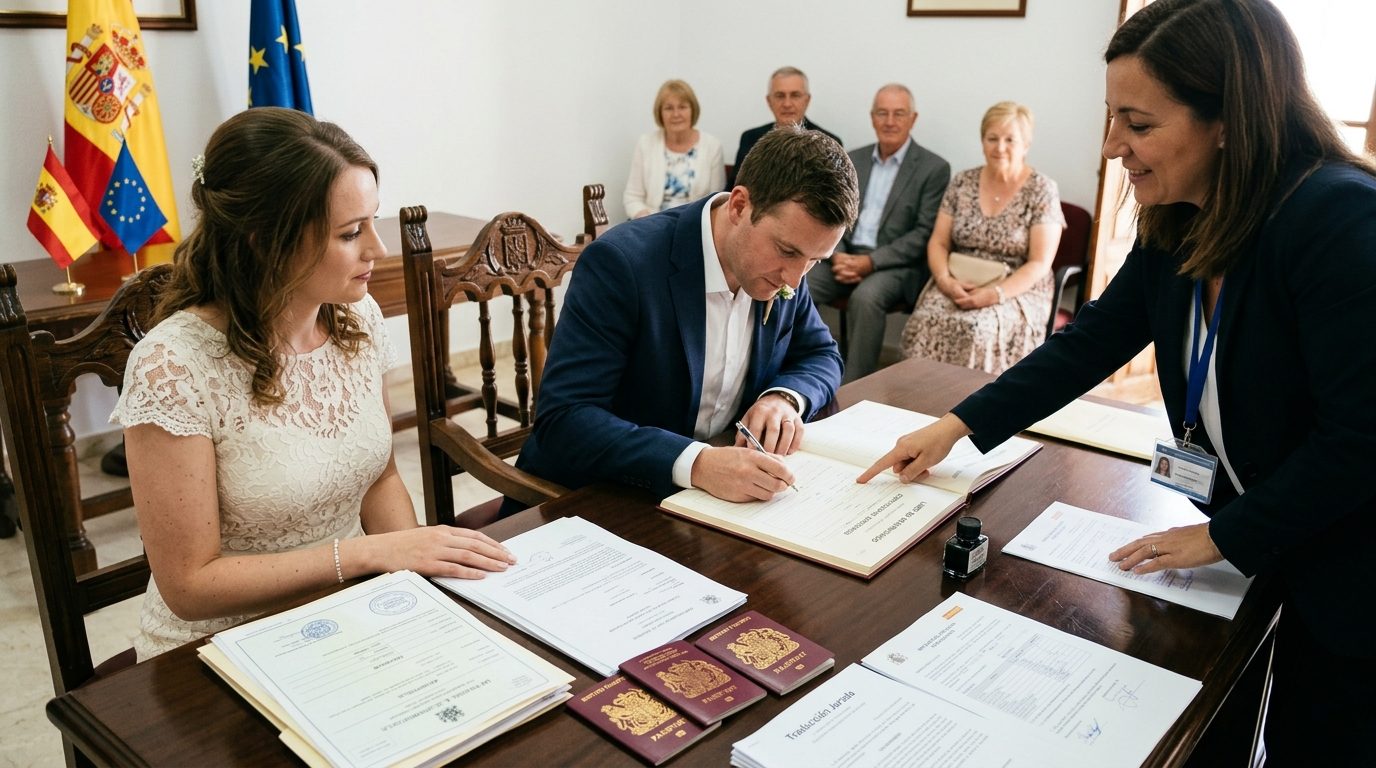
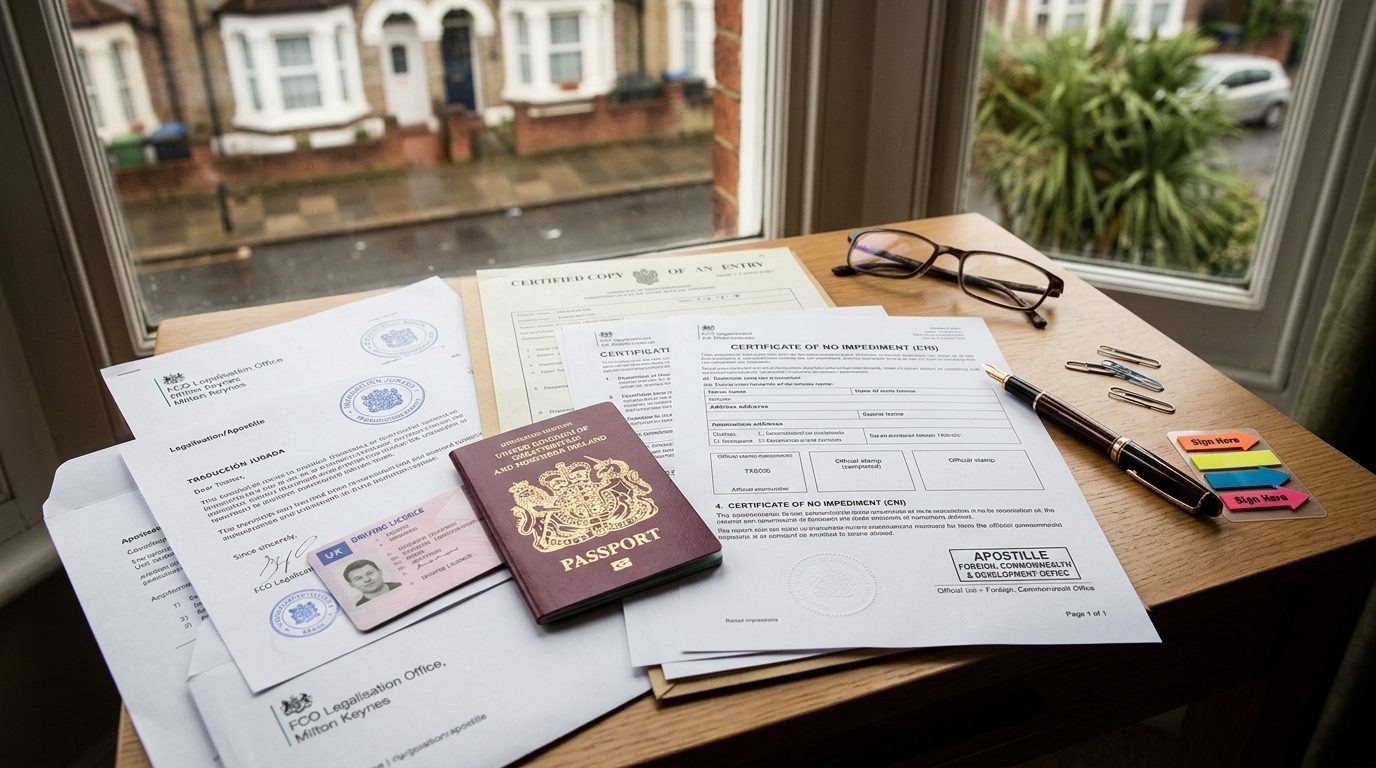 Many couples who marry abroad choose to hold a blessing or party in the UK for family and friends who cannot travel.
A blessing is not a legal ceremony — it has no legal effect. It can be held in a garden, church, village hall, or any venue. Some brides wear their wedding dress again; others choose a second outfit. Some couples exchange vows a second time as a personal commitment; others simply use the occasion for the photographs and speeches they could not have abroad.
A UK blessing for 50-80 guests typically costs:
- Venue hire: £800-£2,500
- Catering: £2,000-£4,500
- Flowers and décor: £500-£1,200
- Total: £4,000-£8,500
This is not a legal requirement. It is a social decision — it allows family members who could not travel to celebrate with you, and it resolves the tension some couples feel about getting married without extended family present.
Getting married abroad: what can go wrong
Documents arrive too late. The 28-day CNI waiting period is a legal minimum. If you give notice at your register office at the last minute, you may not receive your CNI in time. Start the process 10-12 weeks before your wedding date.
Country requirements change. Brexit changed the documentation requirements for UK nationals marrying in EU countries. Requirements continue to evolve — always check with your specific country’s UK embassy or a current-year source. Do not rely on advice more than 12 months old.
The local officiant does not speak English. This is only a problem if you have not planned for it. A good local wedding planner will arrange a celebrant who speaks English, or a simultaneous interpreter. Plan this in advance — do not assume.
Guest travel complications. Destination weddings self-select for smaller guest lists because some people cannot or will not travel. Give guests 6+ months’ notice so they can plan travel and accommodation at reasonable prices. Some guests will not attend regardless of notice — accept this before choosing to marry abroad.
The local ceremony is nothing like you imagined. A civil ceremony abroad, in a register office or municipal building, may be a brief 15-minute formality conducted in the local language. Many couples plan the legal ceremony as a private event with witnesses only, then hold the real celebration (vow exchange, reception, dinner) separately on the same day. Your wedding planner should explain exactly what the legal ceremony involves.
Getting married abroad: FAQ
Is a marriage abroad legally recognised in the UK?
Yes. A marriage legally performed in another country is automatically recognised in England, Wales, and Scotland, provided it was legally valid in the country where it took place. You do not need any additional UK ceremony or registration to be legally married in the UK.
What documents do UK couples need to marry abroad?
Most countries require valid passports, a Certificate of No Impediment (CNI) from your local register office (takes 28 days minimum to obtain), proof of single status, and sometimes a sworn affidavit. Requirements vary by country — always check with your chosen country’s consulate or a local wedding planner at least 6 months before your date.
What is a Certificate of No Impediment (CNI)?
A Certificate of No Impediment (CNI) is a document issued by your local register office confirming there are no legal obstacles to your marriage. It costs around £35 in England and Wales. After giving notice, there is a mandatory 28-day waiting period. Most countries accept a CNI for up to 3-6 months after issue. Apply at least 8-10 weeks before your wedding date.
Which countries are easiest for UK couples to marry in legally?
The most straightforward countries for UK couples are: Gibraltar (British law, no residency requirement), Malta (English-speaking, streamlined documentation), Cyprus (English-speaking, well-established process), Portugal (simpler than Spain for non-EU couples), Italy (beautiful but more complex), and Greece (popular but documentation can be lengthy).
Do you need a UK ceremony if you get married abroad?
No. If your marriage is legally performed abroad, you are fully married under UK law without any additional ceremony. However, many UK couples hold a wedding blessing or party in the UK for family and friends who cannot travel. A blessing is not legally binding but can feel like a full wedding celebration.
How much does getting married abroad cost for UK couples?
A legal destination wedding for 20-30 guests typically costs £8,000-£18,000 including flights, accommodation, venue, catering, photography, and ceremony fees. This is significantly less than an equivalent UK wedding, which averages £21,990 for 65 guests. Adding a UK blessing for family back home typically adds £2,000-£5,000.
How far in advance should UK couples book a destination wedding?
Book the venue 12-18 months in advance for popular summer dates in Italy, Portugal, Spain, and Greece. Start document gathering 6 months before. Give guests at least 6 months’ notice to allow time to book flights and accommodation at reasonable prices.
Related reading:
- Legal Marriage Reform UK 2026: What Engaged Couples Need to Know
- Portugal Destination Weddings: The £20k Full-Wedding Guide
- Greece Wedding Venues 2026: 10 Best for UK Couples
- Italy Destination Wedding: Lake Como After Charli XCX
- Civil Partnership vs Marriage UK 2026
- Hen Do Abroad: The Complete UK Guide
Frequently asked questions
Is a marriage abroad legally recognised in the UK?
Yes. A marriage legally performed in another country is automatically recognised in England, Wales, and Scotland, provided it was legally valid in the country where it took place. This means both parties were free to marry, the ceremony met local legal requirements, and it was registered with the local authorities. You do not need any additional UK ceremony or registration to be legally married in the UK.
What documents do UK couples need to marry abroad?
Most countries require: valid passports for both parties, a Certificate of No Impediment (CNI) from your local register office (takes 28 days minimum to obtain in England and Wales), proof of single status (birth certificates, decree absolute if previously divorced), and sometimes a sworn affidavit. Requirements vary by country — always check with your chosen country's consulate or embassy and the local wedding venue at least 6 months before your date.
What is a Certificate of No Impediment (CNI)?
A Certificate of No Impediment (CNI) is a document issued by your local register office confirming that there are no legal obstacles to your marriage. It costs around £35 in England and Wales. After giving notice at your register office, there is a mandatory 28-day waiting period before the CNI is issued. Most countries accept a CNI for up to 3-6 months after issue. Apply at least 8-10 weeks before your wedding date.
Which countries are easiest for UK couples to marry in legally?
The most straightforward countries for UK couples are: Gibraltar (British law, English-language documentation, no residency requirement), Malta (English-speaking, streamlined documentation), Cyprus (English-speaking, well-established process), Portugal (increasingly popular, simpler documentation than Spain for non-EU couples), Italy (beautiful but more complex documentation requirements), and Greece (popular but documentation can be lengthy). Avoid countries with residency requirements or lengthy apostille processes if you want a simple legal process.
Do you need a UK ceremony if you get married abroad?
No. If your marriage is legally performed abroad, you are fully married under UK law without any additional ceremony. However, many UK couples choose to hold a wedding blessing or party in the UK for family and friends who cannot travel. A blessing (which is not legally binding) can be held in a church, garden, or any venue, and often feels like a full wedding celebration without the legal paperwork.
How much does getting married abroad cost for UK couples?
A legal destination wedding for 20-30 guests typically costs £8,000-£18,000 including flights, accommodation, venue, catering, photography, and ceremony fees. This is significantly less than an equivalent UK wedding, which averages £21,990 for 65 guests. The savings come from smaller guest numbers, lower venue hire costs in southern Europe, and the natural limit that travel creates. Adding a UK blessing for family back home typically adds £2,000-£5,000.
How far in advance should UK couples book a destination wedding?
Book the venue 12-18 months in advance for popular summer dates in Italy, Portugal, Spain, and Greece. Start document gathering 6 months before — CNI applications require 28 days to process and some countries have additional apostille or notarisation requirements that can take 4-6 weeks. Give guests at least 6 months' notice to allow time to book flights and accommodation at reasonable prices.