Festival Weddings: Wellies, Bands, and Beyond
Key Takeaways
- Festival weddings cost £5,000-£15,000 for the venue, infrastructure, and entertainment — before standard wedding costs
- You need a Temporary Event Notice (TEN) for events with alcohol, regulated entertainment, and up to 499 guests
- Glamping, street food, and live music are the three pillars — get these right and everything else falls into place
- Weather is the biggest risk: budget for a wet weather plan from day one, not as an afterthought
- Start planning 12-18 months ahead — festival weddings have more moving parts than any other style
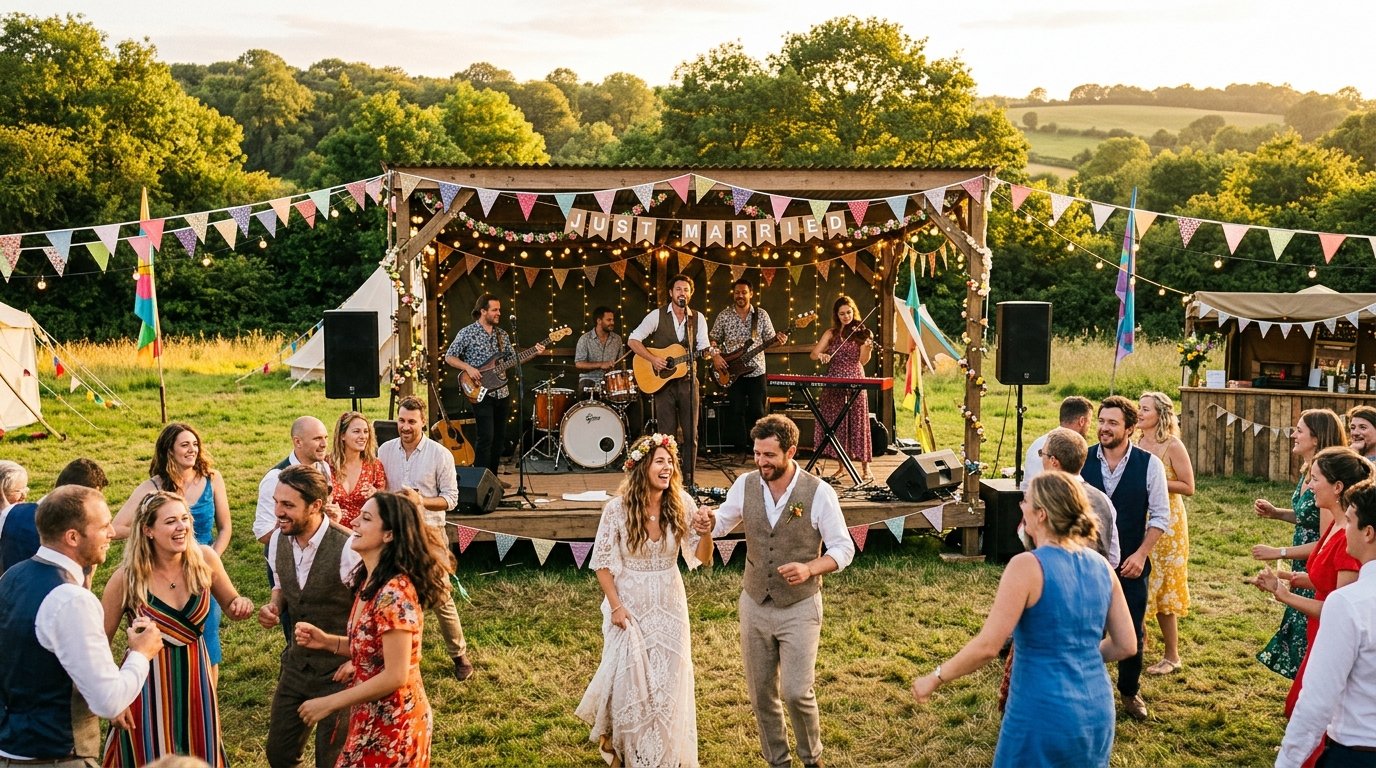
A festival wedding is what happens when you take the structure of a traditional reception and replace it with everything you actually want: live music, street food, dancing on grass, and your friends sleeping in bell tents under the stars.
It is not a cheap option. It is not a simple option. But done well, a festival wedding is the most memorable day you will ever throw. This guide covers how to plan one, what it costs, and how to avoid the logistical disasters that turn a festival into a fiasco.
What a festival wedding actually involves
Forget the image of a field with a guitar. A proper festival wedding has multiple zones, structured entertainment, and enough infrastructure to run a small village for 24 hours.
A typical layout includes:
- Ceremony area — a decorated clearing, gazebo, or tipi where the legal or symbolic ceremony takes place.
- Main stage — a raised platform or hired stage for live bands, DJs, or acoustic acts.
- Food zone — two or three street food vendors, a bar, and seating (hay bales, benches, picnic tables).
- Chill-out area — cushions, blankets, garden games, a fire pit for evening.
- Glamping village — bell tents or yurts for overnight guests.
- Facilities — portable toilets, generators, lighting, waste collection.
The magic of a festival wedding is that guests move freely between zones. There is no seating plan dictating who sits where. People eat when they are hungry, dance when they feel like it, and drift to the fire pit when the evening cools down.
Venue types for festival weddings
You need a large, flat piece of land with vehicle access. The three main options:
| Venue type | Hire cost | Pros | Cons |
|---|---|---|---|
| Farm or estate | £2,000-£6,000 | Often has buildings for backup, power, toilets | Restrictions on noise and hours |
| Private field | £500-£2,000 | Cheap, full creative freedom | You provide everything |
| Your own land | Free | No hire cost, total control | All logistics fall on you |
| Dedicated outdoor venue | £3,000-£8,000 | Some infrastructure included | Less flexibility on layout |
Farms are the most popular choice. A working farm with a flat field, a barn for backup, and track access for vehicles gives you the best of both worlds — festival atmosphere with a solid plan B.
The three pillars: music, food, camping
Live music and entertainment
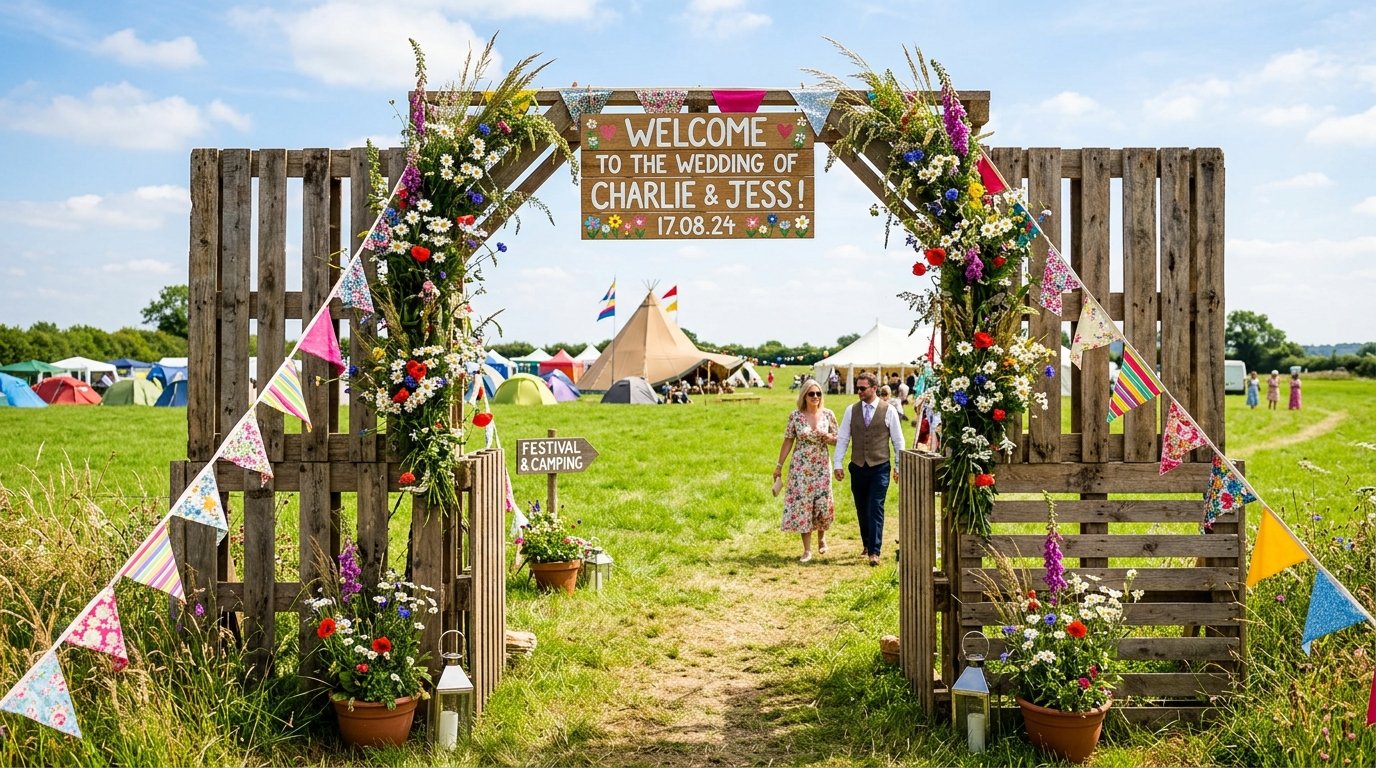
Music is the heartbeat of a festival wedding. Without it, you just have a picnic in a field.
What to budget:
| Act | Cost | Duration |
|---|---|---|
| Acoustic duo (ceremony + drinks) | £400-£800 | 2-3 hours |
| Cover band (evening) | £1,000-£3,000 | 2 sets of 45 mins |
| DJ | £400-£800 | 3-4 hours |
| Headline band + support | £2,000-£5,000 | Full evening |
| Sound system hire (PA, monitors) | £500-£1,500 | Full day |
Staging tips:
- Hire a proper stage. Even a small raised platform (4m x 3m) makes a massive difference to sightlines and atmosphere. Cost: £300-£600.
- Face the stage away from residential neighbours to direct sound across your site.
- Hire a sound engineer if you have live bands. A bad sound mix ruins even the best band.
- Create a timetable. Print it on the “programme” so guests know when each act plays.
Street food
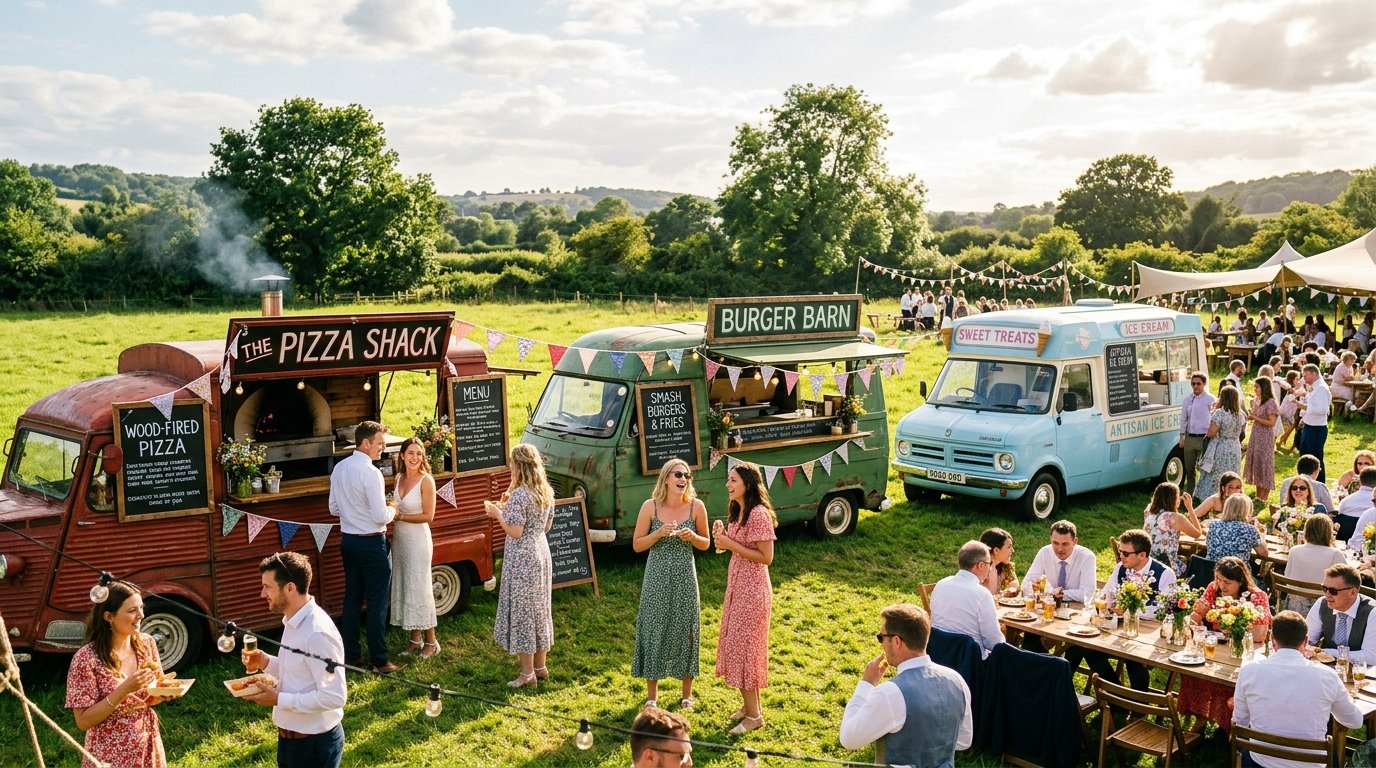
Street food is the perfect festival wedding catering. Guests choose what they want, there is no seating plan to manage, and the vendors handle everything — you just provide power and space.
Popular options and costs:
| Vendor | Cost per head | Best for |
|---|---|---|
| Wood-fired pizza | £10-£14 | Crowd-pleaser, feeds everyone fast |
| Gourmet burgers | £10-£15 | Casual, universally popular |
| Fish and chips | £8-£12 | Classic British, great for evening |
| Tacos / Mexican | £10-£14 | Colourful, handles dietary needs well |
| Curry / Indian | £10-£15 | Flavourful, good for cold evenings |
| Ice cream van | £3-£5 | Dessert and nostalgia |
| Crepes / waffles | £4-£7 | Dessert or late-night snack |
How many vendors? Two food trucks and a dessert option covers 80-120 guests comfortably. Three food trucks suit 120+ guests or if you want variety.
Budget £15-£25 per head total for food across the day. Most vendors charge per head or offer a package rate for weddings.
Compare this to traditional sit-down vs buffet options to see how the costs stack up.
Glamping
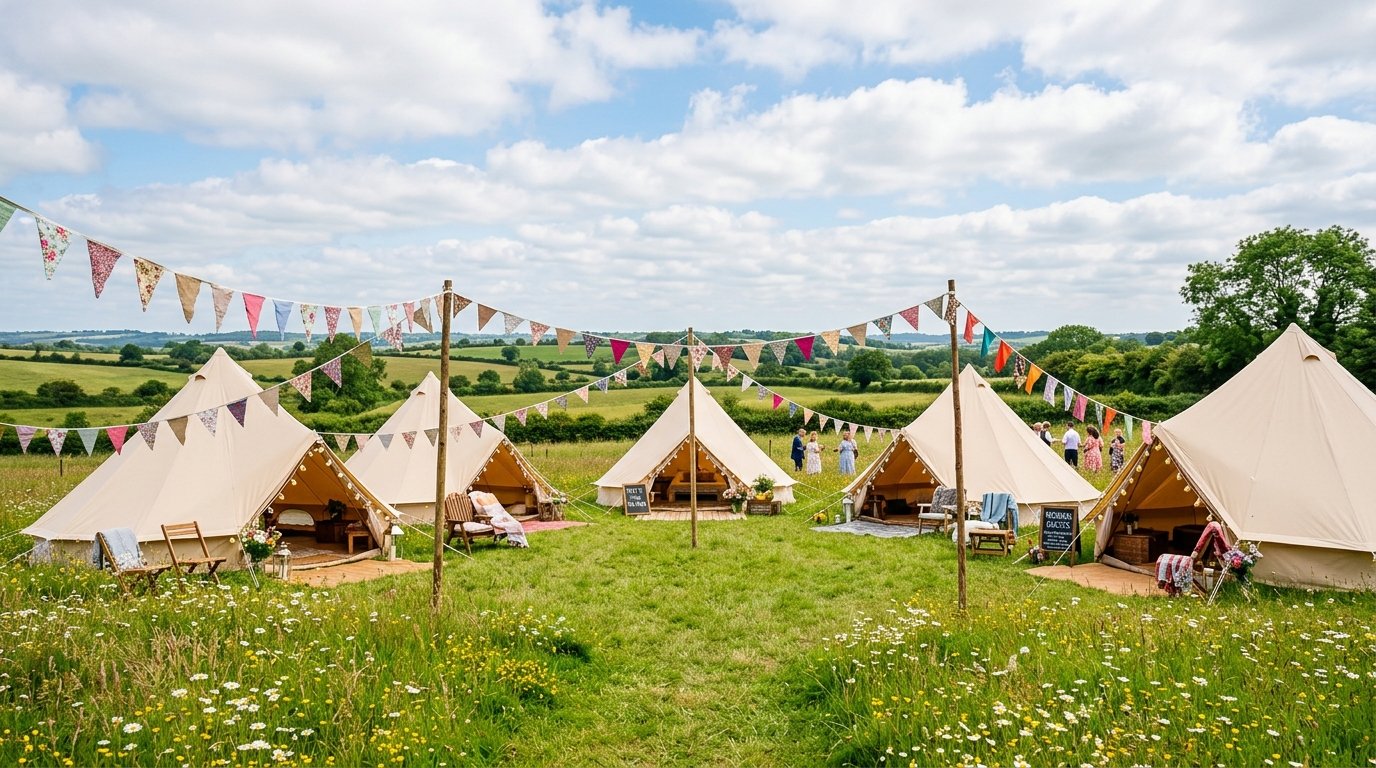
Overnight camping turns a one-day wedding into a weekend. It also solves the rural transport problem — nobody needs a taxi home from the middle of a field.
Costs:
| Option | Per tent/night | Sleeps | Includes |
|---|---|---|---|
| Standard bell tent | £150-£200 | 2-4 | Camp beds, bedding, lantern |
| Luxury bell tent | £250-£350 | 2 | Proper bed, rugs, toiletries, bunting |
| Yurt | £300-£500 | 2-4 | Furnished, sometimes heated |
| Campervan pitch | £20-£40 | — | Power hookup, flat pitch |
For 30 guests staying over, budget £2,000-£4,000 for bell tent glamping.
Essentials for the glamping area:
- Separate toilet and washing facilities (not shared with the main event).
- Lighting along pathways — guests stumble in the dark otherwise.
- A map showing tent assignments, sent to guests before the day.
- Breakfast provisions for the morning after.
Licensing and legal requirements
You cannot serve alcohol or have amplified music without the right paperwork. Here is what you need:
Temporary Event Notice (TEN)
- Covers: Sale of alcohol, regulated entertainment (live/recorded music), late-night refreshment.
- Capacity: Up to 499 people (including staff and performers).
- Cost: £21 per notice.
- Apply to: Your local council’s licensing team.
- Deadline: At least 10 working days before the event. Apply 28 days ahead to be safe.
- Limits: A single premises can have 15 TENs per year. You can apply for 5 per year as an individual.
Over 499 guests?
You need a full premises licence. This involves a formal application, public consultation, and potentially conditions imposed by the police, fire service, or environmental health. Costs run into thousands and the process takes months. Keep your guest list under 500 if at all possible.
Other paperwork
- Public liability insurance: £2-5 million cover. Most venues and suppliers require it. Cost: £80-£200.
- Risk assessment: Required by your insurer and recommended by your council. Cover fire, weather, first aid, traffic, and crowd management.
- Noise restrictions: Check your council’s environmental health guidelines. Many areas have strict limits after 11pm.
Guest experience details
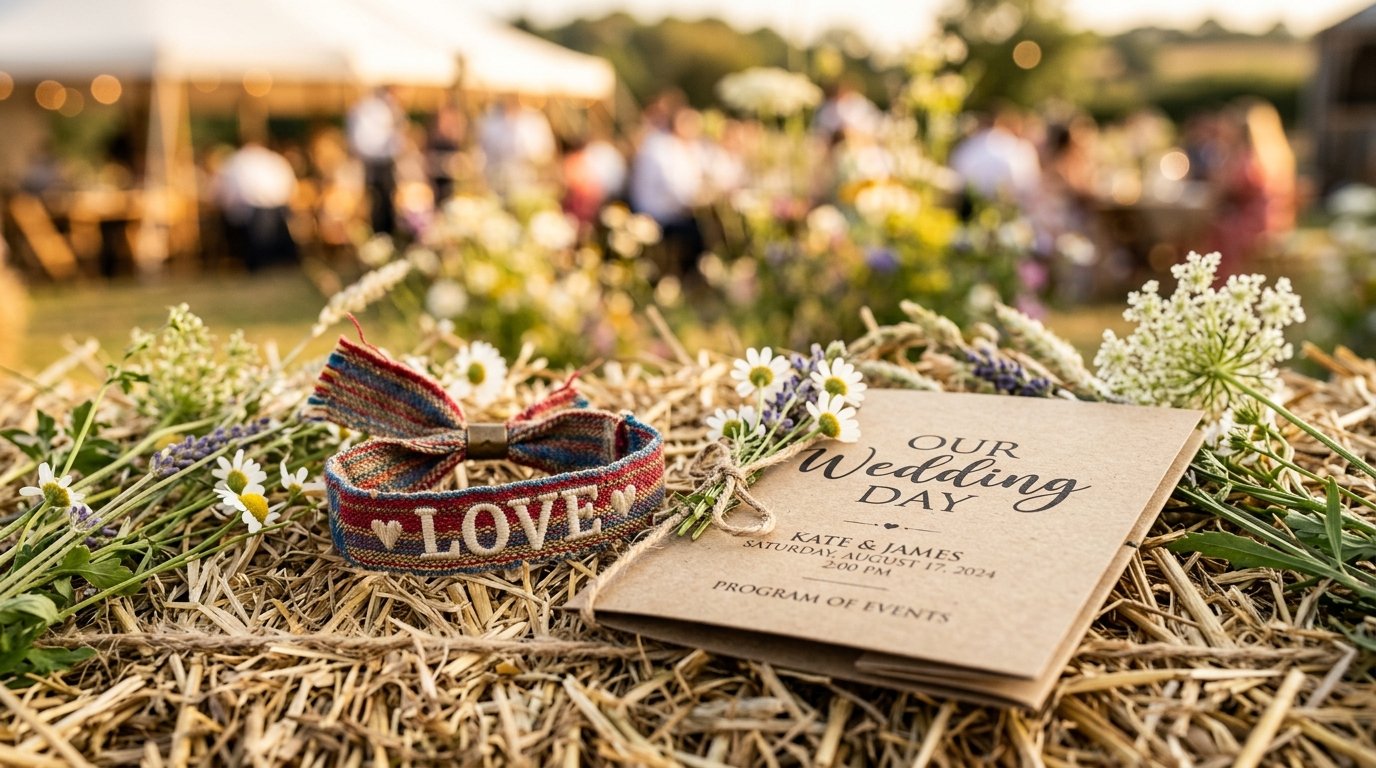
The details are what make a festival wedding feel like a festival and not just a party in a field.
Wristbands
Fabric festival wristbands with the couple’s names and date printed on them. Guests wear them as a memento. Cost: £1-£3 per wristband. Order from specialist suppliers — they need 2-3 weeks lead time.
Programme
A printed schedule showing the running order — ceremony time, food service, band times, last orders, breakfast. Format it like a festival line-up poster for the full effect. Print on A5 card or a folded leaflet.
Signage
Hand-painted signs on reclaimed wood or chalkboards. Point guests to the ceremony, food, bar, toilets, glamping, and chill-out area. Budget £50-£200 for materials.
Dress code
State it clearly: “Festival casual.” This tells guests to wear comfortable shoes, layers, and clothes they do not mind getting muddy. Mention wellies if the forecast looks wet.
Weather contingency
Rain will not ruin a festival wedding if you plan for it. Rain you did not plan for absolutely will.
Non-negotiable wet weather provisions:
- A covered structure (stretch tent, marquee, or barn) large enough for all guests.
- Straw or matting on high-traffic walkways between zones.
- A drying area for wet coats and umbrellas.
- Free wellies or flip-flops at the entrance (a box of cheap wellies costs £100-£200 for 20 pairs).
- Covered seating for food — nobody enjoys eating a burger in a downpour.
The mindset: Accept that some weather is part of the experience. Light rain during a festival wedding can actually be fun — people laugh about it for years. But have the infrastructure to move everything under cover within 30 minutes if it turns serious.
Costs breakdown
| Item | Budget | Mid-range | Premium |
|---|---|---|---|
| Venue hire (field/farm) | £500 | £3,000 | £6,000 |
| Stage + PA system | £500 | £1,500 | £3,000 |
| Live band + DJ | £1,400 | £3,000 | £5,000 |
| Street food (80 guests) | £1,200 | £1,600 | £2,000 |
| Bar (drinks package) | £1,500 | £2,500 | £4,000 |
| Glamping (15 tents) | £2,250 | £3,750 | £5,250 |
| Toilets | £200 | £700 | £1,500 |
| Generator + power | £300 | £600 | £1,000 |
| Decoration + signage | £200 | £500 | £1,000 |
| Licensing + insurance | £100 | £200 | £400 |
| Total | £8,150 | £17,350 | £29,150 |
These are venue and entertainment costs only. Add standard wedding expenses (dress, photography and rings) on top.
Who festival weddings suit
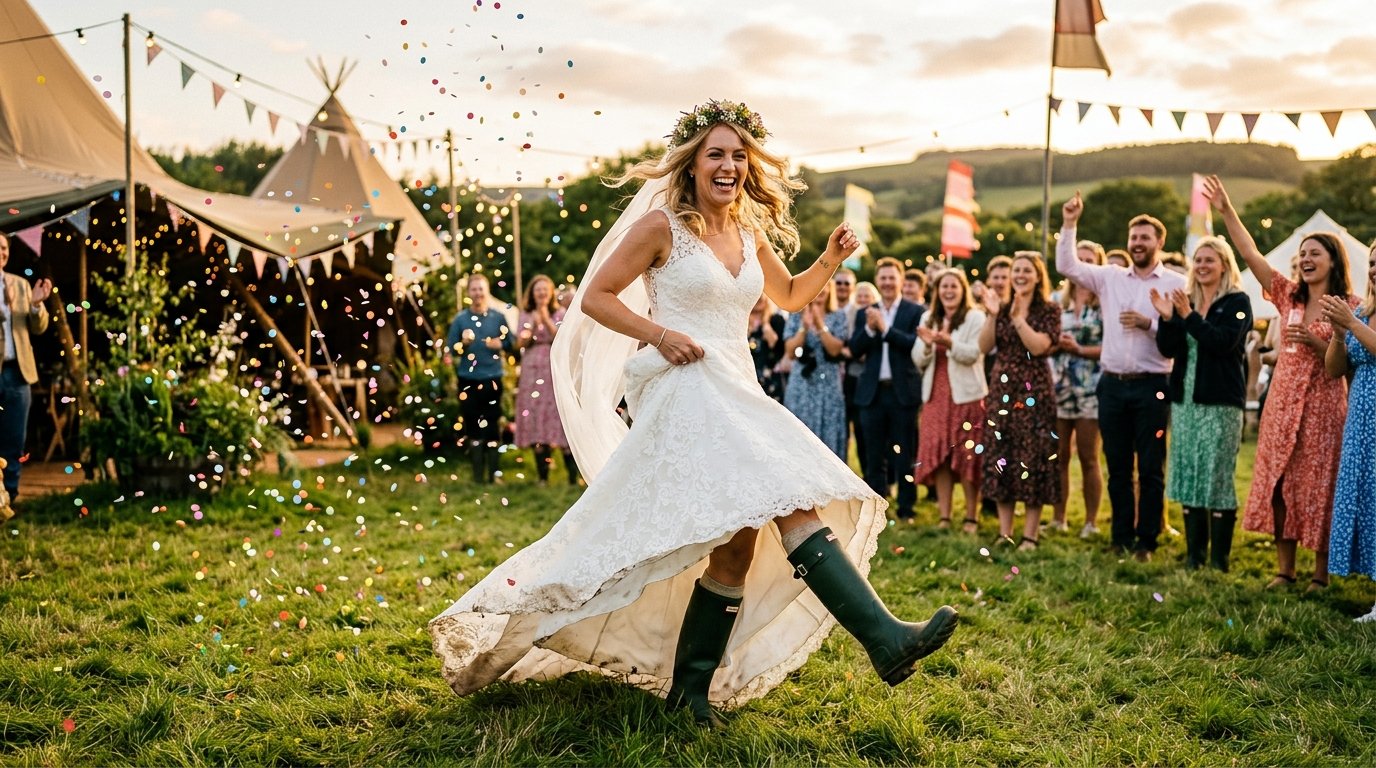
Festival weddings work brilliantly for couples who:
- Prioritise music and atmosphere over formal tradition
- Have a large guest list (80+) and want everyone to have fun, not just sit at a table
- Are willing to project-manage a complex event (or hire a planner)
- Have friends and family who will embrace camping, wellies, and informality
- Are getting married between June and August
They are harder to pull off if:
- Many guests are elderly or have mobility issues — uneven ground and long walks between zones are tough
- You want a formal, structured day with a seating plan and sit-down meal
- Your budget is tight — the infrastructure costs add up fast
- You are planning a winter or early spring wedding
Planning timeline
| When | What |
|---|---|
| 12-18 months | Book venue, book headline band, apply for TEN |
| 9-12 months | Book street food vendors, glamping supplier, generator/toilet hire |
| 6-9 months | Book DJ/acoustic acts, order wristbands, plan layout |
| 3-6 months | Confirm all suppliers, create programme, order signage |
| 1-3 months | Send glamping assignments, confirm guest numbers, site visit |
| 1 week | Confirm weather plan, brief all suppliers, print programmes |
| Day before | Suppliers arrive, stage goes up, tents go up, walk the site |
Start early. A festival wedding has more suppliers and moving parts than any other style. Build a detailed checklist and use it every week from 12 months out.
Planning your festival wedding? Read our complete guide on how to plan a wedding for the full timeline, or compare venue types in our how to choose a wedding venue guide.
Frequently asked questions
How much does a festival wedding cost UK?
A festival wedding costs £5,000-£15,000 for venue, infrastructure, and entertainment alone. A smaller field wedding with one band, a food truck, and basic glamping sits at the lower end. A full multi-stage event with several acts, multiple food vendors, luxury camping, and professional production reaches the upper end. Add standard wedding costs (dress, photography, rings) on top.
Do you need a licence for a festival wedding?
Yes, you need a Temporary Event Notice (TEN). A TEN covers the sale of alcohol and regulated entertainment (live music, DJ) for events with up to 499 attendees. Apply to your local council at least 10 working days before the event — but 28 days is safer. The fee is £21. Events over 499 guests require a full premises licence, which is significantly more complex and expensive.
What is the best month for a festival wedding?
June to August offers the best weather odds. July has the longest daylight and warmest average temperatures. June is slightly less busy and often drier. August risks clashing with school holidays and music festival season, which can inflate supplier prices. May and September are possible but evenings get cold quickly.
How do you handle bad weather at a festival wedding?
Have a covered space large enough for all guests. A stretch tent, marquee, or large tipi works as the anchor — the festival happens around it in good weather, inside it in bad. Lay straw or matting on walkways to manage mud. Provide free wellies or flip-flops at the entrance. Accept that some rain adds to the festival atmosphere — but torrential downpours need a solid indoor backup.
Can you have a festival wedding on your own land?
Yes, if your land is large enough and you obtain a TEN from the local council. You also need landowner permission (if rented), temporary toilet facilities, vehicle access for suppliers, and adequate parking. Check noise restrictions with your council — residential neighbours can object. Private land gives you full creative control but means you source and manage every supplier yourself.