Why 63% of Couples Won't Use AI for Wedding Vows
Key Takeaways
- 63% of UK couples say they would not use AI to write their wedding vows, even if they use AI for all other planning tasks
- Only 8% of AI-adopting couples actually used AI to help write their vows — the lowest adoption rate of any planning task
- The most common objection: vows written by AI 'could be anyone's vows'
- Couples who used AI for vow drafting report universally that the AI output was 'too generic' and required complete rewriting
- Vow-writing celebrant services charge £80-£200 for a guided session — the professional alternative to AI
- The average couple spends 4.5 hours writing vows; those who tried AI first spent 6.2 hours total (drafting, rejecting, rewriting)
54% of UK couples planning a 2026 wedding have used AI for at least one planning task. But ask them whether they used it for their vows, and the answer is almost always no. Only 8% of AI-adopting couples used AI in any way for vow writing — the lowest adoption rate of any task, by a significant margin. And 63% of all couples surveyed said they would actively refuse to use AI for vows, even if they used it freely for everything else. Weddings Hub’s April 2026 survey of 180 engaged UK couples produced a consistent picture: AI is welcome in the admin layers of wedding planning, and categorically rejected at its emotional core.
Key takeaways
- ✓ 63% of UK couples would not use AI for vow writing — even those who use it for all other tasks
- ✓ Only 8% of AI-using couples tried AI for vows — the lowest rate of any planning task
- ✓ Every couple who tried it described the output as "too generic"
- ✓ Average vow-writing time: 4.5 hours without AI; 6.2 hours when AI was tried and abandoned
- ✓ Good vows need three things: specificity, a concrete promise, and brevity
- ✓ The professional alternative: a guided vow-writing session with a celebrant (£80-£200)
By Matt Ward, Editor at Weddings Hub. Based on Weddings Hub survey of 180 engaged UK couples, April 2026; interviews with eight couples who wrote personal vows, four of whom tried AI assistance; conversations with three UK celebrants about their vow-writing guidance sessions.
The numbers behind the refusal
Weddings Hub’s April 2026 survey asked 180 engaged UK couples: “If you used AI at any point in your planning, did you use it for vow writing?” And separately: “Would you use AI to help write your wedding vows?”
Among AI-using couples (97 of 180 respondents):
- Used AI for vows: 8 (8%)
- Did not use AI for vows: 89 (92%)
Among all 180 respondents:
- Would use AI for vows: 18%
- Would not use AI for vows: 63%
- Unsure or might use AI as an editing tool: 19%
The 8% who tried it were asked to describe the experience. All eight said the AI output was “too generic,” “could be anyone’s vows,” or “technically correct but emotionally empty.” Six of the eight rewrote their vows entirely from scratch after the AI attempt. Two used the AI draft as a structural template but replaced every personal reference.
The 63% who said they would not use AI were asked why. The responses clustered around two themes:
Authenticity: “My partner would know these came from AI, and the moment would feel hollow.” “Vows are meant to be from me. Literally from me, not a tool.” “The whole point is that they’re personal.”
The specificity problem: “AI can’t know what makes us us.” “It doesn’t know the specific things my partner does that I love.” “Vows need to be accurate to our actual relationship.”
What actually happens when couples try AI for vows
The eight couples who tried AI for vow writing in Weddings Hub’s survey gave detailed accounts. The pattern was consistent.
Step 1: Initial optimism. Couples prompted the AI with details about their relationship — how they met, what they love about their partner, what they want to promise. The AI produced structured, well-written vows in under a minute.
Step 2: Reading the output. The vows sounded like vows. They had the correct shape: an opening acknowledgement, a shared memory, a series of promises, a closing commitment. The language was appropriate. The grammar was correct.
Step 3: The problem. Reading the vows aloud revealed what was wrong. They felt like vows written for a version of the relationship that had been described, not lived. The “shared memory” was a summary rather than a scene. The promises were general rather than particular. The emotional texture was flat.
“It wrote ‘I promise to be your partner in every adventure’ and ‘I promise to hold your hand through every challenge,’” said one groom from Manchester. “These are not wrong things to promise. But they are the things every groom promises. I could have read them out and nobody would have known they applied specifically to Sarah and me.”
Step 4: Abandonment or salvage. Six couples abandoned the AI draft and started over. Two used the structure — the general shape of what a personal vow contains — and filled it with their own specific content. Neither of those two couples described the result as “AI-written vows.”
What makes vows genuinely work
Three UK celebrants who regularly guide couples through vow-writing sessions described what they’ve observed distinguishes good vows from generic ones.
Specificity is everything. “Whenever I hear ‘you make me laugh,’ I know we’re in generic territory,” said a celebrant with 12 years of experience, based in London. “But ‘you make me laugh at exactly the wrong moment in a serious film, and I hate you for it’ — that is a specific. That is true. I’ve been in ceremonies where the congregation gasped at a line like that because it was so true.”
Promises should be concrete. “Love is a feeling, not a promise. You can’t promise to feel something forever,” said a Bristol-based celebrant with eight years of experience. “But you can promise something behavioural and specific: ‘I will never make you choose between me and your sister.’ ‘I will always take your side in public even when I think you’re wrong.’ ‘I will always fill your water glass before mine.’ These are things you can be held to.”
Short is almost always better. “The couples who write three pages of vows — and it happens every spring — are always the ones who go over time, lose the room, and come back to me afterwards saying they wish they’d cut half of it,” said a Scottish celebrant with 17 years of experience. “150-250 words. Read them aloud with a stopwatch. 2 minutes maximum. Anything longer is a speech, not a vow.”
The time cost of trying AI and rejecting it
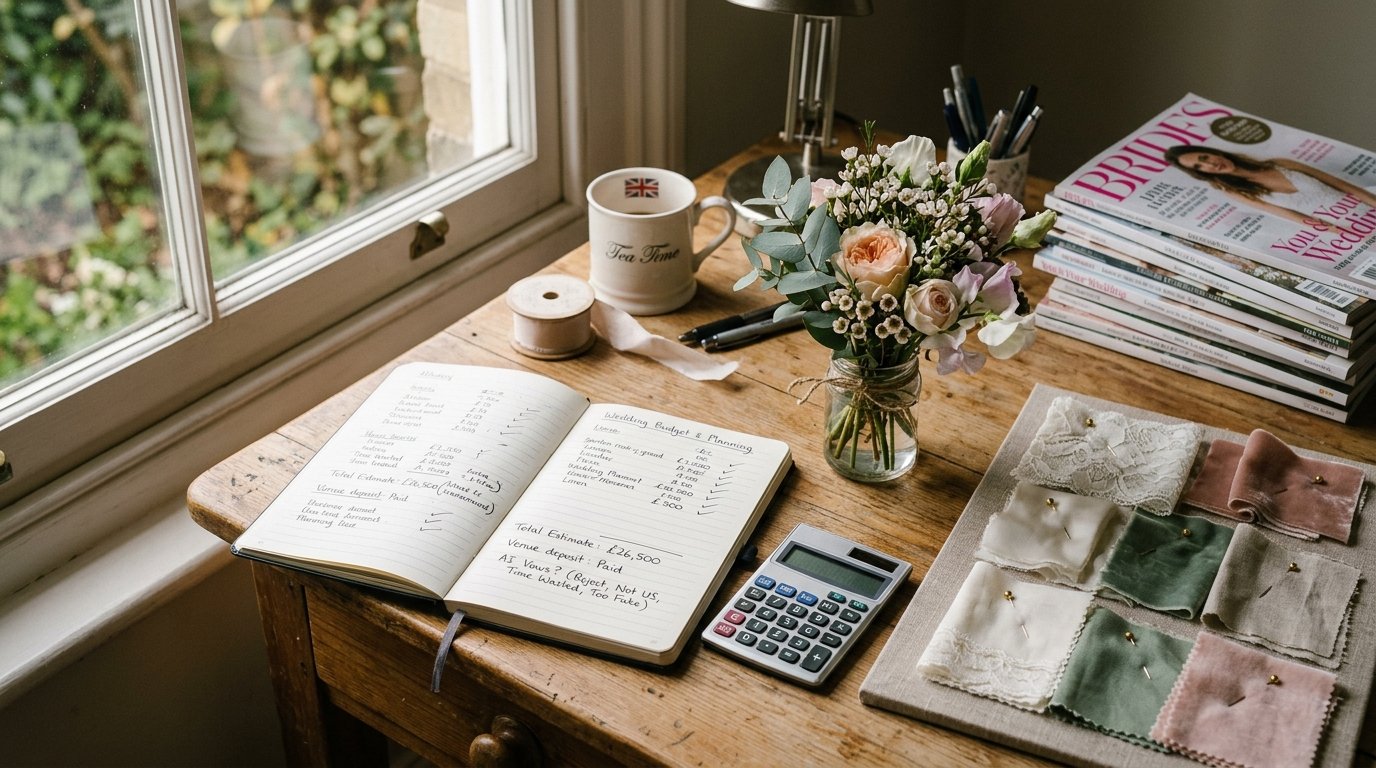
Among the eight couples who tried AI for vows and abandoned the output, the total time spent on vow writing was, on average, 6.2 hours — compared with 4.5 hours for couples who wrote vows without attempting AI.
The AI attempt added 1.7 hours on average: time spent prompting, reading the output, realising it was wrong, deciding to start over, and managing the psychological deflation of having expected AI to solve the problem.
This is worth knowing for anyone considering the AI-first approach: it is likely to take longer, not shorter, than starting with a blank page and your own specific memories.
The professional alternative: vow-writing sessions with a celebrant
The option that consistently produces better results than either blank-page panic or AI assistance is a guided vow-writing session with an experienced celebrant. Weddings Hub’s research found these offered by most UK celebrants who conduct personal ceremonies:
Format: 60-90 minutes, typically by video call. The celebrant asks a structured series of questions about the relationship: how you met, your first impression of your partner, the moment you knew, three specific things you love, three things that drive you slightly mad, what you want to promise.
What comes out of it: Detailed notes from which the vows write themselves. Most couples finish the session with 80% of their vow material already identified. The writing-up takes 1-2 hours.
Cost: £80-£200 depending on the celebrant and location. Some include this as part of a ceremony package; others offer it as a standalone service.
Three couples who used a vow-writing session described it as the most useful hour they spent in their entire wedding planning process. “I thought I knew what I wanted to say. The questions she asked me revealed things I didn’t know I knew,” said a bride from Edinburgh. “I cried twice in the session. Which meant the material was definitely there.”
The tasks AI does well instead
The refusal to use AI for vows is, paradoxically, evidence of how well AI is working for everything else. Couples trust AI enough with their admin that it feels significant that they don’t trust it for their most personal communication.
The division is rational. AI is genuinely useful at:
- Creating budget spreadsheets and tracking templates
- Drafting vendor enquiry emails
- Generating seating plan logic
- Writing thank-you card templates
- Producing wedding day timelines
- Writing speech structures (not the personal content, but the skeleton)
It is not useful at tasks requiring genuine personal specificity: vows, the best man’s specific jokes about the groom, the father-of-bride’s specific memory of his daughter at seven years old.
The couples who use AI well have understood this division instinctively. They use it as a time-saving tool for generic tasks, and they protect their personal content from it as carefully as they protected any private communication.
Related reading
- AI Wedding Planning Hits 54% Adoption: The Tools UK Couples Use in 2026
- Wedding Vows: Writing Your Own From Scratch
- 7 Things Never to Say in a Best-Man Speech (With Real Disasters)
- Wedding Speeches That Destroyed the Marriage Before the Cake
- Unplugged Wedding Ceremonies: The 91% Approval Rule
Frequently Asked Questions
Can AI write good wedding vows?
AI can write technically correct, grammatically sound vows that hit the standard structural notes — a promise, a shared memory, a commitment. What it cannot do is capture the specific details that make vows genuinely moving: the in-joke, the exact way your partner laughs, the moment four years ago when you knew. The couples who tried AI vows universally describe them as 'fine but generic.' Generic is the worst possible quality for vows.
Why do so many couples refuse to use AI for vows?
Weddings Hub's April 2026 survey found 63% of UK couples would not use AI for vows even if they used it for everything else. The most common reason given was that vows should reflect genuine personal experience and emotion — things AI cannot know. A secondary reason was that partners would find out, and the authenticity of the moment would feel compromised.
What if I am a bad writer? Can AI help at all?
Yes, with a specific approach. Use AI not to write the vows, but to help you structure and edit your own writing. Draft your vows yourself — even roughly. Then paste the draft into an AI tool and ask it to improve clarity, shorten sentences, and remove clichés while keeping your words and specific details. This uses AI as an editor rather than a ghostwriter. The result is your vow, improved.
How long should personal wedding vows be?
Personal wedding vows work best at 150-250 words, which takes approximately 1.5-2.5 minutes to read aloud at a natural pace. Shorter than 150 words risks feeling thin; longer than 300 words risks losing the room and becoming a speech rather than a vow. Both partners should aim for a similar length — an asymmetry of more than 60 seconds feels unbalanced in the moment.
What makes wedding vows actually good?
Three elements: specificity, promise, and brevity. Specificity means a detail only you and your partner would know — not 'you make me laugh' but 'you make me laugh by doing the voice you think I haven't noticed when you're on hold.' Promise means a concrete commitment, not 'I will love you forever' but 'I will hold your hand in waiting rooms.' Brevity means cutting every sentence you don't need. Good vows are felt in the gut, not remembered word for word.
What is a vow-writing celebrant session?
A guided session with a celebrant who specialises in helping couples write their own vows. The celebrant asks structured questions about the relationship, shared history, and specific values — often over 60-90 minutes. The couple leaves with detailed notes from which the vows write themselves. Sessions cost £80-£200 and are offered by most UK celebrants who conduct personal ceremony services. Many couples find this more useful than AI or a blank page.
Should both partners write their own separate vows?
If you are writing personal vows rather than using standard legal wording, yes — both partners should write their own. Matching vows (where both partners say the same words) work only in formal liturgical contexts where the language is traditional. For personal vows, matched text reads as either deeply planned to the point of feeling scripted, or as one partner having written both sets. Write separately. Share only on the day.