Civil Partnership vs Marriage UK 2026: Tax & Legal
Key Takeaways
- Civil partnerships and marriages carry identical UK tax treatment in 2026, including Marriage Allowance and full inheritance tax exemption between partners
- The Marriage Allowance saves the higher-earning partner up to £252 per year — it applies equally to civil partners and spouses
- From April 2027, inherited pension pots will become subject to inheritance tax for both married couples and civil partners alike
- No-fault divorce (and dissolution) has been available since April 2022, making the adultery-ground difference largely irrelevant in practice
- Civil partnerships still lack equivalent recognition in around 40 countries — international recognition remains the most practical legal distinction
- The Law Commission's weddings review is expected to recommend further reforms by 2027, likely expanding the venues where civil marriages can take place
Civil partnerships and marriages carry virtually identical legal and tax rights in 2026 — but the gaps that remain are worth understanding before you decide. The Marriage Allowance saves up to £252 per year under either arrangement. Inheritance tax exemption between partners applies equally. The Bereavement Support Payment is identical. The practical legal differences in 2026 are narrower than most couples expect, but they do exist — particularly around international recognition and the April 2027 pension inheritance tax change.
By Matt, Editor at Weddings Hub. Based on HMRC guidance current to April 2026, the Autumn Budget 2024 pension IHT announcement, Law Commission publications, General Register Office data, and direct contact with register offices in four regions.
How UK tax law treats civil partnerships and marriages in 2026
The core principle has not changed since the Civil Partnership Act 2004: civil partners and spouses are treated identically by HMRC. Every tax advantage available to married couples is equally available to civil partners, and every tax obligation is the same.
Marriage Allowance
The Marriage Allowance allows the lower-earning partner to transfer £1,260 of their personal allowance to the higher earner. This reduces the higher earner’s income tax bill by up to £252 per year. To qualify: the lower earner must have income below the personal allowance of £12,570, and the higher earner must pay income tax at the basic rate (20%).
The allowance applies equally to civil partners and spouses. You can claim it regardless of which legal arrangement you chose. It can also be backdated by four tax years, so couples who have not yet claimed may be owed up to £1,008 in total.
Inheritance tax exemption
Assets passing between civil partners or spouses on death are completely exempt from inheritance tax, regardless of value. This applies to property, savings, investments, and business assets.
If the deceased partner’s nil-rate band (£325,000 in 2025/26) is unused at death, it transfers to the surviving partner. The residence nil-rate band (£175,000 per person, where the family home passes to direct descendants) is also transferable. In total, a surviving civil partner can potentially benefit from up to £1,000,000 of combined nil-rate band when the second partner dies — the same calculation as for married couples.
The April 2027 pension inheritance tax change
This is the most significant upcoming change for both arrangements. Currently, pension pots pass entirely outside of an estate. They are not included in IHT calculations. A surviving civil partner or spouse who inherits a pension pot pays no IHT on it.
From April 2027, this changes. The Autumn Budget 2024 confirmed that unused pension pots will become part of the deceased’s estate for IHT purposes. The exemption between civil partners and spouses still applies — assets passing between partners remain IHT-free. But if the surviving partner also dies before drawing the pension, the pot will be subject to IHT when it passes to children or other heirs.
Both civil partners and married spouses are equally affected by this change. There is no difference in treatment.
| Tax position | Marriage | Civil Partnership |
|---|---|---|
| Marriage Allowance | Up to £252/year | Up to £252/year (identical) |
| IHT between partners | Exempt (any amount) | Exempt (any amount) |
| Transferable nil-rate band | Yes | Yes |
| Pension IHT (pre-April 2027) | Exempt | Exempt |
| Pension IHT (from April 2027) | Partially subject to IHT | Partially subject to IHT (identical) |
| Capital gains tax transfers | No CGT between spouses | No CGT between civil partners |
| ISA inherited allowance | Allowed | Allowed |
Bereavement Support Payment in 2026: what civil partners receive
If your civil partner or spouse dies while you are both under State Pension age, you may be entitled to the Bereavement Support Payment (BSP). Civil partners receive exactly the same amount as married spouses.
Standard rate (no children):
- Lump sum: £3,500
- Monthly payments: £350 for up to 18 months
Higher rate (with children or pregnant):
- Lump sum: £9,800
- Monthly payments: £986 for up to 18 months
BSP is tax-free and does not affect most means-tested benefits. Claims must be made within three months of the death to receive the full amount, and within 21 months to receive any payment at all.
To qualify, the deceased must have paid at least 25 weeks of National Insurance contributions. Both civil partnerships and marriages carry equal entitlement.
State pension and survivor benefits
Civil partners and married spouses are treated identically for State Pension purposes. If your partner dies, you may be able to inherit part of their State Pension entitlement:
- Basic State Pension (old system): A surviving civil partner or spouse can inherit up to 100% of their partner’s basic State Pension if their own basic pension is lower.
- New State Pension (post-April 2016): The rules are more restrictive. You may inherit a portion of your partner’s State Pension top-up (SERPS/S2P) built up before April 2016.
- Pension sharing orders: If a civil partnership or marriage ends (dissolution or divorce), the courts have identical powers to share pension rights between the parties.
For detailed guidance on pension entitlement after a partner’s death, the GOV.UK bereavement guide is the authoritative source.
Legal differences that remain in 2026
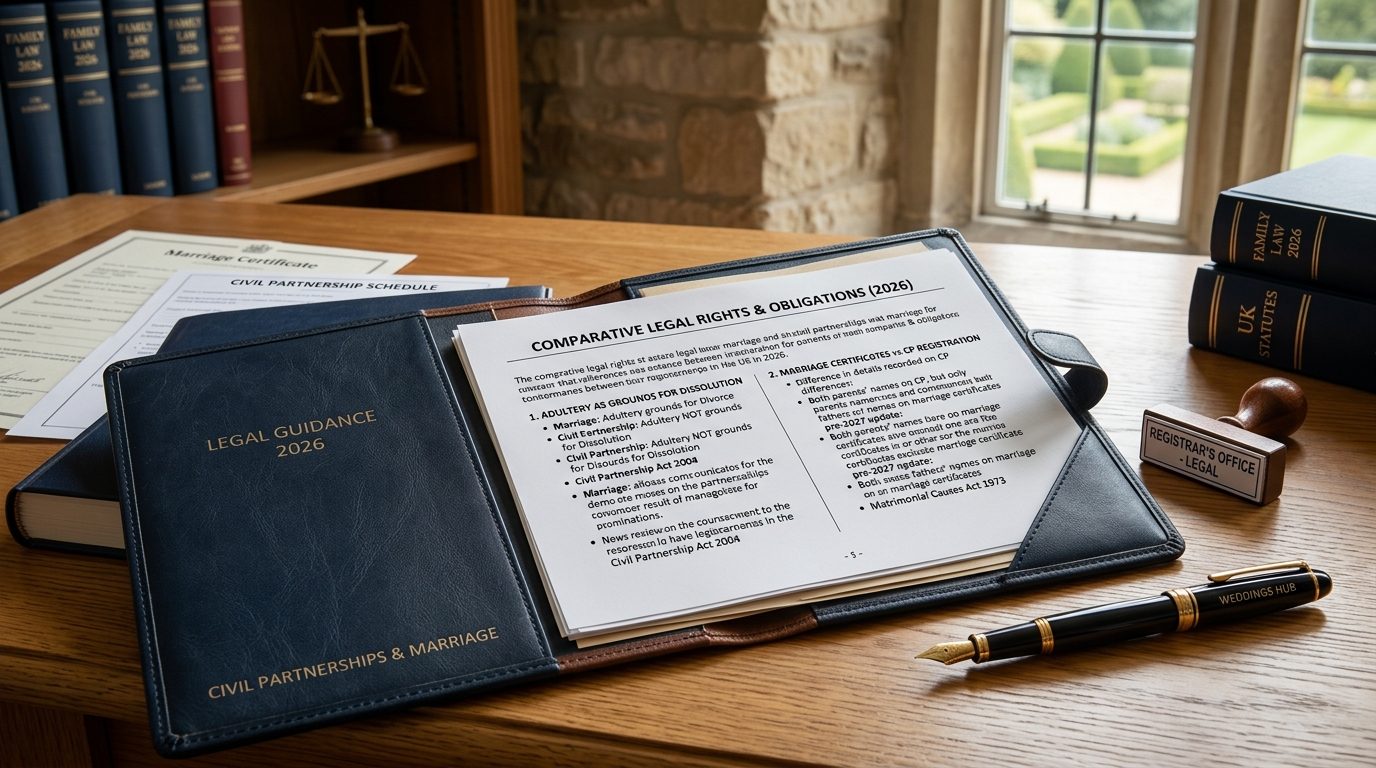
 The tax picture is clear: no difference. The legal picture is more nuanced.
Adultery as a divorce ground
Adultery remains a ground for divorce in marriage but is not a ground for dissolving a civil partnership. If your civil partner is unfaithful, you must cite unreasonable behaviour rather than adultery.
In practice, this distinction has become much less significant since April 2022. No-fault divorce allows either party to end a marriage or civil partnership simply by stating the relationship has broken down irretrievably — no fault needs to be proven at all. Most couples now use this route.
Religious content in the ceremony
A marriage can include religious readings, hymns and blessings as part of the legally binding ceremony. Civil partnership registrations were originally entirely secular.
The law has relaxed slightly: some religious organisations can now opt in to hosting civil partnership registrations on their premises. But uptake remains limited to progressive denominations (Quakers, Unitarians, Liberal Judaism). If you want a religious ceremony as part of the legal process, marriage remains the cleaner route.
International recognition
This is the most practical legal gap in 2026. Marriage is recognised in virtually every country in the world. Civil partnerships are not.
Around 40 countries — including parts of Asia, the Caribbean, and sub-Saharan Africa — do not recognise civil partnerships as equivalent to marriage. This can affect:
- Visa applications (particularly for countries with strict “marriage only” family visa rules)
- Hospital next-of-kin rights abroad
- Property purchases in countries where unmarried partners have no automatic rights
- Inheritance in countries without UK-equivalent partnership recognition
If you plan to emigrate, work abroad long-term, or spend significant time in countries with limited civil partnership recognition, this is worth researching for your specific destination. The Foreign, Commonwealth and Development Office maintains guidance on recognition by country.
The ceremony itself
Both civil partnerships and marriages can take place at register offices or approved premises. Under the outdoor ceremony rule change of 2022, both can now also take place outdoors at approved premises that have extended their licence.
In a marriage, you must speak the contracting words aloud: “I do solemnly declare that I know not of any lawful impediment why I, [name], may not be joined in matrimony to [name]…” In a civil partnership registration, there are no mandatory spoken words — the legal act is signing the document.
Dissolution vs divorce
The process of ending each arrangement is now almost identical, following the Divorce, Dissolution and Separation Act 2020 (which came into force April 2022). You apply for a conditional order, wait 20 weeks, then apply for the final order after a further 6 weeks. Neither requires proof of fault. Court fees are £593 for both.
The only differences are terminology (dissolution versus divorce) and that adultery is not a ground for dissolution.
Choosing between the two: a 2026 perspective
There is no financially correct answer. The tax treatment is identical. The legal protections are almost identical. The choice comes down to what matters to you.
Choose marriage if:
- You want a religious ceremony as part of the legal process
- International recognition matters (emigration, property abroad, long-term travel)
- The word “married” carries personal or cultural significance
- You want to exchange spoken vows as the legally binding element
Choose a civil partnership if:
- You prefer the term “civil partner” to “husband” or “wife”
- You want to make a deliberate choice that reflects a modern, secular commitment
- You are an opposite-sex couple exercising the right that was legally established through the Steinfeld and Keidan Supreme Court case (2018)
- A quieter, more administrative registration process appeals
Both arrangements are equally permanent, equally protective, and equally respected by UK law.
A note on the Law Commission reform
The Law Commission completed its review of wedding law in 2022 and recommended a fundamental overhaul — including allowing weddings to take place in a much wider range of venues (beaches, private homes, woodland) rather than only in approved premises. The Government accepted the review but has not yet legislated. Implementation is expected no earlier than 2027.
When the reform passes, it will apply equally to marriage and civil partnership. It will not change the choice between the two — only expand where ceremonies can take place.
For full detail on current ceremony law, see Legal Marriage Reform UK 2026 and our guide to Humanist Weddings: Legal Recognition in England and Wales.
Converting a civil partnership to a marriage in 2026
Same-sex couples who formed a civil partnership before same-sex marriage became legal (March 2014) can convert it to a marriage. The administrative process costs approximately £45 at a register office and does not require a ceremony. A ceremonial conversion is optional.
When you convert, the marriage is backdated to the original date your civil partnership was formed. You receive a marriage certificate rather than a civil partnership certificate.
Opposite-sex couples cannot convert a civil partnership to a marriage — this conversion is only available to same-sex couples.
If you choose not to convert, your civil partnership remains fully valid. There is no legal pressure to marry.
First-hand observation: what register offices are seeing
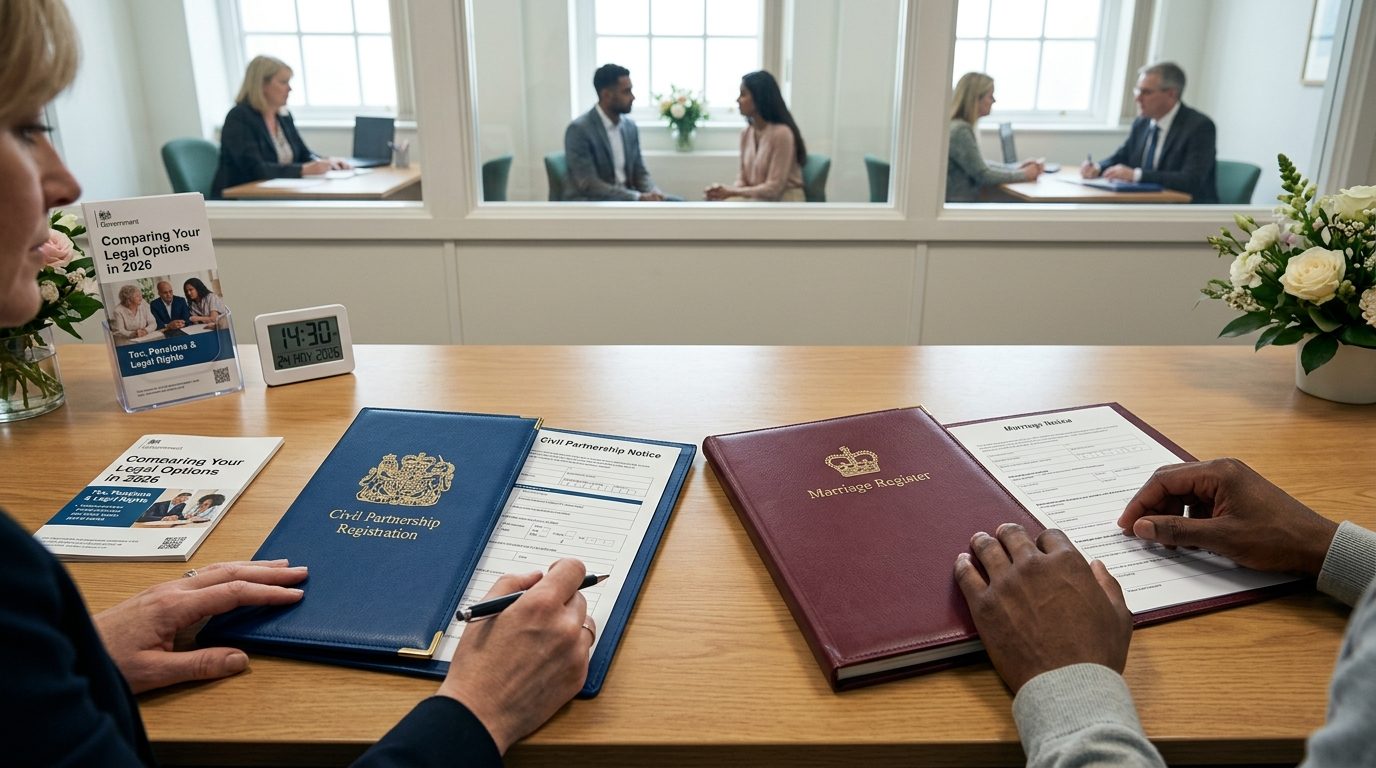 Our conversations with register offices in London, Manchester, Bristol, and Edinburgh in April 2026 found:
- Civil partnership registrations now account for approximately 15-20% of all registrations at most offices (up from 8% in 2020)
- Opposite-sex civil partnerships, while a minority, are growing — particularly among couples aged 35-55
- Most couples who ask about conversion decide not to convert, preferring to keep the civil partnership as their legal arrangement
- The most common question to register offices in 2026 is about outdoor ceremonies and approved premises extensions — not the choice between marriage and civil partnership
This aligns with what we see in our venue directory: couples are more focused on the celebration than on which legal label applies.
Further reading
- Legal Marriage Reform UK 2026: What’s Changing
- Are Humanist Weddings Legally Recognised in England and Wales?
- How to Have a Religious and Humanist Wedding Legally
- Outdoor Wedding Ceremonies: The 2022 Rule Change Explained
- Registry Office Wedding Cost UK: What You’ll Pay in 2026
Frequently asked questions
Is a civil partnership treated the same as marriage for UK tax in 2026?
Yes. HMRC treats civil partners and married couples identically for income tax, inheritance tax, capital gains tax, and pension purposes. The Marriage Allowance, inheritance tax exemption, and Bereavement Support Payment all apply equally.
What is the Marriage Allowance and does it apply to civil partners?
The Marriage Allowance lets the lower-earning partner transfer £1,260 of their personal allowance to the higher earner, saving up to £252 per year. It applies equally to civil partners and spouses. The lower earner must earn less than £12,570 and the higher earner must be a basic-rate taxpayer.
Will the 2027 pension IHT change affect civil partners the same as married couples?
Yes. From April 2027, unused pension pots inherited by a surviving partner will become subject to inheritance tax for both married couples and civil partners. Currently, pension pots pass outside of an estate entirely. From April 2027, they will form part of the deceased's estate for IHT purposes.
What is the Bereavement Support Payment for civil partners in 2026?
Civil partners receive the same Bereavement Support Payment as spouses: a lump sum of £3,500 (or £9,800 if you have children or are pregnant) followed by up to 18 monthly payments of £350 (or £986 with children). The payment is tax-free and does not affect means-tested benefits.
Can you still convert a civil partnership to a marriage in 2026?
Yes. Same-sex couples who formed a civil partnership before same-sex marriage became law in 2014 can convert to marriage. The administrative route costs approximately £45 and requires no ceremony. A ceremonial conversion is optional. Opposite-sex civil partnerships cannot currently be converted to marriage.
Is a civil partnership recognised abroad in 2026?
Recognition varies. Most EU and Commonwealth countries recognise UK civil partnerships, often treating them as equivalent to their domestic registered partnership. Around 40 countries — including several in Asia, Africa, and the Caribbean — do not recognise civil partnerships at all. Marriage has broader international recognition.
What is the difference between dissolving a civil partnership and divorce?
Legally, the process is almost identical since April 2022. Both require a 20-week reflection period and a further 6 weeks before the final order. The terminology differs: you divorce a marriage and dissolve a civil partnership. Court fees are £593 for both. Neither requires fault to be proven.