Changing Your Name After Marriage UK: 2026 Guide
Around 70% of women in the UK still take their partner's surname after marriage, with 8% using double-barrelled versions, according to ONS and YouGov data. The process requires a marriage certificate as the legal basis — you cannot change official documents until you have the original. Most UK name changes take 4-10 weeks depending on the number of documents. The Passport Office currently processes name changes in 3-5 weeks; DVLA takes 2-4 weeks.
Key Takeaways
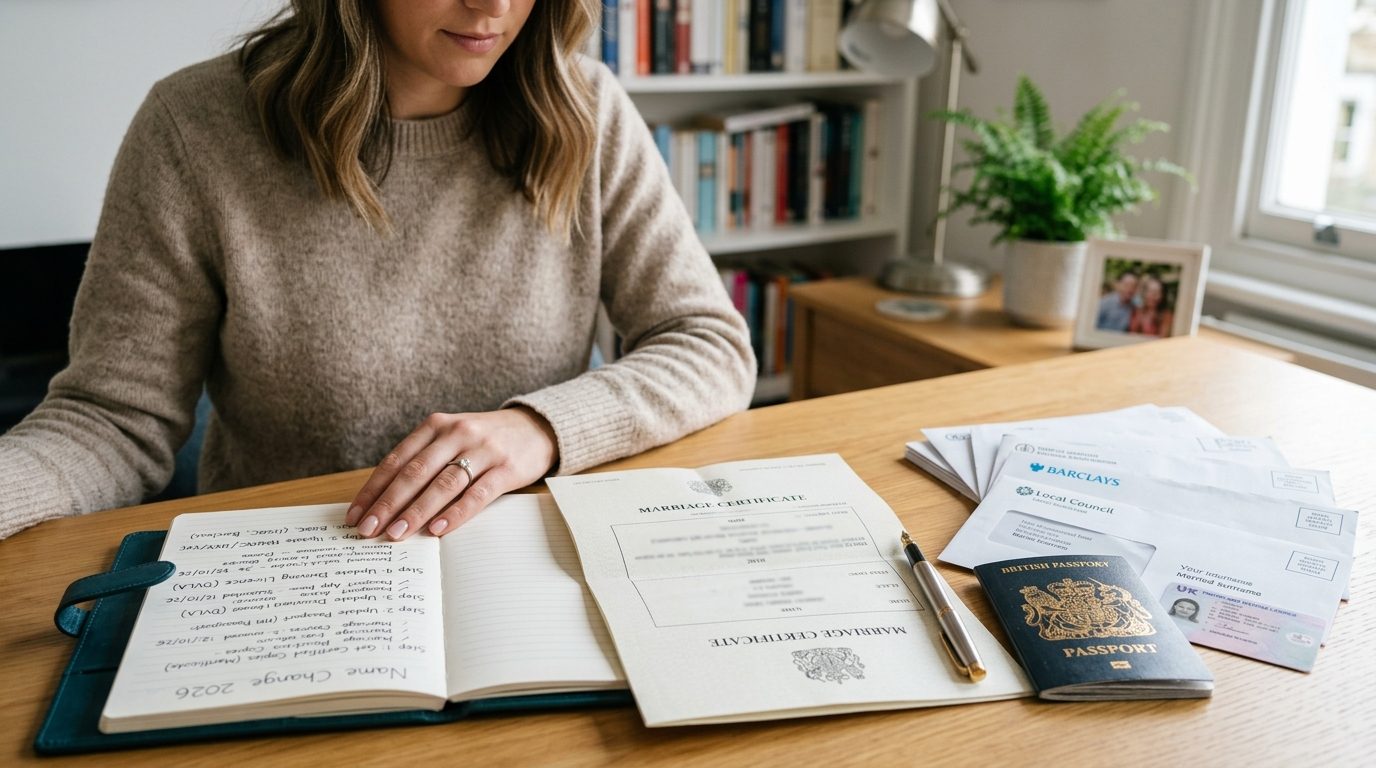
- Your marriage certificate is the legal document that proves your name change — you need the original, not a copy
- Start with your passport if you have a honeymoon abroad — Passport Office processing takes 3-5 weeks
- HMRC and your bank can often be updated simultaneously once you have your certificate and passport
- Around 70% of UK women change their surname after marriage; 8% use a double-barrelled version
- You do not need a deed poll to change your name after marriage in England and Wales — the certificate is sufficient
- DWP (pension, benefits), DVLA, GP surgery, and employer are often forgotten — update these too
Most couples think about the wedding itself long before thinking about the paperwork that follows. Changing your name after marriage is one of the tasks that looks simple in theory and generates surprising complexity in practice — particularly around ordering, timing, and which institutions to tackle first.
By Matt, Editor at WeddingsHub. Compiled from HMRC, Passport Office, DVLA, and General Register Office guidance, with input from 15 UK couples who went through the name-change process in 2024-2025.
Before you start: get multiple certified copies of your marriage certificate
This is the single most useful thing you can do before beginning the name-change process. When you register your marriage at the register office, you can purchase additional certified copies on the spot. The General Register Office charges £11 per certified copy.
Order 3-5 copies. You will need originals for most official updates — passport, driving licence, bank account updates — and photocopies are not accepted for anything significant. If you send your only certificate to the Passport Office and the DVLA simultaneously asks for it, you have a problem.
You can also order additional copies online later via the General Register Office (gro.gov.uk), but this takes several weeks and costs the same per copy. Getting them on the day of registration is faster.
The name-change priority order
Most name-change guides list institutions alphabetically. That is the wrong approach. The right order is based on what you need first and what depends on what.
If you have an overseas honeymoon booked:
- Passport (book appointment at Passport Office — standard processing is 3-5 weeks; fast track available)
- Travel insurance (update to match new passport name before departure)
- All flight and hotel bookings (your travel documents must match your passport name exactly)
- Everything else after you return
If no immediate travel:
- HMRC (informs other government departments; has a cascade effect)
- Employer (payroll must match HMRC records)
- Passport
- Driving licence (DVLA)
- Bank accounts and credit cards
- GP surgery and NHS records
- Everything else on the full list below
Updating your passport
This is the most time-sensitive update for anyone with a honeymoon.
What you need:
- Your current passport
- Your marriage certificate (original)
- A completed passport application form (available at a Post Office or on GOV.UK)
- Two new passport photos
- Payment: £88.50 for a standard adult passport
Processing time: 3-5 weeks for standard service. Fast track (1-week) is available at a Passport Office appointment for an additional fee (£177 as of 2026).
Important: Book the fast track appointment rather than sending by post if your honeymoon is within 6 weeks of the wedding. Post delays in the UK have been significant in recent years. The Passport Office will return your marriage certificate when they issue the new passport.
If you’re travelling before you can update your passport: You can travel on your existing passport (in your maiden name) and update it when you return. Your flight bookings and visa documents will match your maiden-name passport. Do not change your flight bookings before your passport has been updated.
Updating your driving licence (DVLA)
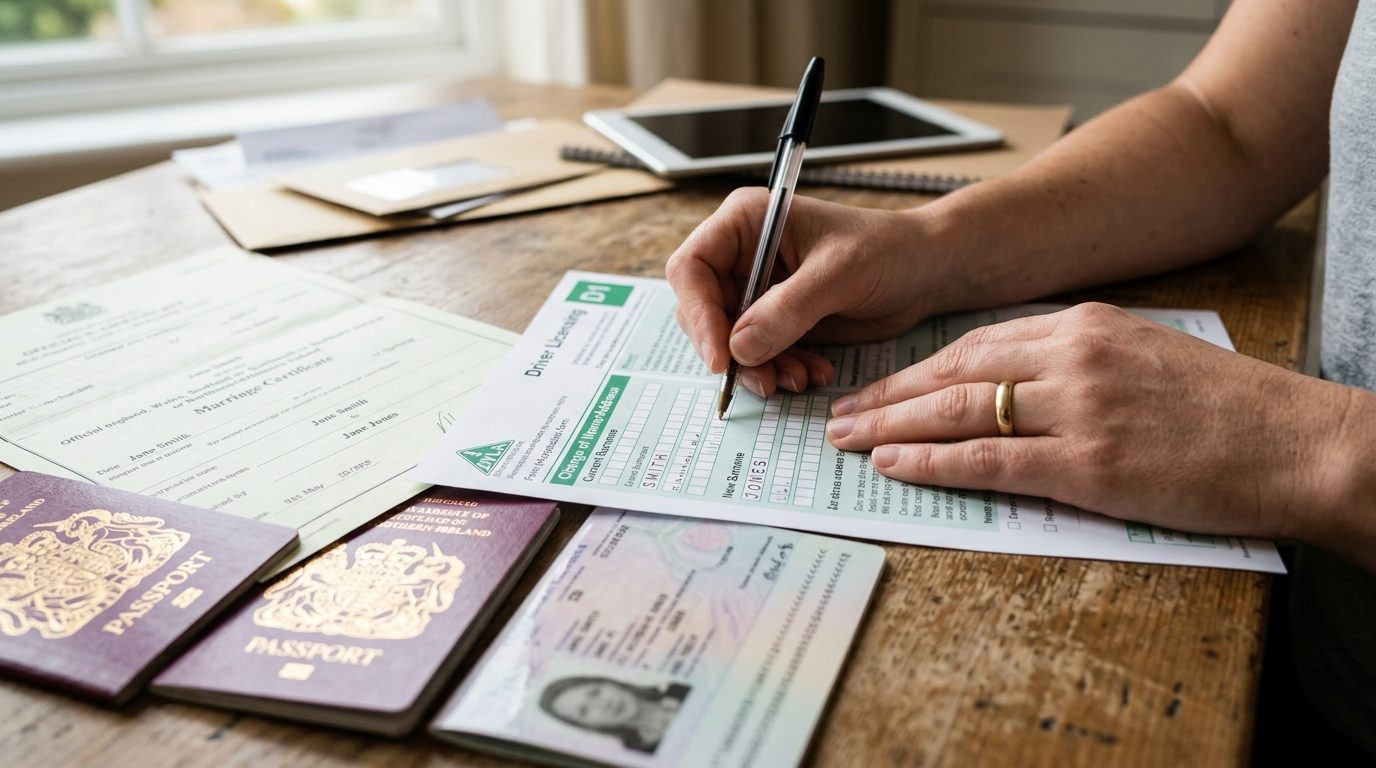
What you need:
- Your current photocard driving licence
- Your marriage certificate (original)
- A passport-style photo
- A completed D1 form (available at Post Offices) or use the DVLA online service
Online vs. post: The DVLA online service at GOV.UK is faster and free. You will need a valid UK passport or biometric residence permit to verify your identity online. If you don’t have a valid passport yet, update your licence after your passport comes through.
Processing time: 2-4 weeks. Free if done online.
Updating your bank accounts and credit cards
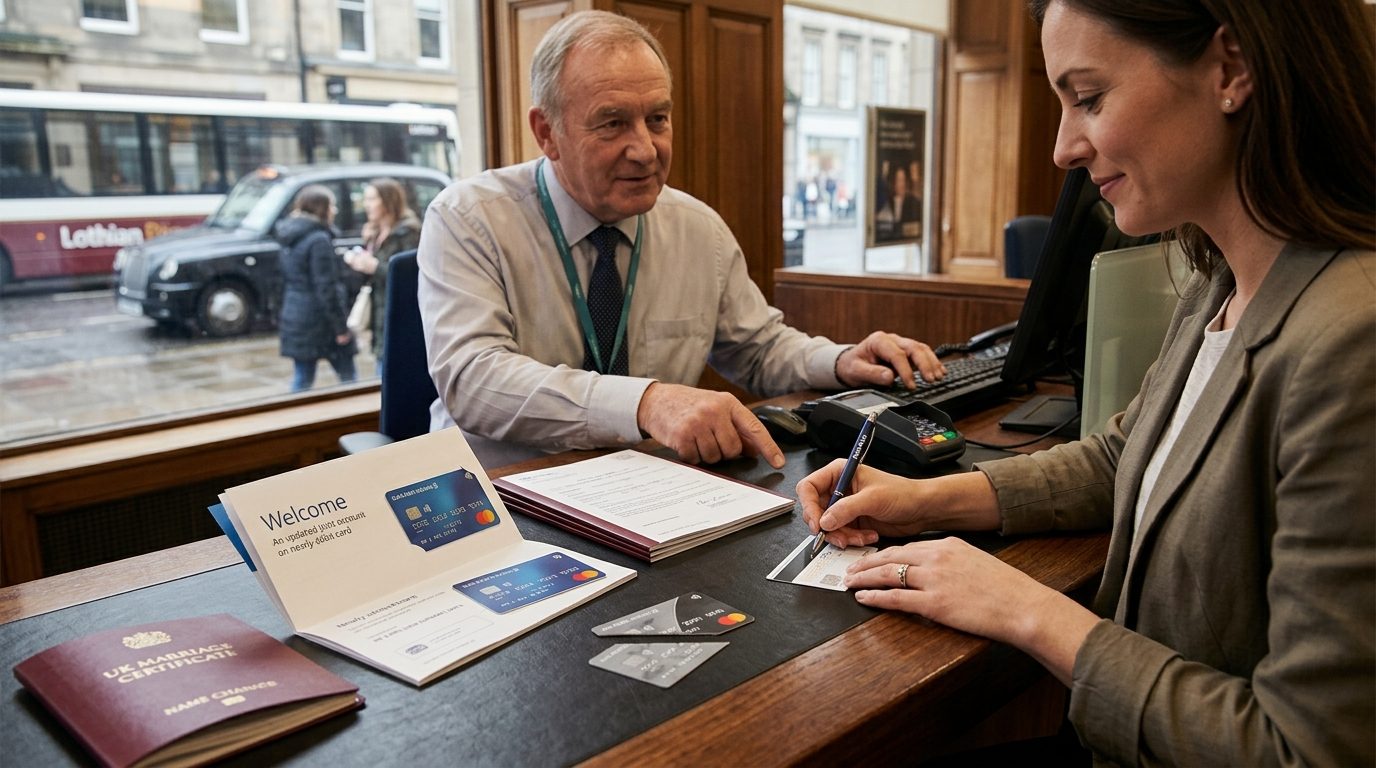 Banks vary significantly in how they handle name changes. Some allow you to walk into a branch with your marriage certificate and update the same day. Others require a postal application. A few — particularly online-only banks — have online processes.
What to take to the bank:
- Your original marriage certificate
- Existing debit/credit cards
- A second form of photo ID (some banks require this)
Inform your current account bank first. Do not cancel cards before the new ones arrive — allow a 2-week overlap.
If you have multiple banks or credit cards: Make a list and work through them in the week after you return from your honeymoon. Most people have more accounts than they initially recall — credit cards, savings accounts, ISAs, premium bonds, store cards.
Updating HMRC
HMRC handles your income tax, National Insurance, and any self-assessment records.
How to update: Call HMRC on 0300 200 3300 (have your National Insurance number ready) or write to HMRC with a certified copy of your marriage certificate. Online updates are possible via your Personal Tax Account on GOV.UK.
Processing time: 2-4 weeks by post; faster by phone or online.
Why this matters: Your employer’s payroll must match HMRC records. If your name on HMRC differs from your payroll name, you can have tax code problems. Update HMRC before you notify your employer’s HR department.
Notifying your employer
Once HMRC is updated, notify your employer’s HR department with:
- A copy of your marriage certificate (ask if they need the original)
- Your new name as you want it to appear on payroll records, contracts, and email address
Also consider:
- Your work email address (ask IT to update this)
- Any professional qualifications or memberships registered in your name
- Employment contracts — your employer may issue a new contract or an amendment letter
Updating your GP and NHS records
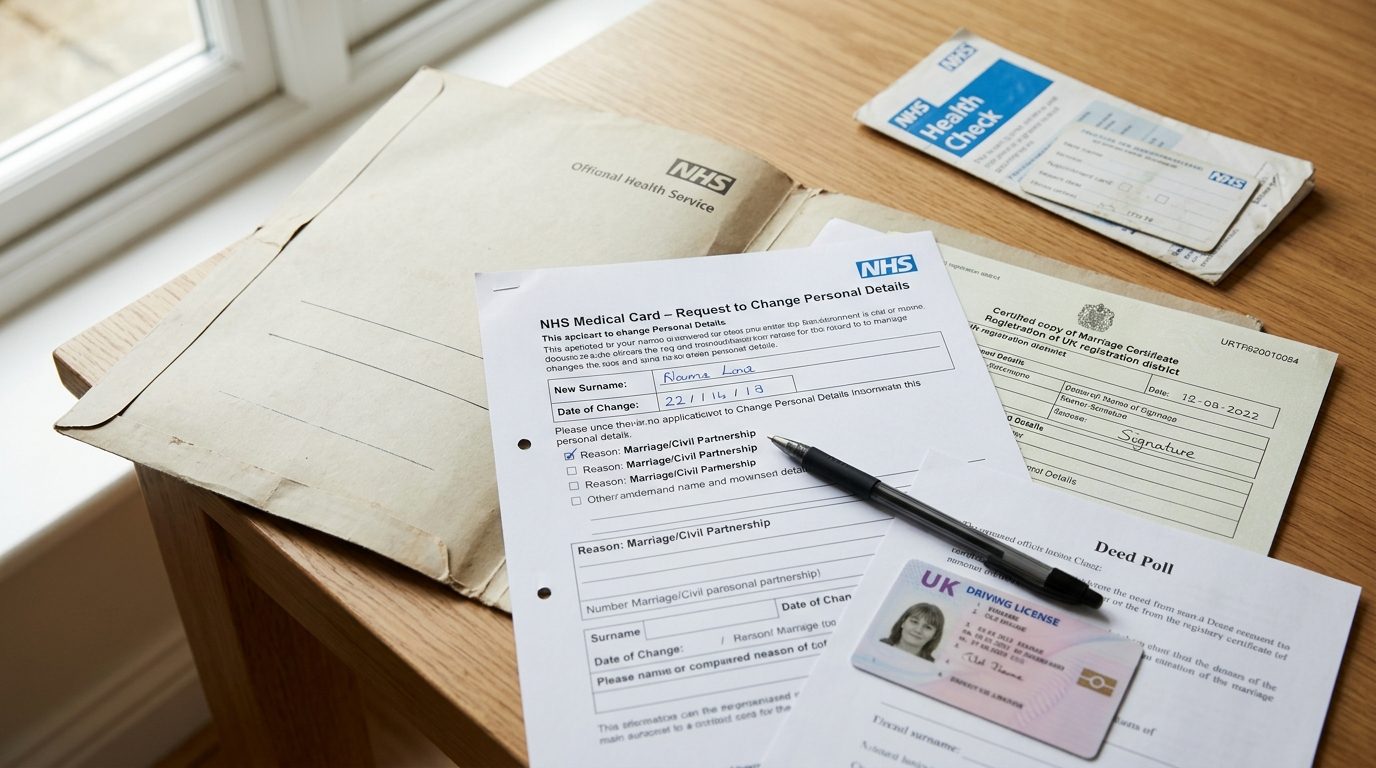
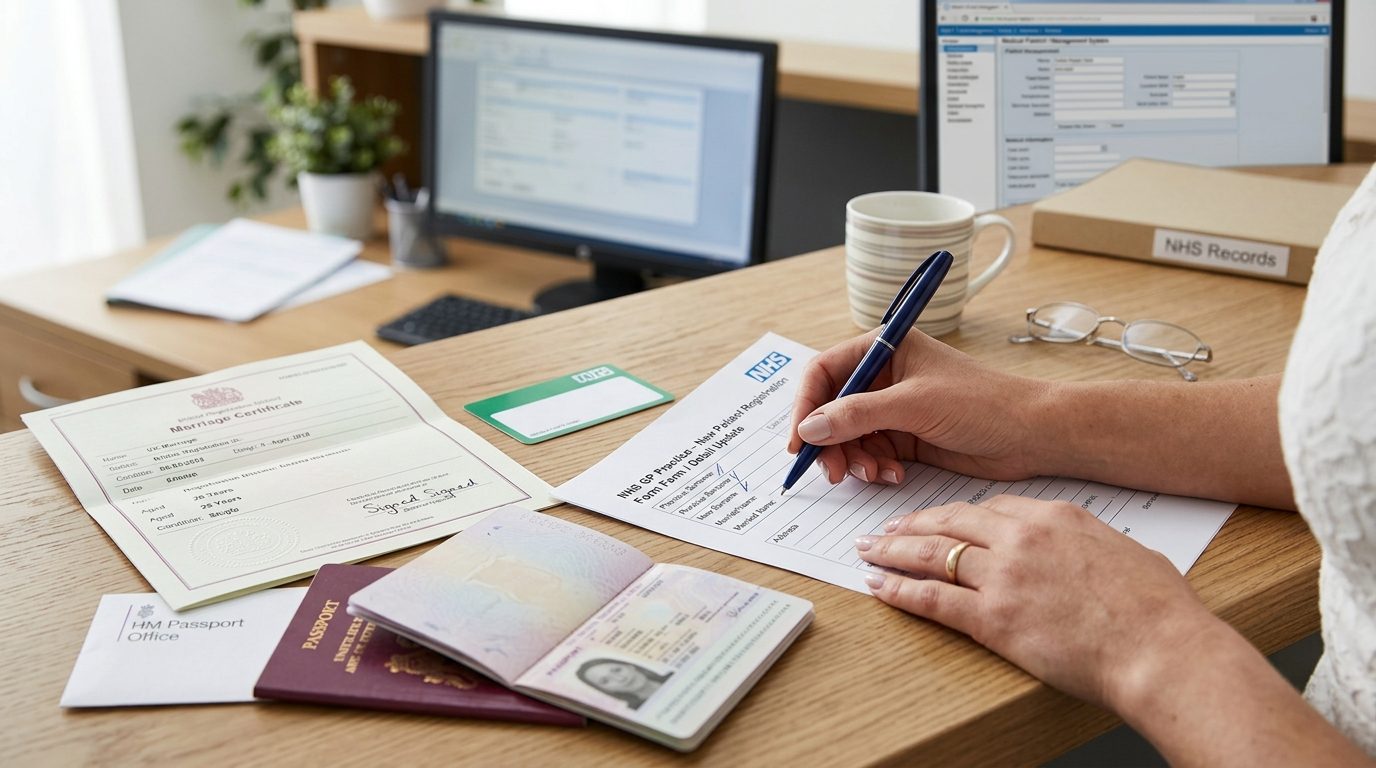 This is the most commonly forgotten update. Your GP surgery holds your NHS records under your previous name, and if you are admitted to hospital or need emergency care, the name on your records may not match your ID.
How to update: Visit your GP surgery in person or call ahead. They will ask for sight of your marriage certificate. The update is made in the NHS Summary Care Record.
Also update:
- Any specialist clinics or consultants you see regularly
- Your dentist and optician
- Any prescriptions registered in your name
The full list of what to update
Here is a complete checklist of institutions and accounts that typically need updating. Work through this systematically over 4-6 weeks after the wedding:
Government and official:
- Passport
- DVLA driving licence
- HMRC (tax records, National Insurance)
- DWP (if you receive any benefits or State Pension)
- Electoral roll (notify your local council)
- GP surgery and NHS records
Financial:
- All bank accounts (current, savings, ISA)
- Credit cards
- Mortgage (notify your lender; a formal deed of name change may be needed for mortgage documents)
- Pension (both employer and any personal pension)
- Premium Bonds (NS&I)
- Any investment accounts
Employment:
- Employer payroll and HR records
- Work email address
- Professional memberships and qualifications
- Trade union membership
Other:
- Car insurance (update immediately — driving with the wrong name on your policy can cause claims to be declined)
- Home contents and buildings insurance
- Life insurance and any protection policies
- Utility accounts (gas, electricity, water, broadband)
- Council Tax
- Mobile phone contract
- Subscriptions (Spotify, Netflix, etc. — low priority, but worth doing)
- Loyalty cards (Clubcard, Nectar, etc.)
- Library card
- Any professional licences (solicitor, medical, teaching) — check with your professional body for their specific process
Special situations
If you want a double-barrelled surname
A hyphenated name using both partners’ surnames is legally straightforward in England and Wales if one or both names are changing through the marriage. Your marriage certificate is the legal basis.
If you want to combine your existing surname with your partner’s — say, Smith-Jones — this is achievable without a deed poll as long as the combination can be traced through your certificate and previous ID. The Passport Office will typically accept this.
If both partners want to take a new shared surname (neither of their existing surnames), you will need a deed poll. A deed poll for both partners costs around £36 each from an enrolled deed poll provider, and is legally binding.
If you are a same-sex couple
The name-change process is identical for same-sex couples. The marriage certificate is the legal basis regardless of gender. Both partners can change their names in any direction — one, both, neither, or a new shared surname.
If you are in Scotland
The process in Scotland is largely the same, with some differences. The National Records of Scotland holds Scottish marriage records. You can request additional certified extract copies from the register office where you registered your marriage.
If you are in Northern Ireland
Update your passport and driving licence as above. The General Register Office for Northern Ireland (GRONI) issues marriage certificates. Contact GRONI for additional copies.
How long does it all take?
| Institution | Typical time |
|---|---|
| Passport (standard) | 3-5 weeks |
| DVLA driving licence | 2-4 weeks |
| HMRC | 2-4 weeks |
| Bank (branch visit) | Same day to 2 weeks |
| GP surgery | Same day or 1-2 weeks |
| Car insurance | Same day (phone call) |
| Employer HR | 1-2 weeks |
| Electoral roll | 2-4 weeks |
Most people complete the core updates within 6-8 weeks of the wedding. Some secondary updates (pension documents, professional memberships, investment accounts) take longer. Be patient — there is no legal deadline by which you must update each institution.
Keep planning
Frequently asked questions
How do you change your name after marriage in the UK?
Your marriage certificate is the legal proof of your name change. You do not need a deed poll. Start with your passport (needed for travel), then update your driving licence, bank accounts, and employer records. The process typically takes 4-10 weeks depending on the number of institutions involved.
Do you need a deed poll to change your name after marriage?
No, not in England, Wales, Scotland, or Northern Ireland. Your marriage certificate is the legal basis for the name change. A deed poll is only needed if you are changing your name for a reason other than marriage.
How long does it take to change your name after marriage in the UK?
The full process typically takes 4-10 weeks. Passport Office name changes currently take 3-5 weeks. DVLA driving licence updates take 2-4 weeks. Banks vary from same-day branch updates to 2-3 weeks by post. HMRC updates typically take 2-4 weeks.
What documents do you need to change your name after marriage?
You need your original marriage certificate (not a photocopy) for most official updates. Some institutions — banks in particular — may ask for an original certificate plus a second form of ID. Order 3-5 certified copies of your marriage certificate from the register office when you collect it.
Can a man change his name when getting married in the UK?
Yes. Men can change their surname to their partner's, use a double-barrelled version, or create a new combined surname, all using the marriage certificate as the legal basis. The process is identical regardless of which partner is changing their name.
What if you want to double-barrel your name after marriage?
A double-barrelled surname after marriage requires no deed poll if both names appear on the marriage certificate. If only one name is on the certificate and you want to combine it, you will need a deed poll. Update your passport first — the Passport Office will accept the marriage certificate for a hyphenated version as long as both names can be traced.
Is it free to change your name after marriage in the UK?
Changing your name using your marriage certificate is free in most cases. The costs involved are: additional certified marriage certificate copies (£11 each from the General Register Office), a new passport if required (£88.50 adult standard fee), and DVLA licence update (free if done via the DVLA online service).