Caped Veils & Detachable Overskirts: UK Bridal Guide
Key Takeaways
- Bridal capes and caped veils are among the top three most-searched bridal accessory terms on WeddingsHub in early 2026 — behind only veils and tiaras
- A floor-length bridal cape in silk or organza costs £350-£900 from a UK bridal accessory specialist, or £500-£1,400 when made to order by a UK designer
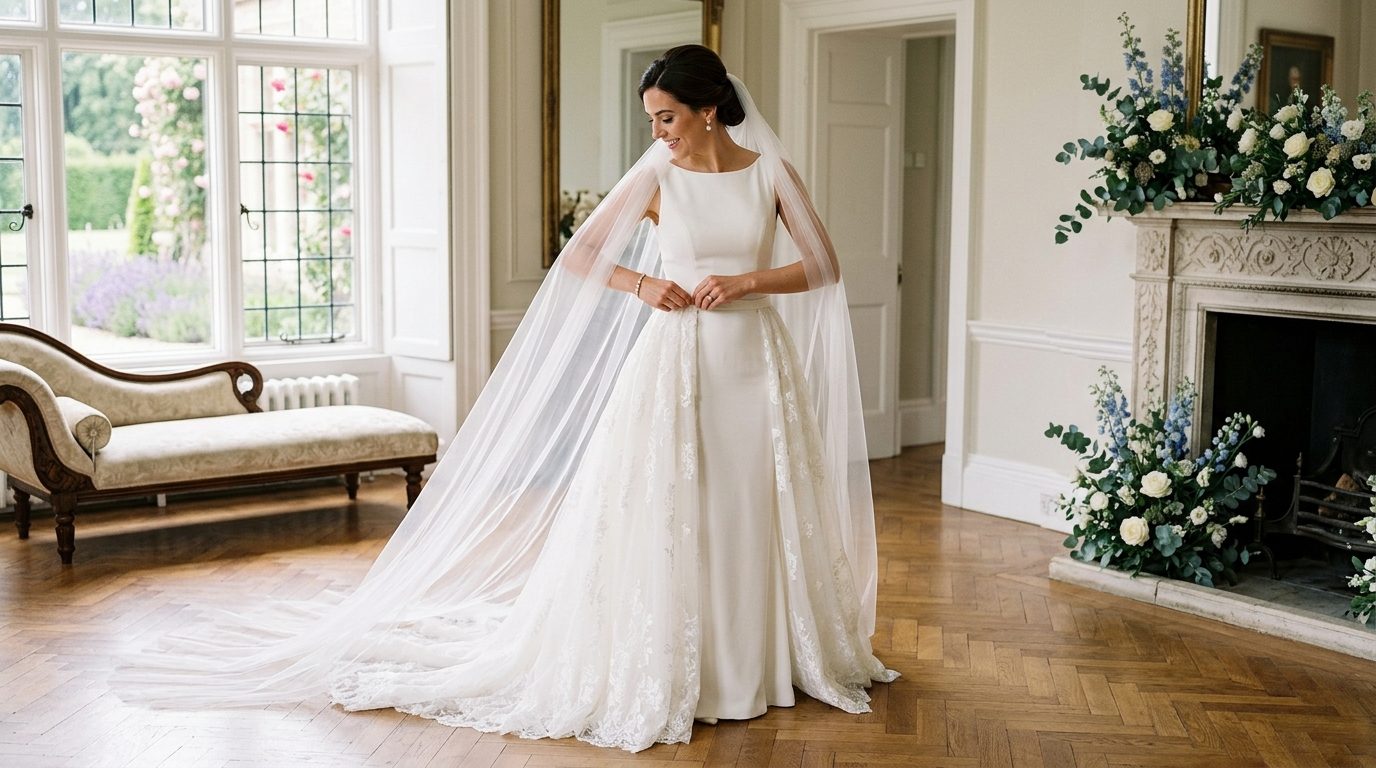
- The caped veil combines a traditional veil with a cape body — it reads as ceremonially formal but removes cleanly to reveal a completely different look beneath
- Halfpenny London pioneered the designer bridal cape in the UK market; the style has now been adopted by major UK department stores and online bridal retailers
- Most capes attach via a simple hook-and-eye or ribbon at the neck or shoulders — removal takes under 30 seconds with a helper
What is a bridal cape and why is it growing?
A bridal cape is a standalone layer worn over the wedding dress. It is not part of the gown — it attaches independently, usually at the neck or shoulders, and removes without any alteration to the dress beneath. Lengths range from shoulder-skimming boleros to floor-trailing dramatic trains in their own right.
The bridal cape solves a specific problem that modern couples increasingly face: they want one look for the ceremony and a different look for the reception, without buying two separate outfits.
Traditional approaches to this problem were unsatisfactory. Buying a second “going-away” outfit added cost and complexity. Wearing a jacket over the dress was a practical solution but rarely as visually impactful. The bridal cape threads the needle: it adds dramatic ceremonial presence that photographs powerfully on the aisle, then detaches to reveal the simpler dress beneath — which is often exactly what is needed for dancing, the first conversation, and the four hours after dinner.
The style was pioneered in the contemporary UK market by Halfpenny London from around 2014 onwards, and has since been adopted by every tier of the UK bridal market from couture to high street.
For the broader context of detachable layers across the bridal market, see our guide to modular wedding dresses.
Types of bridal cape in 2026
The floor-length trailing cape
The most dramatic option — a cape that meets or exceeds the length of the dress, with a trailing section behind that creates the impression of a very long train. Made in organza, silk, or embroidered tulle.
The floor-length cape works best visually when the base dress is relatively simple: a silk slip dress, a column gown, or a fitted sheath. The cape provides all the ceremony-scale visual weight. Removing it reveals the dress at its cleanest.
Cost: £500-£1,400 made-to-order. £350-£700 ready-to-wear.
Best for: outdoor ceremonies, long church aisles, large format venues where scale matters.
The three-quarter length lace cape
The most popular length — falling to mid-back or hip level. Long enough to create visual presence on the aisle, short enough to not complicate movement or require bustling.
Lace is the most popular fabric at this length. A lace cape over a plain silk gown creates the impression of a lace dress at ceremony distance, without committing the full dress to lace construction.
Cost: £350-£800 made-to-order. £250-£600 ready-to-wear.
Best for: church weddings where shoulder coverage is expected or preferred; brides who want lace as a ceremony element without a lace gown; the most versatile length across venue types.
The bolero-style cape
Short, structured, falling to the waist or above. A fashion-forward option that reads more like a jacket than a traditional cape. Typically in heavier fabric — ivory satin, embellished dupion, structured mikado.
Cost: £200-£600. More accessible at the lower end because the smaller fabric quantity reduces production costs.
Best for: civil ceremonies, contemporary venues, brides with a fashion-editorial sensibility who want the ceremony coverage without the length.
The caped veil
The caped veil combines a traditional veil with a cape body. Unlike a standard veil (which attaches at the crown of the head), a caped veil attaches at the shoulders and falls behind the bride with veil-like length and movement.
The visual effect at the ceremony is of something between a cathedral veil and a cape — significant, trailing, and deeply dramatic on a long aisle. Post-ceremony, it detaches as a single piece.
The caped veil is particularly popular for church weddings where the full ceremonial impact of a long veil is wanted but the bride does not want to wear a hairpiece all day.
Cost: £400-£950. The construction complexity (combining the cape body with veil fabric neatly) means caped veils are more expensive than comparably sized plain capes.
The embellished evening cape
A separate category — a cape added not for the ceremony but for the reception or evening. Heavily beaded, sequinned, or feather-trimmed. These are reception-addition pieces rather than ceremony-removal pieces: the bride starts in a simpler look and adds the cape for a dramatic entrance at the first dance.
Cost: £450-£1,200.
Detachable overskirts: the other half of the trend
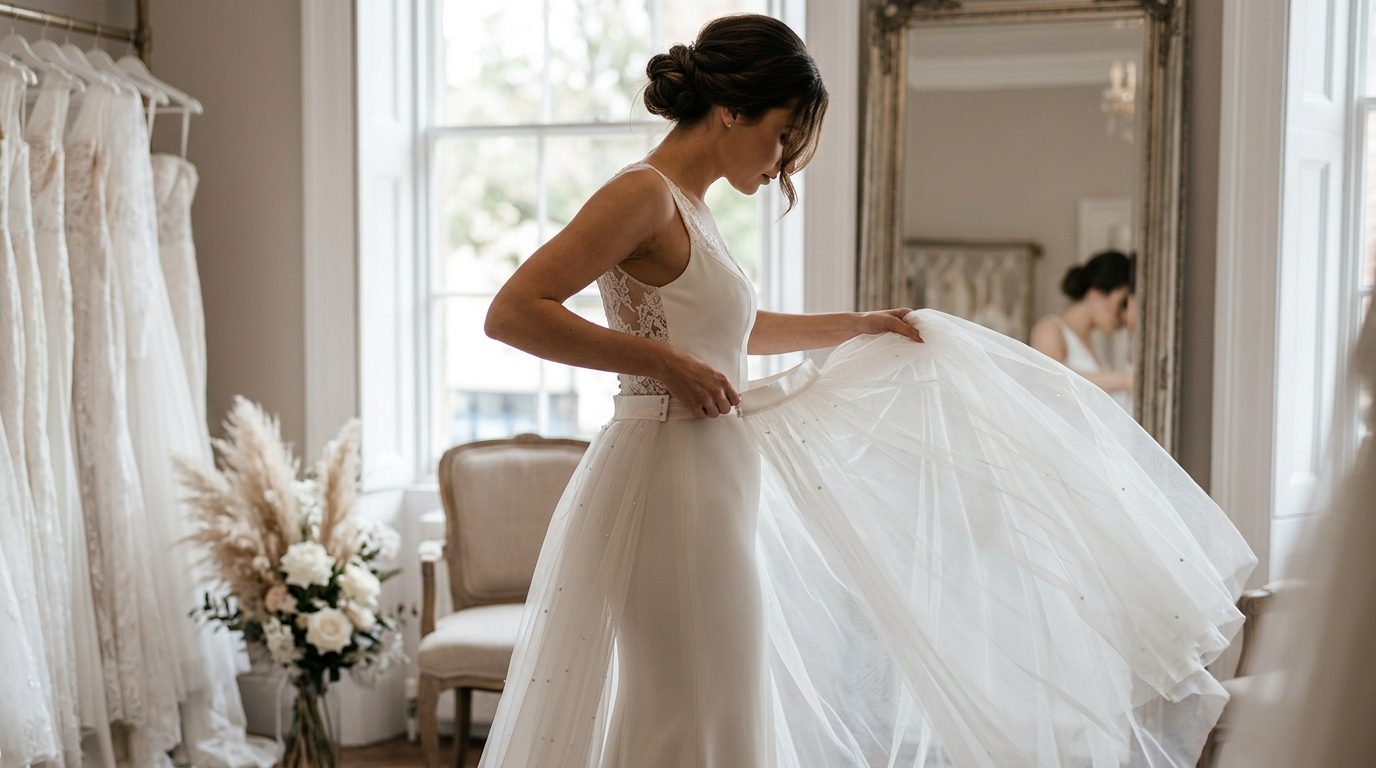
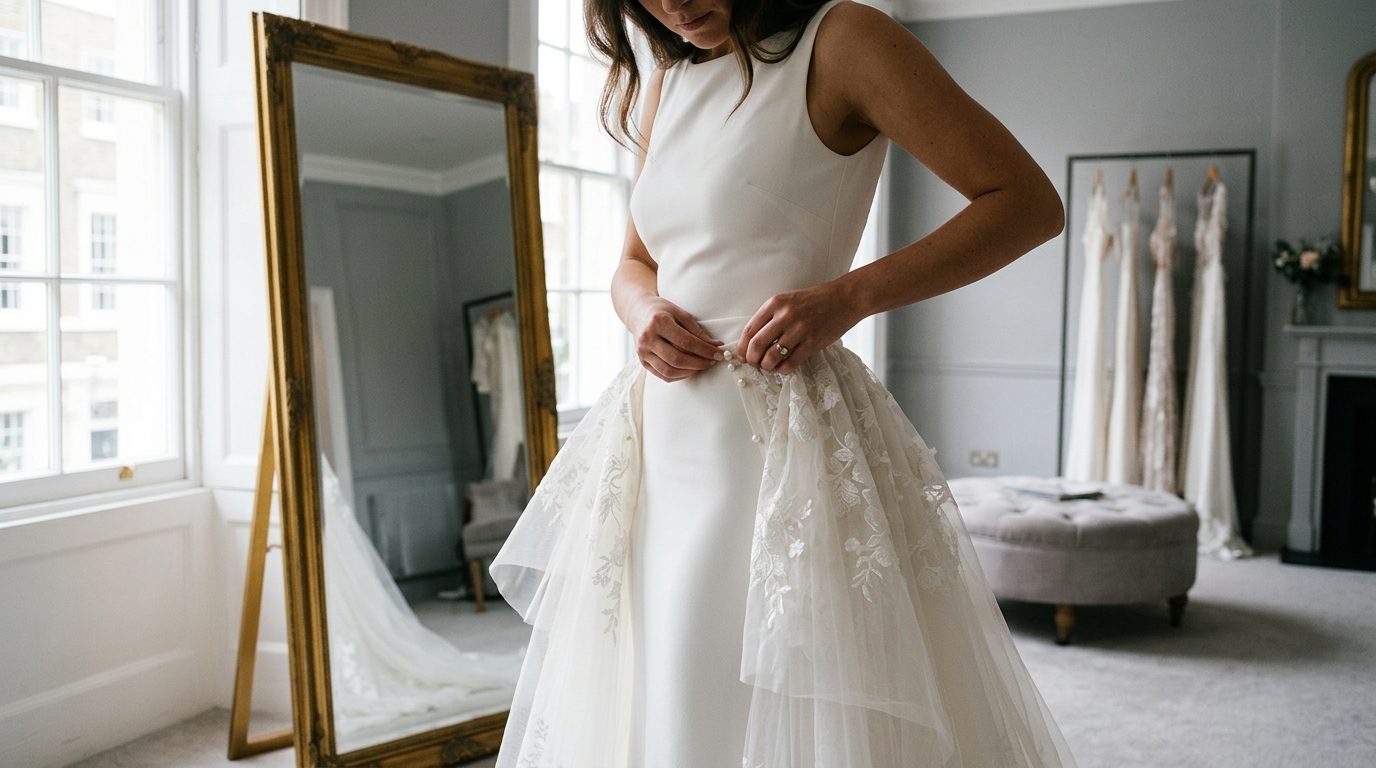 While bridal capes transform the upper half of the dress, detachable overskirts transform the lower half. The two approaches can be combined, but each works independently.
What a detachable overskirt does
A detachable overskirt attaches at the waist of the base dress — usually via a hook-and-eye waistband or a zip closure — and creates a completely different silhouette beneath the waist. The most common transformation: converting a sheath or column dress into a ball gown or A-line silhouette for the ceremony, then removing it to reveal the original slim dress for the reception.
This transformation is visually dramatic — the silhouette below the waist changes entirely. It is also genuinely practical: dancing in a full tulle overskirt is harder than dancing in a sheath.
Overskirt styles and attachment methods
Full tulle overskirt: The most popular. Layers of tulle creating soft volume. Attaches at a waistband hooked around the base dress. Removal is usually done by a bridesmaid or partner — unhook the waistband, lift the overskirt over the head or step out of it.
Structured satin A-line overskirt: A firmer, more structured shape. Creates a cleaner, more traditional A-line silhouette versus the soft volume of tulle. Suits more formal settings.
Draped organza overskirt: A single layer of structured organza, usually asymmetric or with a trailing side. More contemporary and editorial than a traditional full overskirt.
Attachment methods:
- Waistband hook-and-eye: The most common and most secure. A waistband sewn into the overskirt hooks around the waistband of the base dress. Requires the base dress to have a defined waistband or seam.
- Ribbon tie: Simple ties at the waist. Quicker to put on and remove. Less secure for heavier overskirts.
- Hidden zip: Creates the cleanest line at the waist. Requires the overskirt to be taken to the ceremony already attached.
Overskirt costs
| Overskirt type | Ready-to-wear | Made-to-order | Custom fit |
|---|---|---|---|
| Full tulle (3-5 layers) | £200-£450 | £350-£700 | £450-£900 |
| Structured satin A-line | £250-£500 | £400-£750 | £500-£950 |
| Draped organza | £200-£420 | £350-£650 | £450-£800 |
How to wear a bridal cape: practical guide
The attachment points
Most bridal capes attach at one of two points:
Neck hook: A single hook at the collar or just below. The simplest and most common. The cape hangs from this single point and is held in place by the weight distribution and the slight tension of the fabric at the back.
Shoulder ties or hooks: Two attachment points, one at each shoulder seam. More secure for heavier capes. Less elegant than a single neck hook because the attachment hardware is more visible.
Press-stud system: Multiple press studs along the shoulder or collar seam. Very secure, slightly fiddlier to attach correctly at the ceremony venue.
Removing the cape
Brief one bridesmaid to be the “cape handler.” Practise the removal once before the wedding day — it should take no more than 30 seconds. The removal is often captured on video as a transition moment and can be choreographed deliberately (a turn-around reveal).
Storing the cape
The cape is a delicate garment and needs a dedicated garment bag for transport and storage during the reception. Most brides leave it with the bridesmaid responsible, in a safe space at the venue.
Where to buy bridal capes and overskirts in the UK
UK designer options
Halfpenny London: The market pioneer for the contemporary UK bridal cape. Floor-length organza and silk capes from approximately £650-£1,100. Available direct from Shoreditch studio or via authorised stockists.
Eliza Jane Howell: A London-based bridal designer known for heavily embellished pieces. The cape collection focuses on embellished and beaded evening capes at £700-£1,400.
Anie Bridal: An online UK bridal brand with a strong overskirt collection. Ready-to-wear options from £295-£650. Ships in 12-16 weeks.
Rachel Simpson: Known primarily for bridal shoes but expanded into accessories including simple organza capes at £250-£450.
Department stores and accessible options
John Lewis Partnership: Stocks a growing selection of bridal capes through its bridal accessory range, including pieces from independent UK makers via its marketplace. Prices £150-£450.
ASOS Bridal: Has expanded its bridal accessory section significantly in 2025-26. Capes from £95-£250. Good for ready-to-wear accessible options. Less suitable for brides who need custom sizing.
Not On The High Street: A curated marketplace of UK independent makers. Search “bridal cape” for a range of handmade options from £180-£600.
Etsy UK: The most varied selection of UK-made bridal capes. Prices range significantly (£80-£800) and quality varies accordingly. Always check maker reviews and lead times.
The bridal cape and the 2026 trend context
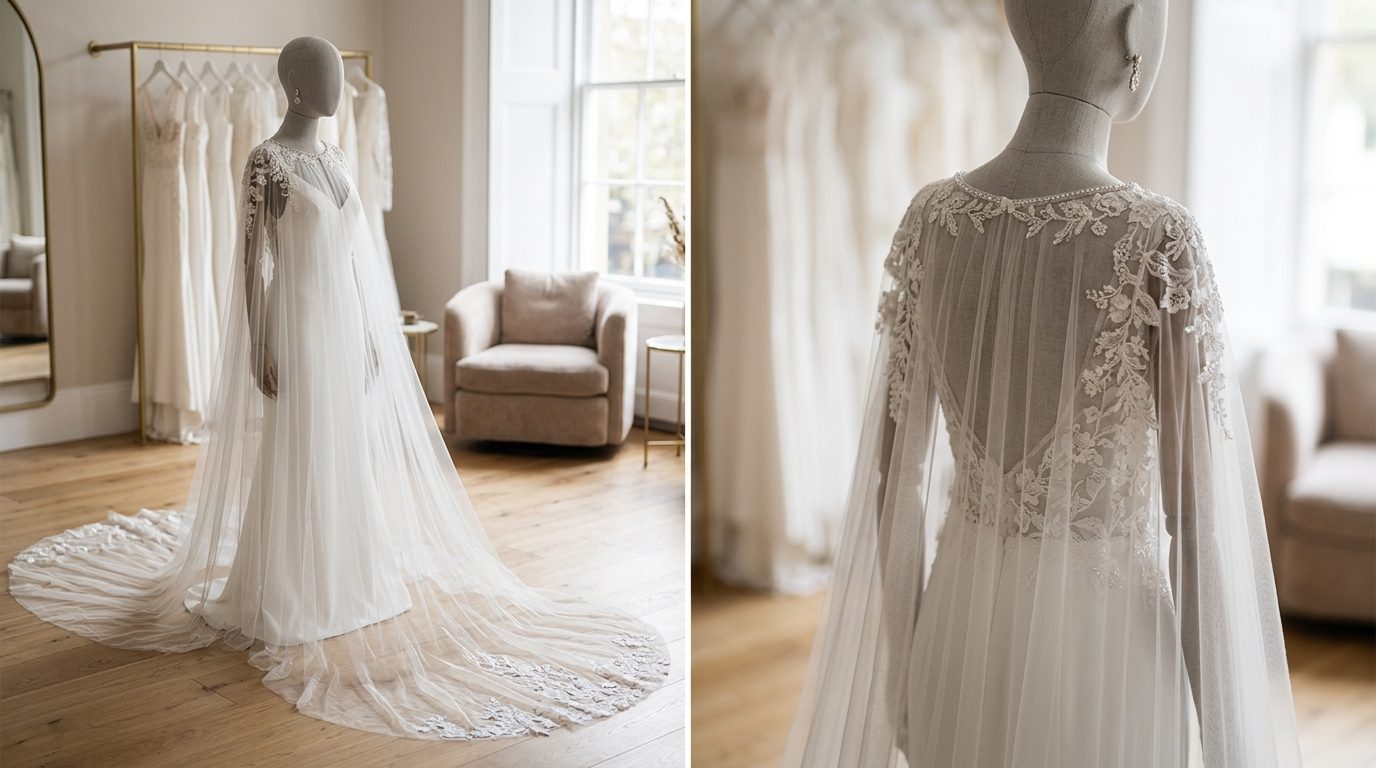
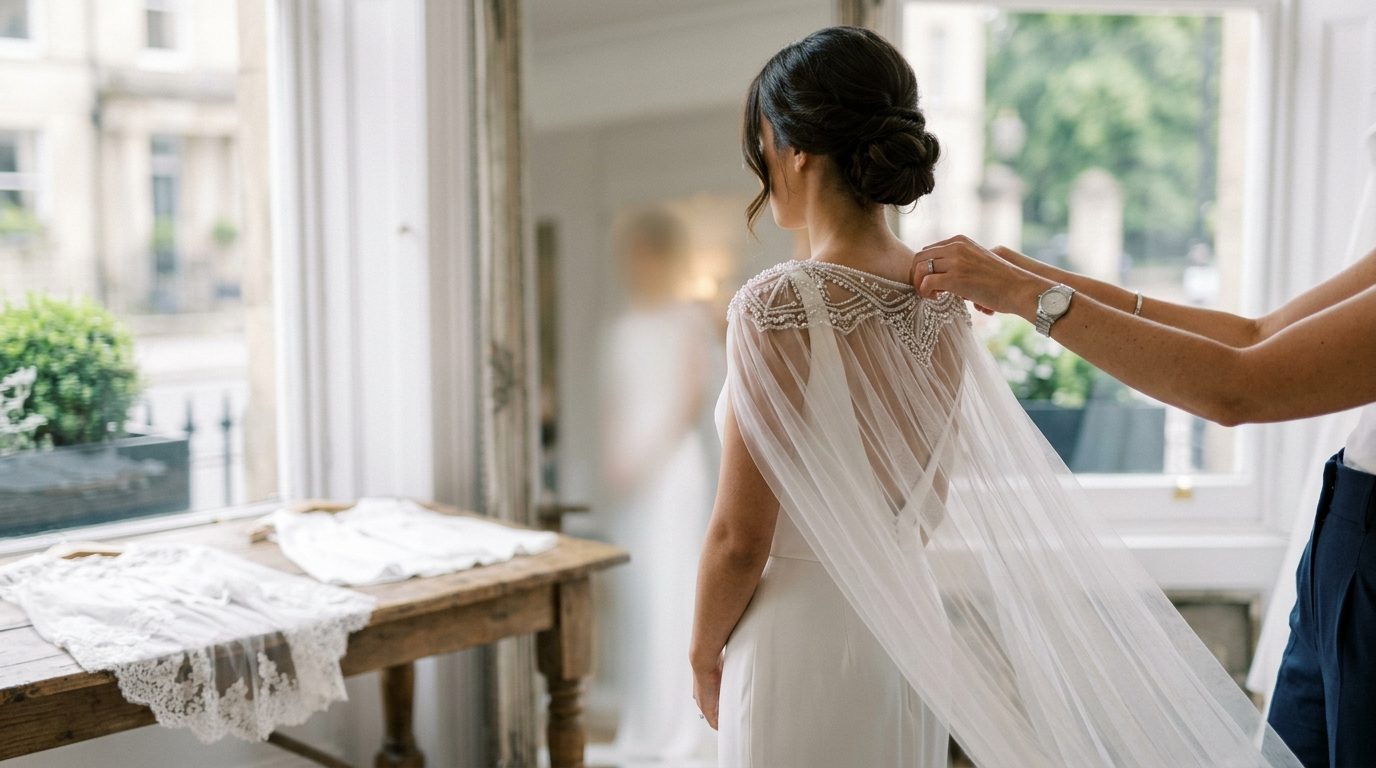 The bridal cape connects to several of the broader aesthetic movements in UK wedding fashion in 2026.
The modular dress trend: Capes are the most accessible entry point into modular bridal fashion — they do not require modifying the base dress and cost significantly less than a full separates approach. A bride who wants the flexibility of two looks but cannot afford two designer pieces can achieve a strong two-look effect with a well-chosen cape on a relatively simple base dress.
The outdoor ceremony effect: Post-2022, more UK ceremonies happen outdoors. Outdoor settings demand more visual presence from the dress at distance — a long train, a dramatic cape, or a full overskirt that reads well across a meadow. Indoors, the intricate detail of a lace bodice can carry the ceremony; outdoors, scale and movement matter more.
The warm florals palette: The 2026 wedding palette trend towards warm botanicals — cream, terracotta, blush, burgundy — suits the fabric choices that bridal capes work best in. A silk or organza cape in warm ivory, ecru, or soft white blends naturally with a warm botanical setting.
For the 2026 UK bridal dress colour context, see our warm ivory wedding dress guide. For the full bridal trends overview, see 2026 UK Bridal Trends from London Bridal Week.
A first-hand account: one cape, two very different looks
One bride in our reader panel — married in Devon in August 2025 — used a floor-length organza cape over a simple slip dress.
“My dress was a very simple bias-cut silk dress I bought for £680 from Ghost. It was exactly what I wanted for the reception — light, easy to move in, looked like a luxurious party dress. But for an outdoor garden ceremony with 70 guests, it felt too small visually. The cape changed everything. I had a floor-length organza cape made by an independent Etsy maker — I paid £320 for it.”
“Walking down the aisle with the cape on, I had the full ceremonial presence. The fabric moved in the breeze. My grandmother cried. Two minutes after the ceremony we were by the lake taking photographs, and my bridesmaid unhooked the cape. Ten seconds, and it was a completely different look. Everyone commented on how different I looked at the reception.”
Her total cost: £680 (dress) + £320 (cape) + £280 (alterations) = £1,280. “For what I got — two completely different looks — it was exceptional value.”
Frequently asked questions
What is a bridal cape veil?
A bridal cape veil combines the function of a veil (length behind the bride, movement on the aisle) with a cape body that covers the shoulders and upper back. Unlike a traditional veil attached at the crown, a caped veil is worn like a cape — draped over the shoulders — and typically fastens at the neck or chest. It creates strong visual impact on the aisle and removes cleanly for the reception.
How much does a bridal cape cost in the UK?
A ready-to-wear bridal cape in silk or organza costs £350-£700 from UK bridal accessory specialists. Made-to-order capes from a bridal designer cost £500-£1,400 depending on fabric, length, and embellishment. Accessible options from ASOS Bridal and H&M Conscious collection cost £95-£250.
What is the difference between a cape and an overskirt?
A bridal cape is worn over the shoulders and upper body — it addresses the upper half of the dress. A detachable overskirt attaches at the waist and addresses the lower half — converting a slim sheath or column dress into a fuller silhouette for the ceremony. Both serve the same functional purpose: transforming the aisle look, then removing for the reception.
Can I add a cape to any wedding dress?
Yes. A bridal cape is a standalone piece that does not require any modification to the underlying dress — it is worn over the top and fastens independently. The attachment method (hook, ribbon, or tie) works with virtually any dress style. The visual effect varies: a cape over a strapless gown creates a dramatically different look to a cape over a long-sleeved dress.
What styles of bridal cape are popular in 2026?
The most popular styles in 2026 are: floor-length organza or silk capes with trailing length behind (the most dramatic); three-quarter-length lace capes that cover the shoulders and fall to mid-back (the most popular length for church ceremonies); short bolero-style capes for a fashion-forward look; and embellished beaded capes for evening or winter weddings.
Do detachable overskirts stay on securely during the ceremony?
When properly fitted, yes. A detachable overskirt attaches via a waistband that hooks onto the underlying dress, usually at two or three points. The fit should be snug enough that the overskirt does not shift during movement. Have a seamstress assess the fit at the fittings stage — a poorly attached overskirt can fall at the worst possible moment.
Where can I buy a bridal cape or overskirt in the UK?
UK options include: Halfpenny London (the originator of the contemporary UK bridal cape aesthetic), Anie Bridal, Eliza Jane Howell, and independent bridal accessory makers on Etsy UK. At accessible prices, ASOS Bridal, John Lewis Partnership, and Not On The High Street have growing cape selections.