Home / Articles / Hair & Beauty
Bridal Hair Trial UK: Costs, Timings & What to Ask
Key Takeaways
- Book your trial 2-4 months before the wedding — not too early (hair changes) and not too late (no time to rebook)
- Wear a top with the same neckline as your dress to the trial — or bring your dress if the stylist is at your home
- Take photos in natural light, from all angles; ask for a photo log from your stylist too
- Most brides need one trial; those with very fine, curly, or colour-treated hair may need two
- Ask about travel fees — many UK bridal stylists charge £1-£2 per mile beyond 10 miles
What is a bridal hair trial and why does it matter?
A bridal hair trial is a full styling appointment booked specifically to test and photograph your chosen wedding hairstyle. It is not a consultation — the stylist actually creates the style from start to finish.
The purpose is four-fold:
- Confirms the style works with your face shape, dress neckline, and accessories.
- Tests hold time. Your stylist can see whether your hair needs extra product or pins to last 10+ hours.
- Builds trust. You meet the stylist before the highest-stress morning of your wedding planning.
- Creates a record. The stylist photographs the finished style from all angles and notes exactly what products and techniques they used.
Without a trial, you are trusting that a style you saw on Pinterest will translate to your specific hair texture, density, and length — on a morning when there is no time to start over.
What does a bridal hair trial cost in the UK?
| Service | Average cost | Range |
|---|---|---|
| Bridal hair trial | £85 | £65-£140 |
| Wedding day bridal styling | £180 | £130-£350 |
| Bridesmaid hair (per person) | £65 | £45-£110 |
| Flower girl hair | £35 | £25-£55 |
| Travel fee (beyond 10 miles) | £1.50/mile | £1-£2/mile |
| Second trial | £75 | £50-£120 |
Most stylists deduct the trial cost from your wedding day invoice. A few include the trial for free when you book a full wedding party package (bride + 3 or more people).
London premium: stylists in Greater London charge 25-40% more than the UK average. Expect £100-£180 for a trial in Zone 1-3 London.
When to book your bridal hair trial
Booking the stylist: 9-12 months before
Top UK bridal stylists in popular wedding counties — Surrey, Cheshire, Yorkshire, Kent — fill up 10-12 months ahead for summer Saturdays. Book the stylist and the wedding day slot well before you need the trial.
Scheduling the trial: 2-4 months before the wedding
This window matters. Too early (6+ months out) and your hair may change — colour, cut, or condition — between the trial and the wedding day. Too late (less than 6 weeks out) and you have no room to rebook if the result is wrong.
Ideal timing: 10-12 weeks before the wedding. This gives you:
- Time for a second trial if needed
- Time to grow out or trim to the right length
- Time to try a different stylist if necessary
What to bring to your bridal hair trial
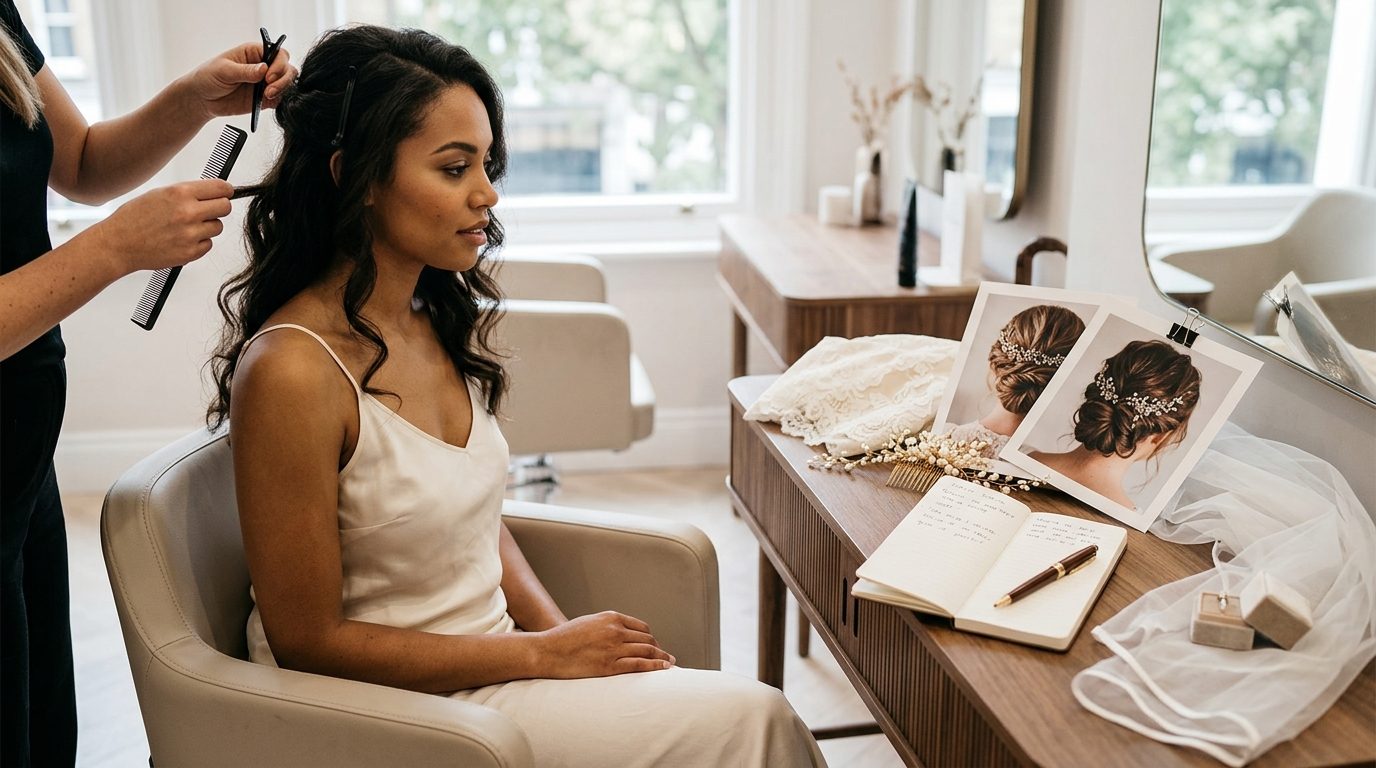
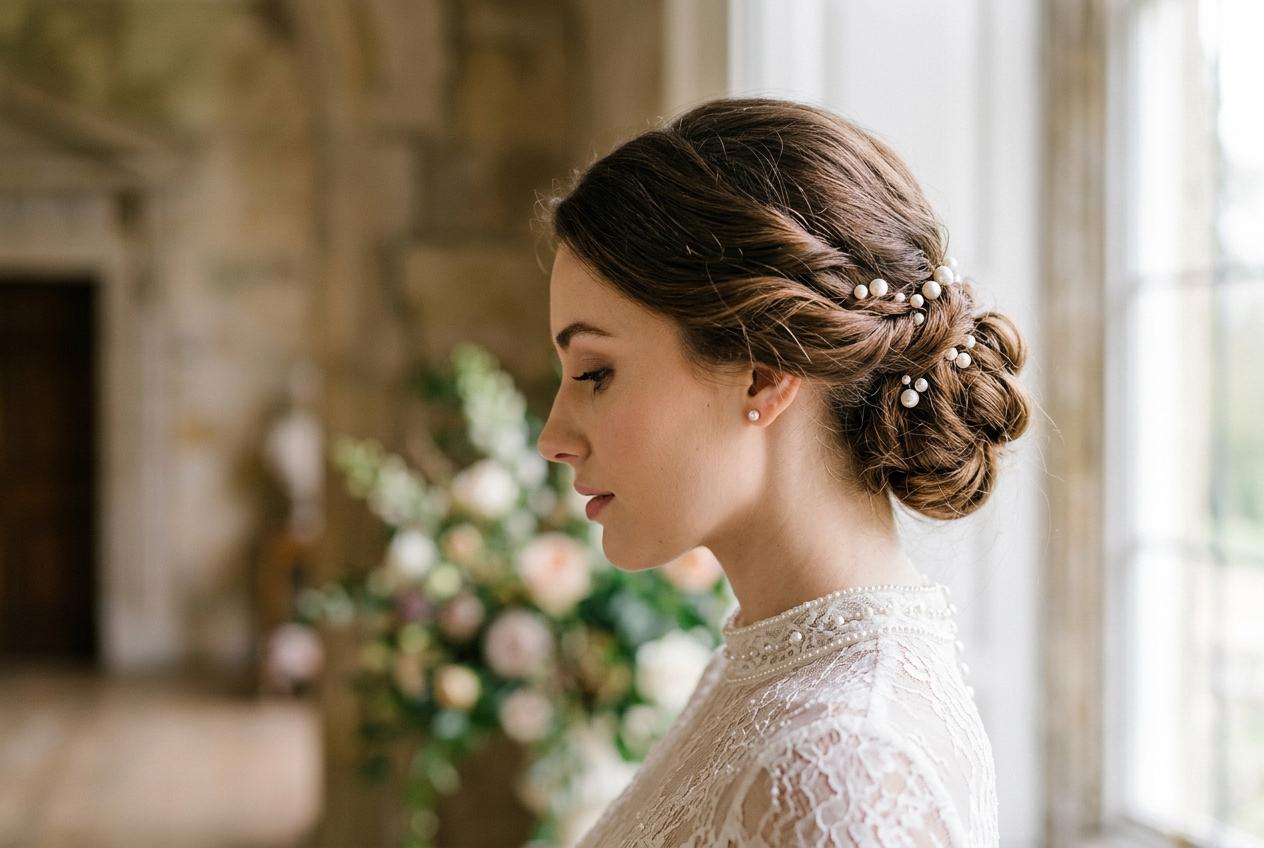
Photos (5-10 references)
Save images of styles you like on your phone, not just one perfect photo. Include styles from different angles — front, side, back. Mix in images of hair you don’t like, explained briefly (“I like this but don’t want it so tight”). This gives your stylist contrast to work from.
Pinterest boards work well for this. Browse UK bridal hair styles for a starting reference.
Your veil and hair accessories
Bring any tiara, comb, clip, or pearl pins you plan to wear. The stylist needs to fit the accessory into the style — finding out it doesn’t sit correctly on your wedding morning is not acceptable.
If your veil is not yet purchased, bring a fabric scarf in a similar length and weight so the stylist can simulate where the attachment point will fall.
A top with the right neckline
Do not wear a polo neck or high-collar shirt to a hair trial for a strapless or low-back dress. Wear a strapless or V-neck top, or bring your dress if the stylist is attending your home on the wedding morning.
The neckline affects how much hair sits on the shoulders, which changes the visual weight of the style.
A friend for a second opinion
Your stylist will be behind you for most of the appointment. You will be looking in the mirror, which is not the same as seeing yourself as a guest would. Your maid of honour or mother can see the back, the full profile, and how the style looks when you turn.
What happens during the trial
- Consultation (15-20 minutes): The stylist asks about your dress, venue, and timing. They look at your photo references and assess your hair — texture, density, natural curl, and condition.
- Prep: The stylist may wash, blow-dry, or curl your hair before creating the style, depending on the look.
- Styling (60-90 minutes): The full style is created from start to finish.
- Finishing: Products applied, hold tested.
- Photography: Both of you photograph the result from all angles. Many stylists now use a shared album or WhatsApp thread.
- Notes: Your stylist records exactly which products, tools, and techniques were used so the wedding day is a precise repeat.
- Discussion: You discuss what worked, what to adjust, and whether a second trial is needed.
18 questions to ask at your bridal hair trial
Ask these during the consultation and styling appointment. Your stylist should be able to answer all of them.
Before the trial:
- Have you styled this type of hair before — texture, density, length?
- How many weddings do you do per day?
- Will you be the person styling my hair on the day, or an assistant?
- What time will you arrive on the wedding morning?
- How do you handle delays if one of the wedding party runs late?
During the trial: 6. What products are you using and why? (Useful if you are sensitive to certain ingredients) 7. How long will this style realistically hold without touching? 8. Will humidity or wind affect this style, and what should I do if it does? 9. What pins or grips are in the style, and will I feel them? 10. Can I add more volume or texture or softness — and what would that look like? 11. How do I travel to the venue without crushing it?
After the trial: 12. Are you happy with how this went? What would you do differently on the day? 13. Do I need to do anything to my hair in the weeks leading up to the wedding? 14. Should I come with my hair washed, dry, or with product in it on the morning? 15. What happens if my hair is in worse condition than today? 16. Do you carry spare pins, grips, and products with you on the day? 17. What is your cancellation policy if you are unwell? 18. Can you provide a backup stylist in case of emergency?
That last point matters more than most brides realise. UK wedding supplier protection explains what to do if a supplier cancels at short notice.
Bridal hair styles to discuss at your trial
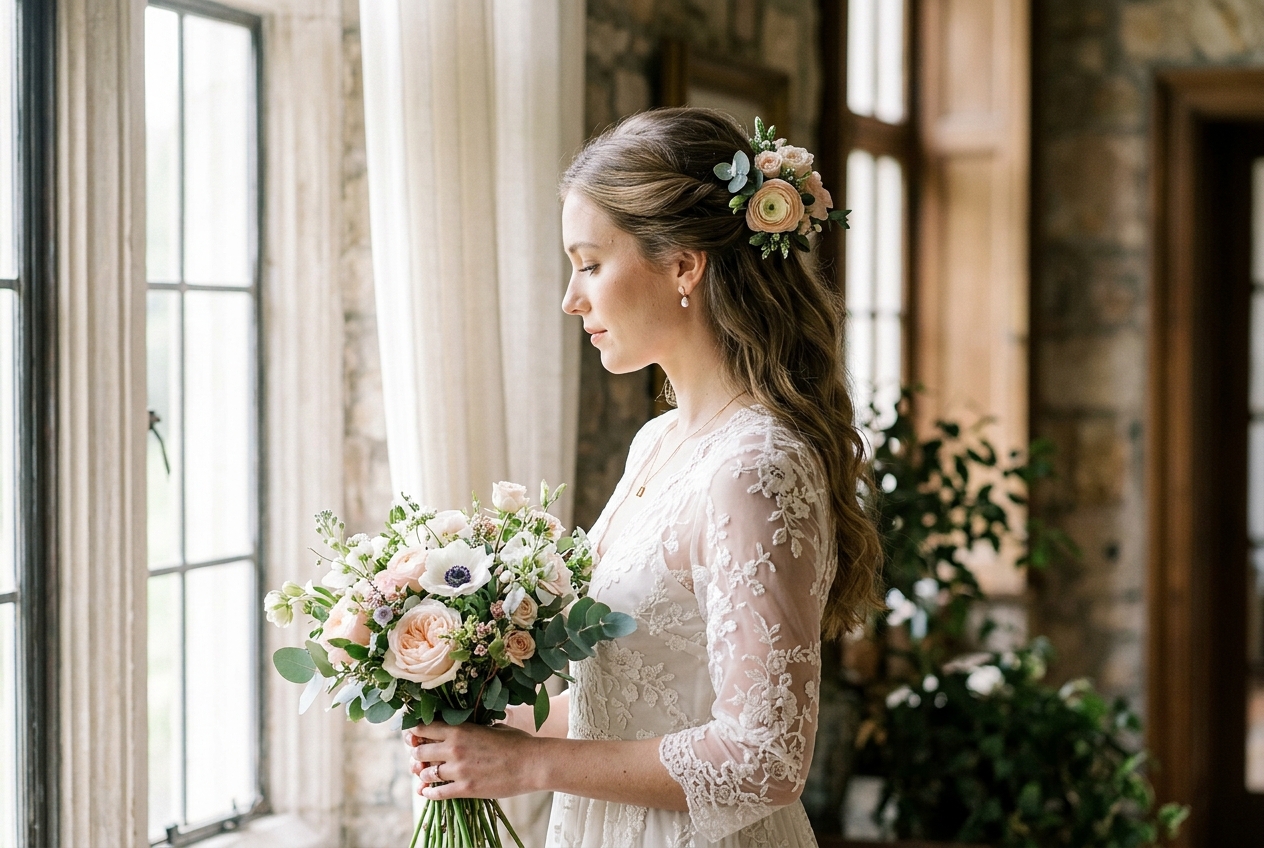
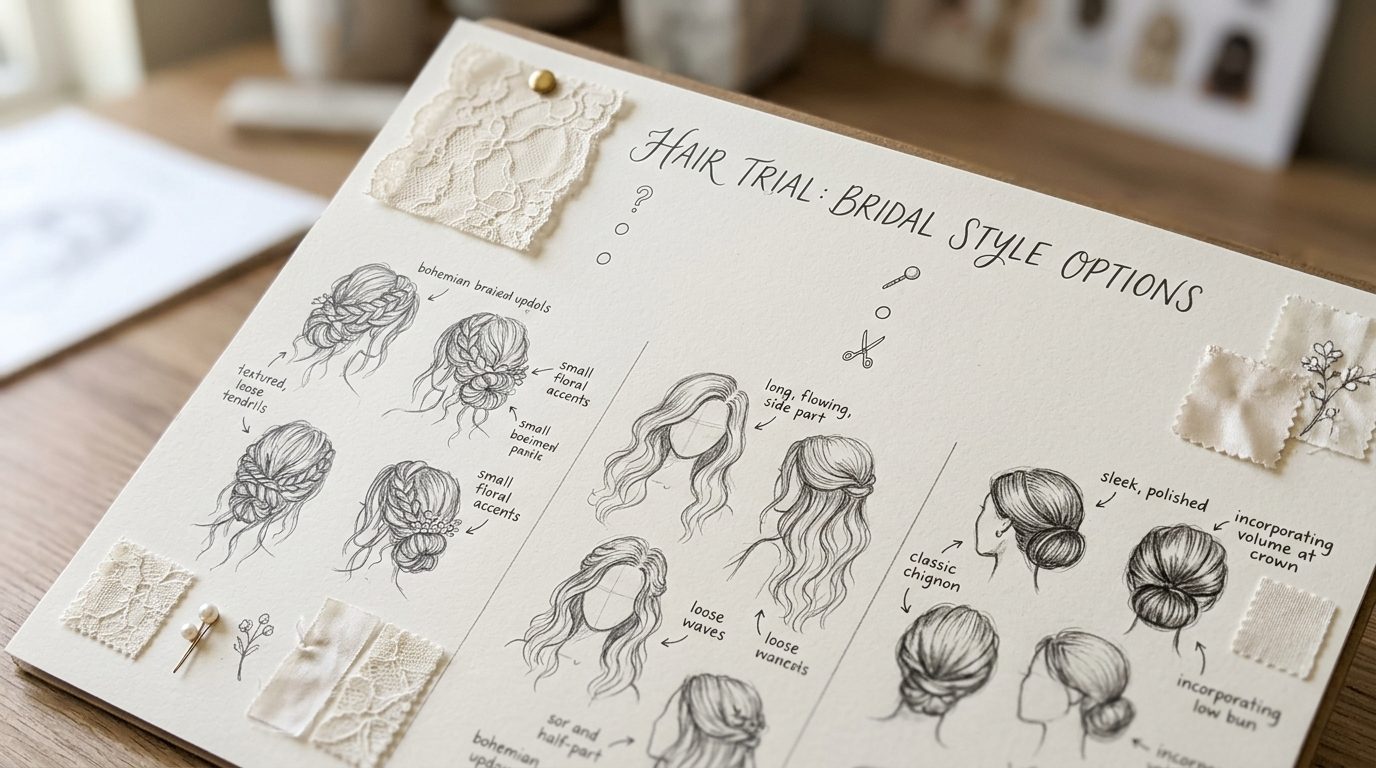 The trial is the right moment to test different styles — not on the day. Consider these UK-popular options for 2026:
Down and waves
The most relaxed option. High-risk for humidity at outdoor venues in June-August. But stunning in photographs. Your stylist should be honest about whether your hair texture can hold loose waves for 8+ hours.
Braided styles
A growing trend in 2026. Works especially well for boho venues, outdoor ceremonies, and brides with long thick hair. Ask your stylist to show you the braid pattern at the trial — braids look very different loose versus tight.
What to do if you don’t like the result
Tell your stylist immediately. A good bridal hairdresser expects feedback and will adjust on the spot. Specific feedback helps: “Can we make the bun sit lower?” is more useful than “I’m not sure about it.”
If adjustments fix the problem, great. If you leave the trial still uncertain, book a second trial with a modification. If the core style is wrong, book a second trial with a different approach — or a different stylist. Two months is enough time to change both.
Do not convince yourself the problem will fix itself on the wedding day.
For brides with coloured, fine, or curly hair
These hair types require specific conversations at the trial:
Coloured hair: tell your stylist exactly when your last colour was and when you plan to colour next. Freshly coloured hair is sometimes more slippery or dry. Your stylist should know so they can adjust product choices.
Fine hair: extensions or padding may be needed for styles that look voluminous in photos. Discuss this at the trial — fitted hair extensions take time and cost extra (£40-£120 for clip-in placement).
Curly hair: discuss whether the style works with or against your natural curl. Fighting your curl takes longer and holds less reliably in humidity. Embracing it is often the better technical choice. Wedding hairstyles for different textures covers this in more detail.
On the wedding morning: what to expect
- Average time in the stylist’s chair: 55 minutes (versus 80 minutes without a trial)
- Percentage satisfied with the result: 91% (versus 68% for those with no trial)
- Percentage who needed adjustments mid-morning: 8% (versus 29% without a trial)
Prepare your wedding day emergency kit with spare pins, a small can of hairspray, and a bristle brush — your stylist will usually leave some with you. The wedding day skincare timeline explains what to do in the 90 days before the wedding to maximise hair and skin condition.
Related articles
- UK Bridal Hair Styles: The Complete 2026 Guide
- Wedding Hair Updos: 20 Styles That Last All Day
- Half-Up Half-Down Wedding Hair: What Works for Your Face Shape
- Wedding Day Emergency Kit: 47 Essentials to Pack
- Wedding Day Skincare Timeline: 90 Days to Glowing
- How to Ask Someone to Be Your Bridesmaid UK: Proposal Ideas 2026
Frequently asked questions
How much does a bridal hair trial cost in the UK?
Day-of bridal hair styling averages £180, though complex updos or styles requiring extensions can reach £250-£350. Many stylists deduct the trial fee from your wedding day invoice if you book with them.
When should I book my bridal hair trial?
Book your bridal hair stylist 9-12 months before the wedding and schedule the trial 2-4 months before the wedding day. Earlier than that, your hair may have changed colour, length, or condition by the wedding. Later than that, there is insufficient time to rebook if you want a different stylist.
What should I bring to a bridal hair trial?
Bring photos of styles you like (save 5-10 on your phone), your veil or hair accessory if you have it, and a top with a similar neckline to your dress. Arrive with clean, dry, product-free hair unless your stylist asks otherwise. Bring a friend or your maid of honour for a second opinion.
How long does a bridal hair trial take?
Most bridal hair trials take 1.5-2.5 hours, depending on hair length and style complexity. Long, thick hair in a complex updo takes longest. Allow 3 hours if you plan to try two different styles. The wedding day appointment is typically slightly faster because the stylist knows exactly what they are doing.
Do I need a bridal hair trial?
The trial confirms the style suits your face shape and dress, lets you test hold all day, and gives the stylist a map of your hair's behaviour.
What if I don't like my bridal hair trial result?
Be honest with your stylist immediately — they cannot fix what they do not know about. If minor tweaks are needed, most stylists are happy to adjust on the day. If the overall result is wrong, it is better to know at trial than on the wedding morning. Book a second trial or find a different stylist with 2 months to spare.
How do I find a bridal hair stylist in the UK?
Ask your venue and wedding photographer for recommendations — photographers know which stylists produce camera-ready results. Check Instagram and Google reviews for candid client feedback.