Adaptive-Reuse Wedding Venues UK: Factories & Libraries
Key Takeaways
- Hire costs for converted industrial spaces range from £2,500-£8,000 for dry hire, making them 20-35% cheaper than equivalent country house venues at the same capacity
- The blank-canvas format suits 2026 wedding aesthetics — botanical maximalism, tipi-style interior dressing, and statement lighting all work better without fixed venue decor
- Most adaptive-reuse venues operate on a dry-hire model, meaning couples supply their own caterers, bar, and furniture — adding flexibility but also coordination overhead
- London has the highest density of adaptive-reuse venues nationally, with over 60 listed on WeddingsHub — but Manchester, Leeds, and Bristol are growing fastest
- Original architectural features — exposed brick, industrial ironwork, vaulted ceilings, original tiling — are the primary booking driver cited by 71% of couples who choose this venue type
Why adaptive-reuse venues are the story of 2026
The UK’s wedding venue market has been bifurcating for several years. At one end, destination rural venues with accommodation, full service, and exclusive-use grounds. At the other, urban blank-canvas spaces that offer nothing except a spectacular shell and a licence to fill it with whatever the couple imagines.
Adaptive-reuse venues sit firmly in the second camp — and they are winning with a specific type of couple: those who want creative control, care deeply about visual character, and are not interested in the standardised country house wedding format.
Three forces are driving the growth.
The aesthetics match what 2026 couples want
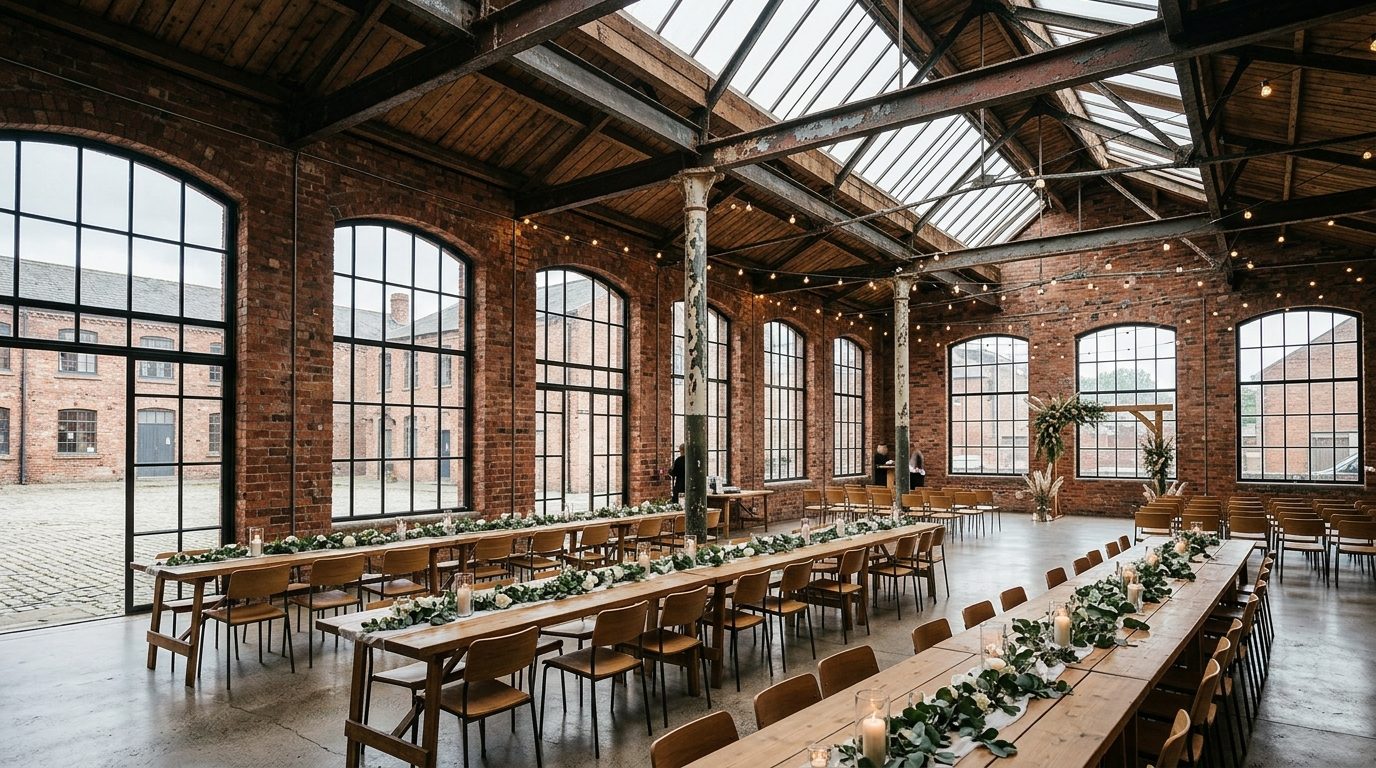
The dominant 2026 wedding aesthetics — botanical maximalism, statement lighting, tipi-style interior dressing, textured linens, found-object centrepieces — are all designed for spaces that are visually interesting without being fussy. They do not fight a converted Victorian mill’s exposed ironwork. They amplify it.
A country house ballroom’s existing decor, carpet, and lighting scheme creates constant tension with bespoke styling. A warehouse with white-washed brick and concrete floors creates none. You are not fighting the room; you are finishing it.
The blank-canvas model gives total supplier freedom
Most adaptive-reuse venues operate on a dry-hire model: you pay for the space, and you bring every supplier yourself. No minimum catering spend. No preferred photographer you are obligated to use. No house band requirement.
This freedom has real monetary value. A venue that mandates a £95-per-head minimum food spend on 120 guests adds £11,400 to your budget before you even choose a menu. A dry-hire converted space charges you for the room and lets you source food at whatever standard you choose.
For couples who are experienced at event planning, the dry-hire model is liberating. For those who are not, see the note on coordination below.
The cost advantage versus country houses
- London (Zone 1-3): £5,000-£15,000
- London (Zone 3-6 and inner suburbs): £3,500-£8,000
- Manchester, Leeds, Bristol, Birmingham: £2,500-£7,000
- Edinburgh, Cardiff: £3,000-£7,500
- Secondary cities (Sheffield, Newcastle, Nottingham): £2,000-£5,000
These figures are 20-35% below equivalent country house venues at the same capacity and quality tier in most markets. The difference is larger in London, where the scarcity of rural land within the city drives country house alternatives significantly higher.
Types of converted spaces
Victorian and Edwardian factories and mills
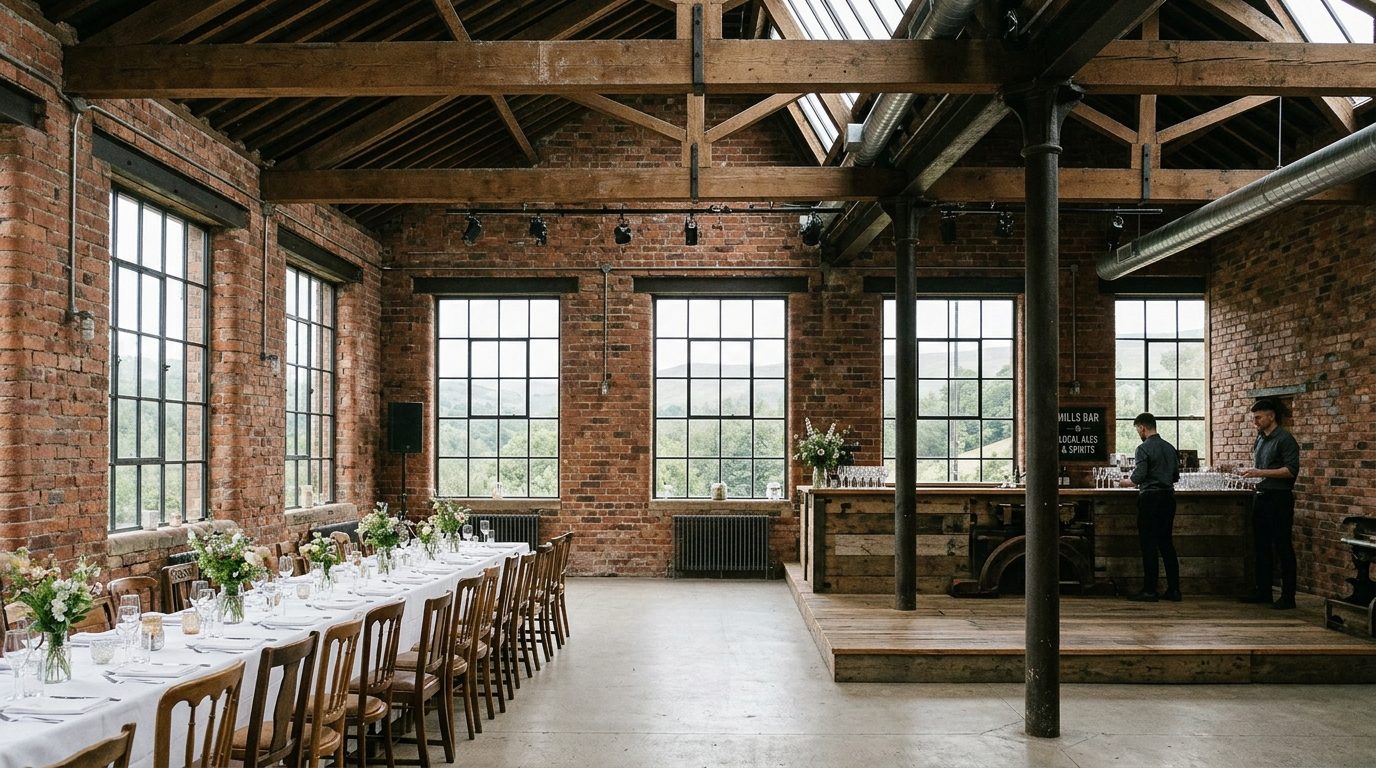
Yorkshire, Lancashire, the Midlands, and South Wales have the highest concentration of converted mill and factory venues nationally. These are typically large-footprint spaces with high ceilings, original machinery mounts, iron pillars, and stone or brick walls.
The best examples retain their industrial character while providing modern event infrastructure: sound systems, uplighting rigs, commercial kitchen areas (or designated catering zones), and accessible toilet facilities.
Capacity: commonly 150-350 seated. Hire rates outside London: £3,000-£8,000.
What makes them work: The scale. A converted mill floor for 250 guests at £5,000 hire is genuinely extraordinary value versus any alternative for that capacity.
What to check: Heating. Mill buildings with stone walls and high ceilings are challenging to heat in autumn and winter. Ask specifically what heating system is in place and what it costs to run for an evening event.
Railway arches and train depots
Urban railway arches — particularly in London, Manchester, and Leeds — have produced some of the most interesting smaller converted wedding venues. Arched brick ceilings, raw concrete or cobblestone floors, and often small courtyard spaces outside.
The acoustic properties of brick arches are complex — sound bounces in ways that can be beautiful or overwhelming depending on the entertainment format. Bands work well; DJ setups need careful sound management.
Capacity: typically 80-150 for seated dinner. Hire: £4,000-£10,000 in London; £2,500-£5,500 elsewhere.
What makes them work: Visual impact per pound spent. A London railway arch venue at £6,000 delivers a level of character that a hotel ballroom at twice the price cannot.
What to check: Licence conditions. Urban arch venues often have strict noise and finish time restrictions from local authorities. Confirm the licence for your date before booking.
Former churches and chapels
Deconsecrated churches and chapels converted to event spaces are widespread in cities and market towns. These offer soaring ceilings, stained glass, stone floors, and an architectural grandeur that no purpose-built venue can replicate.
For ceremonies, there is often a natural theatre in a former church’s layout — a central aisle, a raised chancel area, dramatic natural light. For receptions, the high nave provides a natural dance floor setting.
Capacity: 80-250 depending on the building. Hire: £3,000-£9,000.
What makes them work: The combination of ceremony setting and reception space in one building. You get the visual impact of a church ceremony without the religious requirement.
What to check: Acoustic management. Stone churches are notoriously reverberant. Band and DJ setups need professional acoustic management. Ask what sound equipment is already installed and what restrictions apply.
Old power stations and civic buildings
The UK’s heritage of Victorian civic architecture has produced a number of exceptional large-capacity converted venues. Former power stations, town halls, drill halls, and civic halls in urban centres offer extraordinary scale and architectural weight.
These are typically the premium tier of adaptive-reuse venues, both in hire cost and in the level of in-house infrastructure. Some have full commercial kitchens, permanent bar installations, and professional event management teams.
Capacity: 200-600+. Hire: £7,000-£20,000 in London; lower in regional cities.
Victorian libraries
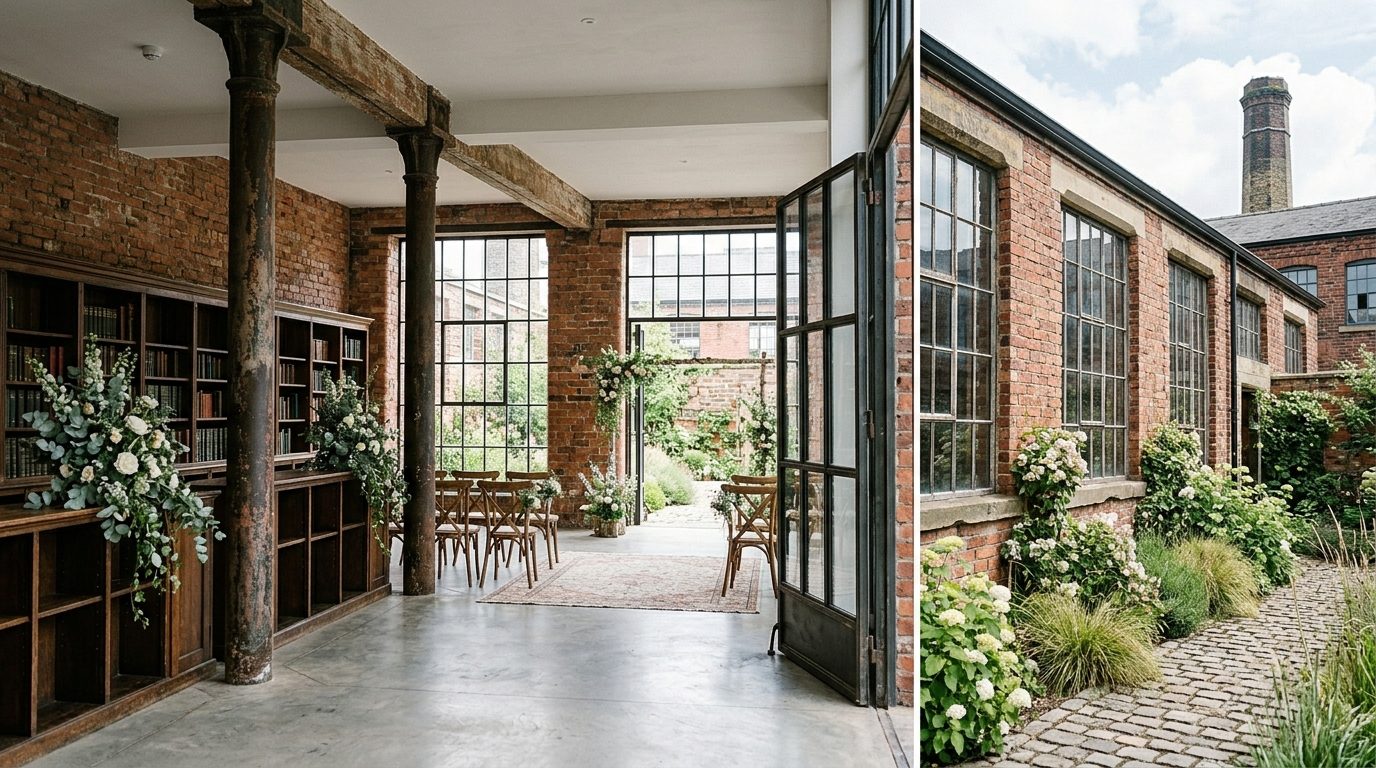
A small but growing category. Former Carnegie libraries and Victorian public libraries converted to event spaces combine intimacy (most have capacities of 80-160) with extraordinary shelved-book backdrops, ornate plaster ceilings, and parquet floors.
For photography, the library aesthetic produces some of the most distinctive wedding images available in any UK venue type. The backdrop is instantly recognisable and consistently beautiful.
What to expect from the booking process
Adaptive-reuse venues typically have smaller operations than major country house venues. You may be dealing directly with the building owner, a single event coordinator, or a small team. This can mean faster and more flexible communication — or less structured support, depending on the venue.
The venue show-round: Budget time for a proper visit. The character of a converted space only fully reveals itself in person. Photos capture the best angles; the show-round reveals ceiling height, flow between spaces, kitchen access, acoustic character, and practical realities.
The licence check: Before booking, confirm the venue holds:
- An approved premises licence for marriages (if you want to legally marry there)
- A premises licence for the sale of alcohol (or confirm you can bring your own under a dry-hire arrangement)
- Any relevant planning conditions that restrict finish time, external lighting, or noise
The supplier list: Most dry-hire converted venues provide a list of recommended suppliers — caterers and bar operators who know the space, the access, and the power supply. You are typically not obligated to use these, but it is worth starting there. A caterer who has worked in the space before knows the flow and the limitations.
Coordination load
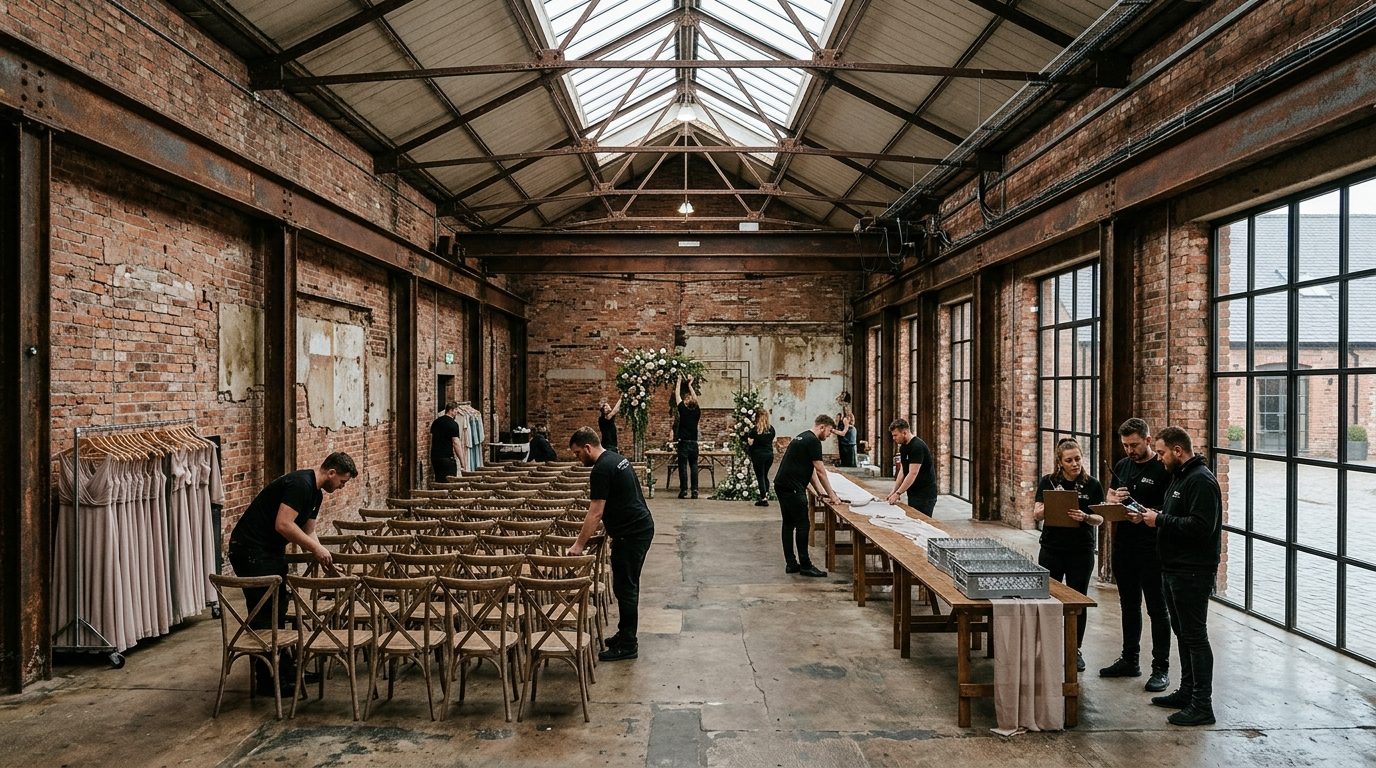
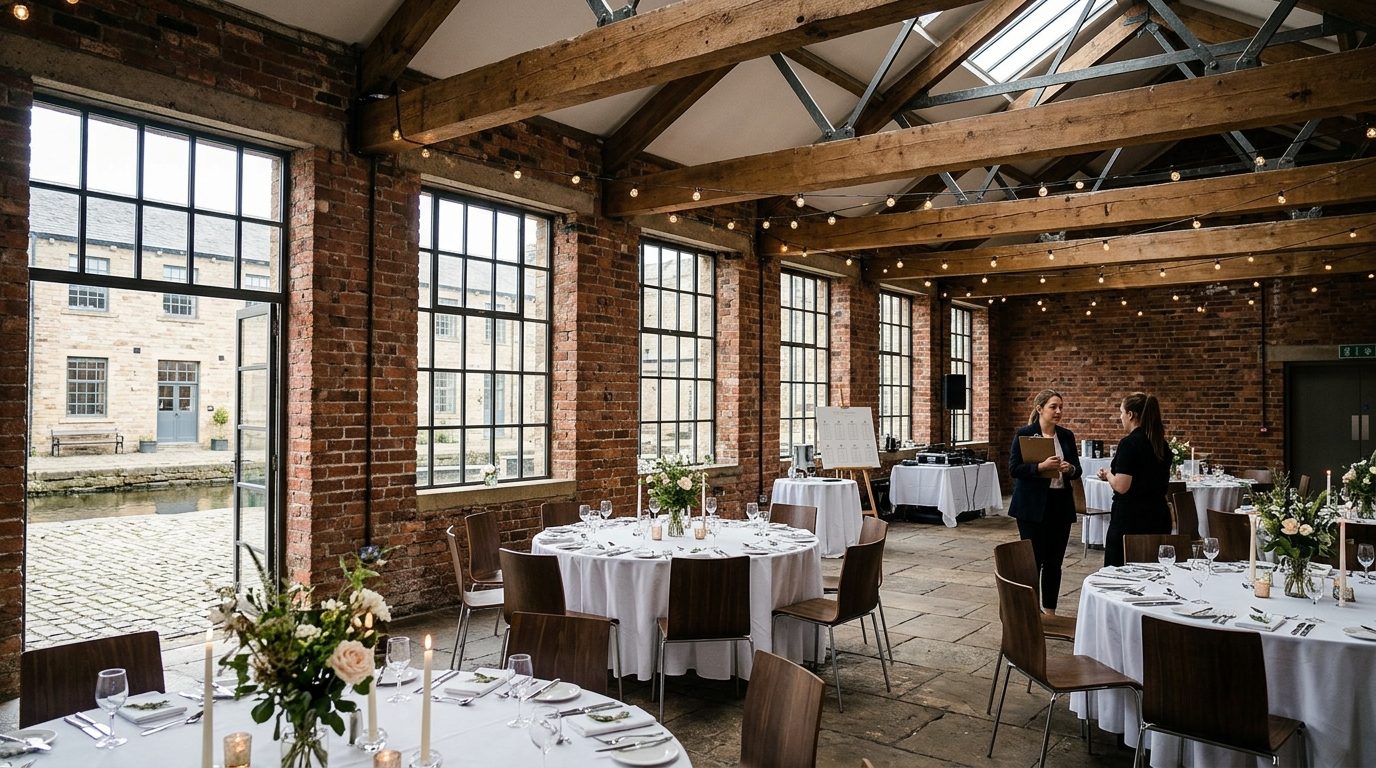 As with marquee weddings, adaptive-reuse venues on a dry-hire model require more coordination than a fully serviced venue. You will typically manage:
- Venue hire
- Catering company (often without an on-site commercial kitchen — generators and mobile kitchen setups are common)
- Bar supplier
- Furniture hire (tables, chairs, bar furniture, lounge seating)
- Lighting designer
- Florist and stylist
- Sound and AV
- Photographer and videographer
- Entertainment (band, DJ, photo booth)
- Wedding coordinator (strongly recommended for this format)
For the coordination approach and what to look for in a wedding coordinator, see our Wedding Planning Timeline and Wedding Planner Red Flags guides.
How adaptive-reuse compares to barn venues
The adaptive-reuse venue and the barn venue are the two dominant blank-canvas formats in the UK market. They suit overlapping but distinct audiences.
| Adaptive-reuse / converted | Barn venue | |
|---|---|---|
| Setting | Urban or peri-urban | Rural |
| Architecture | Industrial, civic, ecclesiastical | Agricultural, pastoral |
| Capacity | Commonly 100-350 | Commonly 80-250 |
| Outdoor space | Often none or limited courtyard | Usually yes — grounds included |
| Legal ceremony | Possible (check licence) | Possible if licenced |
| Hire cost (excl. London) | £2,500-£8,000 | £3,000-£10,000 |
| Coordination model | Dry hire typical | Mix of dry hire and full service |
| Best aesthetic match | Contemporary, botanical maximalist, industrial | Rustic, meadowcore, organic |
For detailed barn venue cost and trend data, see our Barn Weddings UK guide.
Frequently asked questions
What is an adaptive-reuse wedding venue?
An adaptive-reuse venue is a building originally designed for another purpose — a factory, library, train depot, power station, church, or mill — that has been converted and licenced for events and weddings. The original architecture is preserved or celebrated, not stripped out. The building's character becomes the venue's core selling point.
How much do converted industrial wedding venues cost in the UK?
Dry-hire costs typically run £2,500-£8,000 for exclusive use of the space for the day, depending on capacity and location. London venues charge a premium: central London warehouse or Guildhall spaces run £5,000-£15,000 for hire. Outside London, converted mills and factories in Leeds, Manchester, and Bristol often offer the same capacity for £3,000-£7,000. Total wedding costs, once catering and bar are added, typically run £20,000-£50,000.
What types of buildings get converted into wedding venues in the UK?
The most common conversions are: Victorian and Edwardian factories and mills (particularly in Yorkshire, Lancashire, and the Midlands), old power stations (London and major cities), former churches and chapels (widespread nationally), railway arches and train depots (urban centres), Victorian libraries (city centre locations), warehouses (dockland areas), and old farm buildings re-envisioned as contemporary event spaces rather than traditional barn venues.
Are adaptive-reuse venues good for large weddings?
Many converted industrial buildings have very large footprints — former factories and mill floors can accommodate 250-400 guests seated. This makes them some of the most practical options for large weddings in urban areas, where country house alternatives are scarce. However, the dry-hire model means large-scale catering requires experienced caterers comfortable working in non-purpose-built kitchens.
What should I check when booking a converted building as a wedding venue?
Key checks: approved premises licence status (confirm ceremonies are legally permitted); licence conditions (finish time, noise restrictions for urban venues, external lighting restrictions); access for catering vehicles; power capacity for your intended setup; heating and ventilation adequacy; and what furniture, if any, is included. Many conversions retain original features — beautiful in photos, but draught-prone in practice. Ask specifically about winter heating capacity.
Which UK cities have the best adaptive-reuse wedding venues?
London has the highest concentration nationally, particularly in the East End, Southwark, and Peckham. Manchester has a strong cluster of converted mill and industrial spaces. Leeds offers excellent mill conversion venues. Bristol's docklands have produced several high-quality converted spaces. Edinburgh has notable converted venues in the New Town and beyond. All these cities offer converted options at lower prices than London for equivalent capacity.
Is a converted venue better than a country house venue?
Neither is universally better — they suit different couples. Converted industrial spaces suit urban aesthetics, contemporary styling, and couples who want a venue that photographs interestingly. Country houses suit traditional aesthetics and couples who want outdoor grounds and accommodation on site. The former offers better value per square metre in urban settings; the latter offers a more complete single-supplier experience.