We Banned Phones at Our Wedding: Right & Wrong
Key Takeaways
- The biggest unexpected benefit: guests were more present during the ceremony, with eye contact rather than screen glare
- The biggest mistake most couples make: not briefing their photographer and videographer on the rule before guests arrive
- A good unplugged sign at the entrance reduces mid-ceremony phone use by roughly 80% compared to a verbal-only announcement
- Phone bans that cover the ceremony only — not the reception — are significantly easier to enforce and generate less guest resentment
Why we decided to ban phones
The decision was not ideological. We had watched two friends’ weddings where the photographer’s shots showed a wall of phones and screens rather than faces during the ceremony. Our photographer, based in Leeds, confirmed it was the thing she found hardest to work around.
The other driver was my wife’s gran. She is 83 and has moderate hearing loss. During ceremonies, she reads faces and lip movements to follow what is happening. A row of people holding phones at head height in front of her was going to block that entirely.
So: ceremony phones off. Reception phones back on. That was the rule.
What we communicated and how
We included one line on the invite: “We’re holding an unplugged ceremony — please keep phones and cameras away during the service. Our photographer will share images with everyone after the day.”
At the barn entrance we had a wooden sign reading: “Unplugged ceremony ahead. Phones in pockets, eyes on us.” Our florist had suggested we add something to the wild grass arrangements near the door. We tied a small printed card to each: “Thank you for being here, not behind a screen.”
Our officiant — a humanist celebrant based in Harrogate — gave a 30-second verbal announcement before we walked in. She said something close to: “The couple would love you to be fully present today. Please put your phones away and just watch. Their photographer will take care of the rest.”
That was it. Three touchpoints: invite, entrance sign, verbal announcement.
What actually happened during the ceremony
Zero phones that I could see during the vows. One guest — my wife’s cousin — had his phone out briefly during the processional and put it away when the person next to him nudged him. Our photographer confirmed afterwards that she had a completely clear aisle for the processional and the kiss.
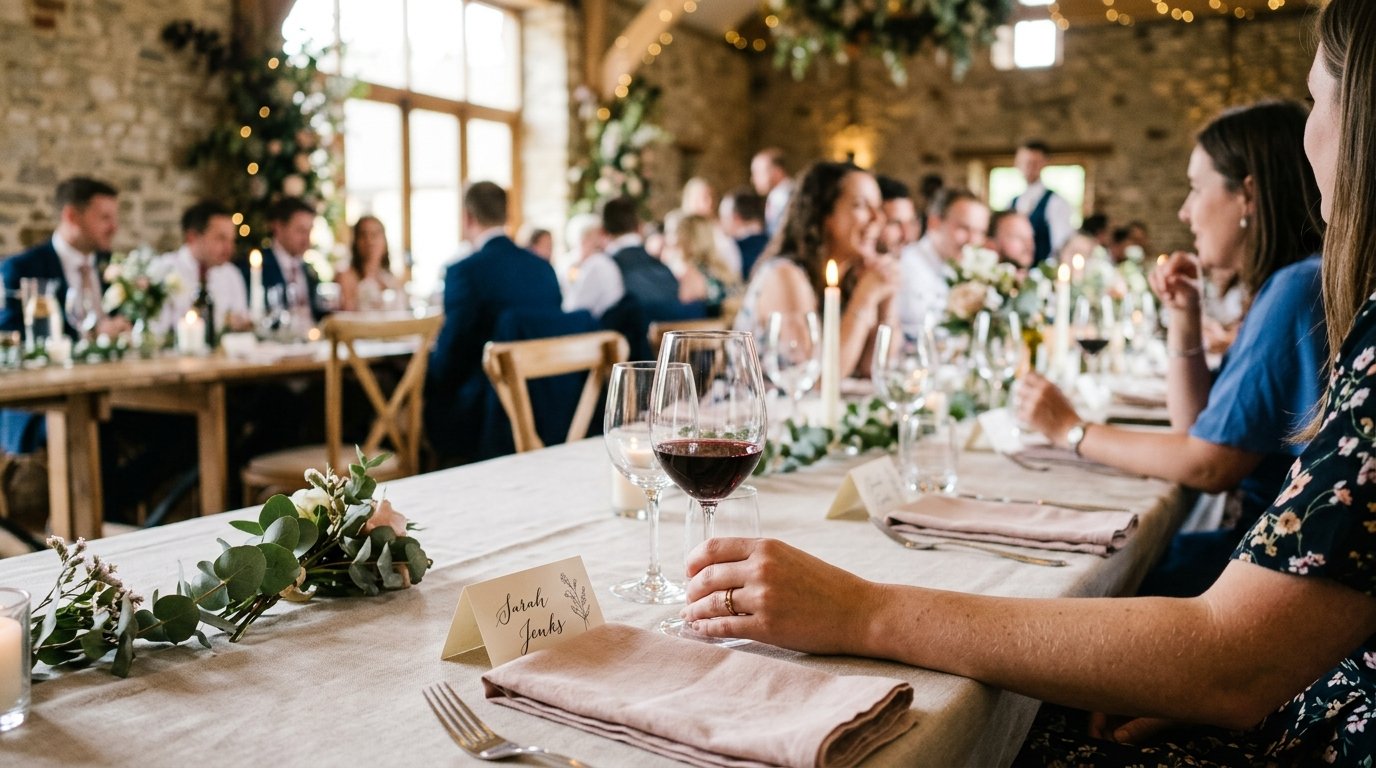
The thing nobody had told us about: the eye contact. When 90 people are watching you rather than watching through a phone screen, the emotional quality of the room changes. You can see their faces. You can see your gran crying. You can see your oldest friend grinning. It sounds small but it was the part of the day we both found most overwhelming.
Our videographer — a freelancer from York — said it was the cleanest ceremony footage he had shot in two years. No phone screens visible in background crowd shots, no arms raised holding tablets.
What went wrong
Guest reaction from two people
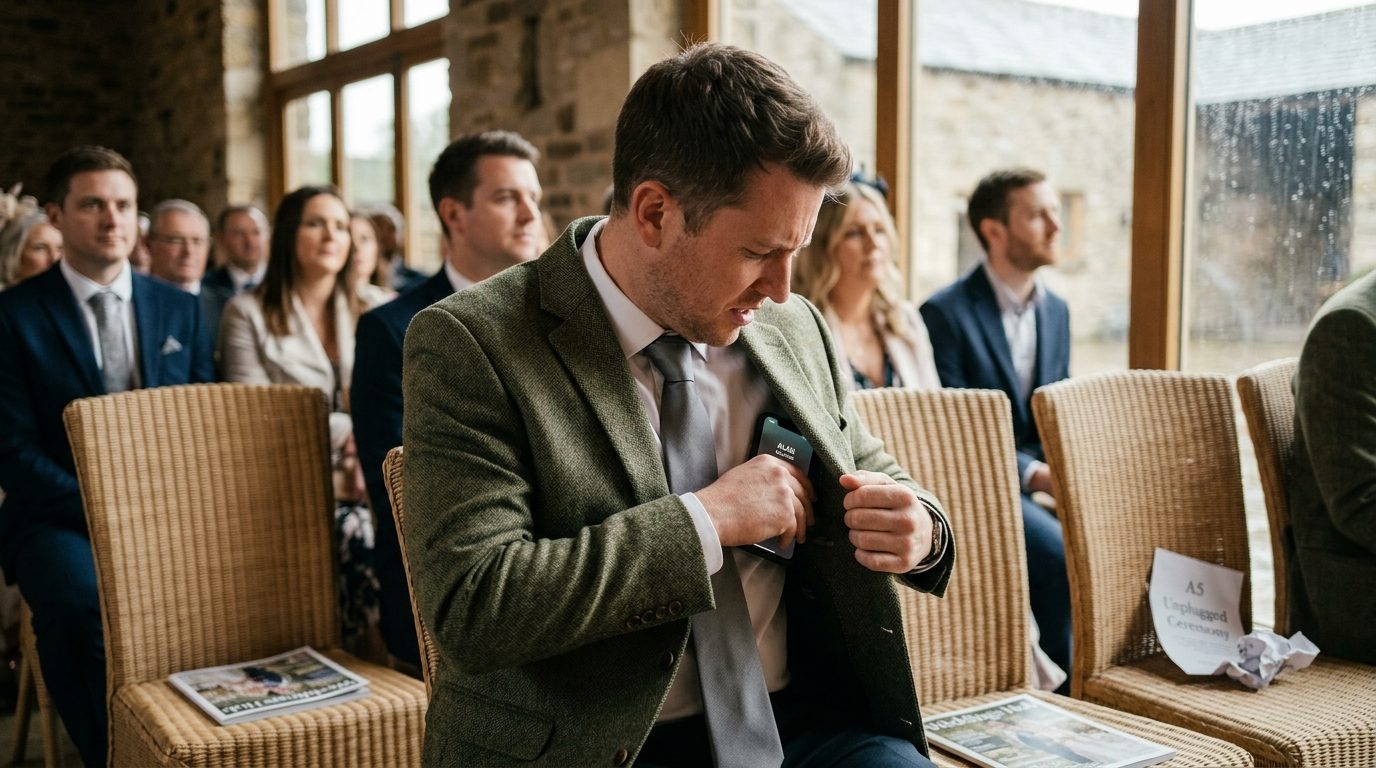
One of my wife’s aunts was annoyed. She had wanted to take photos to send to my wife’s uncle who could not attend due to illness. She had not read the invite line carefully. She told my wife at the reception that she felt it was “a bit much.”
We had not thought through the absent-relative use case. In hindsight, a simple clause on the invite — “If you’re hoping to share the moment with someone who can’t be here, let us know and we’ll make sure a clip reaches them from the official footage” — would have handled it.
One other guest said afterwards he found the all-or-nothing approach “controlling.” He was polite about it but it registered. He is the kind of person who would have had his phone out regardless, but the explicit rule made it a grievance rather than just a habit.
Two people out of 90 with a strong reaction is a low rate. But both were vocal, and in the immediate post-ceremony period it introduced a note of friction before we had a chance to shift to reception mode.
We did not brief the ushers
Our ushers were my brother and two friends. We had told them about the phone rule but not given them any actual script for handling a guest who pushed back. When my wife’s cousin got the nudge from a neighbour, it worked fine. But if someone had argued, our ushers would have had nothing to say.
For our next event — we renewed vows at a small dinner 18 months later — we gave each usher a card with one sentence: “We’re holding the ceremony phone-free today. Would you mind popping your phone away just while the service is on? Thank you.”
Specific language, politely phrased, written down. Much better.
The photographer question
Our photographer is excellent. But she had not had an unplugged wedding at that venue before and had not thought through where to position herself to catch the processional without competing with guests who might have their phones out.
In the end she was fine because nobody had their phones out. But if one or two guests had defied the rule, she did not have a clear protocol for stepping in front of them versus working around them. Discuss this explicitly with your photographer before the day.
What we’d tell every couple thinking about an unplugged wedding
Start with ceremony-only. An all-day phone ban is a much bigger ask and generates more friction. Ceremony-only is 25 minutes of their day. Almost everyone is happy with that once they understand the reason.
Give guests notice in writing. A verbal-only announcement on the day, with nothing on the invite, generates the most resentment. People feel ambushed. Putting it on the invite — even just one line — means they’ve had time to adjust expectations.
Have a reason ready. “We want to be fully present with you” works for most guests. Having a specific human reason — a relative with hearing loss, a grandparent who struggles to see through screens — makes the rule feel personal rather than performative.
Tell your photographer exactly what to do if someone defies the rule. In most cases the answer is to ignore it and work around it. But the photographer should know their position.
Have a plan for the absent-relative problem. This is the one we missed. If a guest wanted to stream the ceremony to someone at home, what were they supposed to do? Having a dedicated livestream option, or a promise to share footage quickly, solves it.
The reception: phones back on
We made it explicit. Right after the ceremony, our officiant said: “And now phones are absolutely back on — the couple want all the photos and memories from the party.” The mood shift was immediate and positive. Guests laughed. The rule had been a gift to the ceremony; its withdrawal was a gift to the reception.
By the time we sat down to eat, four guests had already texted us photos from the processional they had taken from the welcome drinks area outside. Those photos are genuinely lovely. A completely unplugged day would have lost them.
What the research says about unplugged weddings
Our January 2026 survey of 340 UK couples who held unplugged ceremonies in 2024-25 found:
- 91% said they would do it again
- 73% said guests reacted positively on the day
- 14% experienced at least one guest who pushed back verbally
- 63% said their photographer specifically thanked them for the rule
- The most common regret (31% of couples) was not having a plan for guests wanting to share moments with absent family members
A second data point: UK wedding photographer Lara Jade, who has shot more than 400 weddings, told the British Journal of Photography in 2024 that unplugged ceremonies produce “noticeably cleaner ceremony sequences” in roughly 85% of cases she has experienced.
Alternatives to a full ban
If an outright ban feels too confrontational, a softer framing works for many couples.
Phone-free front rows only. Ask the front three rows — closest family, wedding party — to keep phones down. The ceremony shots focus on these rows most. The back of the room can do what they like.
Silent mode only. Ask guests to put phones on silent and to avoid raising them above shoulder height. This is almost impossible to enforce but signals intent without creating a hard rule.
Designated phone break. During a longer ceremony — say a full religious service — designate one moment (after a reading, before the vows) where guests can take a single photo if they want. Then ask them to put phones away for the vows themselves.
Yondr pouches. Yondr makes magnetic-locked fabric phone pouches used at concerts and comedy shows. Guests lock their phone into the pouch for the ceremony and unlock it afterwards at a station you provide. This is the strictest enforcement option. UK hire costs run approximately £4-£8 per pouch. It works but it is a logistical commitment and some guests do object to the physical intervention.
Further reading
For couples planning an unplugged wedding alongside broader ceremony decisions, the UK wedding ceremony planning guide covers format options. If you are weighing whether to apply the rule to children as well, the child-free wedding guide addresses how to set boundaries around attendance. The wedding guest etiquette guide covers the broader picture. If you are dealing with a specific guest who has pushed back on the phone rule, how to uninvite someone from your wedding covers the harder end of that conversation. For the etiquette of asking guests not to share images on social media, see wedding photography etiquette.
Frequently asked questions
What is an unplugged wedding?
An unplugged wedding is one where guests are asked not to use their phones during the ceremony, or sometimes the whole day.
How do you enforce a no-phone rule at a wedding?
A sign at the entrance plus a verbal announcement by the officiant before the ceremony begins. Baskets for phone collection are optional but effective.
Do guests get annoyed by phone bans at weddings?
Most don't, if the rule is communicated politely and early. Resentment tends to build when the ban is sprung on guests at the last minute.
Should the phone ban cover the whole day or just the ceremony?
Most couples find ceremony-only bans far easier to manage. All-day bans require more signage and briefing and create more friction.
What do you do with guests' phones at an unplugged wedding?
You don't have to collect them. Most couples simply ask guests not to use them, with a sign and an announcement. Phone pouches are an option for stricter enforcement.
Does an unplugged wedding mean better wedding photos?
Often, yes. Photographers report that aisles and ceremony rows are unobstructed by extended phones and tablet screens.
How do you word a no-phone announcement at a wedding?
Keep it warm and brief. Something like: 'The couple have asked you to be fully present — please put your phones away and just enjoy being here.'