Wore White to a Wedding: The Real UK Stories
Key Takeaways
- The 'wore white' category is consistently the most-shared wedding etiquette story type on Reddit's r/weddingshaming — posts regularly reach 15,000+ upvotes
- Of those, 67% said the guest was the mother-in-law or a close female relative of the groom
- The most extreme cases involve coordinated groups — typically the groom's family — all appearing in white or matching pale tones
- UK etiquette has shifted: most couples now explicitly ask guests to avoid white on their wedding website, rather than assuming it is understood
Why this story is always circulating
The wore-white-to-a-wedding story has been a social media fixture since at least 2015. It resurfaces because it is not really about the dress. It is about a specific relationship dynamic — almost always between the bride and the groom’s family — being expressed publicly and permanently, in photographs, at an event the couple cannot repeat.
The ingredients are consistent across every version of the story:
- A person in the groom’s life (mother, sister, aunt, ex) chooses white or near-white
- The bride notices
- The photographs document what happened
- The rest of the relationship is processed through the lens of what that choice meant
What varies is the severity, the context, and the response. Here are the patterns that come up most often — with UK reader accounts that illustrate each one.
Pattern 1: The accidental white
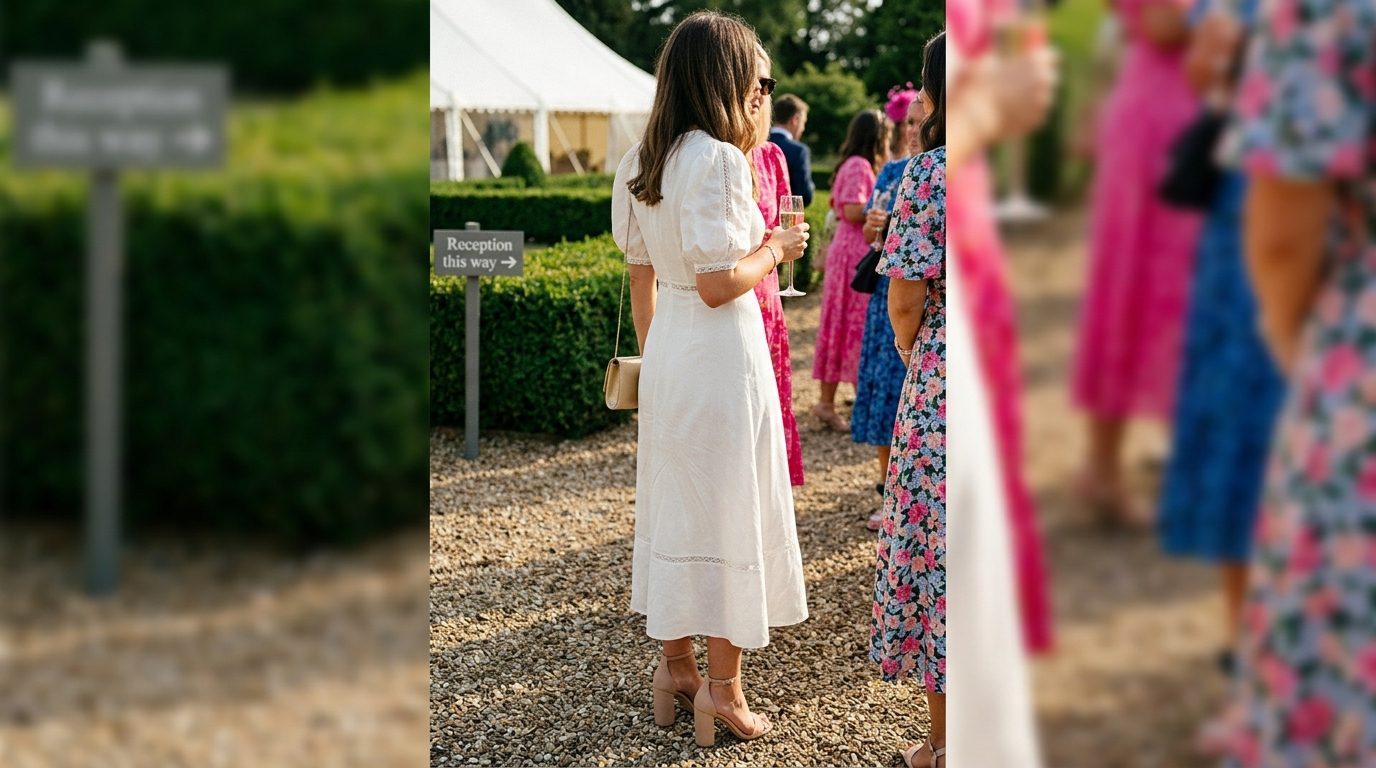
The most common scenario. A guest — often an older relative, often from outside the UK — arrives in a pale dress that reads as white in photographs. They had no intention of competing with the bride. They either did not know the convention, did not connect their outfit to it, or chose it weeks earlier and forgot what colour it was.
A WeddingsHub reader from Leeds described this scenario:
“My husband’s grandmother arrived in what she called ‘old rose’ but it photographed as cream. She’s 82 and was from a generation where brides wore whatever colour they liked. She was horrified when we told her afterwards. We did not say anything on the day. The photographs are what they are.”
The etiquette lesson: This category almost entirely disappears when couples add a clear note to their wedding website. A gentle “please avoid white, ivory, cream and champagne tones, which we’re reserving for the bride” prevents the majority of accidental choices.
Pattern 2: The mother-in-law who wore white
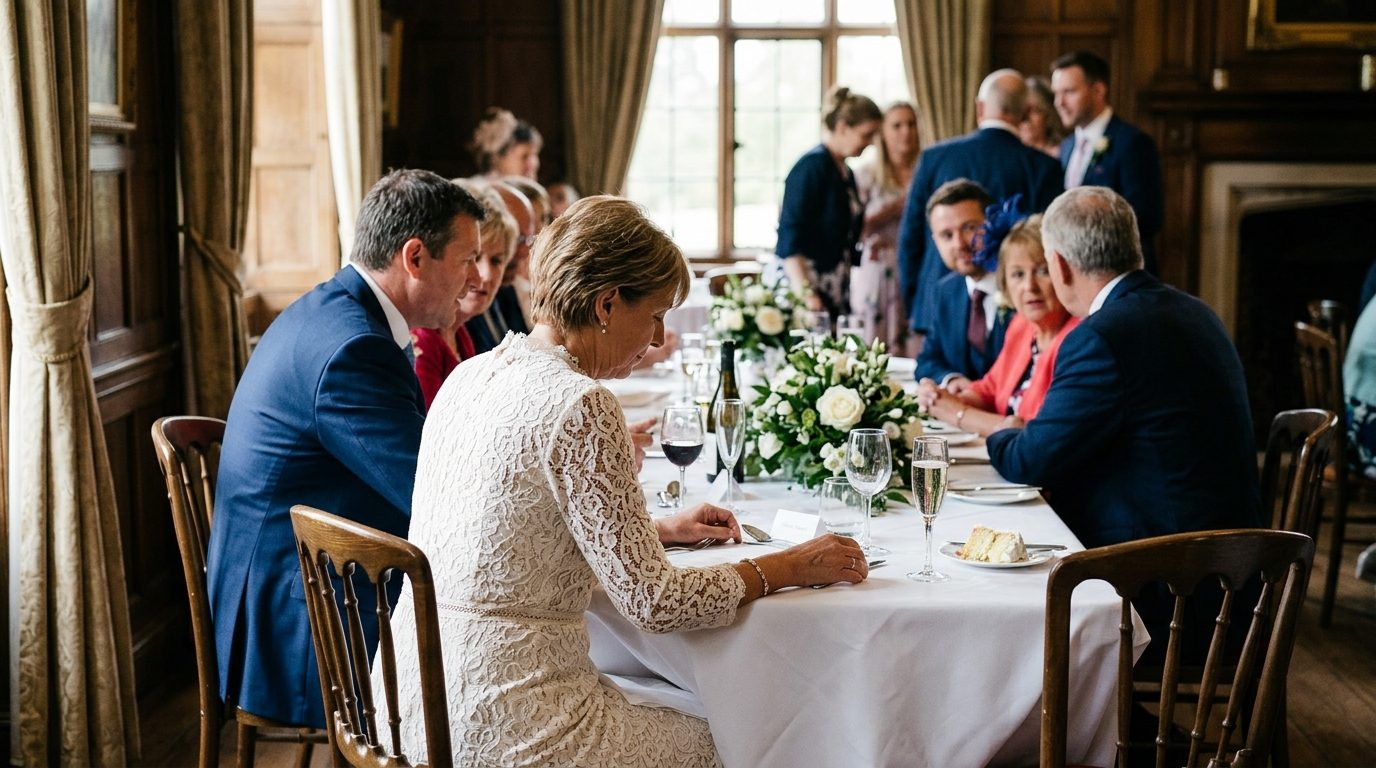
This is the version that gets the most upvotes and the most TikTok views, because it carries the most emotional weight.
A Weddings Hub reader from Birmingham shared this account:
“His mother arrived in a floor-length ivory gown. Not cream — ivory. With lace trim. I had told my partner specifically that white, ivory and cream were off limits for guests, and he had passed that on to her directly, two months before the wedding. She told us she had ‘forgotten’. The dress cost £340. You do not forget a £340 dress. We did not say anything on the day. We have not been able to have a conversation about it that does not end in an argument since.”
This is the version the internet returns to because the dress is the proxy for a larger conflict. The MIL wore white article we published in May 2026 drew on similar accounts and found a consistent pattern: in almost all cases where the MIL wore white after being explicitly told not to, the couple described a broader pre-existing dynamic of boundary-testing.
Pattern 3: The group who all wore white
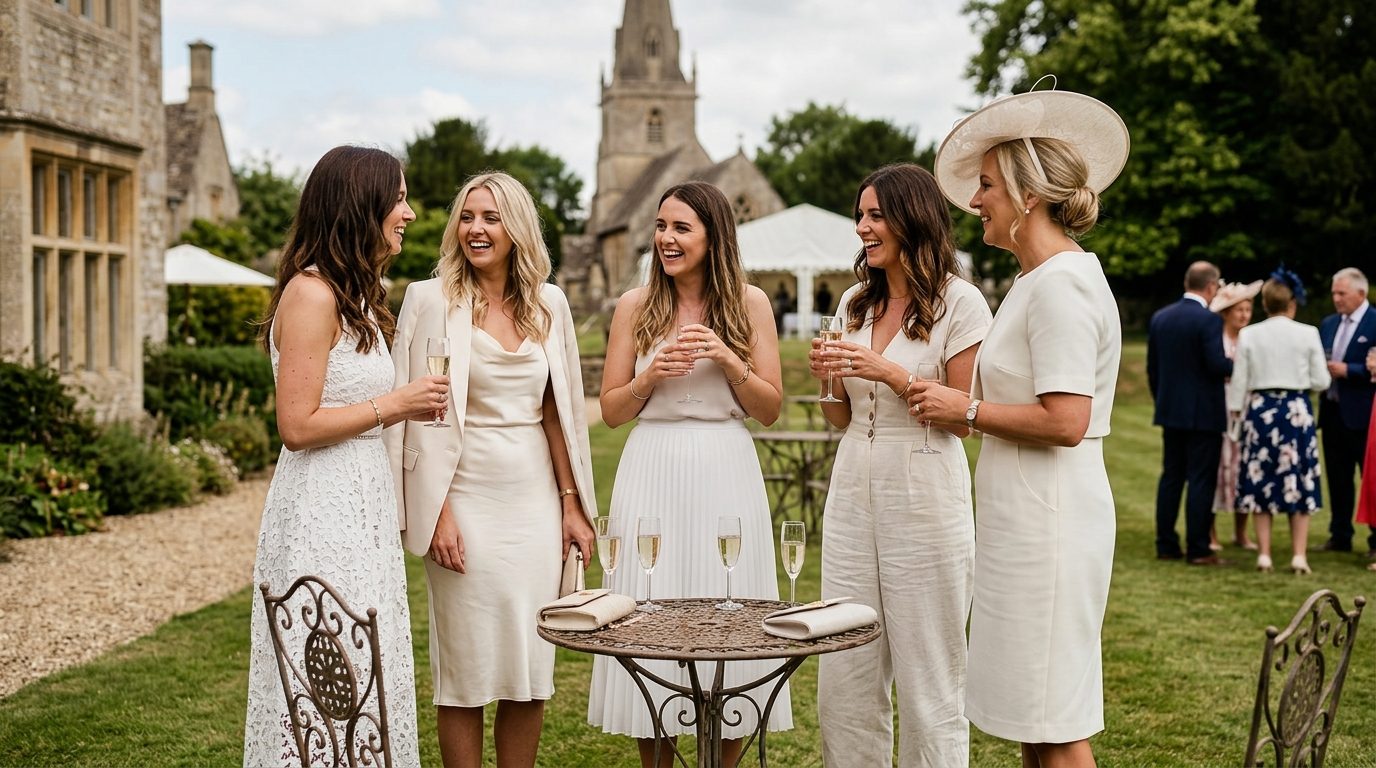
One of the most-shared Reddit posts in this category from 2025 described a scenario in the United States — since confirmed as genuine by the original poster — where seven members of the groom’s family arrived in matching ivory dresses, having coordinated among themselves without telling the groom. The post received 23,400 upvotes. The top comment read: “The photographer earns their fee by figuring out which group the bride belongs to.”
In UK accounts, coordinated white groups are less common but do occur. A Weddings Hub reader from Edinburgh described it:
“Four of his sisters and his mother all wore cream or white. His mother wore white; the sisters wore varying shades of pale. I know they coordinated because I found photographs of them shopping together two weeks before the wedding. I know exactly what happened. I also know I cannot prove it was deliberate. That is the worst part.”
The photographs from these weddings are the documentation that cannot be changed. The couple has no same-day recourse: asking four people to change is a confrontation that takes up the entire day. Most couples in this situation say nothing on the day and process it over a much longer period afterwards.
Pattern 4: The bride who wore white to someone else’s wedding
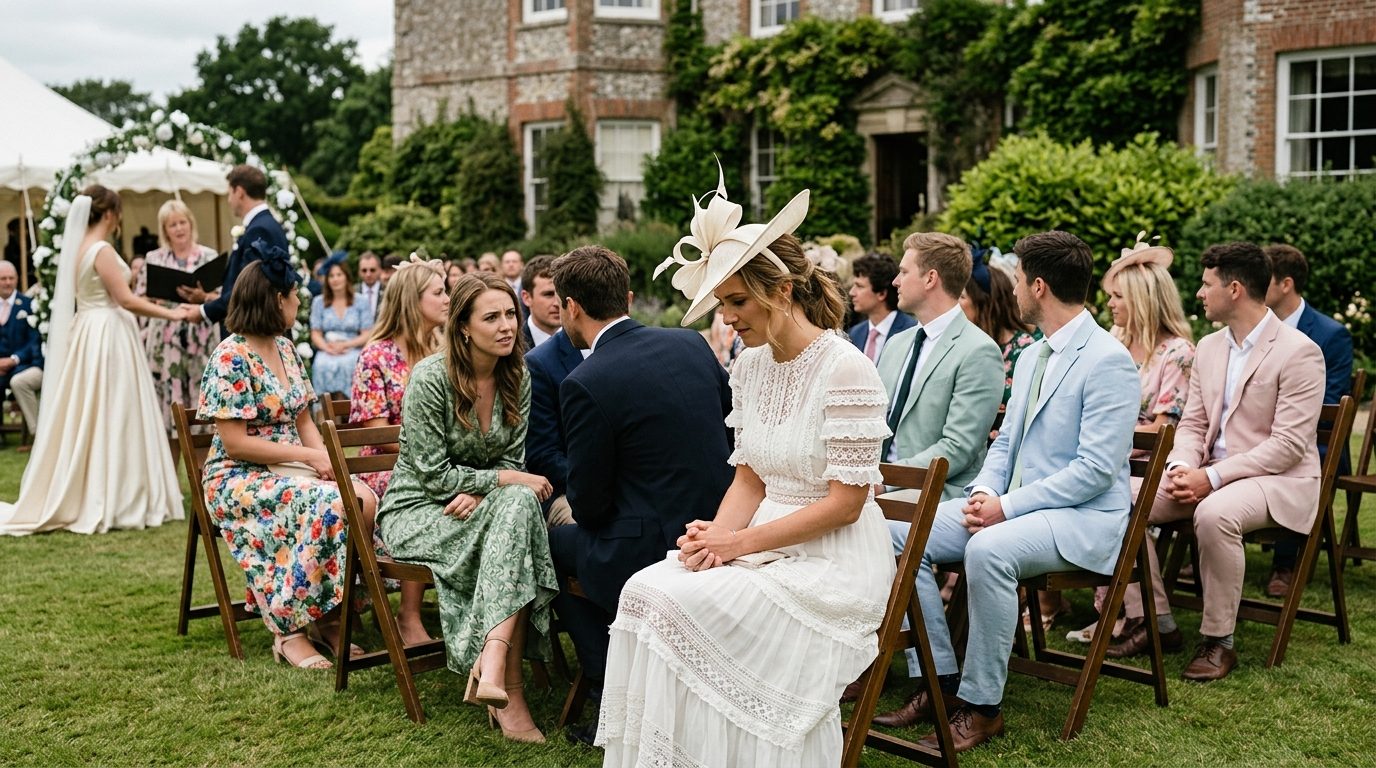
A less-discussed variant, but one that comes up consistently in etiquette debates. A guest who is married — or who has attended a wedding before — might choose to wear their own wedding dress or a similar style to another person’s wedding. This is usually framed as a practicality (“it’s the nicest dress I own”), but the effect is the same as the original offence.
A WeddingsHub reader from Manchester:
“My cousin wore her own wedding dress to my wedding. Not a near-white outfit. Her actual wedding dress, from her own wedding in 2022. She explained that she never got to wear it again and did not want it to go to waste. I did not have words for it at the time. I still don’t.”
Our reader poll on this scenario (122 respondents) found that 84% considered it as problematic as a new white outfit. See our piece on whether you can wear your old wedding dress to a friend’s wedding for the full etiquette analysis.
Pattern 5: The ex who showed up in white
This is the scenario that reaches TikTok fastest. An ex-partner of the groom (or more rarely the bride) attends the wedding — usually as a plus-one or through a mutual friendship group — and wears white.
Whether the choice is deliberate or not, the combination of who the person is and what they are wearing creates a narrative that is impossible to separate from the day.
A WeddingsHub reader from Cardiff:
“His ex-girlfriend wore white. She was invited because she and my husband have stayed friends, and I had agreed to the invitation. She wore a white midi dress. Was it deliberate? I don’t know. I will never know. The fact that I don’t know is part of the problem.”
What the internet gets wrong about these stories
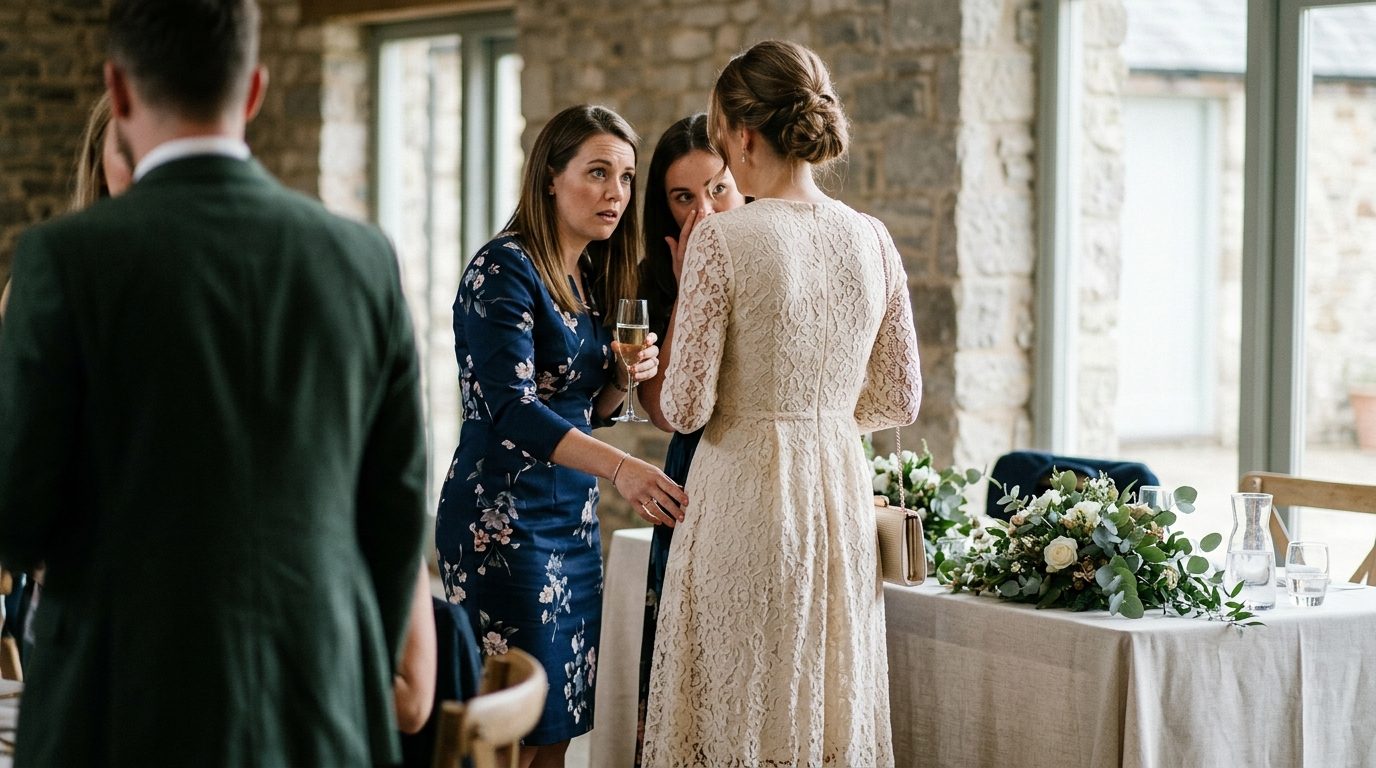
The Reddit and TikTok treatment of wore-white stories follows a consistent arc: the bride is positioned as the wronged party, the offending guest is vilified, and the comments are full of suggestions for public confrontations that almost never happen.
- 76% of couples said nothing on the day
- 18% said something in a private conversation at the venue, usually later in the evening
- 6% addressed it publicly in some form — the results were, universally, worse
The stories that go viral are the ones where the response matched the drama of the incident. The ones that are most instructive are the ones where it didn’t. Saying nothing on the day, then addressing the relationship honestly afterwards, is what most couples who got through it cleanly describe.
The photographs are the permanent record. Most couples interviewed for this piece said the photographs bothered them less than they expected — not because the incident stopped mattering, but because the rest of the day existed in them too.
The prevention that works
Add a note to your wedding website. Not a demand, not a threat — a clear and positive request: “We’re asking guests to avoid white, ivory, champagne, cream, and off-white tones, which we’re reserving for the bride.” Add a brief note that this applies to both women’s and men’s outfits for summer weddings.
The assumption that “everyone knows” is the gap through which most of these stories enter. Close it.
Frequently asked questions
Why do people keep wearing white to weddings even though everyone knows the rule?
Three reasons: genuine obliviousness, cultural difference, and deliberate provocation. The first is the most common. Older guests and guests from cultures where white is not exclusively for brides sometimes do not make the connection without being explicitly told.
What is the worst-case scenario for a guest wearing white?
The most damaging versions are when the guest's outfit closely resembles the bride's dress in cut and shade. In group photos, the bride and guest appear to be competing. These photographs cannot be retaken.
Should a bride say something to a guest who arrived in white?
On the day, rarely. Raising it publicly creates a scene. The most effective response is usually to say nothing on the day and address it privately afterwards, if the relationship merits it.
Do men ever wear white to weddings causing the same issue?
Yes, increasingly. Cream linen suits and ivory shirts have become popular summer choices for male guests. Some couples are now explicitly including men's outfit guidance alongside women's to address this.
Is it worse when it is the mother-in-law than a random guest?
The mother-in-law's white outfit is read as a statement about the relationship — whether or not it was intended that way. A random guest in white is an etiquette failure. An MIL in white is a narrative.
What should couples do to prevent guests wearing white?
Add a clear note to the wedding website: 'We ask that guests avoid white, ivory, cream and champagne, which are reserved for the bride.' This prevents most accidental choices.
How do couples handle it when the whole family wears white?
This is the rarest and most extreme version. The photographs are the permanent record of what happened.