Questions to Ask Your Wedding Planner

Key Takeaways
- Understand the three service levels — full planning, partial planning, and on-the-day coordination — before your first call
- Ask how many weddings they manage simultaneously and whether your wedding date conflicts with another
- Check whether they earn commissions from suppliers they recommend — it can create a conflict of interest
- Get a detailed breakdown of what's included versus what's extra before signing anything
- Ask for references from couples with a similar budget and wedding size to yours
A wedding planner can be the most valuable supplier you hire — or the most expensive unnecessary cost. It depends entirely on what you need, what they actually do, and whether they’re the right fit for your wedding.
These 20 questions will help you find a planner who genuinely earns their fee.
Service levels
1. What service levels do you offer? Most planners offer three tiers:
- Full planning: They handle everything from venue sourcing to the last dance. You make decisions; they do the work.
- Partial planning: You’ve done some things yourself (venue, maybe catering) and need help with the rest. They step in partway through.
- On-the-day coordination: You plan everything yourself. They manage the wedding day so you don’t have to.
Understand the difference before your first call.
2. What exactly is included in the package? Get a written list. For full planning, this should include: initial consultation, venue sourcing, supplier research and booking, budget management, design and styling, timeline creation, RSVP management, rehearsal coordination, and full wedding day management.
For on-the-day, it should include: pre-wedding meeting, supplier confirmation, timeline creation, full-day management, and troubleshooting.
3. What is NOT included? Ask about extras that may be charged separately: travel to venue visits, styling consultations, stationery design, welcome bags, post-wedding tasks, or anything involving physical setup.
Experience and approach
4. How many weddings have you planned? Experience matters, but the number alone isn’t enough. Ask specifically about weddings similar to yours — same size, budget range, venue type.
5. Can I see photos and testimonials from recent weddings? Ask for 3-5 examples from the last 12 months. Look at a range of budget levels and styles, not just the planner’s most expensive event.
6. Have you worked at our venue before? A planner who knows your venue knows its quirks — the loading bay that’s too small for the florist’s van, the ceremony room that overheats in summer, or the coordinator who’s difficult to work with.
7. How do you handle disagreements between the couple? This sounds awkward, but it happens. A good planner diplomatically manages different visions and helps couples find compromises without taking sides.
8. How many weddings do you take on at the same time? If your planner is managing 5 weddings in the same month, you won’t get the attention you need. Ask how many events overlap with your date.
Suppliers and budget

9. Do you have a network of preferred suppliers? An experienced planner has relationships with trusted venues, photographers, caterers, florists, and entertainment. Their recommendations save you hours of research. But check the next question too.
10. Do you earn commissions or referral fees from suppliers you recommend? This is the most important question about a planner’s business model. Commission-based planners may steer you toward more expensive options. Fee-only planners have no conflict of interest. Neither model is inherently wrong — but you need to know which one you’re working with.
11. Can you work within our budget? Share your total budget at the first meeting. A good planner will tell you honestly whether your budget is realistic for your vision — and where to spend more or less to get the best result.
12. Will you track spending and manage the budget? Full and partial planning packages should include budget tracking. The planner should provide regular updates showing what’s been spent, what’s committed, and what’s left.
Communication
13. How will we communicate, and how quickly do you respond? Email, phone, WhatsApp, a project management app? Agree on the channel and response time expectations upfront. During the final month, you’ll need faster responses than during early planning.
14. How often will we meet? Full planning typically involves monthly meetings, increasing to weekly in the final month. On-the-day coordination involves 1-2 meetings plus a venue walkthrough. Check what’s included and whether extra meetings cost more.
15. Who else is on your team, and will they be at the wedding? Some planners have assistants or junior planners who handle day-to-day tasks. That’s fine — but make sure you know who you’ll be dealing with and that you’ve met the person who’ll be there on the day.
The wedding day

16. What does your wedding day management look like, hour by hour? On the day, your planner should: arrive early, manage supplier setup, handle any problems, keep the timeline on track, coordinate transitions (ceremony to drinks to dinner to party), and be your single point of contact so you never have to deal with logistics.
17. What happens if something goes wrong on the day? The whole point of a planner is to handle problems invisibly. Ask for examples of real problems they’ve solved — a supplier not showing up, bad weather forcing a plan change, a family dispute at the venue. Their answer tells you whether they’re experienced under pressure.
18. What time do you arrive, and when do you leave? Check whether their fee covers the entire day or a set number of hours. Ask about overtime charges if the event runs past the planned end time.
Contracts and terms
19. What’s the deposit and payment schedule? Planner deposits are typically 25-50% of the fee. Full planning fees are often split into 3-4 payments across the planning period.
20. What’s your cancellation and postponement policy? Check what happens to your deposit and any payments made. Date changes should be possible with reasonable notice — check whether there’s a fee for moving the date.
Planner comparison table
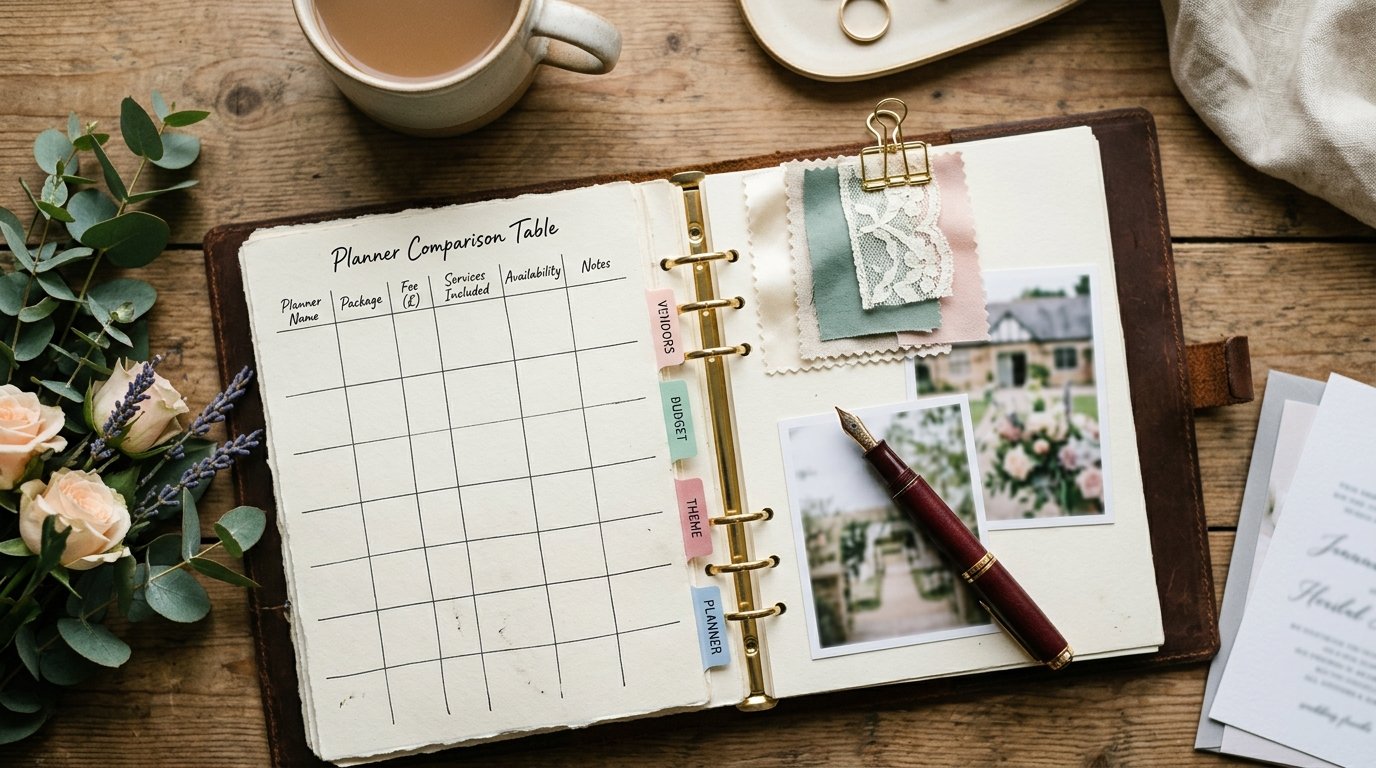
| Question | Planner 1 | Planner 2 | Planner 3 |
|---|---|---|---|
| Service level | |||
| Total fee | |||
| Commission-based or fee-only? | |||
| Weddings managed at same time | |||
| Worked at our venue? | |||
| What’s included | |||
| Day-of team size | |||
| Cancellation terms |
How to decide
The right planner is someone you trust, communicate well with, and who understands your priorities. In your consultation, pay attention to how much they listen versus how much they talk. A great planner asks more questions than they answer in the first meeting.
Check references. Call or email 2-3 previous clients and ask: Was the planner responsive? Did they stay on budget? Were there any surprises? Would you book them again?
Keep planning
Frequently asked questions
How much does a wedding planner cost in the UK?
On-the-day coordination costs £800-1,500. Partial planning (6-12 months of support) costs £1,500-3,500. Full planning from engagement to wedding day costs £3,000-10,000+. Prices vary by region, experience, and wedding size. London planners typically charge 30-50% more than planners outside the M25.
Is a wedding planner worth the money?
For complex weddings, large guest lists, destination events, or couples with demanding work schedules — yes. A good planner saves you time, avoids costly mistakes, and often negotiates supplier discounts that offset their fee. For a straightforward wedding at an all-inclusive venue, on-the-day coordination alone may be sufficient.
What is on-the-day coordination?
On-the-day coordination means the planner manages everything on the wedding day itself — supplier arrivals, timeline, troubleshooting, and logistics. They typically get involved 4-6 weeks before the wedding to learn your plans. They don't help with planning, design, or supplier sourcing — those are your responsibility.
When should I hire a wedding planner?
Hire a full planner as soon as you're engaged. Hire a partial planner 9-12 months before. Hire on-the-day coordination at least 3 months before — earlier if possible. The sooner they're involved, the more value they add.
Do wedding planners get commissions from suppliers?
Some do. Commission-based planners earn 10-20% of the supplier fees they book on your behalf. This creates a potential conflict of interest — they may recommend more expensive suppliers. Fee-only planners charge you directly and don't take commissions. Ask which model your planner uses.