Home / Articles / Wedding Trends
Opalite Weddings: The Iridescent UK Trend Up 2,710%
Key Takeaways
- Pinterest Predicts 2026 lists 'opalite weddings' as one of its highest-growth searches, up 2,710% year-on-year
- Opalite as a wedding aesthetic means shifting iridescent tones — soft whites, pale lavender, pearl, aurora-blue and blush — not a single fixed colour
- The trend is a direct reaction to the flat-all-white aesthetic that dominated UK weddings from 2015 to 2023
- Key applications include table linens, candle vessels, bridal party dresses, stationery and cake finishes
- UK suppliers including Cox & Cox and Anthropologie UK already stock iridescent tableware suitable for the look
- The opalite trend pairs naturally with celestial whimsigoth, meadowcore and the broader 2026 shift toward iridescent maximalism
Pinterest recorded a 2,710% increase in searches for opalite weddings between 2024 and 2026. The trend sits in Pinterest Predicts 2026 alongside other iridescent and dimensional palettes — celestial whimsigoth, aurora-inspired tablescapes and pearl-toned bridal parties. Opalite is not a single colour. It is a quality of colour: soft, shifting, luminous, changing with the light. This guide breaks down what the aesthetic means, how to build it across your wedding day and which UK suppliers are already stocking the right pieces.
By Matt, Editor at Weddings Hub. I track Pinterest Predicts data and UK wedding trend reports as they are released. This article draws on the Pinterest Predicts 2026 report, Vogue UK bridal trend coverage, and supplier conversations with UK wedding stylists and stationery designers in March–May 2026.
What “opalite” actually means as a wedding aesthetic
The word opalite has two existing meanings. In crystal healing, opalite is a synthetic glass with a milky, blue-white iridescence. In interior and fashion styling, “opalite” has become shorthand for a quality rather than a specific material: the shifting, light-reactive quality that opals possess, applied to colour palettes, fabrics and surfaces.
For weddings, opalite means a palette where the colours appear to shift. Ivory catches the light and looks pearl. Pale lavender in shadow looks grey-blue; in sunshine it glows almost white. Soft blush on silk organza changes across the day as light angles change. The defining quality is luminosity — the palette is alive.
This is explicitly distinct from the flat all-white or chalk-white aesthetic that defined the Instagram wedding era of 2015 to 2022. That look was static: pure white tablecloths, white florals, white candles, white cake. It photographed with graphic clarity but it created a coldness in person that the trend industry began flagging as early as 2023.
The 2024 and 2025 wedding seasons saw a tentative move toward “warm ivory” — off-white with a cream or champagne undertone. Opalite is the next step: not just warmth, but dimension.
The six colours that build an opalite palette
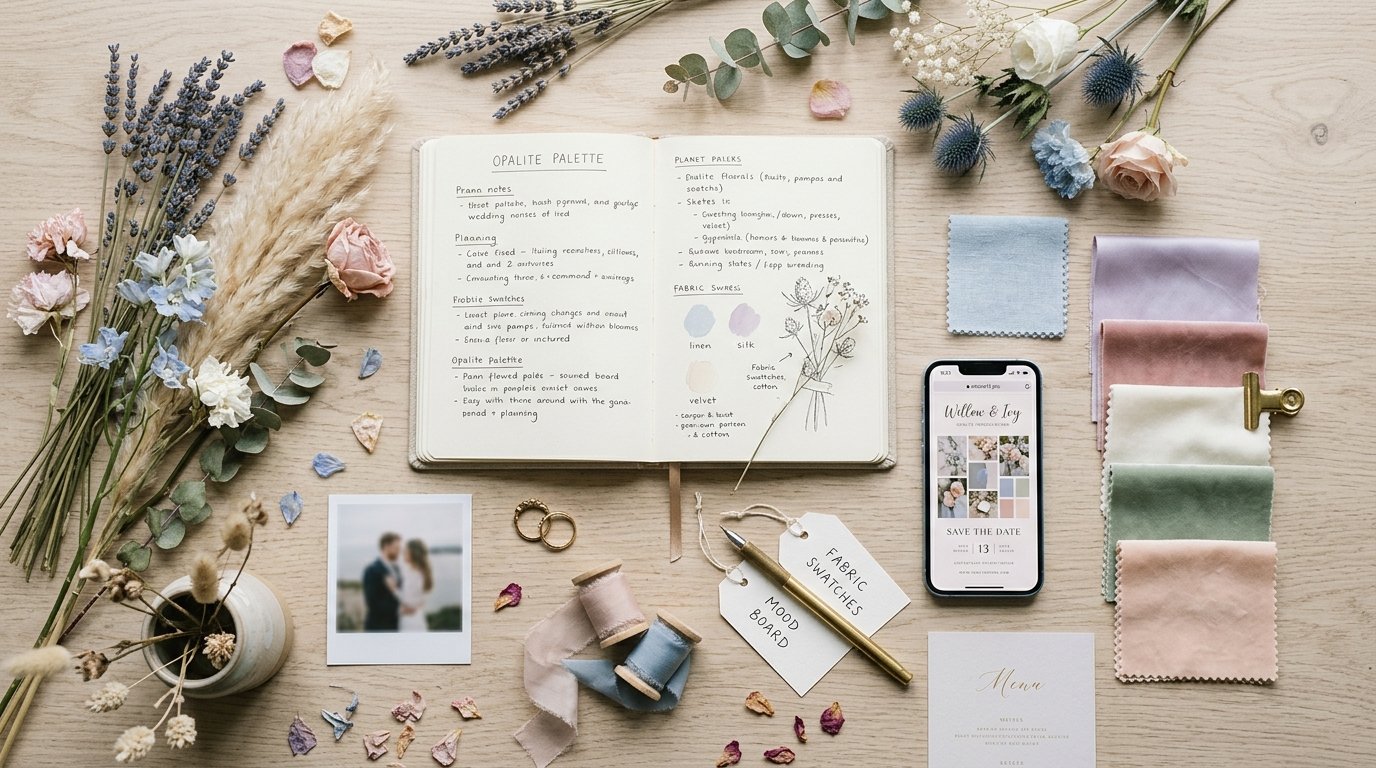
An opalite palette is not about choosing one colour. It is about choosing colours that share the luminous, shifting quality:
1. Pearl white. The anchor of most opalite palettes. Not cold-white, not warm-ivory — pearl white has a slight luminosity that reads differently in different light. Dupioni silk, organza and satin all carry this quality in pearl tones.
2. Pale lavender. The signature tone of Pinterest’s opalite moment. Lavender reads as romantic without being saccharine. It pairs with ivory and blush without conflict. In natural light it appears soft; in candlelight it darkens to something more dramatic.
3. Aurora blue. The icy, faintly iridescent blue that reads like glacial light. This is the highest-risk tone in the palette — it can tip toward cold if overused. As an accent — in stationery, in candle holders, in a single bridesmaid’s dress — it is distinctive and striking.
4. Soft blush. The most accessible opalite tone. Blush is already established as a UK wedding colour (it has never fully gone away since 2016). In the opalite context, the relevant blush is softer and more translucent than the petal-pink that was dominant — closer to a bare lip than a rose.
5. Champagne. The warm foil to the cool tones. Champagne catches light as gold but stays muted enough not to dominate. Champagne sequin overlays on tablecloths, champagne-toned candles or champagne-shaded bridesmaid dresses keep the palette from reading as merely pale.
6. Iridescent silver. The metallic note. Silver that shifts blue in one light and warm-white in another — aurora-finish metallic, not flat chrome silver — works as a highlight rather than a dominant tone.
A workable opalite palette for a UK wedding in 2026 would be: pearl white as the primary (60%), pale lavender as the secondary (25%), aurora blue as a tertiary accent (10%), iridescent silver as highlight (5%).
How to apply the opalite aesthetic: category by category
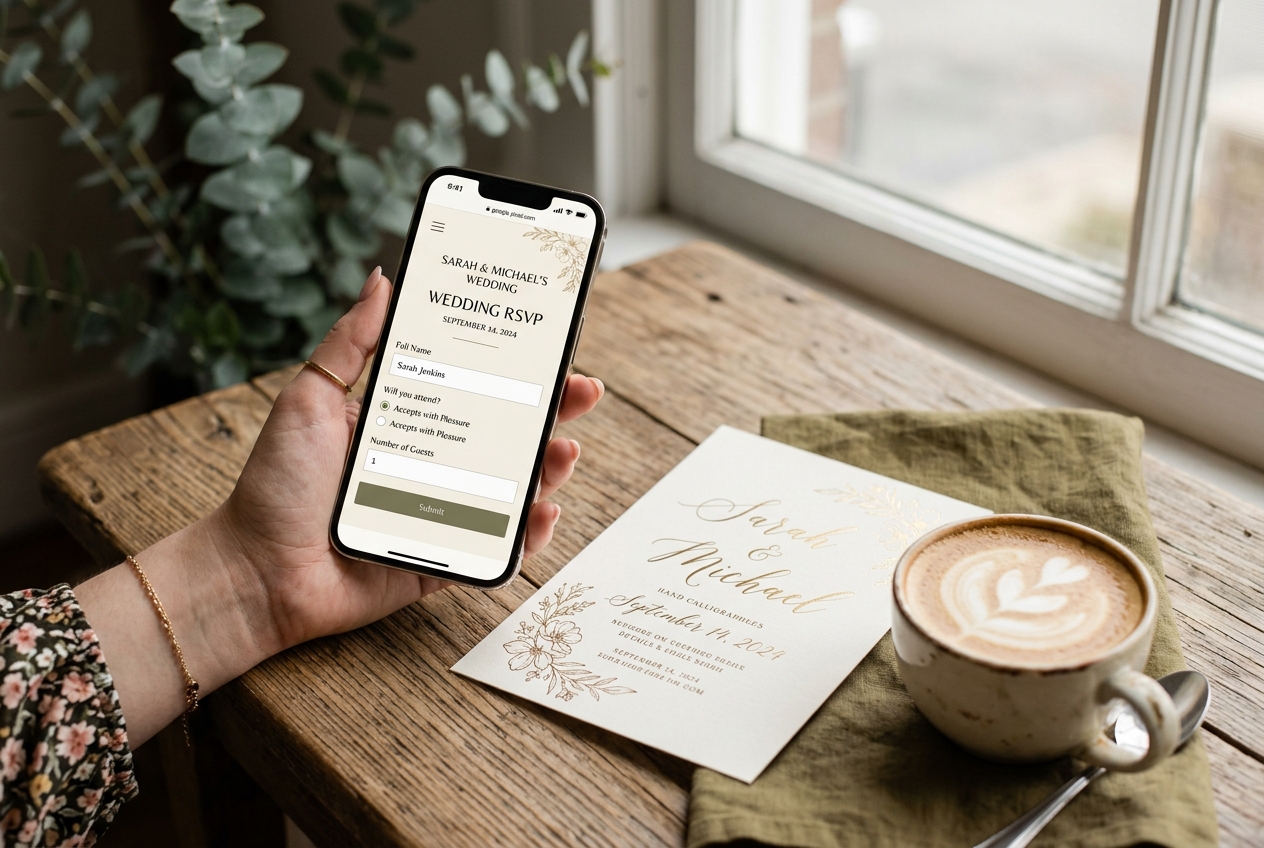
Table linens and tableware
The most accessible entry point. You do not need to change your venue or your dress to adopt the opalite look — table styling is where the aesthetic lands most strongly in the room.
Iridescent table runners: Aurora-effect organza runners in a pale lavender-to-ivory gradient are available from Etsy UK sellers (search “iridescent organza wedding runner”). Expect £8–£18 per runner for 180cm lengths. Order at least 8–10 weeks before the wedding.
Iridescent candle holders: Cox & Cox stocks glass pillar holders with a pearl-foil interior finish that catches light beautifully at £12–£28 each. Anthropologie UK has a rotating stock of aurora-glass votives in the £6–£15 range that disappear and reappear seasonally — check early.
Pearl-finish charger plates: Available via Party Pieces, The Wedding of My Dreams, and various Etsy UK sellers at £2–£5 per plate. For a 10-person table, the charger plates alone shift the aesthetic significantly.
Florals
The opalite palette works best with florals that are soft in tone rather than saturated. White and blush peonies, pale lavender sweet peas, ivory ranunculus and white garden roses all sit naturally within it.
The key choice is whether to add iridescent or metallic floral accents:
Aurora borealis crystal floral picks: Small crystal accents wired into bouquets or centrepieces, catching light and scattering colour. Available from Berisfords Ribbons and various bridal floristry suppliers. Cost: £0.80–£1.50 per pick.
Iridescent floral wire and ribbon: Tying stems with a pearl-shimmer organza ribbon rather than a standard satin ribbon shifts the bouquet into the opalite visual register. Berisfords and Mokuba ribbons both stock suitable options at £2–£4 per metre.
Avoid deep or saturated colours in your florals if you are committing to the opalite look. A single stem of deep fuchsia or cobalt blue pulls the eye out of the palette immediately. Consistent softness is the point.
Bridal party dresses
The opalite trend gives bridesmaids a legitimate reason to wear the pale lavender or dusty periwinkle dresses that many want but struggle to justify against a bride in ivory.
ASOS Edition, Ghost and Needle & Thread all stock long bridesmaid dresses in the relevant pale lavender, pearl and blush tones at £80–£220 per dress. Needle & Thread’s embellished dresses — often covered in aurora-crystal beading — are probably the most directly opalite option available on the UK high street.
For a mixed palette across the bridal party — different opalite tones on each bridesmaid — specify pale lavender, soft blush, and pearl across a group of five and the cumulative effect reads as highly intentional.
Stationery
Iridescent foiling has been a stationery option for several years. In the opalite context, it is a precise fit. Aurora foiling — which shifts between silver, blue and purple depending on the angle — is available from UK stationery studios including Papier, Artifact Uprising’s UK operation and independent Etsy sellers.
Pearl-card stock in soft lavender or champagne gives the printed surface a dimension that flat card does not. Expect to pay £1.80–£3 per invitation for iridescent foil on pearl card stock at specialist stationery studios.
Wedding cake
The opalite cake finish is one of the most visually distinctive outcomes of this trend. Key techniques:
Ombre buttercream with shimmer: Pale lavender blending to ivory to pearl white, with edible pearl dust over the surface. A six-inch three-tier cake in this finish costs £280–£450 from a specialist cake designer.
Mirror glaze: A shiny, colour-shifting glaze finish that produces an extreme opalite effect. Less common for traditional wedding cakes but increasingly popular for cutting cakes and dessert table features.
Edible lustre sprays: Wilton and Squires Kitchen both sell edible lustre sprays in pearl and aurora-finish gold at £4–£8 per can. Applied over pale-toned buttercream, they produce a credible opalite surface finish without bespoke cake-design costs.
The venues that suit the opalite aesthetic
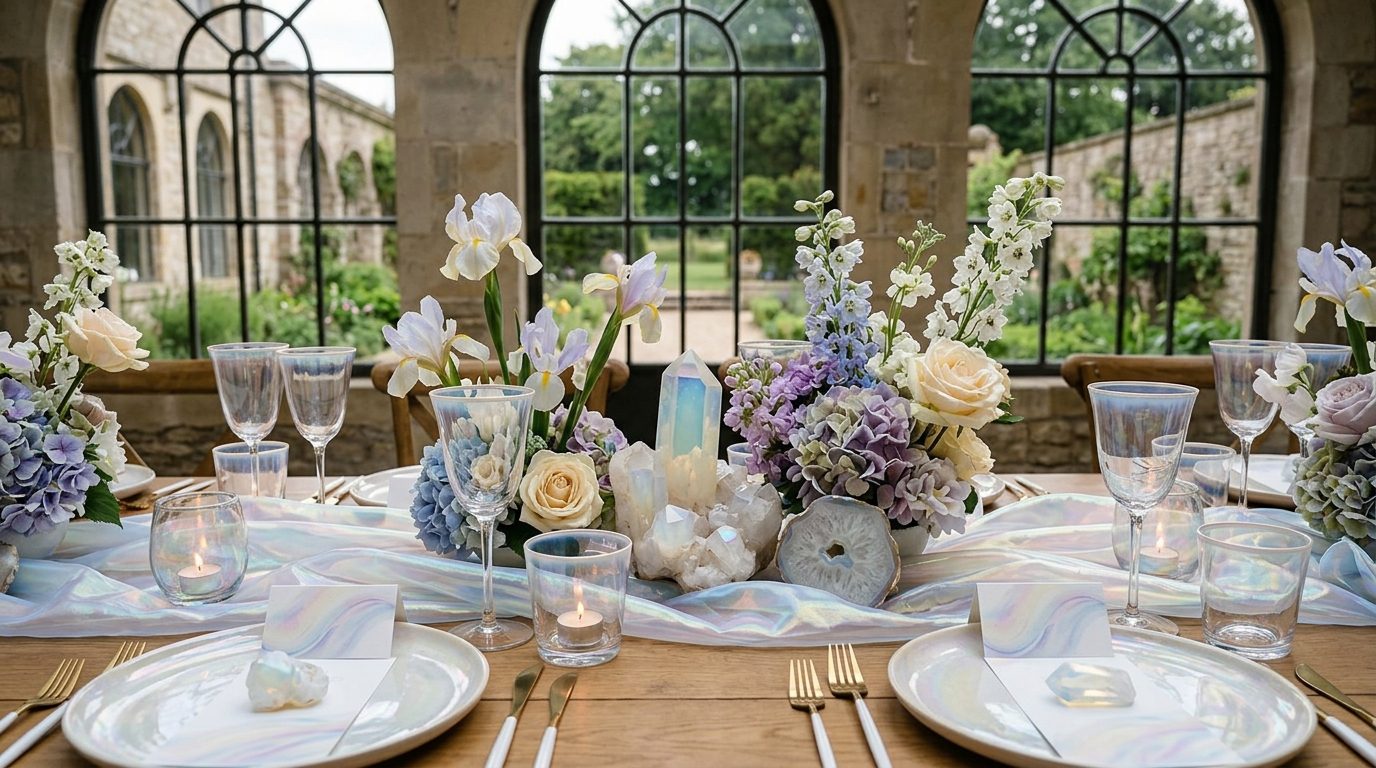
The opalite palette is light-dependent. Venues with good natural light — tall windows, glass ceilings, light-coloured stone walls — amplify the iridescent quality of the palette. Venues with low ceilings and dark panelling require more candle and fairy-light work to compensate.
Best-fit venue types:
Glass greenhouse and conservatory venues. The glass structure refracts light throughout the day, changing the palette with the sun’s position. Our outdoor wedding venues guide covers UK venues with glass or glazed ceremony spaces.
Coastal venues with sea light. The quality of light near large bodies of water has a natural iridescence — salt particles in the air, the reflected brightness from below the horizon. Coastal venues amplify soft palettes.
Historic house interiors with large windows. Georgian and Regency interiors — tall sash windows, pale plasterwork, parquet floors — create the right base for an opalite palette to read at its best.
How the opalite trend fits 2026’s broader aesthetic shift
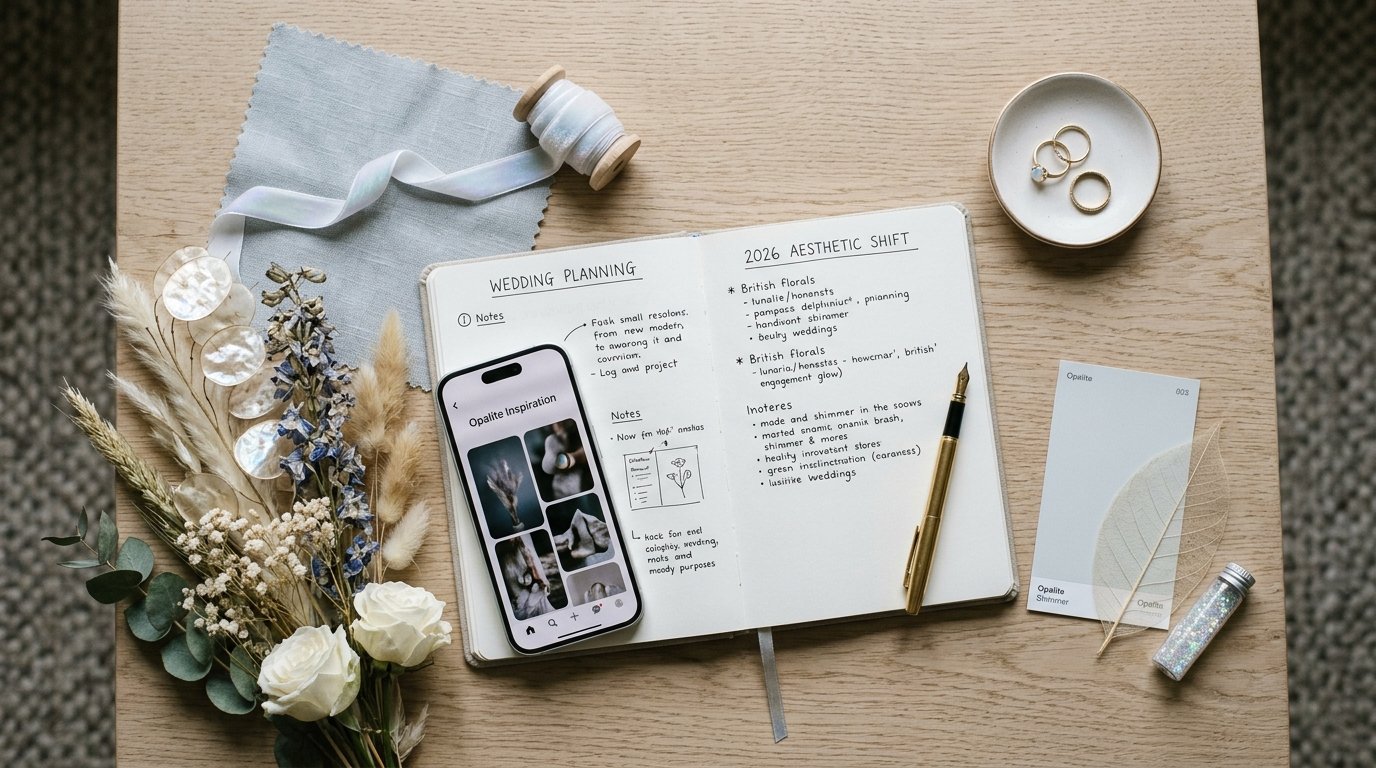
Opalite does not sit in isolation. Pinterest Predicts 2026 includes several overlapping iridescent and maximalist aesthetics: celestial whimsigoth (dark fairytale with iridescent accents), aurora-inspired tablescapes, pearl headdresses (up significantly as a bridal accessory) and what trend forecasters are calling “dimensional neutrals” — the shift from flat calm to textured, light-reactive versions of traditional wedding colours.
The underlying driver is a post-pandemic, post-cost-crisis desire for visual excess after several years of “pared-back” and “sustainable simplicity” messaging. Couples who married in 2020–2022 often got stripped-back weddings by necessity. Those planning 2026–2027 weddings want something more. The opalite trend delivers spectacle without requiring either complexity or high cost — a table set with iridescent candle holders and a pearl-shimmer runner is not expensive, but it looks extraordinary.
Our wedding trends 2026 guide covers the full landscape of what is changing across venues, formats and aesthetics in the UK this year.
Opalite wedding budget: what it costs to achieve the look
A full opalite aesthetic across a 100-person UK wedding does not require a high budget. The key items and typical costs:
| Item | Per unit | 100-guest total |
|---|---|---|
| Iridescent table runners (10 tables) | £12–£18 | £120–£180 |
| Pearl-finish charger plates (100) | £2–£5 | £200–£500 |
| Aurora glass candle holders (3 per table, 30 total) | £8–£18 | £240–£540 |
| Aurora crystal floral picks (10 per centrepiece, 100 total) | £0.80–£1.50 | £80–£150 |
| Iridescent bridesmaid dresses (4 dresses) | £120–£220 | £480–£880 |
| Aurora foil stationery (100 invitations) | £180–£300 | £180–£300 |
Total opalite styling cost above a standard base: £1,300–£2,550 for a 100-person wedding, depending on which elements you prioritise.
Frequently asked questions
What is an opalite wedding?
An opalite wedding uses a shifting iridescent colour palette — soft whites, pale lavender, pearl, aurora-blue and blush — that changes tone in different light. It is an aesthetic, not a fixed colour scheme.
Why are opalite weddings trending in 2026?
Pinterest Predicts 2026 recorded a 2,710% rise in opalite wedding searches. The trend reflects a wider shift away from the flat all-white wedding palette toward dimensional, light-catching colour.
How do I style an opalite wedding on a budget?
Start with iridescent candle holders and table runners, which cost £15 to £40 per table. Add aurora borealis crystal accents to centrepieces. Keep florals in soft ivory and pale lavender to complement the palette.
What colours go with an opalite wedding palette?
Ivory, pearl white, pale lavender, soft blush, ice blue and warm champagne all sit within the opalite palette. Deep metallics — platinum, white gold — complement without overpowering.
What flowers work with an opalite wedding?
White and blush peonies, pale lavender sweet peas, ivory ranunculus, white garden roses and silver-leafed eucalyptus all work within the opalite palette. Avoid saturated colour — the palette is defined by its softness.
Is the opalite trend suitable for a winter UK wedding?
Yes. The pearl and ice-blue tones in the opalite palette work exceptionally well in candlelit winter settings. Iridescent table linens catch candlelight differently from white, making the effect stronger at evening winter events.
What UK venues suit an opalite wedding aesthetic?
Glass greenhouse venues, listed building interiors with tall windows and coastal venues with natural light all amplify the iridescent quality of the opalite palette. Stone-walled barn venues can work with additional candle and fairy-light layering.