Multi-Day Weddings: 3-Day Wedding Weekends Explained

Key Takeaways
- 37% of US couples in 2026 planned a three-day wedding weekend, per The Knot's 2026 annual survey
- The three-day format typically costs 35-50% more than a one-day wedding but spreads cost across smaller individual events
- Welcome parties and Sunday brunches are not subject to the same venue minimum spend as the main wedding day
- The most important logistical consideration: accommodation — 67% of multi-day couples make exclusive-use accommodation a requirement
- A three-day wedding weekend works best with a minimum of 50 guests travelling to the same location
The three-day format
The structure that most UK multi-day couples use:
Thursday or Friday: welcome party. Guests arrive. The event is informal — cocktails, light food, a chance to meet each other. Duration: two to four hours. Dress: smart casual. Venue: often the main venue’s bar, the grounds, or a private space. The welcome party is where the social foundation of the weekend is laid. By the time Saturday comes, no one is a stranger.
Saturday: the main wedding. The ceremony and reception. This is the full day — ceremony, drinks, seated meal, speeches, dancing, the works. 70-80% of the total wedding budget is spent here.
Sunday: farewell brunch. Guests who stayed overnight gather for a relaxed meal before departing. Duration: two to three hours. Format ranges from full cooked brunch to pastries and coffee. Some couples do a casual BBQ or picnic if the weather is good. The Sunday event closes the weekend and gives everyone a proper goodbye.
This structure can be extended. Some couples add a Thursday rehearsal dinner for the wedding party and immediate family, making it a four-day event. Others add a Saturday-morning yoga session or group activity for early risers.
Why this format is growing
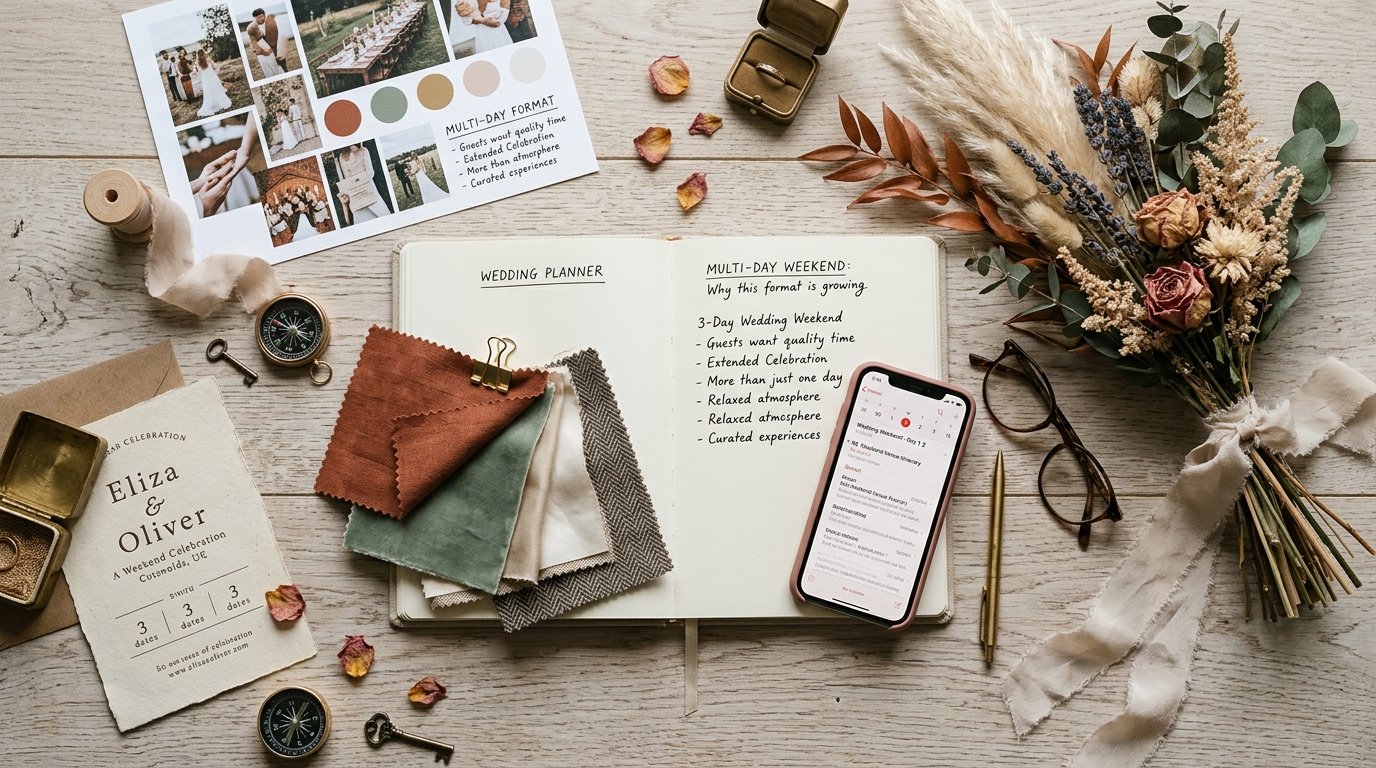
Accommodation economics. Exclusive-use venue hire has grown in popularity across the UK — barn venues, country houses, and estate properties increasingly offer full-weekend hire. When guests are already staying on-site, extending the event across three days adds relatively little to the total cost. A Friday night event costs far less when the kitchen is already staffed and the grounds are already hired.
The “wedding content” phenomenon. Multi-day weddings produce vastly more content than one-day weddings — welcome party footage, morning-of preparation at a residential venue, ceremony and reception, Sunday morning with guests. For couples who want a rich record of their wedding, the three-day format delivers.
Guest experience as the product. The generation currently getting married (mid-20s to mid-40s in 2026) grew up with festival culture and experience travel. A multi-day wedding functions more like a mini festival than a single formal event. This aligns with how many couples want their wedding to feel.
What it actually costs
Adding a welcome party and Sunday brunch to a one-day UK wedding:
Welcome party costs:
- Venue (if separate from main venue): £0-£1,200. If using the main venue’s space, often included or charged at £300-£600.
- Drinks: £15-£30 per person for a two-hour cocktail event.
- Canapés or light food: £12-£25 per person.
- Total for 60 guests: £1,600-£3,300.
Sunday brunch costs:
- Venue: usually the same venue, often no additional room hire.
- Catering: £18-£45 per person for brunch (buffet to sit-down).
- Total for 60 guests: £1,080-£2,700.
Total addition to the wedding budget: £2,680-£6,000 for both events, assuming 60 guests at each.
That brings a standard £22,000 UK wedding to £25,000-£28,000. Significant — but couples consistently report that the additional cost feels proportionate to the extension of the experience.
Where the savings come: exclusive-use venues that include all three events in a single package. Weddings Hub spoke with six UK exclusive-use venues in 2026 that offered “full weekend” packages including accommodation, welcome party, ceremony, reception, and Sunday brunch for £28,000-£45,000 for 60-80 guests — inclusive of all catering and accommodation. Compared with a similar venue booked just for the Saturday, the premium for the full weekend package was 25-35%.
Planning the welcome party
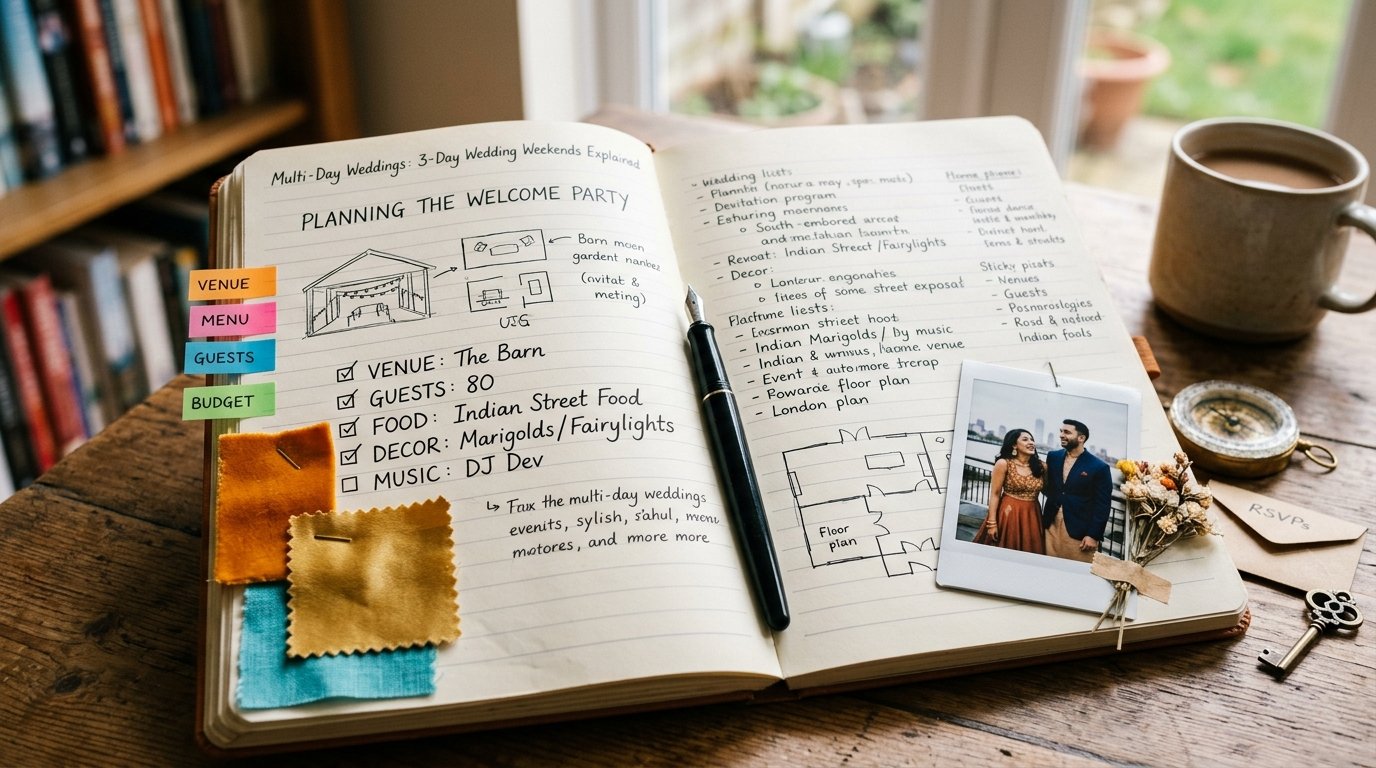
The welcome party’s job is to warm up the social dynamics for Saturday. The decisions that matter most:
When to start. Most welcome parties start at 7pm to allow guests time to travel, check in, and freshen up. Starting at 6pm catches early arrivals but risks feeling sparse until 7:30pm. 7pm is the reliable start time.
How long to run. Two to three hours. Not four. The main event is tomorrow. Keep people energised.
Format. Standing drinks with circulating canapés is the dominant format — it forces mingling in a way that a seated dinner doesn’t. Some couples hire a live musician or DJ for the last hour to signal the shift to party mode.
What not to do. Don’t make the welcome party compete with the main wedding. No special dress code, no elaborate decorations, no long speeches. It sets the tone — it doesn’t steal the show.
A practical example: Rachel and Tom, Bristol, 2025. They hosted 85 guests at a Somerset country estate. Friday welcome party: drinks and grazing table on the lawn, string quartet for the last hour, finished by 10:30pm. Saturday ceremony and reception: full day, 10am to midnight. Sunday brunch: eggs, pastries, Bloody Marys, finished by 1pm. “The Friday made the Saturday feel completely different,” Rachel told Weddings Hub. “Everyone was relaxed, everyone knew each other, and the ceremony felt like a celebration with friends rather than a room full of people who barely knew each other.”
Planning the Sunday brunch
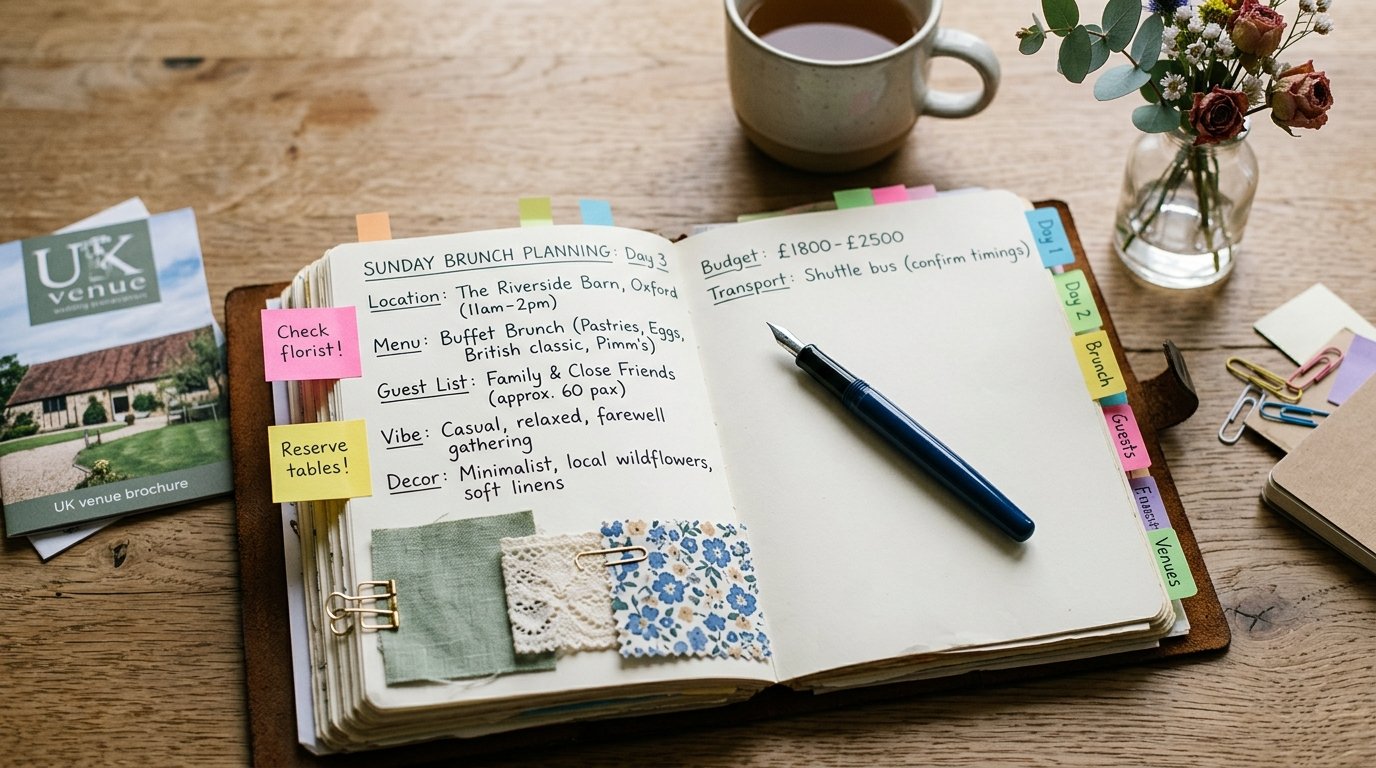
The Sunday brunch is the event most couples underplan. It tends to feel like an afterthought — but guests often describe it as one of the highlights.
Why it matters. Saturday night ends in high energy. Sunday morning is quieter, more intimate, and often produces the conversations that wouldn’t happen in the noise of the reception. Long tables of guests eating together with time to talk — this is where the weekend becomes a memory rather than just an event.
Format choices. The three most common:
- Formal-ish sit-down brunch: eggs benedict, salmon, pastries, coffee, juice. 10:30am to 1pm.
- Relaxed buffet: guests serve themselves, come and go, no fixed end time. 10am to 12:30pm.
- Continental self-service: pastries, fruit, coffee stations, very low effort. 9am to 11am.
Couples with budgets under pressure should choose option 3. The value of the Sunday brunch isn’t the food — it’s the time and space to say goodbye properly.
Venues that work
Multi-day weddings require specific venue attributes. The most important:
Self-catering facilities. If the venue provides catering for all three events, the couple negotiates one contract. If guests have access to a kitchen for making their own breakfasts, Sunday morning logistics simplify.
Outdoor space. Three consecutive days at a venue benefit from outdoor flexibility — especially for the welcome party and Sunday brunch, which feel better outside in good weather.
The strongest UK regions for multi-day exclusive-use venues: Scotland (large estates, castle hire, strong supply of residential properties), Wales (rural estates, coastal properties), Yorkshire (barn conversion estates with cottages), and the Cotswolds (country house hotels with exclusive hire options).
Related reading
- Sequel Weddings: The Two-Ceremony Format Explained
- Exclusive-Use Wedding Venues UK: The Complete Guide
- Barn Wedding Venues UK: The Best Picks by Region
- The Average UK Wedding Now Costs £21,990 — Which Number Is Right?
- How to Budget for a Wedding: The Step-by-Step UK Guide
Frequently asked questions
What is a multi-day wedding?
A multi-day wedding spreads the wedding celebrations across two or three consecutive days. The typical three-day format is: Friday welcome party (cocktails and dinner), Saturday main wedding ceremony and reception, Sunday farewell brunch. Some couples add a rehearsal dinner on Thursday, making it four days. The Saturday ceremony and reception is always the main event; the other days are supporting celebrations.
How much does a multi-day wedding cost in the UK?
Adding a welcome party and Sunday brunch to a traditional one-day UK wedding typically adds £3,500-£8,000. Welcome parties average £1,500-£4,000 (drinks, light food, a relaxed venue). Sunday brunches average £900-£2,500 for 50 guests. The main wedding day remains the largest cost. Couples using exclusive-use venues for the whole weekend often save on the welcome party and brunch because both are catered by the same kitchen.
Do you have to invite everyone to all three days?
No. It is common to have different guest lists for different parts of the weekend. The welcome party might include only travelling guests and close friends — 40 people. The main wedding might be 100 guests. The Sunday brunch might be 70 guests who stayed the night. The invitation should clearly state which events each person is invited to. It is not rude to have tiered invitations, provided the tiers are clearly communicated.
What is a welcome party at a wedding?
A welcome party is the informal gathering on the night before the main wedding ceremony. It typically runs for two to four hours, involves drinks and light food, and allows guests who have travelled to arrive, settle in, and meet each other before the main day. It is less formal than the reception, usually held at the venue's bar, a marquee, or an informal space. Dress code is smart casual rather than wedding guest formal.
What happens at a Sunday brunch at a wedding?
A wedding Sunday brunch is a farewell gathering the morning or early afternoon after the main reception. It allows guests to say proper goodbyes, recover from the previous evening, and extend the celebration. Format ranges from a formal sit-down brunch to a relaxed buffet. Many couples include a 'coffee and pastries' version — lower cost, lower energy, one to two hours. Some couples do a casual BBQ or picnic instead.
Is a multi-day wedding too demanding on guests?
It depends on the guests. For a destination wedding where everyone has already travelled, a three-day format is usually welcomed — it justifies the travel cost. For a local wedding with guests who live nearby, a three-day format with separate events each day can feel like a large time commitment. The solution is to make the welcome party and brunch clearly optional, with the main Saturday event being the only required attendance.
What venues work best for multi-day weddings in the UK?
Exclusive-use venues with on-site accommodation are the best fit. The whole wedding party stays on site, which removes the logistical complexity of coordinating between locations. Popular categories: country house hotels with exclusive hire, private estate rentals with cottages, barn venues with on-site shepherd's huts or glamping, and festival-style camping venues. Scotland and Wales have the strongest supply of large estate venues suitable for multi-day residential weddings.