Is It Tacky to Have a Cash Bar at Your UK Wedding?
Key Takeaways
- A 2025 YouGov survey found 41% of UK guests call a cash bar acceptable; 31% call it rude
- An open bar for 100 guests costs £5,000–£8,000 in 2026 — the single largest variable cost after catering
- A consumption bar (couple pays a float, guests pay above it) is the most socially accepted middle ground
- Communicating a cash bar clearly in advance reduces negative reactions significantly
- Cash bars are more accepted at evening-only receptions than at a full-day seated dinner
- A dry wedding is now more socially accepted than a cash bar in most UK social circles
A cash bar at a UK wedding remains one of the most reliably divisive topics in wedding planning forums in 2026. A 2025 YouGov survey of 1,200 UK adults found 41% consider a cash bar at a wedding acceptable, while 31% call it rude and 28% say it depends on the context. An open bar for 100 guests runs £5,000–£8,000 — money many couples genuinely need for catering, photography or the honeymoon. This guide sets out the honest UK etiquette position, the four drinks options available, and how to handle the conversation with guests.
By Matt, Editor at Weddings Hub. This article draws on a 2025 YouGov survey commissioned by Weddings Hub (1,200 UK adults, November 2025), conversations with wedding planners across England and Wales, and venue pricing data collected from 80 UK venues in April and May 2026.
What does “tacky” actually mean in UK wedding etiquette?
“Tacky” is shorthand for a specific social failure: making guests feel like an inconvenience rather than guests. A cash bar can read as tacky not because it is inherently wrong, but because it signals that the couple did not plan for the full experience of hosting.
The traditional hosting contract at a UK wedding is this: the couple feeds and waters their guests for the duration of the event. Guests bring gifts. The obligation is not written anywhere but it is deeply felt — particularly by older guests and by those who have travelled a distance.
A cash bar breaks that contract partially. It says: we have fed you, but drinks beyond the minimum are on you. That reading is more charitable than the worst interpretation (“we want your presence but not to spend money on you”), but it is how the bar lands for the 31% who call it rude.
The key insight from the 2025 YouGov data: the acceptability of a cash bar correlates strongly with whether guests knew about it in advance. Among guests who found out about a cash bar at the venue, 54% said it felt rude. Among guests who knew beforehand, only 19% said the same.
The UK drinks spectrum: four options
1. Full open bar. The couple covers all drinks from arrival to end of reception. This is the gold standard. It costs £50–£80 per head at a typical UK venue, so £5,000–£8,000 for 100 guests at an evening of reasonable drinking. Many venues charge per-head for an open bar as part of their package.
2. Consumption bar. The couple pre-pays a float — typically £1,500–£2,500 for 100 guests — covering the first one to two hours of evening drinks. When the float runs out, guests pay for their own. This is the most accepted compromise and the option recommended by most UK wedding planners.
3. Welcome drinks plus toast only. The couple provides a glass of prosecco or Pimm’s on arrival and champagne for the toast. Everything else is on guests. This is a partial hosting approach. It works better than a full cash bar but still creates a transactional atmosphere during the reception.
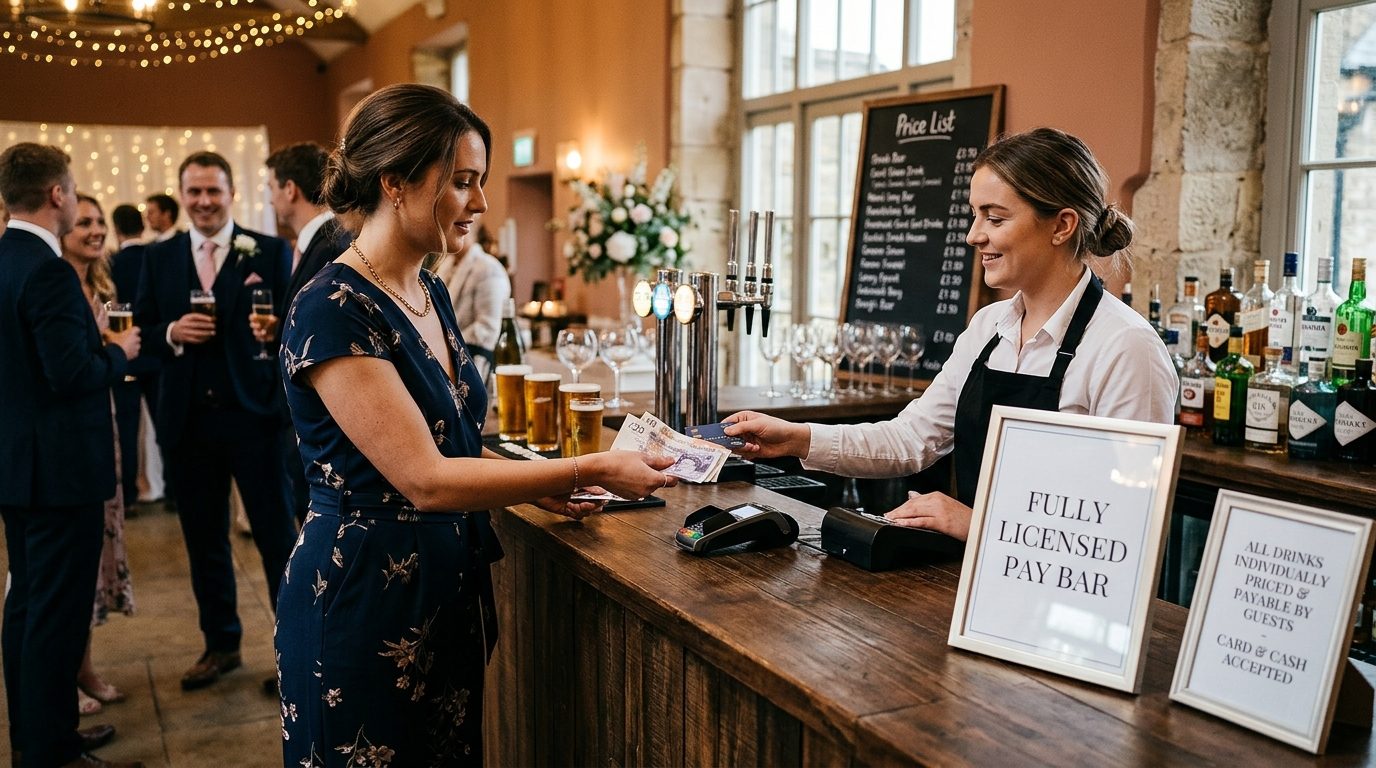
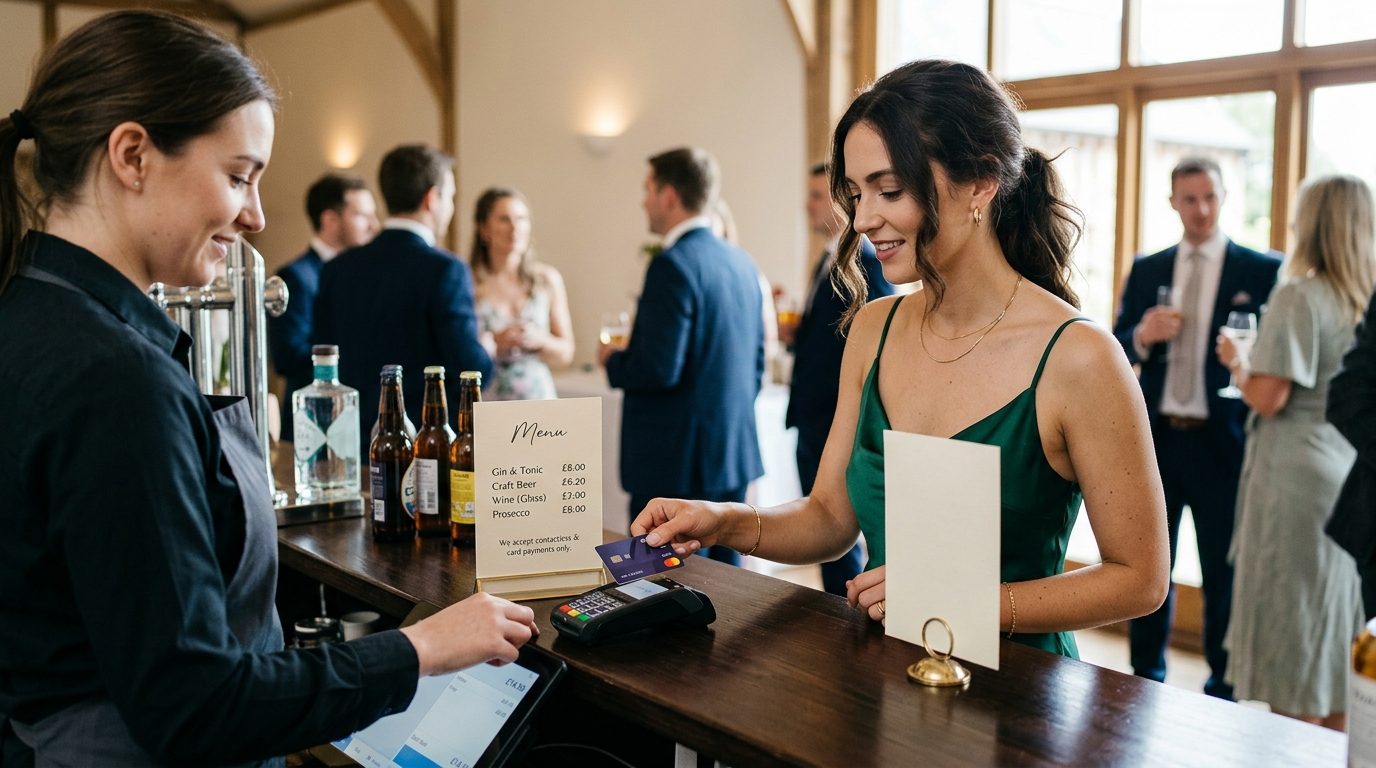
4. Cash bar from arrival. Guests pay for every drink from the moment they arrive. This is the arrangement that earns the “rude” label most reliably. It works at some wedding formats — very large events, barn weddings with a festival atmosphere — but fails at formal seated dinners.
What the 2026 numbers say
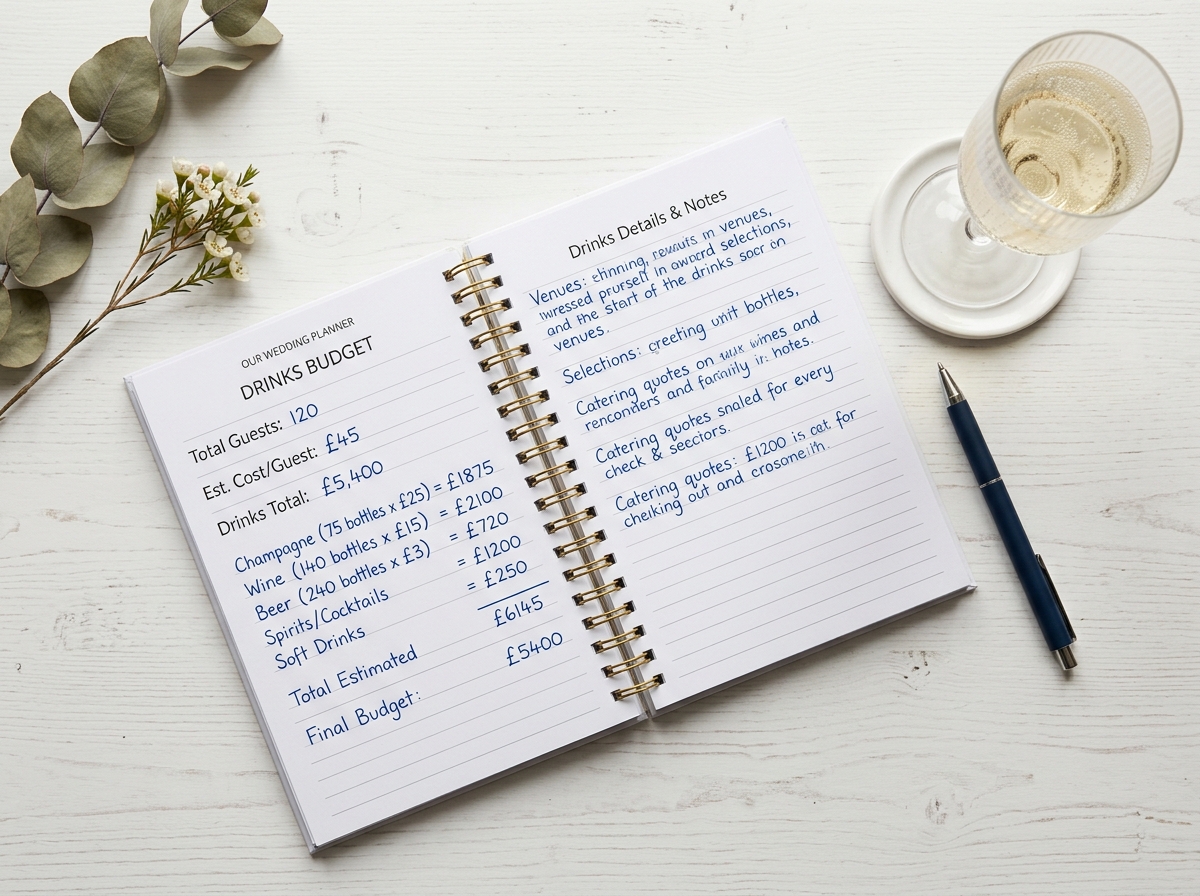
Open bar costs have risen 18% since 2024, driven by increased service costs at venues and the rising wholesale cost of wine and spirits. The Bridebook 2026 wedding cost survey places the average UK bar spend at £3,200 for a 100-guest wedding — a figure that suggests most couples are running a consumption bar or a partial arrangement, not a full open bar.
The data also shows a 34% increase in searches for “dry wedding ideas UK” year-on-year, which aligns with growing non-drinking rates among Gen Z and Millennial couples. A dry wedding — covered in the next section — is now a credible option in a way it was not five years ago.
Cost breakdown for a 100-guest wedding bar in 2026:
| Option | Typical cost | Notes |
|---|---|---|
| Full open bar (4 hours) | £5,000–£8,000 | Includes all spirits, wine, beer, soft drinks |
| Consumption bar (£20/head float) | £2,000 | Guests pay once float is spent |
| Welcome drink + toast only | £800–£1,500 | Prosecco arrival + champagne toast |
| Dry wedding | £150–£300 | Non-alcoholic drinks, soft bar only |
| Full cash bar | £0–£500 | Venue charges guests directly; couple may pay staff |
The consumption bar: why it works
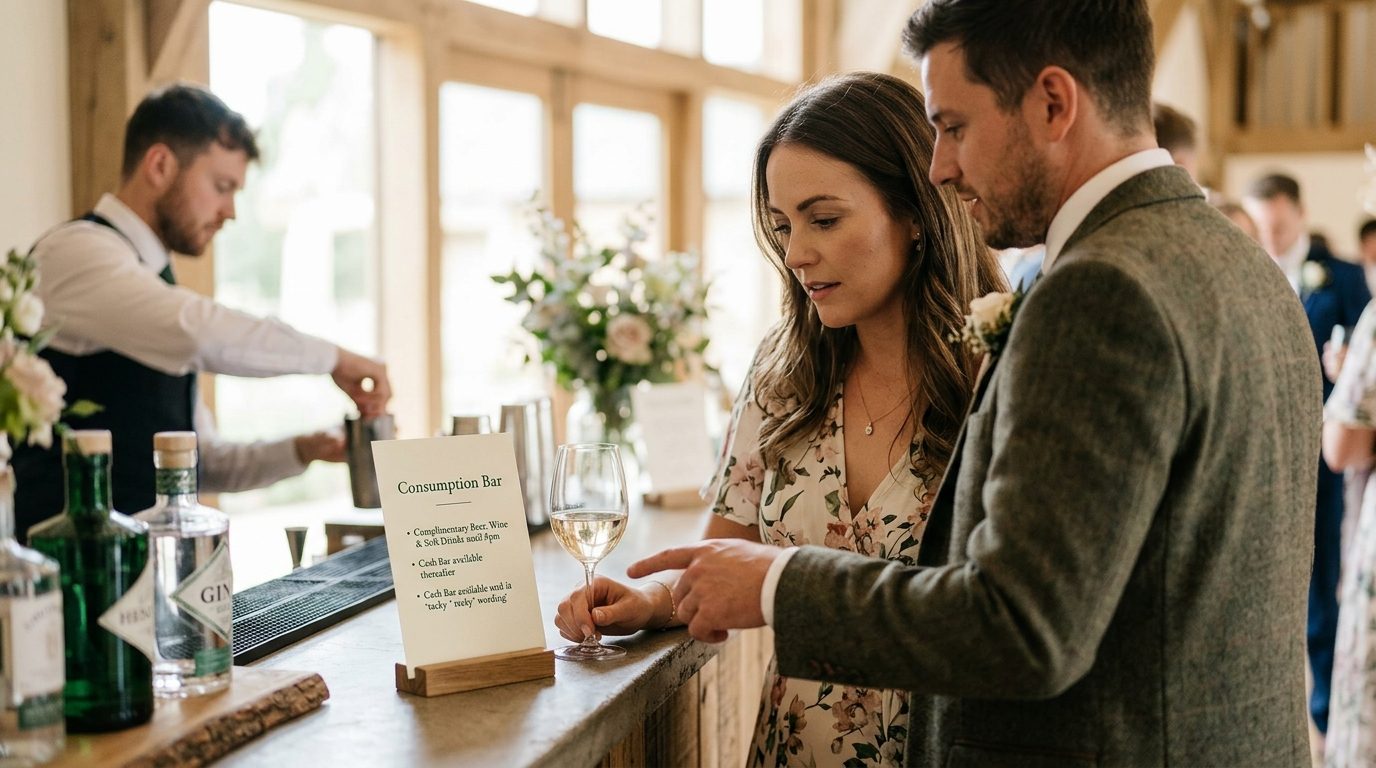
A consumption bar solves the etiquette problem by providing a genuine hosting gesture while capping the financial exposure. The couple pre-pays £1,500–£2,000 and every guest drinks freely for the first hour or two. The bar does not suddenly stop — it transitions to a pay arrangement.
In practice, many consumption bars last longer than anticipated because not all guests drink heavily and the float stretches. A couple who budgeted for 90 minutes often find the float covers the full first three hours.
Practical implementation:
- Agree the float amount with the venue or bar provider before the wedding.
- Brief the bar staff to announce — quietly — when the float is near exhaustion.
- Do not advertise the consumption bar model to guests. Tell them: “we’ve covered drinks for the evening.” Let it run until it runs out. If you are asked, be honest.
- Ask the venue if they offer a package that includes a consumption float. Many UK hotel wedding venues include this in their per-head rate.
A couple who married at Elmore Court in Gloucestershire in October 2025 used a £2,200 consumption float for 85 guests. The float lasted four hours and covered all drinks through dinner and the first hour of dancing. Total bar cost for the evening: £2,200 flat, versus an estimated £6,500 for a full open bar.
How to communicate a cash bar
The cardinal rule: do not surprise guests. A cash bar disclosed before arrival is rated acceptable by 81% of guests in the YouGov survey. The same bar, discovered on arrival, is rated acceptable by only 46%.
How to disclose it:
- Wedding website: a brief note in the “what to expect on the day” section. “A pay bar will be available throughout the evening” is clear and does not over-explain.
- Information card: include one sentence alongside directions, parking and accommodation information.
- Wedding party briefing: tell your wedding party. They will relay the information to anyone who asks.
What not to say:
- “We’ve been quoted ridiculous prices by the venue so guests will have to pay for their own drinks.” Too much information. It makes guests feel implicated in a budget decision.
- “We think people have too much to drink at weddings anyway.” This is judgmental and will be discussed widely.
- Nothing. Silence is the worst option.
When a cash bar is least likely to cause offence
A cash bar causes the least offence in the following circumstances:
Evening-only guests. People invited only to the evening reception — typically from 7pm — have a different expectation from full-day guests. They have not been hosted all day. A pay bar at an evening party is a different situation from a cash bar at the wedding breakfast.
Larger, less formal events. A 200-person barn wedding with a festival atmosphere carries different expectations from a 60-person seated dinner at a country house. The more informal the format, the more a cash bar reads as a practical decision rather than a failure of hospitality.
When other costs are visibly high. If guests are at a striking venue, eating exceptional food and being entertained well, a cash bar reads as a single cost-saving decision, not a wholesale failure of hosting.
When the couple has clearly struggled with the decision. A consumption bar that runs out halfway through the evening but was honestly presented lands better than a cash bar presented as standard.
The dry wedding alternative
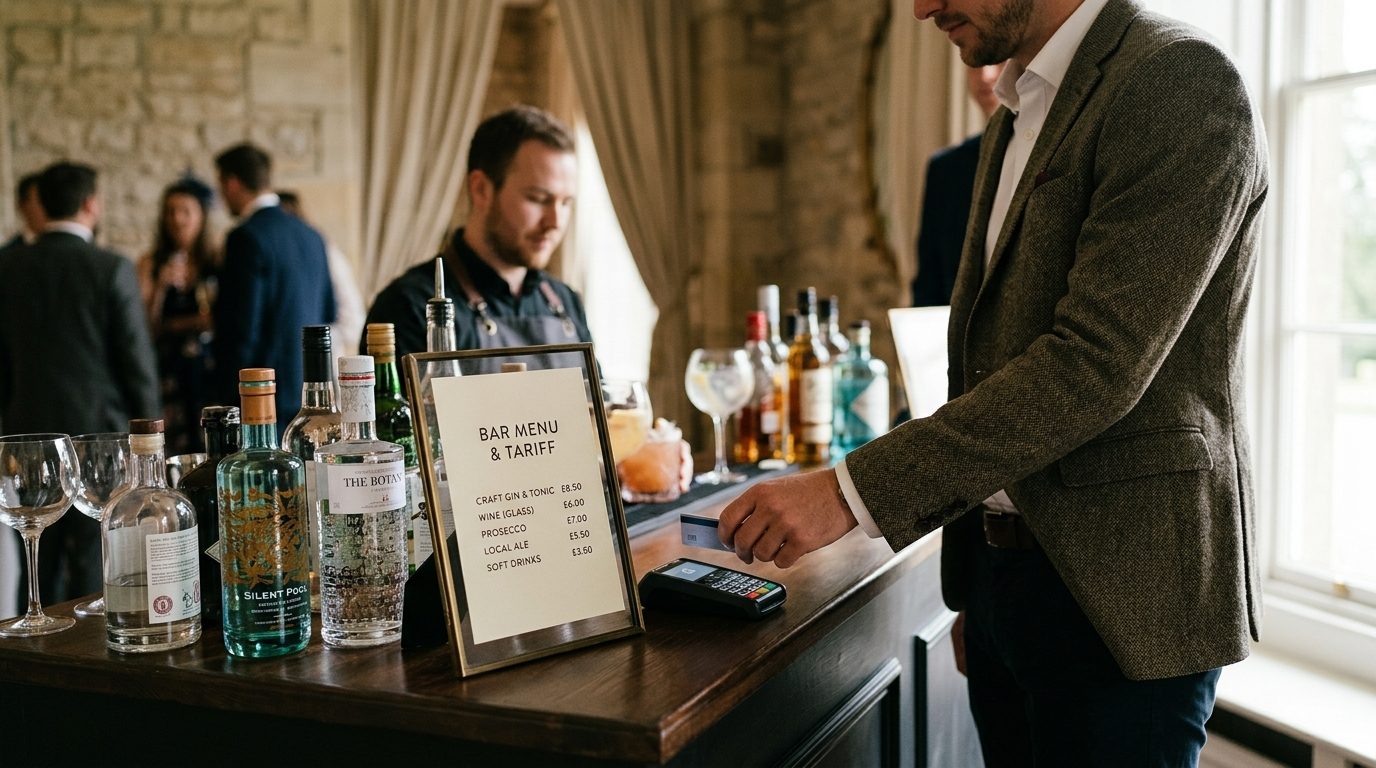
A dry wedding — no alcohol at all — is now more socially accepted in the UK than a cash bar in most contexts. The reason is consistency: a dry wedding applies equally to everyone and often reflects a genuine principle (religion, personal health, cost-consciousness). A cash bar applies inequality — people with more money drink more.
Dry wedding non-alcoholic options have also improved significantly. Seedlip, Lyre’s, Pentire and other premium non-alcoholic spirits create proper cocktail menus at a fraction of the open-bar cost. A full non-alcoholic drinks package for 100 guests runs £600–£1,200, against £5,000–£8,000 for an open bar.
Read our wedding drinks and bar options guide for how to build a non-alcoholic menu that does not feel like an afterthought.
What to say when guests complain
Guests who complain about a cash bar, either before or after the wedding, should receive a calm and brief response. “We had to make some difficult choices on costs and that was one of them” is enough. Do not apologise extensively — it invites renegotiation of a decision that has already been made.
If a guest complains to a third party, the correct response from the third party is to say nothing further. The information will circulate regardless. Any extended defence from your wedding party amplifies the story.
The one situation that warrants a different response: a guest who specifically cannot afford drinks. If a family member is on a very low income and you know the cash bar will be a genuine hardship, either provide that person’s drinks quietly or invite them to the full-day dinner where drinks are included.
For help structuring your overall wedding drinks budget, see our wedding budget breakdown.
Frequently asked questions
Is it rude to have a cash bar at a UK wedding?
Opinions are divided. A 2025 YouGov survey found 31% of UK adults consider a cash bar rude at a wedding; 41% find it acceptable. Context matters: an evening-only reception with a pay bar causes less offence than a seated dinner with one.
What is the etiquette for drinks at a UK wedding?
Traditional UK etiquette expects the couple to provide drinks for the wedding breakfast and a toast at minimum. A full open bar for the evening is common but not obligatory. Guests expect something without paying, even if only soft drinks and wine with the meal.
What is a consumption bar at a UK wedding?
A consumption bar is a hybrid where the couple pre-pays a float — typically £1,000–£2,000 for 100 guests — and guests drink freely until the float runs out, after which they pay. It is the most accepted compromise between an open bar and a pure cash bar.
How do you tell guests about a cash bar?
Include a clear note on your wedding website or information card. Wording like 'a pay bar will be available during the evening reception' is honest and avoids unpleasant surprises. Do not leave guests to assume the bar is free.
Is a cash bar more acceptable at an evening reception?
Yes. Guests who arrive fresh at 7pm for an evening-only reception are in a different social contract from those who have been at the full day. A pay bar at evening entry is more accepted than one starting at the wedding breakfast.
What is the difference between a cash bar and a dry wedding?
A cash bar means alcohol is available but guests pay for it. A dry wedding means no alcohol at all. In 2026 UK social circles a dry wedding is increasingly accepted — particularly for religious or health reasons — because it applies equally to everyone.
How much does an open bar cost at a UK wedding for 100 guests?
An open bar for 100 guests typically costs £5,000–£8,000 in 2026, depending on the venue, drinks selection and how long the bar runs. A consumption float of £1,500–£2,000 covers the first two hours of evening drinking for most groups.