How to Uninvite Someone From Your Wedding

Key Takeaways
- You have no legal obligation to invite anyone to your wedding — uninviting a guest is uncomfortable but entirely within your rights
- Tell the person directly and as early as possible; using a third party is worse in almost every case
- A 2024 UK wedding survey found 14% of couples had removed at least one guest from the list in the six months before the wedding
- Venue/caterer final headcount deadlines fall 4–6 weeks before the wedding — act before that point to avoid paying for absent guests
- The conversation should be brief and firm; lengthy explanations invite negotiation
- Expect some relationship damage; it rarely proves permanent unless the underlying issue is serious
Fourteen per cent of UK couples who married in 2024 removed at least one guest from their final list in the six months before the wedding. The reasons range from budget cuts to relationship breakdowns to safety concerns. There is no legal obligation to invite anyone to your wedding. There is an etiquette obligation to handle the conversation directly, early and clearly. This guide gives you the framework for doing it without making a difficult situation worse.
By Matt, Editor at Weddings Hub. This article draws on UK wedding etiquette conventions, discussions with wedding planners across England and Wales, and a 2024 survey of 450 UK couples about guest list changes in the 12 months before their wedding.
Why uninviting happens: the six most common reasons
Understanding why couples uninvite guests is useful before looking at how, because the reason shapes the approach.
1. Budget cuts. The most common. A couple initially builds their list at full ambition, then confronts the actual per-guest cost (currently averaging £272 per head in 2026, per Bridebook). Cutting 20 guests saves, in theory, £5,440. In practice many costs are fixed, but the caterer and bar run are genuinely per-head. When numbers need to fall from 100 to 80, some people come off the list.
2. Relationship breakdown. A friendship or family relationship deteriorated after the invitation was issued. Divorce, estrangement, a falling-out over something unrelated to the wedding. The guest list was sent when the relationship was intact; circumstances changed.
3. Behaviour at a pre-wedding event. A bridesmaid who caused serious problems at the hen do. A family member who confronted the couple about a decision they disagreed with. Behaviour that makes the couple uncomfortable enough that they do not want that person at the wedding.
4. Conflict between guests. A situation — divorce, custody dispute, workplace conflict — where two invited guests cannot be in the same room. The couple has to choose.
5. Safety or wellbeing concern. The least common but the most clearly justified. An abusive ex, a person with a substance problem who the couple is worried will disrupt the day, a family member with a history of creating scenes.
6. Family override. One partner’s parents pressure for a cousin or family friend to be removed. This is common in families where the parents are contributing financially and attach conditions.
Each reason produces a different conversation, but the same structural rules apply to all of them.
The rules before you have the conversation
Decide before you talk. The conversation only happens once you are certain. If you are still deciding, do not raise it with the person yet. A half-conversation — “we’re thinking about reducing the list” — creates confusion and false hope.
Tell them before they make plans. This is the primary ethical obligation. If someone has already booked flights, accommodation or time off work, uninviting them creates financial and logistical harm. Most people send save-the-dates 6–12 months before the wedding and formal invitations 6–8 weeks before. Uninvite before the save-the-date wherever possible; if not, before the formal invitation.
Do it yourself. Not via a sibling, not via a WhatsApp group, not via a mutual friend. The person deserves to hear it from the couple directly. Third-party delivery signals cowardice and turns a private disappointment into a social event.
Do it by phone or in person. Not by text, not by email for close relationships. For a distant acquaintance who was an add-on to the list, an email is acceptable. For a close friend or family member, it is not.
Do not delay because it feels awkward. Awkward conversations that are postponed become catastrophic conversations. The person will find out eventually — at a mutual friend’s event, via social media, when the wedding photos appear. Finding out from someone other than you is far more damaging than hearing it from you early.
The scripts

Here are direct scripts for the most common uninvitation scenarios. They are intentionally short. The shorter the conversation, the less opportunity for it to go badly.
Budget cut (logistical, no relationship issue):
“I want to call you before you make any plans around [month/date]. We’ve had to cut our guest numbers significantly — from [number] to [number] — and I’m not going to be able to include you. I’m really sorry to have to tell you this. It doesn’t reflect how I feel about you.”
Relationship breakdown:
“I need to be honest with you. Our relationship has changed a lot in the past year, and I don’t think it would be right for either of us to spend the wedding day pretending everything is fine. I’ve decided not to include you on the list. I know that’s hard to hear.”
Behaviour at a prior event:
“After what happened at [event], I’ve been thinking carefully about what I want my wedding day to look and feel like. I’ve decided I need to take you off the guest list. I’m sorry — I know this is difficult.”
Safety or conflict concern (serious):
“This is a difficult call to make. There are circumstances around [situation] that mean I don’t think having you there is something I can manage on the day. I hope you can understand.”
In every case: keep it to two or three sentences. Do not add qualifications, extended apologies or requests for understanding beyond a single brief acknowledgement. More words invite more argument.
What not to say

“The venue has a strict capacity.” True for some venues, but used as a false cover story it frequently gets discovered. Mutual friends will eventually say what the real guest list was. Use this only if it is genuinely the constraint.
“We’ll celebrate separately.” Only say this if you intend to follow through within a specific timeframe. “We’ll do dinner at some point” is a vague promise that makes the uninvited person feel worse when it never happens.
“It’s nothing personal.” Almost always perceived as untrue, even when it is true. Better to simply say it is a difficult decision and move on.
“I hope we can stay close.” You can hope this, but saying it immediately after an uninvitation reads as a hollow consolation. Better to let time pass before addressing the friendship.
A long explanation. The longer the explanation, the more it invites a counter-argument. Two sentences shuts the door more cleanly.
The caterer deadline: why timing matters financially
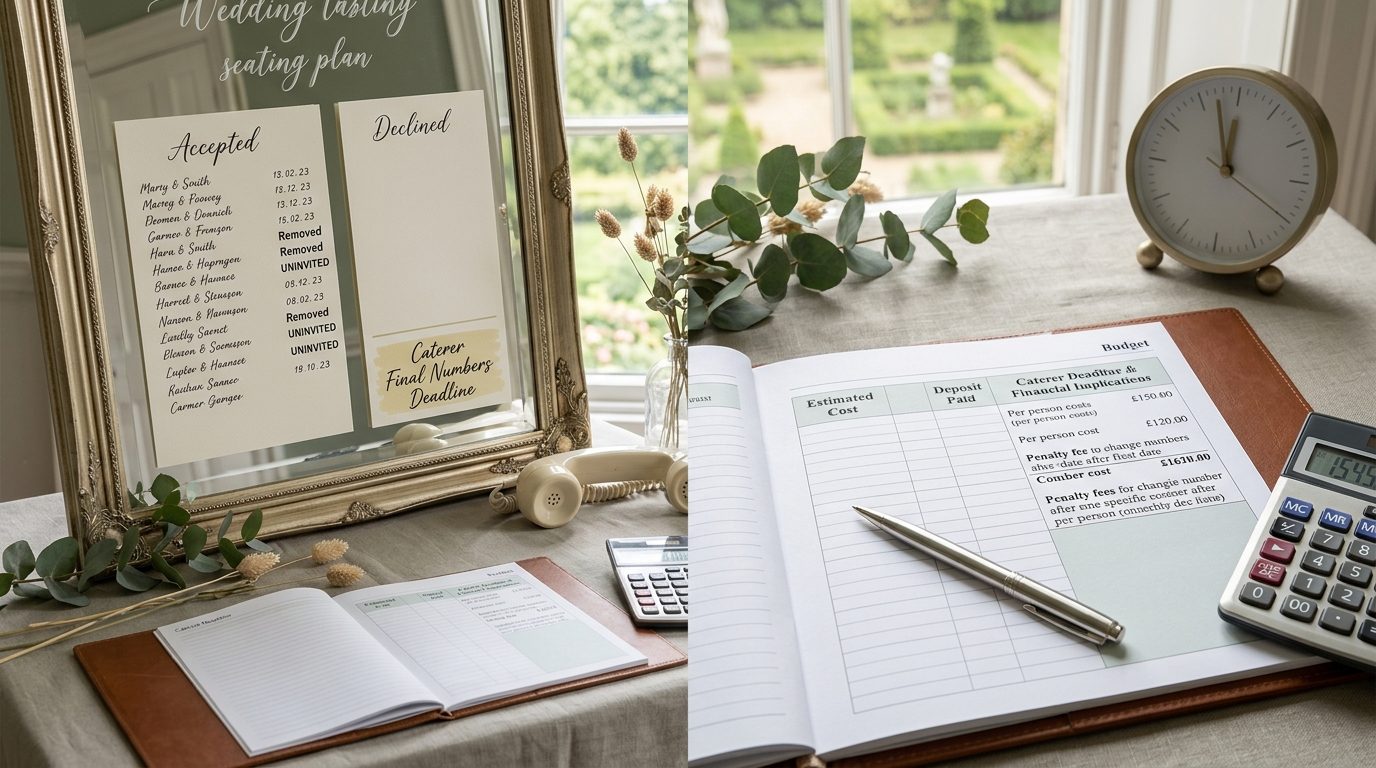
Most UK caterers require a final confirmed headcount 4–6 weeks before the wedding. This is the date beyond which you pay for everyone on the list whether they attend or not.
If you need to uninvite someone after the save-the-date has gone but before the caterer’s deadline, you can at least recover the financial cost. If the decision comes after the caterer’s cutoff, you will pay for that seat regardless.
The cleaner financial scenario: make final guest list decisions at the same time you place your catering order, not after. Our wedding budget breakdown covers the typical caterer timeline and how to build headcount flexibility into your contract.
After the conversation: managing the fallout
The conversation will likely produce one of three reactions:
Resigned acceptance. The person is hurt but understands. They say something like “I’m disappointed but I understand.” The relationship can probably survive this, particularly if the reason was logistical.
Anger. The person reacts with anger or threats — to tell others, to go to the wedding anyway, to involve other family members. Do not engage. Acknowledge their feelings briefly (“I understand you’re upset”) and end the call. One clear firm boundary — “this decision is final” — is enough. Repeating it only escalates.
Negotiation. The person tries to problem-solve. “What if I just come to the evening?” “What if I pay for my own meal?” Your answer: the decision is made and it is not negotiable.
Do not announce the decision to third parties. If others ask, “we had to reduce numbers and it was a hard call” is sufficient.
For managing difficult guest situations more broadly, our wedding planning timeline covers when to address guest list decisions relative to other pre-wedding milestones.
When you should reconsider
Uninviting is appropriate when the guest list needs to shrink, when a relationship has genuinely broken down, or when there is a safety or wellbeing concern. It is probably a mistake when:
- You are acting on a one-sided account of something and have not spoken directly to the person involved.
- A family member or future in-law is pressuring you, and you do not personally want to do it.
- The emotion of a disagreement is still acute — give it two weeks and see if the feeling persists.
- The person will be surrounded by mutual friends at the wedding who will feel awkward about their absence.
The test: if the wedding were happening in six months rather than two weeks, would you still make the same decision? If yes, proceed.
The cost of a place at a UK wedding: context for your decision
At £272 per head — the current UK average — a table of 10 costs £2,720. Cutting four people from a table to reduce it to six saves around £1,088 at per-head variable cost.
See our UK wedding cost guide for what those per-guest figures include and how they break down across catering, bar, and service.
Frequently asked questions
Is it okay to uninvite someone from your wedding?
Yes. You have no legal or etiquette obligation to invite anyone. If circumstances have changed or a relationship has broken down, uninviting is better than having the person there under false pretences.
How do you uninvite someone from a wedding politely?
Tell them directly, in person or by phone. Explain briefly that circumstances have changed and they will not be on the guest list. Do not use a third party or send a group message.
What do you say when uninviting a wedding guest?
A direct script: 'I want to speak to you before you make any plans. We have had to reduce our guest list significantly and I'm not going to be able to include you. I'm sorry to tell you this directly.' Keep it short.
Can you uninvite someone after they have RSVP'd yes?
Yes. It is harder and more expensive — they may have booked travel or accommodation — but it is still sometimes necessary. Acknowledge the inconvenience directly. Do not expect them to feel good about it.
What is the best reason to give when uninviting a wedding guest?
The most useful reason is a genuine one. 'Budget cuts forced us to reduce numbers' is widely understood and hard to argue with. Relationship-based reasons invite debate; logistical reasons do not.
How far in advance should you uninvite a wedding guest?
As soon as you have decided. The earlier the better — both for the person's ability to cancel any bookings and for your caterer's headcount. Most caterers need final numbers 4 to 6 weeks out.
Will uninviting a guest permanently damage the relationship?
Sometimes. If the uninvitation reflects a deeper relationship problem, the wedding becomes the moment that crystallises it. If it is purely logistical, most people recover. Be honest with yourself about which situation you are in.