British Wedding Flowers in Season: May Guide
Key Takeaways
- Peonies are at peak season in late May — wholesale price drops to £2.50–£4 per stem from £5–£9 out of season
- Sweet peas, ranunculus and garden roses are all available in May at their seasonal best pricing
- British-grown flowers in May cost 30–45 per cent less than imported equivalents at the same quality tier
- Alliums and lilac are finishing by end of May — order them for early May weddings only
- Cow parsley (wild-gather or grown) adds structure and volume at near-zero cost — a favourite of UK florists
- May is the best month to work with a local grower-florist — the British season is at its most abundant
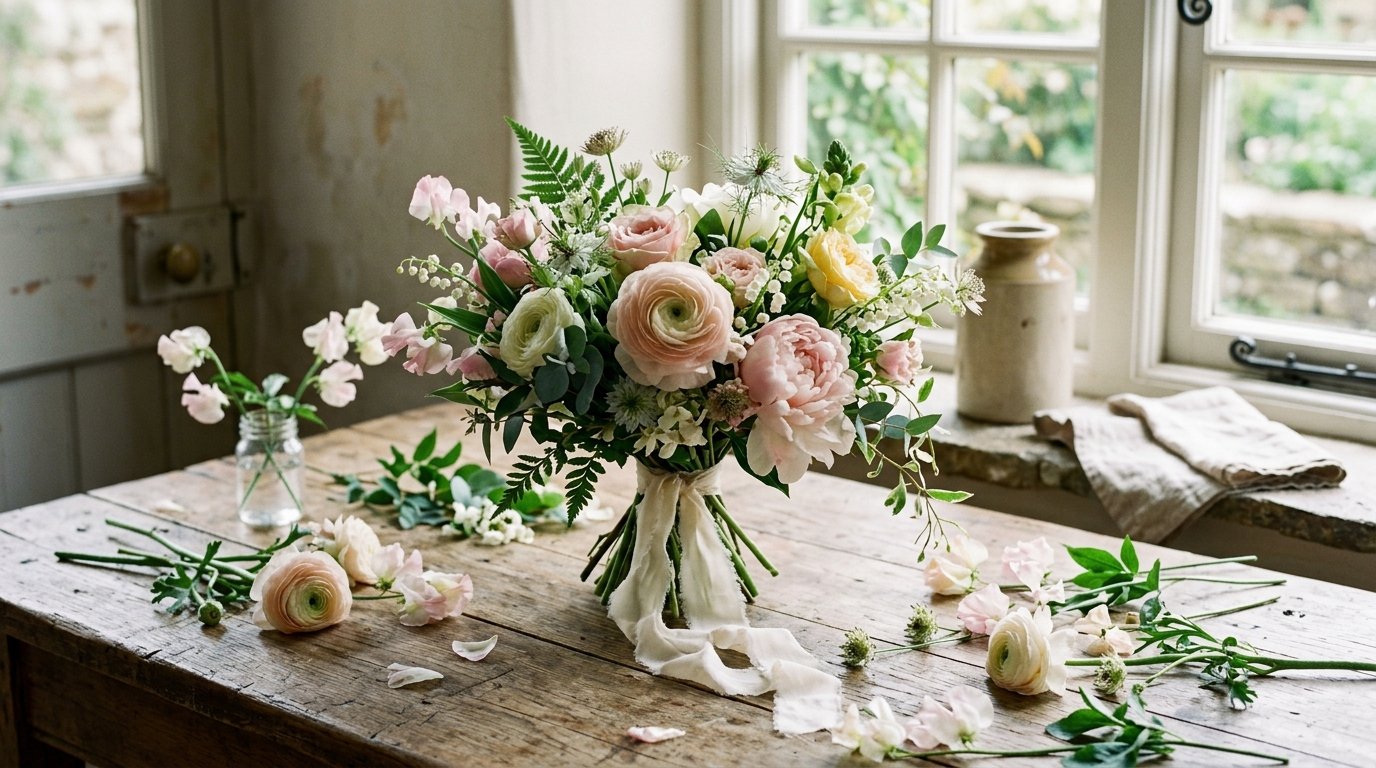
British flower-growing peaks in May. Peonies, sweet peas, ranunculus, garden roses, alliums, lilac, cow parsley and wisteria are all at or near their seasonal best. Wholesale peony prices in May fall to £2.50–£4 per stem — roughly half the out-of-season rate. A full bridal bouquet of 20 British-grown peonies can be sourced for under £80 at wholesale. This guide lists every key May wedding flower, its availability window, typical wholesale price and best use case.
By Matt, Editor at Weddings Hub. I work with florists across the UK and track wholesale pricing through New Covent Garden Flower Market and Flowers from the Farm networks. The pricing data in this article comes from florist interviews and market observations in April–May 2026.
Why May is the best month for British wedding flowers
British commercial flower-growing runs on a relatively short season. Most growers produce from April through October, with May and June representing the absolute peak in variety and volume. The overlap of spring-ending and summer-beginning flowers in May gives you access to a wider palette than any other single month.
The economics are straightforward. When British-grown flowers are plentiful, Dutch imports become optional rather than necessary. Florists who work with British growers — either directly or via the Flowers from the Farm cooperative — can charge less for better flowers in May simply because the supply chain shortens from import-warehouse-distributor-florist to grower-florist.
For couples planning a May wedding, this means the flower budget goes further than at any other time of year. The challenge is knowing which flowers to prioritise and which to avoid.
The full May flower list: availability and pricing
Peonies
Season: late April through mid-June, peak: late May Wholesale price (May): £2.50–£4 per stem Out-of-season price: £5–£9 per stem Best use: bridal bouquets, large centrepieces, statement arrangements
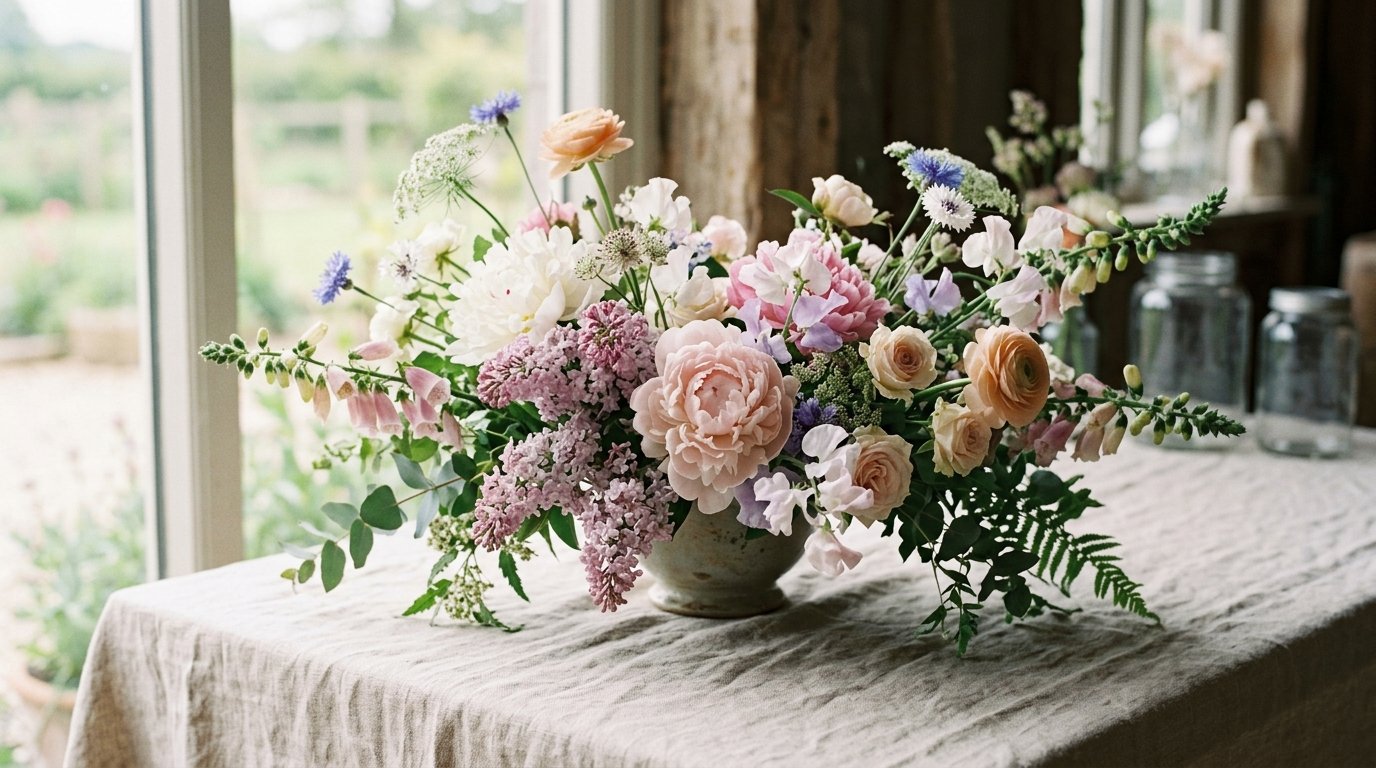
The peony is the defining flower of the late British spring wedding. No other flower generates the same volume of Instagram content or Pinterest saves in the May-June window. Its full, ruffled head creates instant visual impact and it holds exceptionally well in cool conditions.
A bridal bouquet of 18–22 peonies in a single tone — blush, ivory, deep rose or coral — is the single most-copied UK wedding flower arrangement. At late-May wholesale pricing, the stems for that bouquet cost £50–£90 before the florist’s time.
Peony availability varies by variety. Sarah Bernhardt (soft pink) and Bowl of Beauty (pink with cream centre) are the most reliably available UK-grown varieties. Coral Charm (deep apricot-orange) and Duchesse de Nemours (pure white) are often imported from the Netherlands for precise colour matching.
Sweet peas
Season: May through August, peak: May–June Wholesale price (May): £1.20–£2 per stem Best use: loose trailing bouquets, table garlands, buttonholes
Sweet peas are quintessentially British and unmistakably seasonal. They carry the strongest fragrance of any May wedding flower — a single bucket of sweet peas fills a room. They are delicate; they need cool water and should be arranged within 24 hours of cutting.
Their value is as a filler and softener. Combined with the structural volume of peonies or garden roses, sweet peas add the trailing, billowing quality that defines the modern British garden-party wedding aesthetic.
Sweet peas come in a broader colour range than most brides realise: white, ivory, pale pink, deep rose, purple, coral, bicolour. A mixed sweet pea buttonhole for the groom costs under £4 at May pricing.
Ranunculus
Season: February through June, peak: April–May Wholesale price (May): £1.80–£3 per stem Best use: bouquets, low centrepieces, bud vases
Ranunculus is the affordable peony alternative. It has a similar full, layered head structure with a tighter, neater profile. It holds better than peonies in warmth above 18°C, which makes it the pragmatic choice for late-morning outdoor ceremonies in good weather.
The Cloni range (developed by Italian growers) is the standard wedding-quality ranunculus. Colours available in May include white, ivory, blush, salmon, coral, deep red, butter yellow and pale lavender.
Garden roses
Season: May through September, peak: May–July Wholesale price (May): £1.80–£3.50 per stem Best use: bouquets, centrepieces, arch decoration
Garden roses (also called old garden roses or David Austin-style roses) are distinct from spray roses and standard florist roses. They have a higher petal count, a cupped or quartered face, and a subtle fragrance. They photograph well from every angle and hold shape in arrangements for 5–7 days.
British garden rose growing is now a serious commercial sector. Growers in Kent, Essex, the Midlands and the West Country supply cut garden roses from May onwards. The David Austin Roses cut flower operation in Wolverhampton is the largest single source; their stems reach UK florists within 24 hours of cutting.
Popular May varieties include Juliet (apricot-peach), Patience (blush), Keira (deep pink) and Constance (soft lavender-pink).
Alliums
Season: April through June, peak: May Wholesale price (May): £1.50–£2.80 per stem Best use: structural centrepieces, modernist bouquets, table height variation
Alliums (ornamental onion) are the structural flower that the minimalist-leaning bride reaches for. A large Allium giganteum (10–12cm globe, 90cm stem) adds architectural height to a centrepiece that no other May flower can replicate.
Their season is short. Most UK allium varieties finish by the third week of May. For weddings in the last week of May or June, confirm availability with your florist — you may be looking at Dutch imports rather than British-grown.
Colour is limited: purple in several tones (deep violet through pale lilac), white (Allium Mount Everest) and occasionally pink. They pair exceptionally well with the more textural and fragrant flowers — sweet peas, garden roses — as a structural counterpoint.
Lilac
Season: April through mid-May Wholesale price (May): £2–£3.50 per stem (available early May only) Best use: loose fragrant arrangements, arches, trailing ceremony pieces
Lilac is the scent signature of the British spring. Its availability window is tight — most UK-grown lilac finishes by 10–15 May. For weddings in the second half of May, lilac is either unavailable domestically or imported cold-stored, which reduces fragrance significantly.
If your wedding is in the first ten days of May, lilac should be on your list. It is abundant, cheap and creates an intensity of fragrance that no other seasonal flower matches.
Cow parsley
Season: late April through June Wholesale price: minimal (wild-gather or grower-direct) Best use: volume filler, structure, meadow aesthetic
Cow parsley (Anthriscus sylvestris) is technically a wild plant, but it has become a staple of the British wedding industry. Its flat white umbellifer heads add an airy, meadow quality to arrangements that dried or cultivated flowers cannot replicate.
Many growers cultivate it specifically for weddings. Some florists wild-gather from roadside verges (legal on publicly accessible land; check before cutting on private land). The cultivated equivalent — Ammi majus or bishop’s flower — is available through florist wholesalers at £1–£1.50 per bunch.
A centrepiece made primarily from cow parsley and garden roses is one of the most photographed UK wedding arrangements, and one of the most cost-effective.
Lily of the valley
Season: April through May Wholesale price (May): £5–£9 per stem Best use: bridal bouquets, corsages, delicate accents
Lily of the valley is the most expensive British May wedding flower per stem. It is also among the most symbolic — associated with royal weddings (Catherine Middleton’s bouquet, Meghan Markle’s posy) and with spring in British cultural tradition.
Its cost comes from its delicacy. It cannot be stored long, does not travel well and must be arranged close to the wedding day. For a bridal bouquet supplement or a corsage, the premium is worth it.
How to buy: the best channels in May
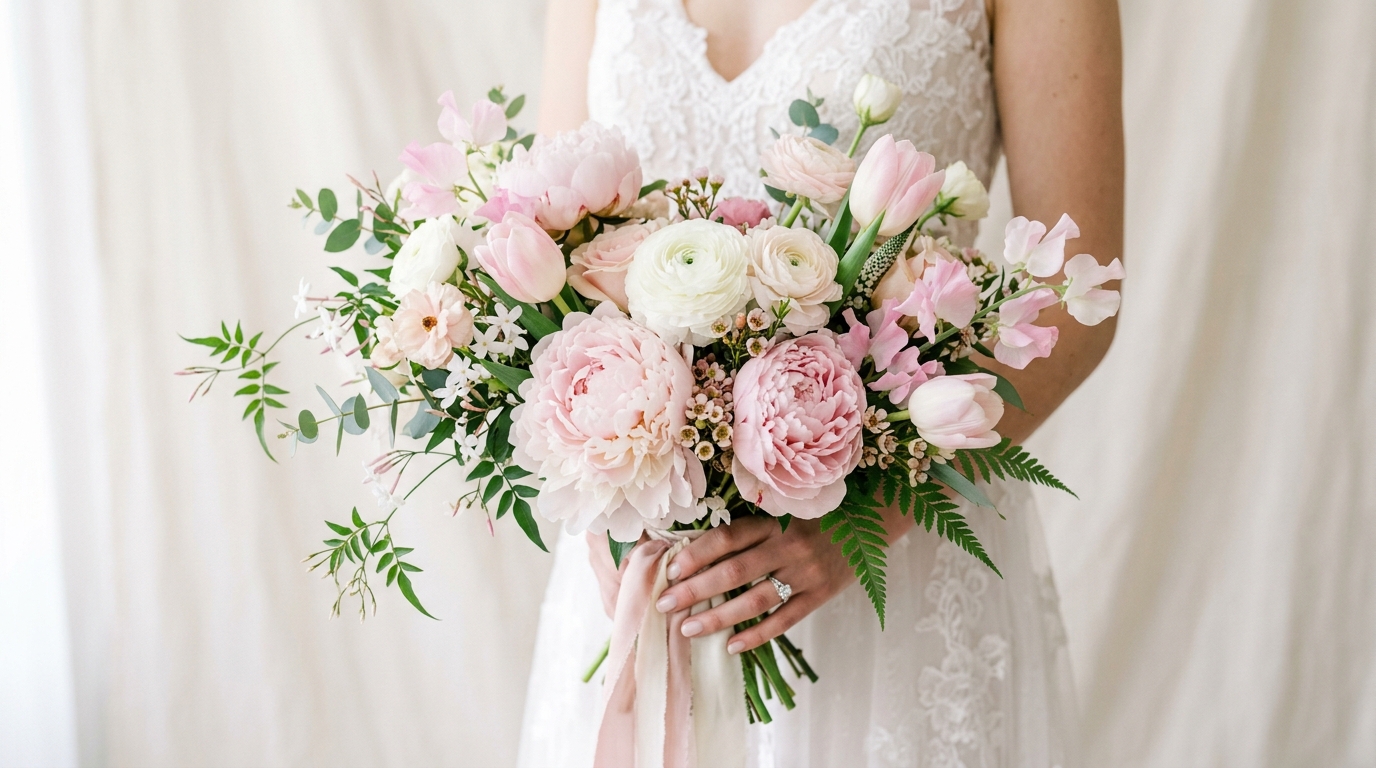
Grower-florists (recommended). A florist who also grows — or who has a direct relationship with a local grower — can offer May flowers at 30–45 per cent below wholesale. Find them via the Flowers from the Farm directory, which lists over 700 UK flower farms.
New Covent Garden Flower Market. The UK’s largest wholesale flower market in Nine Elms, London. Trade buyers and florists shop here from 3am Tuesday to Saturday. Not open to the public without a trade account, but most London-based florists source from here.
Flower farms direct. Many farms now offer wedding packages directly to couples, cutting out the florist entirely. Typically £8–£15 per bucket for mixed seasonal stems. Best for DIY weddings with a capable team.
Online flower delivery. Freddie’s Flowers, Bloom & Wild and Arena Flowers all ship cut flowers nationally. Quality is reliable but the price point is retail, not wholesale. Use for top-up orders only.
Seasonal bouquet combinations that work in May
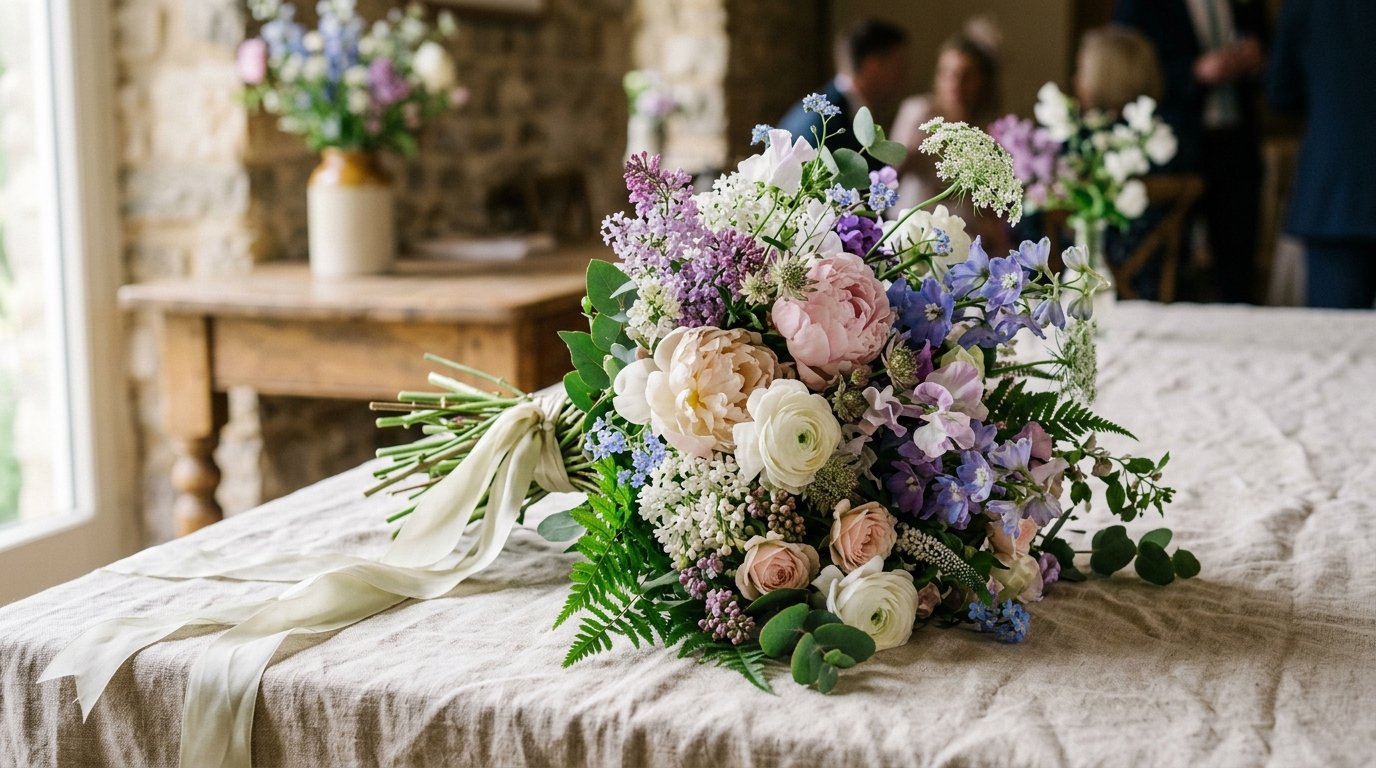
Our wedding colour schemes guide covers the palettes that work with these flowers. Here are the three most-requested May combinations:
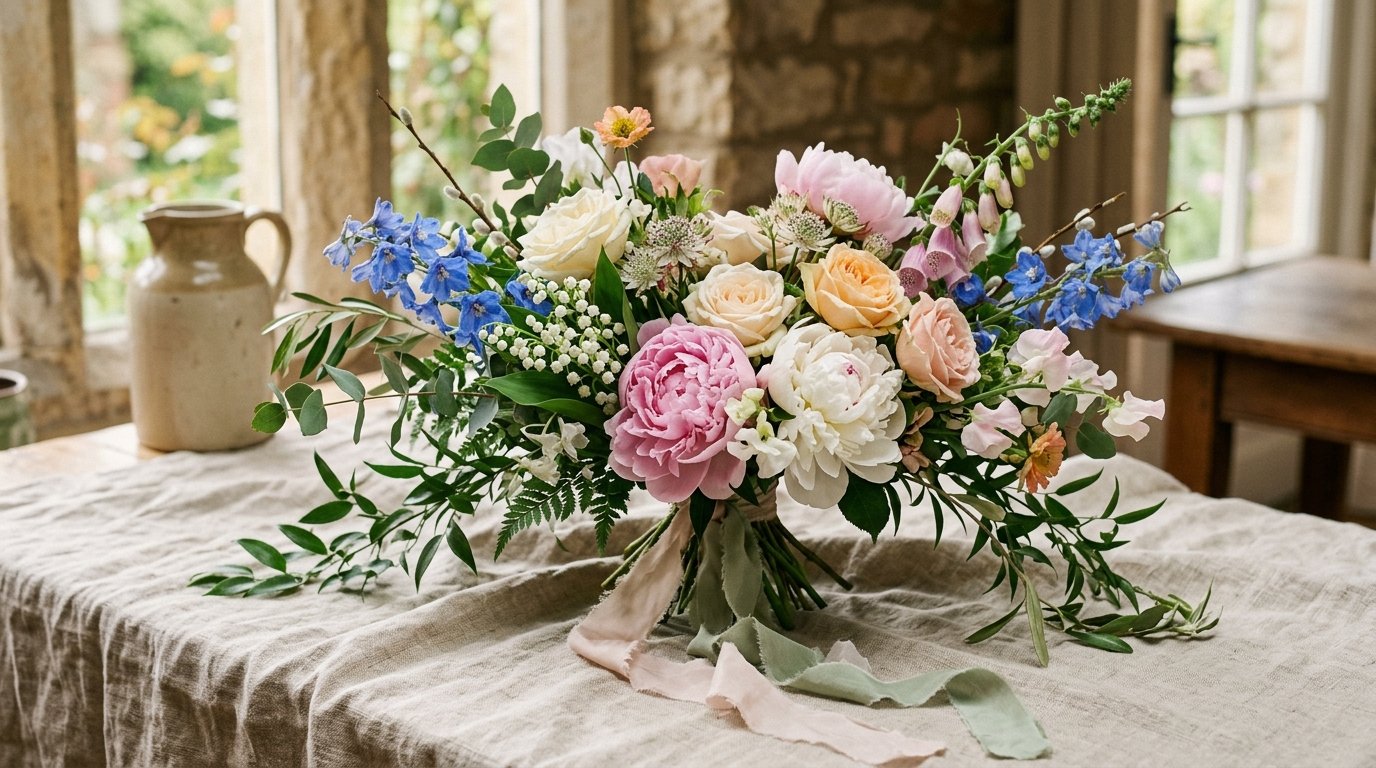
Blush and white garden party. Blush peonies + ivory ranunculus + white sweet peas + cow parsley. Loose, trailing, full volume. Cost for bridal bouquet: £60–£120 depending on florist.
Bold meadow. Deep purple alliums + bright garden roses (Juliet or Princess Alexandra) + wild cow parsley + sweet peas in coral. High contrast, modern meadow aesthetic. Suits converted barn venues.
Monochrome ivory. Ivory peonies + Patience garden roses + Duchesse de Nemours ranunculus + white sweet peas + white alliums. More expensive due to selective variety sourcing (£80–£150 for bridal bouquet).
What to ask your florist when booking for May
When briefing your florist for a May wedding, these are the questions that determine quality and cost:
- “Are you sourcing British-grown flowers, or primarily from Dutch auctions?”
- “Which peony varieties can you guarantee for my date?”
- “What is your cut-off for final flower orders?” — most florists need 3–4 weeks; 6–8 weeks for fully custom arrangements.
- “How will the flowers be stored before the wedding?” — ask about their cool room setup.
Our wedding flowers cost guide covers how to budget across the full floral package and what to expect on total spend for the day.
The regional picture: where British flowers grow
Kent and Sussex (South East). The warmest UK growing region. First peonies, first sweet peas, first garden roses. Kent growers often have variety availability 2–3 weeks ahead of northern regions.
Cornwall and Devon (South West). May brings sweet peas, roses and scabious. Longer growing season due to maritime warmth.
Lincolnshire and Norfolk (East Midlands/East England). Major commercial growing areas. Proximity to New Covent Garden makes London sourcing fast.
Worcestershire and Herefordshire. David Austin Roses operates here. Garden roses are the primary crop.
Related reading
- Wedding flowers: what they cost in 2026
- Wedding colour schemes for every season
- The seasonal wedding flowers calendar
- Wedding centrepiece ideas by style and budget
- Table decoration ideas that photograph well
Frequently asked questions
What flowers are in season for a May UK wedding?
Key May flowers include peonies, sweet peas, ranunculus, garden roses, alliums, lilac, cow parsley, tulips (early May), wisteria and lily of the valley.
How much do peonies cost for a UK wedding in May?
In May, peonies wholesale at £2.50 to £4 per stem — roughly half the out-of-season price of £5 to £9 per stem. A bridal bouquet of 15 to 20 peonies costs around £45 to £80 at wholesale.
Can I get British-grown flowers for my May wedding?
Yes. May is the height of the British flower-growing season. British-grown flowers are available through grower-florists, Flowers from the Farm members, and New Covent Garden Flower Market in London.
What is the cheapest way to buy wedding flowers in May?
Buy British-grown, direct from a grower-florist or via a Flowers from the Farm member. British seasonal flowers in May cost 30 to 45 per cent less than Dutch imports at comparable quality.
Are tulips still available for a May wedding?
Early May, yes. Most UK tulip varieties finish by mid-May. If your wedding is after 15 May, confirm availability with your florist — you may need to source from Dutch growers for later dates.
What wedding flowers last the longest in May heat?
Ranunculus, garden roses and alliums hold well in May temperatures. Peonies are delicate in heat above 20°C — keep them in cool water until the ceremony. Sweet peas are fragile and should be arranged within 24 hours of use.
Which May flowers work best for wedding centrepieces?
Peonies, garden roses and alliums give volume and height. Cow parsley and sweet peas fill the gaps with texture. Ranunculus adds colour depth. A mixed centrepiece of these five flowers is the classic British May wedding arrangement.